CCSD code H4430: Examination of rectum under anaesthetic
CCSD code H4430 pays for the examination alone CCSD code H4430 is the UK private...

Last Updated: Oct 20, 2026
S0073 is the HCPCS Level II code for injection, aztreonam, 500 mg. CMS terminated it with effect from 30 June 2023, so it is no longer valid for claims after that date.
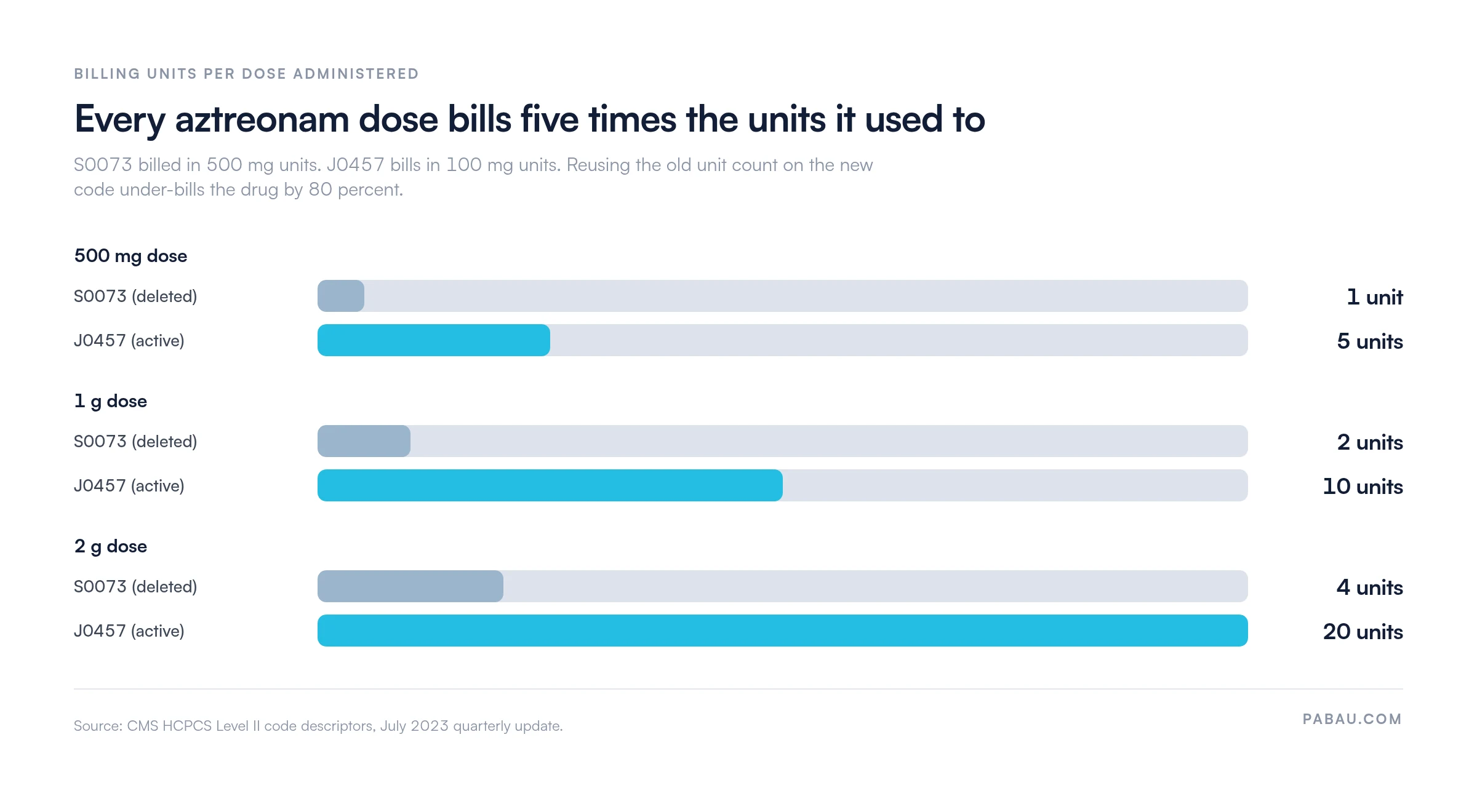
The active replacement is J0457, injection, aztreonam, 100 mg, which Medicare recognizes and prices today. The unit size changed with it. One unit is now 100 mg instead of 500 mg, so a 1 g dose bills as 10 units rather than 2.
Let Pabau's smart automation suggest the right codes, reduce claim denials, and keep your practice compliant—effortlessly.
Automate repetitive tasks and focus on what matters most—your patients.
Reduce coding errors and ensure compliance with the latest regulations.
Clean claims, fewer denials, and faster reimbursements.
Powerful insights and reporting to help your practice thrive.
HIPAA compliant SOC 2 certified GDPR-compliant Trusted by 4,000+ clinics worldwide

HCPCS code S0073, injection, aztreonam, 500 mg, was deleted effective July 1, 2023 and is no longer billable to any payer.
J0457, injection, aztreonam, 100 mg, replaced it in the same July 2023 HCPCS update and is the code billers use today.
The billing unit shrank from 500 mg to 100 mg, so every legacy unit count has to be multiplied by five.
Medicare Part B recognizes and prices J0457, which removes the S-code coverage problem that applied to S0073.
Pabau’s claims management software supports HCPCS drug code entry, claim submission, and reimbursement tracking in one billing workflow.
HCPCS code S0073 was the HCPCS Level II code for injection, aztreonam, 500 mg. It sat in the S-code category, a set of temporary codes CMS maintained for Medicaid programs and private payers rather than for Medicare fee-for-service. CMS deleted the code effective July 1, 2023.
The S-code category existed because Medicare had not assigned a J code to every injectable drug. Aztreonam was one of those drugs for years, which is why Medicaid managed care plans billed it under S0073. That changed in the July 2023 HCPCS quarterly update, when CMS established J0457 for aztreonam and retired the S code.
CMS has repeated that swap on other antibiotic S-codes. S0039 was retired on March 31, 2025, and sulfamethoxazole-trimethoprim injection now bills as J2865. S0080 followed on December 31, 2025, with pentamidine moving to J2516. Each change reset the unit size too.
CMS deleted S0077 in the same July 2023 update that retired S0073, and clindamycin phosphate injection now bills as J0736. The unit size stayed the same, since both codes bill one unit per 300 mg.
S0073 now has no billable use. A claim carrying it will reject as an invalid code regardless of payer, and no modifier or appeal will revive it. Coders who still see S0073 in a chargemaster, a superbill template, or an old payer grid should map it to J0457. Correct the unit multiplier at the same time.
The code still appears in some reference databases and legacy fee schedules, which is how it survives in practice systems long after deletion. Verify any aztreonam code against the current CMS HCPCS Level II code set before it reaches a claim. Working from a stale code list is a common cause of avoidable rejections, especially in practices that bill across payer types.
The table below summarizes the reference attributes for HCPCS code S0073 and names the code that replaced it.
J0457 describes injection, aztreonam, 100 mg. CMS established it as a new drug code effective July 1, 2023, the same quarter it deleted S0073. It is a permanent J code, so Medicare Part B recognizes it and prices it under the average sales price methodology.
The move from an S code to a J code did more than change four characters on the claim. It reopened Medicare as a payer and rewrote the unit arithmetic in the same quarter. The arithmetic is the half that quietly breaks claims.
To convert a legacy S0073 unit count to J0457, multiply by five. A claim that once read S0073 x 4 for a 2 g dose now reads J0457 x 20. Practices that copied old unit counts into the new code under-billed by 80 percent. The claim still paid, so the error can run for months before anyone notices.
The chart below sets the old and new unit counts side by side for the three doses most often administered.
Audit your charge master for the S0073 to J0457 swap as a unit change as well as a code change. Pull every aztreonam claim billed since July 2023 and check the units against the milligrams documented in the administration note. Under-billed units pay without a denial, so the remittance gives no sign of the error.
Aztreonam is a monobactam antibiotic, the only commercially available member of its class. Unlike penicillins and cephalosporins, it has a monocyclic beta-lactam ring that confers activity exclusively against aerobic gram-negative bacteria.
The FDA-approved prescribing information for Azactam covers urinary tract infections, lower respiratory tract infections, and septicemia. It also lists skin and skin-structure infections, intra-abdominal infections, and gynecological infections caused by susceptible gram-negative organisms.
Key organisms in the aztreonam spectrum include:
Aztreonam has no meaningful activity against gram-positive organisms or anaerobes. That narrow spectrum is clinically useful, because it allows targeted gram-negative coverage without disrupting gram-positive flora.
Patients with penicillin or cephalosporin allergies may tolerate aztreonam, since cross-reactivity risk is generally low. Assess that case by case against current clinical guidelines.
For billing purposes under J0457, the route of administration is injection, covering both intravenous infusion and intramuscular administration. Adult doses commonly run 1 g to 2 g every eight hours, which translates to 10 or 20 units of J0457 per administration.
Medicare Part B covers physician-administered aztreonam under J0457. The S-code coverage problem that applied to S0073 no longer exists, because the drug now has a permanent J code that Medicare recognizes and prices. Payment follows the average sales price methodology, and the rate updates quarterly.
Traditional Medicare fee-for-service never covered S codes, and that rule still holds for the whole S-code range. It is simply no longer relevant to aztreonam. Some practices built workarounds to bill aztreonam around S0073, such as bundling the drug cost into a facility fee. Those can be retired in favor of the J code.
Map each drug claim to the code set the payer actually accepts before submission. The table below outlines payer-type coverage for J0457.
Aztreonam is typically administered in the buy-and-bill model. The facility or physician purchases the drug, administers it, and bills the payer for both the drug and the administration. Drug reimbursement is then tied to published pricing benchmarks.
Medicare and most commercial payers price J0457 from average sales price data. Medicaid programs more often use average manufacturer price or wholesale acquisition cost. Because drug pricing changes quarterly, consult the CMS Physician Fee Schedule and the payer’s current drug fee schedule rather than any static figure.
Key billing rules for HCPCS code J0457:
Avoiding denials starts well before claim submission. Confirm patient eligibility, match the drug to an appropriate diagnosis code, and document medical necessity in the clinical record. Those three habits are the foundation of clean claim submission. When a denial does come back, log the reason code before appealing, so repeat errors on the same drug code surface quickly.

Pabau’s claims management software gives billing teams one place to enter drug codes, submit claims, and track reimbursement across Medicare, Medicaid, and commercial payers.

Modifiers give payers clinical and billing context that the base HCPCS code cannot convey. For J0457, the relevant modifiers cover route of administration and single-dose vial waste. The table below lists the modifiers most often appended to injectable drug J codes.
Modifier accuracy is one of the most common sources of drug claim denials. Always verify modifier requirements in the payer’s drug billing manual. The AAPC HCPCS Level II code lookup can help cross-reference modifier applicability during claim preparation. When a claim returns with a modifier-related remark code, read the payer’s remark description before you resubmit.
The National Drug Code crosswalk links a specific drug product, by manufacturer and package, to the corresponding HCPCS billing code. Many Medicaid programs require NDC reporting on the claim in addition to the HCPCS code. Report the NDC in 11-digit format, labeler-product-package, with the quantity expressed in the appropriate unit of measure.
NDC codes are manufacturer-specific and subject to change. The table below shows how common aztreonam vial sizes convert to J0457 units. Verify current NDCs against the CMS NDC-to-HCPCS mapping files or the manufacturer’s labeling before submitting claims.
Because NDC codes are manufacturer- and lot-specific, this table uses verified placeholders rather than static NDC numbers. Obtain current NDCs from the drug manufacturer’s labeling or the CMS NDC-to-HCPCS crosswalk files. The crosswalk logic is consistent: One unit of J0457 equals 100 mg, so divide the milligrams administered by 100.
Coders billing injectable antibiotics work across a small set of J codes with different unit sizes, which is where most unit errors start. The table below lists the codes most often referenced alongside aztreonam. Each one carries its own unit definition. Check the descriptor in our HCPCS Level II codes reference before reusing a unit count across drugs.
The ICD-10 diagnosis codes most often paired on aztreonam claims are J15.1 (pneumonia due to Pseudomonas) and A41.51 (sepsis due to Escherichia coli). N10 (acute pyelonephritis) and J22 (unspecified acute lower respiratory infection) also appear frequently. Linking the diagnosis to the drug’s FDA-approved indication strengthens medical necessity documentation.
An HCPCS deletion does its damage quietly. The code drops out of the CMS file. It stays in the charge master, the superbill template, and the payer grid a practice built around it. Those three places are where a retired code keeps reaching claims.
Practice management software like Pabau keeps the code, the modifier, and the clinical note in one record. The drug claim is then built from the dose recorded in that note. Pabau’s end-to-end claims management lets billing teams enter HCPCS drug codes, attach the right modifiers, and submit claims.
Billers stop toggling between a code lookup tool and a separate billing system. Fewer re-entry points mean fewer chances for a stale code or a stale unit count to reach the payer.
For practices running injectable drug programs under buy-and-bill, claim performance varies sharply by payer. Pabau’s reporting tools let billing managers segment claims by payer, code, and service location. That shows which plans deny drug codes most often, so the practice can act on the pattern.
Superbill generation is built in, which helps practices billing both Medicaid and commercial payers produce the documentation each one requires without duplicating work. Connecting the clinical note directly to claim submission also shortens the lag between administration and billing that inflates accounts receivable.
HCPCS code S0073 is history. It was deleted on July 1, 2023, and any aztreonam claim written today belongs on J0457 instead. The descriptor changed from 500 mg to 100 mg. Multiply the unit count on every legacy claim line by five before reusing it.
The upside of the switch is coverage. Aztreonam now carries a permanent J code that Medicare Part B recognizes and prices, which removes the payer-routing problem S0073 created.
Pabau supports injectable drug billing end-to-end, from entering the HCPCS code and modifier through claim submission and remittance tracking, in one system. To see how it handles drug code billing for your practice, book a demo with the Pabau team.

Need to understand how denials affect revenue for injectable drug claims? Denial management in healthcare explains how to build a systematic denial recovery and prevention workflow.
Want a clearer picture of the full billing cycle for physician-administered drugs? Medical billing workflows covers the end-to-end process from charge capture through remittance posting.
Looking for a compliance framework for drug billing documentation? Medical billing compliance outlines the documentation and audit trail requirements that protect practices during payer reviews.
S0073 is deleted. CMS discontinued it in the July 2023 HCPCS quarterly update, so it was last valid for dates of service through June 30, 2023. The replacement is J0457, injection, aztreonam, 100 mg, which took effect on July 1, 2023. A claim submitted with S0073 today will reject as an invalid code.
HCPCS code S0073 was the Level II code for injection, aztreonam, 500 mg. It belonged to the S-code category, a set of temporary codes used by Medicaid programs and private payers rather than by Medicare fee-for-service. The billing unit was 500 mg, so a 1 g dose was billed as 2 units. The code was deleted effective July 1, 2023.
J0457, injection, aztreonam, 100 mg. CMS established it as a new permanent J code effective July 1, 2023, the same quarter it deleted S0073. Use J0457 for every aztreonam administration billed today, regardless of payer type.
Yes, under J0457. Medicare Part B recognizes and prices J0457 using the average sales price methodology, and the rate updates quarterly. That is a change from the S0073 era, when traditional Medicare fee-for-service did not recognize S codes at all. Medicare Advantage plans follow Medicare code sets, though prior authorization rules vary by plan.
Ten units. One unit of J0457 is 100 mg, so 1 g equals 10 units and 2 g equals 20 units. This is the most common error after the code change, because the old S0073 unit was 500 mg. To convert any legacy S0073 unit count, multiply it by five.
Under buy-and-bill, the facility or physician purchases aztreonam, administers it, and bills the payer for the drug and the administration separately. Bill J0457 for the drug at 1 unit per 100 mg administered, and append modifier JA for intravenous administration. Report any discarded drug from a single-dose vial on a separate line with modifier JW, or use JZ when nothing was wasted. Submit the 11-digit NDC where the payer requires it.
The NDC crosswalk links a specific aztreonam product, by manufacturer and package, to J0457 at a rate of 1 unit per 100 mg. A 500 mg vial is 5 units, a 1 g vial is 10 units, and a 2 g vial is 20 units. Because NDCs are manufacturer-specific and updated regularly, take current numbers from the package insert or the CMS NDC-to-HCPCS mapping files. Most Medicaid programs require the 11-digit NDC in 5-4-2 format on the claim.