CCSD code L6530: Revision femoral bypass graft
CCSD code L6530: Definition and clinical scope CCSD code L6530 carries the offic...

Last Updated: Nov 13, 2026
S0014 is the HCPCS Level II code for tacrine hydrochloride, 10 mg. Tacrine is an oral cholinesterase inhibitor, once sold as Cognex capsules for mild to moderate Alzheimer's dementia. One unit equals 10 mg.
S0014 is a non-Medicare drug code, so traditional Medicare doesn't pay it. Medicaid managed care and commercial plans set their own rules, and most Medicaid programs require the NDC on the claim. Tacrine has not been marketed in the US since 2013, so new S0014 claims are rare.
Let Pabau's smart automation suggest the right codes, reduce claim denials, and keep your practice compliant—effortlessly.
Automate repetitive tasks and focus on what matters most—your patients.
Reduce coding errors and ensure compliance with the latest regulations.
Clean claims, fewer denials, and faster reimbursements.
Powerful insights and reporting to help your practice thrive.
HIPAA compliant SOC 2 certified GDPR-compliant Trusted by 4,000+ clinics worldwide

HCPCS Code S0014 reports tacrine hydrochloride, an oral Alzheimer’s drug, in 10 mg units. A 40 mg daily dose is four units a day.
S0014 sits in the S0012-S0197 non-Medicare drug codes range, so Medicare does not pay it. Medicaid and commercial plans decide coverage plan by plan.
Most Medicaid programs require the 11-digit NDC on drug-related S-code claims.
Tacrine has not been marketed in the US since 2013, so check the drug source and the payer’s code list before any new claim.
Pabau’s claims management software submits S0014 claims through the Claim.MD clearinghouse and posts remittances against the patient record.
HCPCS Code S0014 is the Level II code for tacrine hydrochloride, 10 mg, an oral drug billed in 10 mg units. It sits in the S0012-S0197 non-Medicare drug codes range. That range belongs to the S-code series, which runs from S0012 through S9999. The rest of the Level II set is indexed in our HCPCS procedure codes library.
Private payers created the S-codes for their own billing needs, and CMS publishes them in the CMS HCPCS Level II code set. Each payer decides whether it accepts S0014, what documentation it wants, and what it pays. That plan-by-plan variation makes the code harder to bill reliably than a code Medicare prices.
S0014 reports tacrine hydrochloride, sold in the US under the brand name Cognex. Tacrine was the first cholinesterase inhibitor approved for Alzheimer’s disease, in 1993. Its FDA label covered mild to moderate dementia of the Alzheimer’s type.
Cognex came only as oral capsules, in 10, 20, 30 and 40 mg strengths. The code’s 10 mg unit matches the smallest capsule, so every strength converts into whole units.
Tacrine has not been marketed in the US since 2013, after newer drugs without its liver toxicity replaced it. Today, S0014 turns up mostly in claim history, payer code lists and audits rather than on new prescriptions.
What the code does not capture:
If a payer contract names a different code for tacrine, follow the contract. Otherwise, S0014 is the drug-specific code, and an unlisted oral drug code is the fallback only where the payer rejects S-codes.
S0014 bills in 10 mg units. Divide the total milligrams dispensed by 10 to get the units for the claim line. The table follows the titration schedule on the Cognex label.
The label raised the dose in 40 mg steps at four-week intervals, as tolerated. Each step adds 120 units to a 30-day claim, so a titration month can look like a unit error to a payer edit. Record the dose change before the claim goes out.
Most Medicaid programs require the 11-digit National Drug Code (NDC) on drug-related HCPCS claims, including S-codes. Enter the N4 qualifier and the NDC, followed by the NDC quantity and the unit of measure qualifier. For capsules, that qualifier is UN (unit).
A missing NDC on a Medicaid claim that requires one is an automatic denial. Because tacrine is off the market, a payer that checks NDCs against an active drug file may also reject an old Cognex NDC.
Modifiers for S0014 are payer-specific, and no modifier is universally required. Laterality and site-of-service modifiers have no bearing on a dispensed oral drug. Check the payer’s current billing guidelines before appending any modifier, since an unneeded one is a common claim edit trigger.
Report the place of service where the drug was dispensed. POS 11 (Office) applies when the practice dispenses the capsules itself. Most oral drugs reach patients through a pharmacy instead, which bills by NDC rather than on a HCPCS claim line.
When populating the superbill documentation and CMS-1500 form, enter S0014 in Box 24D and the units in Box 24G. The NDC goes in the shaded area above Box 24A, or on a separate line per payer instructions. Put the PA reference number in Box 23, and check the diagnosis codes in Box 21 against the payer’s coverage policy.
Payers check that the diagnosis on the claim matches the drug’s label indication. For tacrine, that is mild to moderate dementia of the Alzheimer’s type.
ICD-10-CM tells coders to code the underlying physiological condition first for category F02. List the G30 code first and the F02 severity code second, so the claim shows both the disease and the stage the label covered. For a late-onset patient with mild dementia, the pair reads G30.1 then F02.A0.
No dedicated J-code describes tacrine. Oral drugs rarely get one, because Medicare Part B generally does not cover self-administered drugs. That leaves three routes for a tacrine supply.
The rule of thumb: use S0014 for any payer that lists it, since it names the drug exactly. Fall back to J8499 only on the payer’s instruction, and attach the NDC and a drug description to that line. Who dispenses the drug and who pays for it settle the route, in that order.
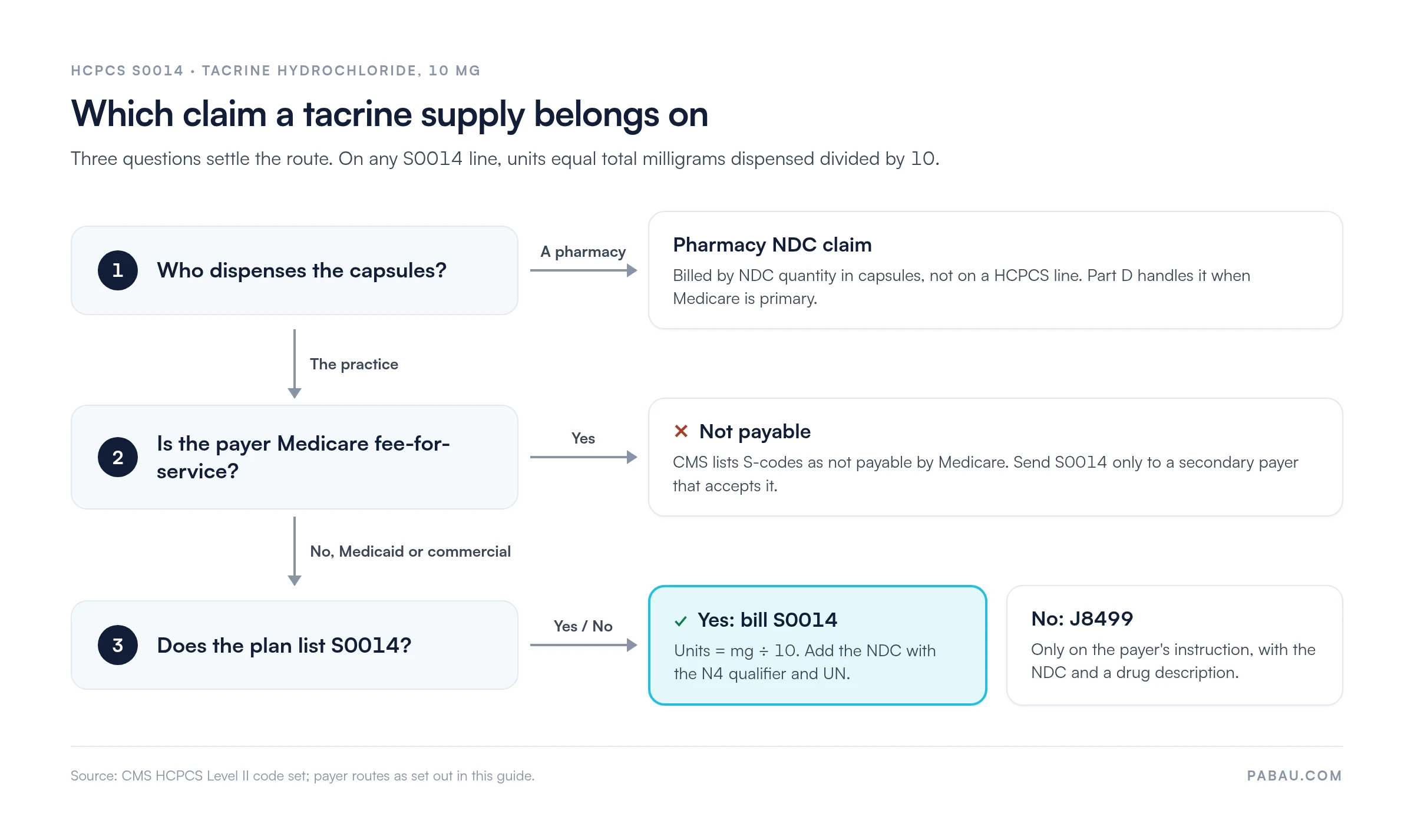
S-code acceptance is not uniform across payer types, and checking it before you submit is the most reliable way to avoid denials. Sound medical billing workflows verify payer acceptance at the plan level, not just the payer-type level.
Submitting HCPCS Code S0014 to Medicare fee-for-service results in automatic denial. If Medicare is primary, an oral drug runs through the patient’s Part D plan at the pharmacy. Send the S0014 line only to a secondary payer that accepts it.
Prior authorization (PA) for HCPCS Code S0014 is not universal, but some commercial plans and Medicaid managed care organizations require it. The trigger is usually the drug’s cost, therapeutic category or formulary status rather than the HCPCS code itself.
When PA is required, the standard workflow runs as follows:
PA requirements can change mid-year as payers update their medical policies. Build a quarterly payer policy review into your billing calendar to catch changes before they cause denials.
Payers audit S0014 claims for medical necessity, correct coding, and accurate NDC reporting. A practice that submits clean claims with complete documentation is far less likely to face post-payment audits or recoupment requests.
Retain the following for every S0014 claim:
Store these records for at least seven years or as required by state law, whichever is longer. Many Medicaid programs can audit claims retroactively within that window.
Denial patterns for HCPCS Code S0014 cluster around a predictable set of errors. Knowing them in advance is the most efficient form of denial management for billing teams.
Run a payer-acceptance audit for S0014 at the start of each contract year. Pull the prior 90 days of S0014 claims, segment them by payer, and flag any payer with a denial rate above 10%. Update your payer-specific billing rules before the new fee schedule takes effect.
Most commercial payers and Medicaid MCOs run a formal appeals process for S0014 denials. Many denied claims are recoverable if the appeal is filed within the payer’s window, typically 60 to 180 days from the denial date.
The electronic remittance advice (ERA) or Explanation of Benefits (EOB) includes a Claim Adjustment Reason Code (CARC) and, often, a Remittance Advice Remark Code (RARC). Together they identify the specific denial reason. Read them before you appeal, because appealing the wrong reason wastes the filing window.
Map the CARC to the denial table in the previous section. A coding error, such as a missing NDC, wrong units or an incorrect modifier, calls for a corrected claim rather than a formal appeal. Payers process corrected claims faster than appeals.
A complete appeal packet for HCPCS Code S0014 includes the original claim (CMS-1500 or 837P) and the payer’s denial notice. Add a letter of medical necessity signed by the prescribing physician, the order, the dispensing record, the ALT results, and the NDC documentation. Include any PA approval and a cover letter that cites the CARC and explains why the denial was incorrect.
Submit the appeal through the payer’s preferred channel (online portal, fax, or certified mail). Log the submission date, the tracking number, and the payer’s stated response window, and set a follow-up task 30 days out. If the first-level appeal fails, escalate to a second level or, for Medicaid denials, request a fair hearing through the state agency.
Drug S-code claims fail on small details. A unit count drifts from the dose, an NDC goes missing, or the diagnosis does not fit the label. Each detail lives in a different place, from the prescription to the dispensing log to the claim form.
Pabau, the practice management platform we build, keeps the prescription and the claim on the same patient record. Its claims management software sends claims through the Claim.MD clearinghouse and handles eligibility checks, claim status and remittance posting from there. Your billing team works from the order and the dispensing note itself, not a re-keyed summary.
Prior authorization codes, dates and sessions sit on the patient’s case, and Pabau warns when one is missing. A rejection for a missing NDC or a unit mismatch shows up the day it comes back. Your team corrects the line while the filing window is still open.

Pabau submits HCPCS claims through the Claim.MD clearinghouse, checks eligibility and posts remittances against the patient record. Your billing team spends less time chasing denials and more time on patient care.

S0014 is a narrow code with one job: tacrine hydrochloride, in 10 mg units. Its claims fail when the units drift from the dose, the NDC is missing, or the line goes to Medicare. Match the units to the milligrams dispensed, put the NDC on the line, and send it only to a plan that lists it.
Tacrine left the US market in 2013. Any new S0014 claim deserves a second look at the drug source and the payer’s current code list. Book a demo to see how Pabau handles drug code billing workflows, from prescription to remittance.

Need payer approval before dispensing tacrine? The prior authorization process walks through each step, from the request to the payer’s decision.
Is the diagnosis documented as Alzheimer’s disease, unspecified? ICD-10 code G30.9 explains when the unspecified code applies and when a more specific G30 code fits.
Confirming coverage before the claim goes out? Our insurance eligibility verification guide shows how to check plan benefits and catch S0014 coverage gaps before submission.
Appealing a denied S0014 claim? The medical appeal form template gives you a ready structure for the medical necessity argument.
HCPCS Code S0014 covers tacrine hydrochloride, 10 mg, an oral cholinesterase inhibitor once sold as Cognex capsules for Alzheimer’s dementia. Each unit is 10 mg, so divide the milligrams dispensed by 10. It is a non-Medicare S-code, used mainly by Medicaid managed care and commercial payers.
No. CMS lists HCPCS S-codes as not payable by Medicare, so submitting S0014 to Medicare fee-for-service results in an automatic denial. Some Medicare Advantage plans may accept S-codes under commercial billing conventions. Verify that with the specific plan before billing.
No J-code describes tacrine, so S0014 is the drug-specific code for payers that accept S-codes. J8499 is the not-otherwise-classified code for oral prescription drugs, and some payers ask for it instead. Medicare Part B generally excludes self-administered oral drugs, so neither code is a reliable Medicare route.
Modifier requirements for S0014 vary by payer, and no modifier is universally required. Laterality and site-of-service modifiers do not apply to an oral drug supply. Check the payer’s current billing guidelines before appending any modifier.
The most frequent S0014 denials come from submission to Medicare, a missing or inactive NDC, and units that do not match the dose. Missing prior authorization and a wrong place-of-service code follow. The CARC and RARC on the remittance advice identify the specific trigger and the fix.
Prior authorization requirements for S0014 vary by payer and plan. Some commercial insurers and Medicaid managed care organizations require PA for specific drugs or therapeutic categories. Verify at the plan level before each course of treatment, and log the authorization number for the claim.