CCSD code H4430: Examination of rectum under anaesthetic
CCSD code H4430 pays for the examination alone CCSD code H4430 is the UK private...

Last Updated: Oct 20, 2026
Q4149 is the HCPCS Level II code for excellagen, 0.1 cc.
Q4149 sits in the Q4100-series block that the Centers for Medicare and Medicaid Services (CMS) uses for skin substitutes and biologicals. Most of its neighbors are sheet grafts billed per square centimeter of wound surface. Excellagen is a flowable gel, so volume sets the unit count instead.
That single difference drives almost every billing decision on this page. Coders who work through the Q4100-series by pattern bill the wound area here and get it wrong.
Q-codes are temporary by design. CMS assigns them while permanent coding decisions are pending, reviews them annually, and can reassign or retire one in any update. Confirm the current descriptor in the official CMS HCPCS release file before you build claim templates around Q4149.
Let Pabau's smart automation suggest the right codes, reduce claim denials, and keep your practice compliant—effortlessly.
Automate repetitive tasks and focus on what matters most—your patients.
Reduce coding errors and ensure compliance with the latest regulations.
Clean claims, fewer denials, and faster reimbursements.
Powerful insights and reporting to help your practice thrive.
HIPAA compliant SOC 2 certified GDPR-compliant Trusted by 4,000+ clinics worldwide

HCPCS code Q4149 covers Excellagen, a professional-use topical wound gel made from fibrillar type I bovine collagen.
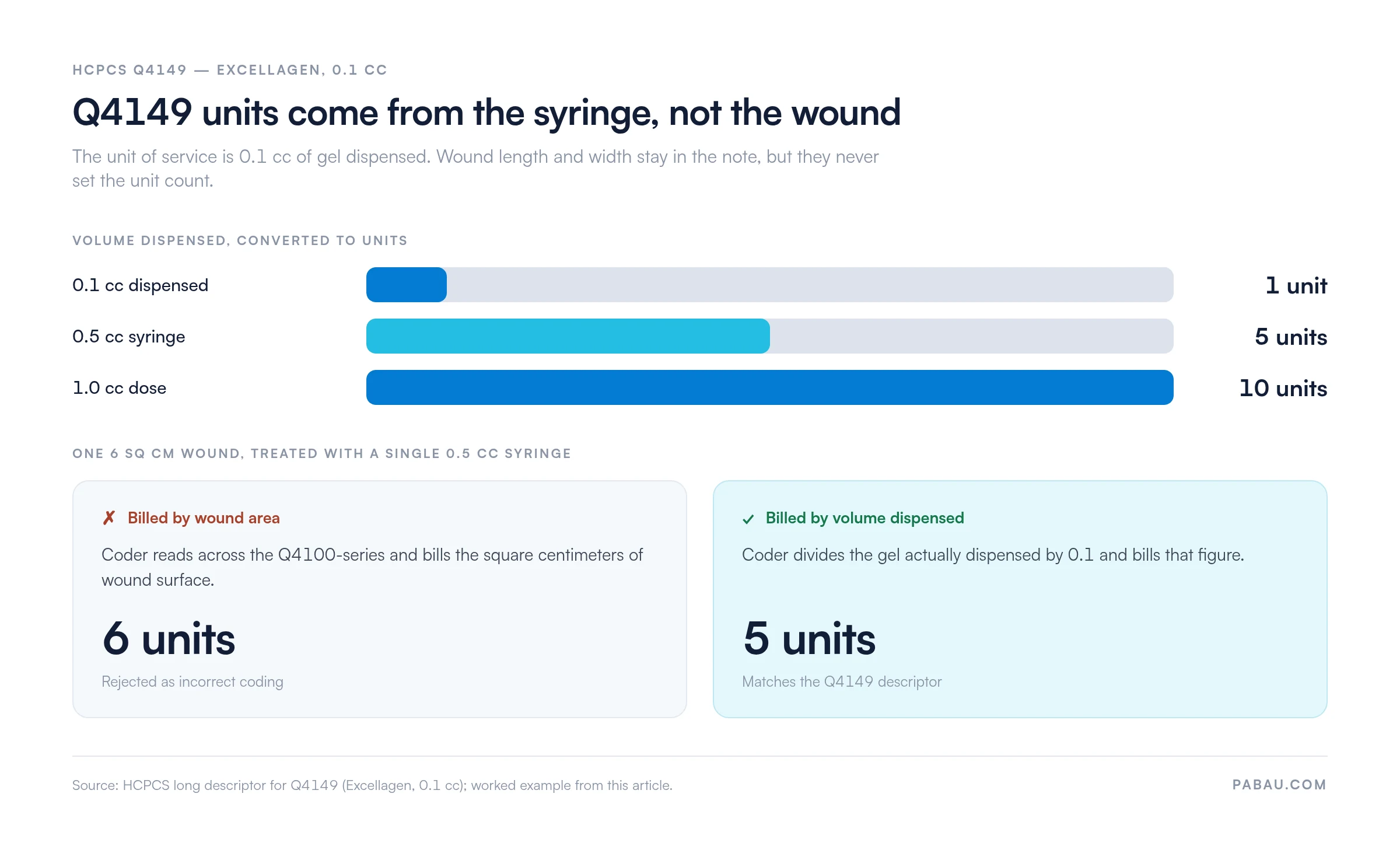
The code is billed in 0.1 cc increments of gel dispensed, not per square centimeter of wound area. One 0.5 cc syringe equals 5 units.
Excellagen is a flowable dressing rather than a sheet graft, so the graft application codes 15271 to 15278 do not apply.
Coverage is restricted. UnitedHealthcare’s commercial policy lists Excellagen as unproven and not medically necessary, so verify benefits before you open a syringe.
Practice management software like Pabau connects the volume recorded in the note to the units submitted on the claim.
Q4149 covers Excellagen, a syringe-based topical gel formulated from fibrillar type I bovine collagen at a 2.6% concentration. It is supplied as sterile, single-use pre-filled syringes with flexible applicators, and a clinician applies it directly to the wound bed immediately after debridement.
Excellagen is not human tissue and it is not a graft. The collagen is bovine in origin, and the gel flows into the wound rather than sitting on it as a membrane. That makes it workable on irregular wound shapes and on tunneled or undermined wounds, where sheet products do not conform well.
The product reached the market through Cardium Therapeutics after FDA 510(k) clearance in 2011. It later moved to Olaregen Therapeutix, a Generex Biotechnology subsidiary, which is the manufacturer named in current payer policies. The HCPCS descriptor has not changed through those transfers.
Excellagen carries unusually broad FDA labeling for a wound care product. The clearance covers acute and chronic wounds across several categories, which is why the code turns up in podiatry, vascular, and dermatologic settings alike.
Labeled applications include:
A product can carry broad FDA labeling and still sit outside every payer’s coverage policy. Each Medicare Administrative Contractor (MAC) sets its own Local Coverage Determination (LCD) for advanced wound care products. Those policies list the specific HCPCS codes they will pay.
A practice billing Q4149 in Noridian’s jurisdiction may face different criteria than one in Palmetto GBA’s jurisdiction. Search your own MAC’s LCD database before you treat, and read the billing and coding article attached to the policy.
Billing Q4149 correctly requires three inputs from the date of service. You need the volume of gel dispensed, expressed in 0.1 cc units. You also need the right modifier for the anatomical site or service context, plus the applicable place of service code. Getting any one of these wrong is enough for a claim to reject or deny.
There is a fourth rule that catches practices new to this code. Excellagen is a flowable dressing rather than a graft. CMS billing guidance says skin substitute graft codes are not to be reported for non-graft wound dressings. The guidance names gels, powders, ointments, foams, and liquids. Reporting CPT 15271 to 15278 with Q4149 is treated as incorrect coding.
Other non-sheet products follow the same rule. Injectable EpiFix under Q4145 reports application with the G0681 to G0684 codes instead.
Graft products go the other way. AlloSkin AC under Q4141 counts units per square centimeter, and its application is reported with a 15271 to 15278 code.
Units for Q4149 equal the volume of Excellagen dispensed, counted in 0.1 cc increments. Wound length and width do not enter the calculation at all. The process has four steps:
Wound size still matters clinically, even though it does not set the unit count. Manufacturer guidance pairs one 0.5 cc syringe with wounds of up to roughly 5.0 sq cm. A large dose on a small wound invites a medical necessity review. Record wound length, width, and depth alongside the volume dispensed.
The common error on this code runs in the opposite direction from sheet products. The arithmetic below shows how far apart the two methods land. A coder who treats Q4149 like its neighbors bills the wound area, so a 6 sq cm wound goes out as 6 units. If a single 0.5 cc syringe treated that wound, the correct figure is 5 units.
Modifiers give payers the anatomical and service-context information that affects adjudication. The table below lists the modifiers most commonly appended to Q4149 claims:
Modifier requirements vary by MAC. Some contractors require KX to confirm that policy criteria are met, while others will simply request the documentation on audit. Because coverage for Excellagen is uncertain with most payers, the GA modifier and a signed ABN matter more here than on a covered graft code.
Place of service codes used with Q4149 most frequently include POS 11 (office), POS 22 (on-campus outpatient hospital), and POS 19 (off-campus outpatient hospital). The payment rate can differ between facility and non-facility settings, so verify the applicable fee schedule using the correct POS designation.
Medicare payment for Q4149 is harder to pin down than for the sheet grafts around it, and the reason is the gel format. National and local policy for skin substitutes is built around graft application, and a flowable dressing does not fit that frame.
MAC billing guidance is explicit on the point. Skin substitute graft codes are not to be reported for the application of non-graft wound dressings such as gels, powders, ointments, foams, and liquids. Under that rule, the gel is a supply furnished with the wound care visit. The payable procedure is the debridement or wound care service you actually performed.
CMS then reset the whole category for CY 2026. Skin substitute products are now paid as incident-to supplies when used with a covered application procedure. The rate is a single national figure of roughly $127 per square centimeter, replacing product-specific average sales price.
That rate is expressed per square centimeter, which is not Q4149’s unit. A code measured in 0.1 cc increments does not map onto an area-based payment amount. Ask your MAC how it prices this code before you quote a patient any figure.
Payment status also moves with each CMS quarterly update. Verify the current status for Q4149 through the CMS Physician Fee Schedule search tool before you calculate expected reimbursement.
Local Coverage Determinations (LCDs) list the products a MAC will pay for, code by code. That list sits in a policy table attached to the LCD or its billing and coding article. The bioengineered skin substitute LCDs are written around graft products applied to lower extremity chronic wounds, and Q4149 does not appear on those covered-code tables. Check these five things in your own jurisdiction:
The major MACs with skin substitute policies include Noridian, Palmetto GBA, CGS Administrators, Novitas Solutions, WPS Government Health Administrators, and First Coast Service Options. Search by the code Q4149 rather than the phrase “skin substitute,” because the phrase returns graft policies that do not govern this product.
Commercial policy is more direct. UnitedHealthcare’s commercial medical policy for skin and soft tissue substitutes lists Excellagen as unproven and not medically necessary for any indication. The policy cites insufficient published evidence. Other national payers take comparable positions, so insurance eligibility verification belongs before the appointment, not after the denial.
Where coverage is unlikely, handle it before treatment rather than after the denial. Issue an advance beneficiary notice, have the patient sign it, and append the GA modifier to the claim. Practices that skip that step write off the product cost. A denied non-covered supply cannot be billed to the patient without the signed notice.
Check two things before you open an Excellagen syringe. Does the payer list Q4149 as payable, and does your note template capture the volume dispensed in cc? Coverage denials outnumber coding mistakes on this code, so a two-minute benefits check prevents most of the rework.
Every Q4149 claim needs a supporting ICD-10-CM diagnosis code that establishes the clinical reason for the wound care episode. The code must reflect the wound type, anatomical site, and laterality documented in the note. Vague or unspecified wound codes are common denial triggers, because they do not show the chronic, treatment-resistant character that payer policies look for.
The table below lists the ICD-10-CM codes most often paired with Q4149 claims, drawn from the wound types in Excellagen’s labeling. Treat it as a reference. Confirm that the code you pick is supported by the clinical note and appears on your payer’s covered diagnosis list.
Use the highest-specificity code available. An unspecified code, such as L97.419 where the note documents the ulcer stage, signals thin documentation and may fail the payer’s diagnosis specificity test.
Check your full code combinations against the covered diagnosis list published with your MAC’s policy. The ICD-10-CM code library carries the wound and ulcer entries in full. That includes the staged pressure ulcer codes payers expect on a chronic wound claim.
Thin documentation drives Q4149 denials and post-payment audits. The note on the date of service has to support every element of the claim. That means the wound’s identity, its chronic nature, and its failure to respond to prior treatment. It also means the reason a collagen gel was chosen, plus the volume dispensed. A line reading “applied collagen gel to right foot wound” supports none of that.
Strong documentation for a Q4149 claim includes all of the following elements:
Keep wound measurement flowsheets and a standard care log in the patient’s ongoing record. Flowsheets are the fastest way to show the required treatment history during an audit. Consistent documentation standards across the wound care team also reduce the record-to-record variation that triggers denials.
Q4149 sits within the Q4100-series alongside hundreds of other product codes. Each one is assigned to a specific product or product line, and they are not interchangeable. Billing Q4148 when the product dispensed was Excellagen is a coding error that creates audit liability, even where the clinical goal was the same.
The table below puts Q4149 next to the three codes around it. Three of the four are per-square-centimeter human tissue products, while Q4149 is the dosage-based bovine collagen gel. Verify the current descriptor for each code with the AAPC HCPCS code lookup alongside the CMS release file.
The unit column is the one to memorize. Q4148, Q4150, and Q4151 are add-on codes reported with a graft application procedure. Q4149 is neither area-based nor a graft, so it follows different rules end to end.
The correct code is set by the product dispensed, not by the clinical indication. Confirm the assignment with the manufacturer’s billing department or the product’s HCPCS assignment letter from CMS. Where your MAC requires PDAC (Pricing, Data Analysis, and Coding) verification, that letter names the code to use.
Wound care product billing has one of the highest denial rates in the outpatient setting. The OIG has flagged Q-series codes in multiple reports, and some MACs run targeted pre-payment review on high-volume Q-code billers. Knowing the specific denial patterns for Q4149 is the fastest way to cut your rework burden.
The most frequent denial reasons, and how to address each one:
When a Q4149 claim is denied, pull the remittance advice and read the Claim Adjustment Reason Code (CARC). Each CARC maps to a denial type, which tells you whether the problem was the unit count, the documentation, or the coverage decision.
Manual HCPCS workflows for wound care products create several points of failure. Units get converted on paper, and modifiers are added from memory. Coverage is checked after the syringe has already been opened, and diagnosis codes are picked without a look at the payer’s covered list.
Pabau’s tools for cleaner claims management connect clinical documentation to claim preparation in one platform. Clinicians record the product name, lot number, and volume dispensed in structured fields on the date of service. Those values carry into the claim instead of being retyped from a paper note.
Claims go to US payers electronically, with eligibility and prior-authorization status checks running before each appointment. For a code with coverage as uncertain as Q4149, catching the benefits problem at scheduling is worth more than any appeal filed later.
High-volume wound care practices feel this most. The volume in the note becomes the unit count on the claim without a manual step. Fewer claims age into denials, and fewer staff hours go to rework.

Pabau’s claims management tools capture the volume dispensed in structured fields, run eligibility checks before the appointment, and submit to US payers electronically. See how it works for a wound care practice.

Q4149 claims fail for two reasons, and neither is clinical. The first is a unit error, where the claim carries wound area in square centimeters instead of the volume of gel dispensed. The second is a coverage problem, because many payers treat Excellagen as unproven and were never going to pay.
Both are fixable before the patient is treated. Verify benefits at scheduling, document the volume in the procedure note, and convert that volume to units at charge capture rather than from memory.
The trade-off worth remembering is small: a signed advance beneficiary notice costs two minutes, while a denied syringe costs the product. Book a demo to see how Pabau keeps the volume you documented and the units you billed in step.

Need to understand how medical billing actually works end to end? What is medical billing covers the full claim lifecycle from charge capture through payment posting.
Struggling with claim denials across your wound care cases? How a medical claims clearinghouse works explains how electronic submission reduces front-end rejection rates.
Want a compliance framework for your billing team? Superbill documentation guide walks through what every superbill needs to support HCPCS claims at audit.
HCPCS code Q4149 is a Level II temporary code whose long descriptor is Excellagen, 0.1 cc. Excellagen is a professional-use topical wound gel made from fibrillar type I bovine collagen at a 2.6% concentration. It is supplied in sterile, single-use pre-filled syringes and applied to the wound bed immediately after debridement. The code sits in the Q4100-series block that CMS uses for skin substitutes and biologicals.
No. Q4149 is billed in 0.1 cc increments of gel dispensed, which is unusual for its part of the Q4100-series. Most neighboring codes are area-based tissue products billed per square centimeter. Coders who work through the series by pattern often bill wound area on this code by mistake. Wound measurements still belong in the note, but they do not set the unit count.
Divide the volume of Excellagen dispensed by 0.1. One 0.5 cc syringe equals 5 units, and a 1.0 cc dose equals 10 units. Record the syringe size opened, the volume applied, the lot number, and the expiration date in the note on the date of service. Check your payer’s wastage policy before you bill any unused portion of a single-use syringe.
No. CMS billing guidance says skin substitute graft codes are not to be reported for non-graft wound dressings. That list covers gels, powders, ointments, foams, and liquids. Excellagen is a flowable gel rather than a sheet graft, so pairing it with the graft application codes is treated as incorrect coding. Report the debridement or wound care service you actually performed instead.
Coverage is limited and jurisdiction-specific. The bioengineered skin substitute LCDs are written around graft products applied to lower extremity chronic wounds, and Q4149 does not appear on their covered-code tables. Many contractors therefore treat the gel as bundled into the wound care visit or as non-covered. Search your MAC’s policy by the code Q4149, and obtain a signed advance beneficiary notice when coverage looks unlikely.
Often not. UnitedHealthcare’s commercial medical policy for skin and soft tissue substitutes lists Excellagen as unproven and not medically necessary for any indication. The policy cites insufficient published evidence. Other national payers take similar positions. Verify benefits in writing before treatment, and collect a signed financial responsibility form where the payer is likely to deny.
There is no reliable published figure to quote. For CY 2026, CMS pays skin substitute products as incident-to supplies at a single national rate of roughly $127 per square centimeter. That rate is expressed in an area unit Q4149 does not use. Confirm with your MAC how a 0.1 cc code is priced. Check the CMS Physician Fee Schedule search tool for the current quarter before you quote a patient.
The most common pairing is E11.621 (Type 2 diabetes with foot ulcer) plus a specific L97.x code for the anatomical site. For venous leg ulcers, coders use the I83.0xx codes for varicose veins with ulcer. Always use the highest-specificity code available, and verify the combination against your payer’s covered diagnosis list.
Each Q4100-series code is assigned to a specific product. Q4148 covers Neox Cord 1K, Neox Cord RT, or Clarix Cord 1K. Q4150 covers AlloWrap DS or dry. Both are human tissue products billed per square centimeter as add-on codes. Q4149 covers Excellagen, a bovine collagen gel billed per 0.1 cc. The correct code follows the product dispensed, never the wound type.