CPT Code 62284: Injection procedure for myelography
CPT Code 62284: official descriptor and procedure overview The American Medical ...

Last Updated: Oct 19, 2026
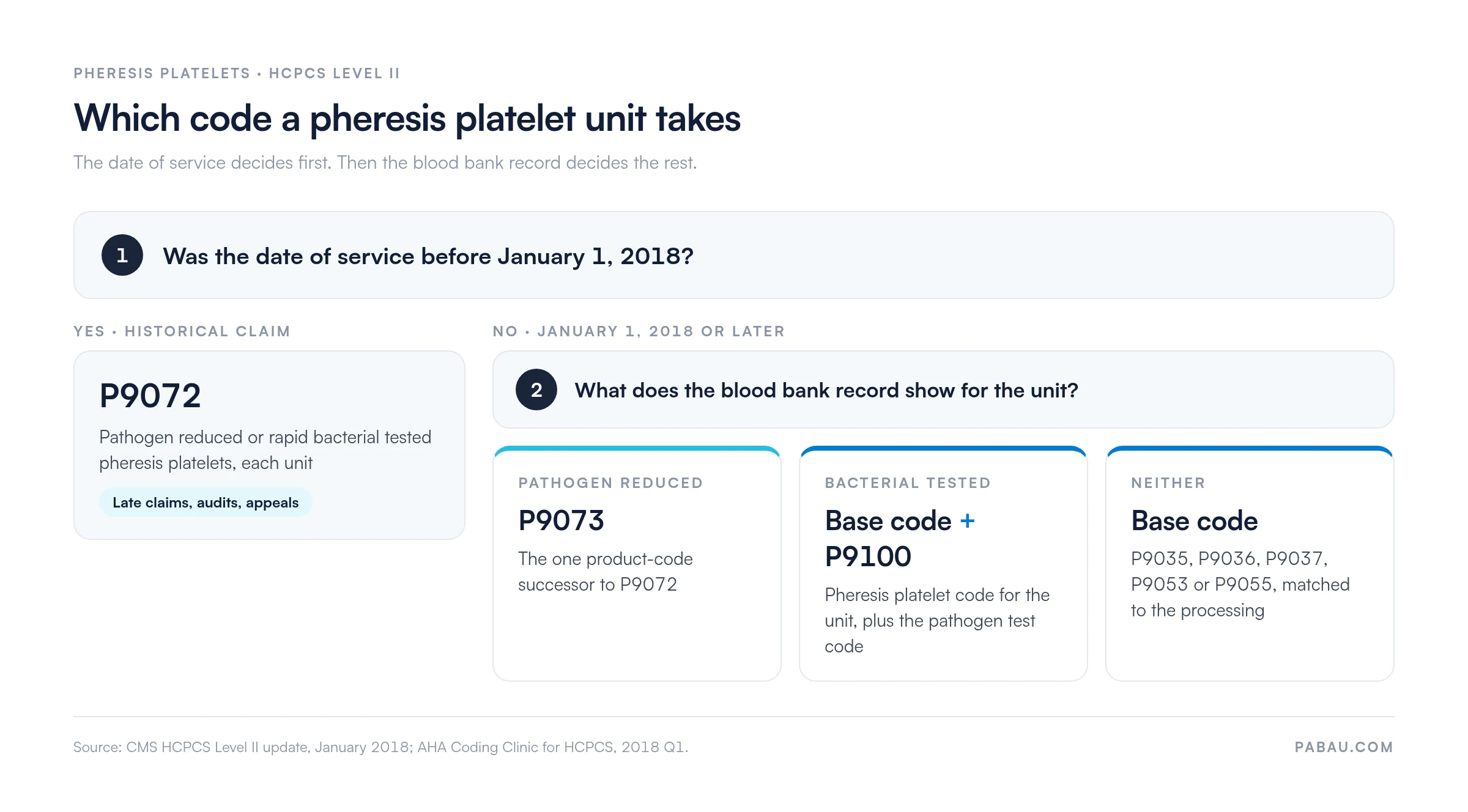
HCPCS code P9072 is the deleted HCPCS Level II code for platelets, pheresis, pathogen reduced or rapid bacterial tested, each unit. CMS retired it on January 1, 2018, so it only belongs on claims for earlier dates of service.
For a newer claim, the unit's processing decides the code. Pathogen-reduced platelets moved to P9073. Bacterial-tested platelets take their base pheresis platelet code plus P9100, the pathogen test code. Pick the wrong one and the claim comes straight back as invalid. Below, you'll find how the old code worked, which codes replaced it, and a checklist to run before you submit.
Let Pabau's smart automation suggest the right codes, reduce claim denials, and keep your practice compliant—effortlessly.
Automate repetitive tasks and focus on what matters most—your patients.
Reduce coding errors and ensure compliance with the latest regulations.
Clean claims, fewer denials, and faster reimbursements.
Powerful insights and reporting to help your practice thrive.
HIPAA compliant SOC 2 certified GDPR-compliant Trusted by 4,000+ clinics worldwide

HCPCS code P9072 was deleted on January 1, 2018, and belongs only on claims for earlier dates of service.
It covered pheresis platelets that were either pathogen reduced or rapid bacterial tested, billed one unit per unit transfused.
Pathogen-reduced platelets now bill as P9073, while bacterial-tested units take their base pheresis code plus P9100.
Platelets bill under revenue code 0384 on the institutional claim, not revenue code 0390.
The blood bank’s processing record, not the transfusion order, decides which platelet code applies.
HCPCS code P9072 described one unit of pheresis platelets that was pathogen reduced or rapid bacterial tested before transfusion. CMS deleted it on January 1, 2018. So it’s still the right code for older dates of service, and the wrong one for any claim since.
The code sat in the P-series of HCPCS Level II, the range for pathology and laboratory services. That range includes the blood products a blood bank supplies.
Its official descriptor reads: Platelets, pheresis, pathogen reduced or rapid bacterial tested, each unit.
Its neighbors cover irradiated, leukocyte-reduced, and CMV-negative platelets. Each one names the processing applied to the unit. You can browse the whole family in our HCPCS procedure codes library.
Two conditions had to be true. The platelets came from a single donor by apheresis, and they went through one of two safety steps.
Notice what the claim never showed. It didn’t say which safety step the blood bank used, because both routes shared one code. That blind spot is exactly what CMS fixed in 2018.
If a unit missed either condition above, P9072 was the wrong code. These are the mix-ups billing teams ran into most.
CMS removed P9072 in its January 2018 HCPCS update. The reason was simple. One code described two different safety methods, and payers couldn’t tell them apart.
AHA Coding Clinic for HCPCS covered the change in its first-quarter 2018 issue, reference H181015. The guidance is titled “New and deleted HCPCS codes for pathogen-reduced platelets and pathogen testing for platelets.”
Under it, P9073 took over pathogen-reduced platelets. Meanwhile, P9100 replaced Q9987 as the code for pathogen testing of platelets.
For historical claims and audits, keep three points in mind:
When a denial cites an invalid HCPCS code, pull the original remittance advice first. Then confirm the date of service against the deletion date before you rebill. Putting P9072 back on a corrected claim for a later date repeats the same error. Cross-check the CMS HCPCS update file for that year.
There’s no single replacement for P9072. P9073 is the only product code that succeeded it, and it covers pathogen-reduced units only.
Rapid bacterial tested platelets never got a product code of their own. Instead, you bill the base pheresis platelet code, plus P9100 for the test.
The date of service settles the first question, and the blood bank record settles the second. The diagram below puts both steps side by side.
Always confirm the code against the HCPCS file for the date of service. The AAPC HCPCS code lookup and the CMS HCPCS overview both show current and past code status. Check one of them before you rebill.
Treating the two methods as interchangeable causes most platelet coding errors. They happen at different points in the unit’s life. The blood bank also records them in different places.
Here’s how that plays out on a claim. Say a patient receives two INTERCEPT-treated units on March 4, 2025. The claim carries P9073 with two units.
Now change one detail. The two units were leukocyte reduced and passed a Verax PGD test instead. This time the claim carries P9035 for two units, plus P9100 to report the testing.
A coder who only sees “platelet transfusion” in the chart will likely default to a generic pheresis code. The fix is a query to the blood bank’s laboratory information system (LIS). If your facility transfuses often, build that query into your regular compliance audit.
P9072 sat among several pheresis platelet codes. After using the deleted code itself, picking the wrong neighbor is the next most common error.
The rule is simple in principle. List every step the blood bank applied, then find the code whose descriptor names exactly those steps. The PGM Billing HCPCS lookup tool lets you confirm a descriptor in seconds before you submit.
While P9072 was active, hospital outpatient departments billed it under the Outpatient Prospective Payment System (OPPS).
The code went on the institutional claim, the UB-04 or 837I. It paired with revenue code 0384, blood platelets. Revenue code 0390 is for blood storage and processing, a different category.
Here’s the path one unit took from order to payment:
A few payment rules applied during the code’s active period:
Working an appeal on an old P9072 claim? Start with the OPPS final rule for that year and the Medicare Claims Processing Manual, Chapter 4. After that, the remittance advice from the original claim period is your best record of what the payer did.
Missing records were the top reason P9072 claims failed after clinical review. When you audit a historical claim, confirm each billed unit has all five of these:
Keep these records linked to the patient’s encounter rather than spread across departments. Then an auditor’s request takes minutes, not a week of chasing the lab.
P9072 claims tended to fail in the same five ways. Its successor codes carry most of the same risks, so the table still applies to platelet claims today.
Denials on a deleted code are the easiest ones to prevent. A short pre-bill review of code validity, records, and administration catches most of them.
If your team already works from a clean claim checklist, add these six lines to it.
Add a monthly code check to your blood bank billing routine. Pull last month’s P-series claims and compare each code against the current CMS HCPCS update file. A deleted code caught in a monthly audit costs you a rebill. One that reaches the payer costs a denial and an appeal cycle.
Many billing teams still check codes against a downloaded HCPCS file and a spreadsheet of past denials. That holds up until a code changes and nobody updates the sheet.
Practice management software like Pabau keeps coding inside the patient record instead. Its claims management software includes CPT and HCPCS lookup libraries, refreshed with official code releases. Claim forms pre-fill from the service already recorded. Pabau also checks that required claim fields are complete before you can send.
In the US, claims go out through Claim.MD, with real-time eligibility checks, claim status tracking, and remittance posting. So when a line comes back with an invalid-code denial, the remittance, the record, and the resubmission sit in one place.
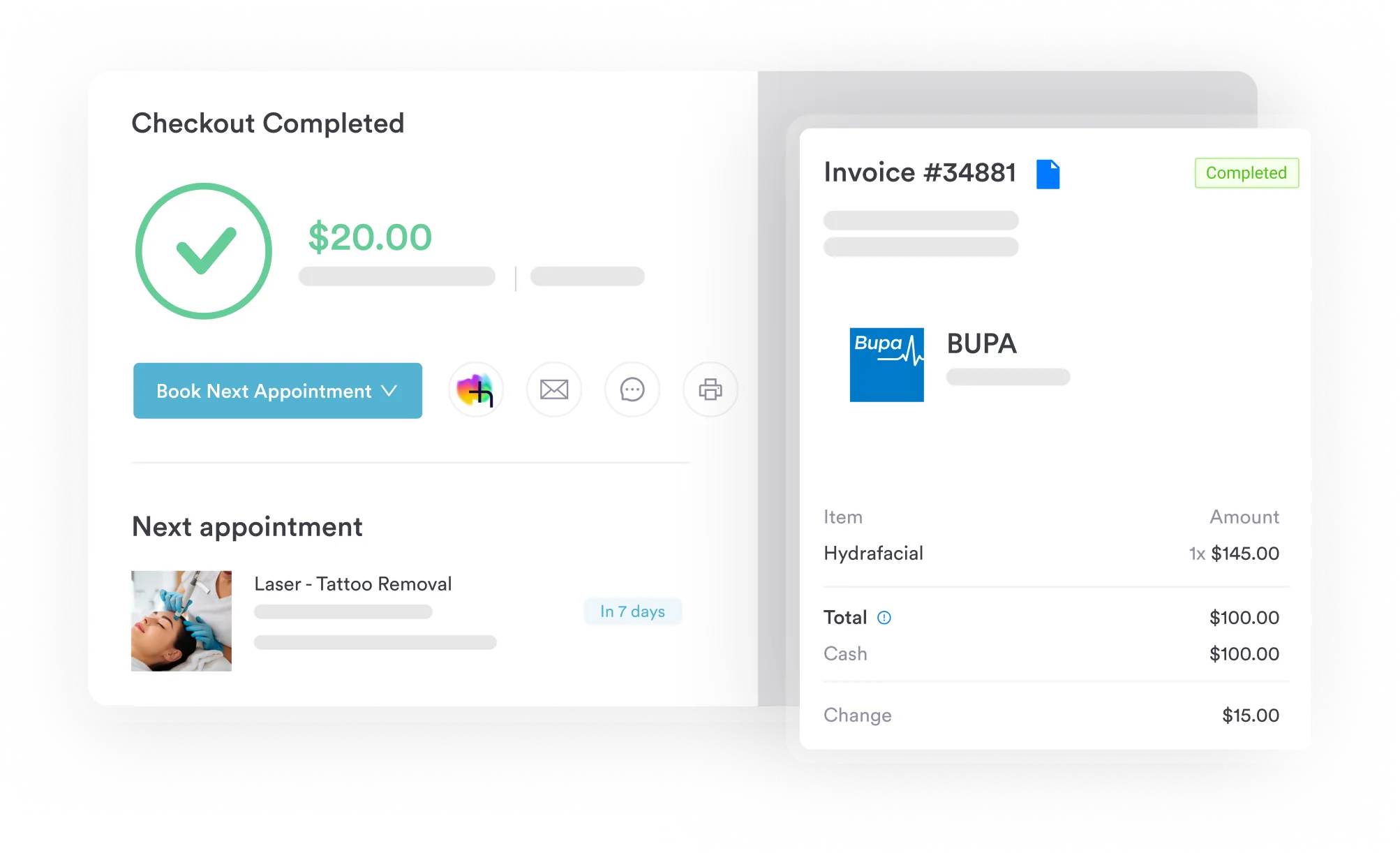

Pabau’s claims management pulls codes from lookup libraries refreshed with official releases. It pre-fills claims from the patient record and tracks each claim through to remittance.

Treat P9072 as a date-of-service question first. If the transfusion happened before January 1, 2018, the code stands, and your job is proving the unit with the blood bank record. If it happened later, the code is gone.
From that point, the processing record decides between P9073 and a base code plus P9100. Querying the blood bank on every platelet claim slows billing a little. Skipping the query costs far more when the claim comes back with CARC 181 or fails an audit.
Book a demo to see how Pabau keeps code lookups current and ties every claim to the record behind it, from order to remittance.

Billing a pathogen-reduced unit today? HCPCS code P9073 covers the product code that replaced P9072 for pathogen-reduced pheresis platelets.
Need to understand how denial codes are structured? Denial codes in medical billing explains the CARC and RARC framework used on remittance advices for blood product claims.
Working through a payer’s remittance on a rejected transfusion claim? Electronic remittance advice covers how to read and act on 835 transaction data to resolve HCPCS billing disputes.
Looking to reduce upstream coding errors before they reach the payer? Clean claim submission outlines the pre-bill checks that keep blood product claims out of the denial queue.
HCPCS Level I is the CPT code set, maintained by the American Medical Association. Level II is maintained by CMS and covers products, supplies, and services that CPT doesn’t. Blood products like platelets sit in Level II, which is why they carry P-codes.
Yes. The P-code covers the blood product itself. The transfusion service is reported separately with CPT code 36430, transfusion of blood or blood components. On a hospital outpatient claim, the two appear on separate lines.
INTERCEPT is a pathogen reduction system made by Cerus Corporation. It treats platelets with amotosalen and UVA light, which stops pathogens from replicating. The FDA approved it for platelets in December 2014. Units treated this way now bill as P9073.
Use the CMS HCPCS quarterly update files. They list additions, deletions, and changes with their effective dates, and the archive goes back many years. Commercial lookup tools show code history too, but cite the CMS file in an appeal.