CCSD code H4430: Examination of rectum under anaesthetic
CCSD code H4430 pays for the examination alone CCSD code H4430 is the UK private...

Last Updated: Oct 20, 2026
P9056 is the HCPCS Level II code for whole blood, leukocytes reduced, irradiated, each unit.
P9056 belongs to HCPCS Level II, the coding system maintained by the Centers for Medicare and Medicaid Services (CMS). Level II covers products and services that CPT does not.
Blood and blood-derived product codes sit in the P9010 to P9100 range, which is the part hospitals and transfusion services bill from. The higher P-series codes, P9603 through P9615, cover travel allowances and specimen collection.
Verify active status against the current CMS HCPCS master file before submission. HCPCS codes are reviewed annually, and P-series codes can be added, revised, or deleted in any update cycle.
Let Pabau's smart automation suggest the right codes, reduce claim denials, and keep your practice compliant—effortlessly.
Automate repetitive tasks and focus on what matters most—your patients.
Reduce coding errors and ensure compliance with the latest regulations.
Clean claims, fewer denials, and faster reimbursements.
Powerful insights and reporting to help your practice thrive.
HIPAA compliant SOC 2 certified GDPR-compliant Trusted by 4,000+ clinics worldwide

HCPCS code P9056 describes whole blood that has undergone both leukoreduction and irradiation, reported per unit.
Use P9056 only when both processing steps are documented. Missing either one invalidates the code selection.
P9056 differs from P9055, which covers CMV-negative platelets, and from P9057, which covers frozen and washed red blood cells.
Selecting the wrong P-series code is the most common billing error on blood product claims.
Pabau’s claims management software tracks HCPCS documentation requirements, so blood product billing errors get caught before submission.
Two distinct processing steps define P9056, and each addresses a different transfusion risk. Coders need to understand both to document claims correctly and to answer payer queries during audits.
Leukoreduction filters out the majority of white blood cells (leukocytes) from the blood unit. According to AABB standards, leukoreduced products must contain fewer than 5 × 10⁶ residual leukocytes per unit.
That threshold reduces the risk of febrile non-hemolytic transfusion reactions and alloimmunization, which matters most for patients who receive repeated transfusions. FDA guidance on leukocyte reduction sets out how pre-storage filtration is expected to be performed and documented.
Irradiation (gamma or X-ray) inactivates T-lymphocytes remaining in the blood product. This step prevents transfusion-associated graft-versus-host disease (TA-GvHD), a rare but frequently fatal complication. The FDA’s gamma irradiation guidance covers the licensing and procedural requirements for this step. The dose and date both belong in the blood bank record, because payers use them to confirm it.
Patient populations for whom physicians typically order both leukoreduction and irradiation include:
The physician order must specify both processing requirements. A general order for “leukoreduced blood” without specifying irradiation does not support P9056. Confirm that the order, the product supplied, and the code on the claim all describe the same unit.
Medicare Part B covers blood and blood products, including HCPCS code P9056, when administered in an outpatient setting. Reimbursement reflects the cost of acquiring, processing, and supplying the unit. Because blood product costs vary by region and supplier, rates are subject to geographic adjustment and annual update.
To find the current fee schedule rate, use the CMS Physician Fee Schedule lookup tool and filter by HCPCS code P9056. Amounts change each fiscal year, so check the CMS source rather than a figure quoted elsewhere.
Commercial payer coverage varies. Key considerations:
Accurate P9056 claims require documentation from both the clinical and blood bank workflows. Missing records from either source are the most common cause of denials during post-payment audits. Assemble the file at submission rather than during an appeal, when the records are harder to retrieve.
Required documentation for each P9056 claim:
The diagnosis code carries the medical necessity argument on a P9056 claim, so it should name the transfusion indication rather than the admitting problem. Confirm the choice against our ICD-10-CM codes reference before the claim goes out.
When a single unit is split between multiple patients, each portion must be billed separately. This happens most often in neonatal practice. CMS guidelines require billing to reflect the volume each patient received.
The blood bank’s split record must document the unit identification, split date, volume of each portion, and recipient. Modifier requirements for split unit billing are payer-specific. Verify them against current CMS transmittals and your payer’s coverage policy before submission.
Document the irradiation log and leukoreduction certification as separate attachments in your blood bank records. When a payer requests supporting documentation for a P9056 claim, these two records are the first items auditors look for. A clean claim that arrives with both records attached as a note avoids the most common request for additional information.
Selecting the wrong P-series code is the most common billing error on blood product claims. The table below covers the codes adjacent to HCPCS code P9056, so coders can confirm they have the right product type. Confirm each description against the current CMS HCPCS file before submission, because descriptors are revised each year.
Packed red cells carry a separate code for the same pairing. Red cells that are leukocyte-reduced and irradiated, with no CMV-negative requirement, bill as P9040.
The most clinically significant distinction is between P9056 (whole blood) and P9058 (red blood cells). Whole blood is transfused far less often than packed red cells, so confirm the product type in the blood bank record before coding. The chart below works through that choice product by product.
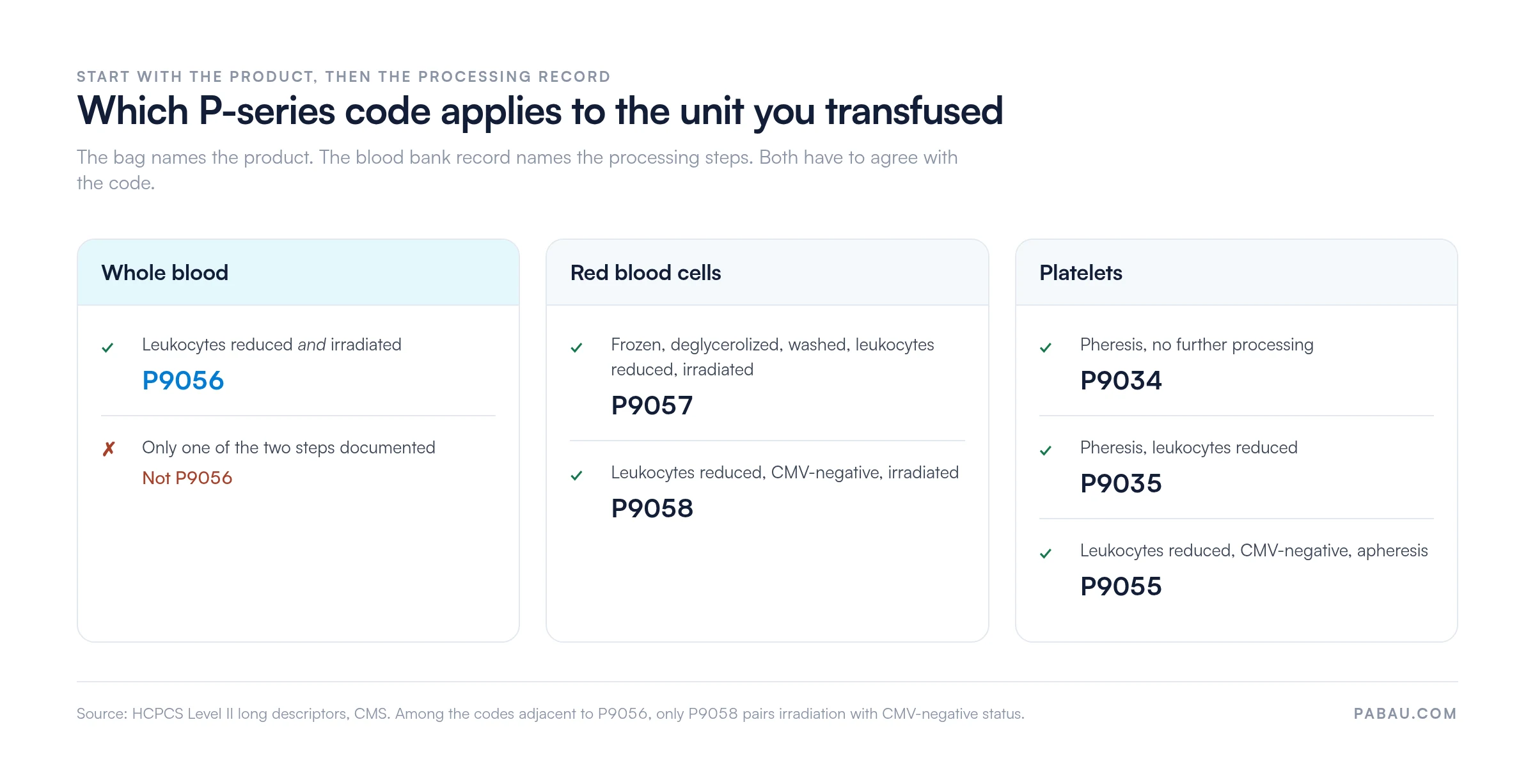
Most P9056 claim denials trace back to four preventable errors. Each maps to a specific fix that resolves the issue before it reaches the payer.
A pre-submission checklist that maps each P9056 claim to its supporting documents catches most of these before they reach the payer. For hospitals with high transfusion volumes, clean claim checks built into the billing workflow hold up better than manual review.
Blood product billing draws on more documentation sources than most HCPCS categories. Physician orders, blood bank processing logs, transfusion administration records, and split unit records all have to agree before a claim goes out. Spread across paper files and disconnected systems, one of them usually goes missing.
Pabau, practice management software for healthcare practices, centralizes that paperwork in one record. Its claims management software attaches blood bank records to the encounter they belong to. It also flags a missing processing document before the claim is submitted.
The billing module also tracks denial patterns across P-series codes. A recurring mismatch between P9055, P9056, and P9058 then shows up as a pattern rather than a run of one-off rejections.
Fee schedule updates land in the same place. The rates a coder sees each fiscal year no longer depend on someone updating a spreadsheet.

Pabau’s claims management tools help hospital billers and blood bank teams track documentation requirements, submit clean claims, and reduce blood product billing errors.

Billing errors on P9056 almost always come down to one missing record for one of the two steps that define the code. Both leukoreduction and irradiation records must be present and match the physician order before a clean claim can be submitted. Assembling the file at submission costs far less than reconstructing it for an appeal months later.
Pabau gives billing teams one place to attach, track, and review blood bank documentation against each P9056 claim before it goes out. Book a demo to see how it fits a transfusion billing workflow.

Need a broader grounding in blood product billing compliance? Medical billing compliance covers the regulatory framework that governs how payers audit HCPCS claims, including blood products.
Tracking denials across multiple HCPCS codes? Denial management in healthcare walks through how to build an appeals workflow that recovers revenue from preventable rejections.
Want to understand how clean claim workflows reduce first-pass denials? Clean claim submission explains the elements payers check before processing any HCPCS claim.
HCPCS code P9056 is a Level II code that describes whole blood that has been both leukocyte-reduced and irradiated, reported per unit administered. It is used by hospitals, blood banks, and outpatient transfusion services when billing Medicare and commercial payers for this dual-processed blood product.
P9055 covers platelets that are leukocytes reduced and CMV-negative, collected by apheresis. P9056 covers whole blood that is leukocytes reduced and irradiated. P9055 carries no irradiation attribute, and the two products are not interchangeable. Using P9055 on a whole blood claim triggers a product mismatch denial.
Bill P9056 when a patient receives whole blood that is both leukocyte-reduced and irradiated. Both processing steps must be documented in the blood bank records. Common indications include transplant recipients, patients with hematologic malignancies, premature neonates, and patients receiving directed donations from first-degree relatives.
Applicable modifiers for P9056 are payer-specific and should be verified against current CMS transmittals and your payer’s coverage policy. For split unit billing, the blood bank’s split record must document the volume and the recipient. Some payers also require a modifier indicating partial unit administration.
Transfusion-associated graft-versus-host disease (TA-GvHD) is a rare but often fatal complication in which donor T-lymphocytes attack the recipient’s tissues. Irradiation of blood products inactivates these T-lymphocytes, making irradiation the primary prevention strategy. P9056 captures this added processing step in the billing record, supporting both medical necessity documentation and reimbursement for the irradiation cost.