CCSD code H4430: Examination of rectum under anaesthetic
CCSD code H4430 pays for the examination alone CCSD code H4430 is the UK private...

Last Updated: Oct 20, 2026
P9051 is the HCPCS Level II code for whole blood or red blood cells, leukocytes reduced, cmv-negative, each unit.
Let Pabau's smart automation suggest the right codes, reduce claim denials, and keep your practice compliant—effortlessly.
Automate repetitive tasks and focus on what matters most—your patients.
Reduce coding errors and ensure compliance with the latest regulations.
Clean claims, fewer denials, and faster reimbursements.
Powerful insights and reporting to help your practice thrive.
HIPAA compliant SOC 2 certified GDPR-compliant Trusted by 4,000+ clinics worldwide

HCPCS Code P9051 describes whole blood or red blood cells that are both leukocyte-reduced and CMV-negative, billed per unit.
P9051 is contractor-priced by Medicare, so no national rate exists and your MAC sets the allowable amount for your jurisdiction.
The most common substitution error is P9051 in place of P9016, which covers leukoreduced red cells with no CMV attribute.
Claims are commonly denied for missing CMV-negative medical necessity documentation or the wrong code from the P-series.
Practice management software like Pabau supports HCPCS code lookup, documentation capture, and electronic claims submission, which reduces P9051 denials.
P9051 sits in the Blood and Blood Products section of the P-series, maintained by the Centers for Medicare and Medicaid Services (CMS). It describes a single unit of whole blood or packed red blood cells that has been leukoreduced and screened as CMV-seronegative.
The code covers two component types under one descriptor. Whole blood units and red blood cells (RBCs) both qualify, as long as both processing conditions are met. Billing is always per unit, not per encounter.
Leukoreduction is the filtering of white blood cells (leukocytes) out of a blood product before transfusion. The resulting product is described as leukocyte-reduced (LR) or leukoreduced. Removing the white cells lowers the rate of febrile nonhemolytic transfusion reactions.
It also reduces the risk of transfusion-transmitted cytomegalovirus, which is why immunocompromised patients are the usual recipients. A published review of leukoreduced blood components documents both effects.
For billing, leukoreduction is the attribute that separates one P-series code from another. A blood product without leukoreduction cannot be billed under P9051, even when it is CMV-negative. Both qualifiers have to be present at once, and the code follows the product’s processing record rather than the clinical indication alone.
Cytomegalovirus (CMV) is a common herpes-family virus. In healthy individuals, CMV infection is usually asymptomatic. In immunocompromised patients, CMV transmitted by transfusion carries serious morbidity risk. Transplant recipients, neonates, and oncology patients on chemotherapy are the groups most often affected.
CMV-negative blood products come from donors who tested seronegative for CMV antibodies. They are typically indicated for patients who are CMV-seronegative and immunocompromised, though eligibility criteria vary by institution and payer policy.
Verify coverage individually with each payer. Medicare criteria are set by MACs through local coverage determinations, and commercial requirements differ across plans.
Verify CMV-negative medical necessity criteria with your specific MAC before submitting P9051 claims. MACs publish local coverage determinations (LCDs) that define covered indications. Relying on a neighboring jurisdiction’s LCD can result in denials that are difficult to appeal.
P9051 is billed per unit of whole blood or red blood cells transfused. If a patient receives three units in one encounter, bill three units of P9051. Each unit requires its own supporting documentation in the transfusion record.
Some payers require prior authorization for CMV-negative blood products, and a missing authorization is one of the most avoidable denial causes. Confirm coverage before the transfusion encounter whenever the schedule allows.
A claim that codes the unit as leukoreduced but omits CMV-negative status will be mismatched against the code descriptor and denied. The superbill has to capture every processing attribute of the product, not only the component type.
P9051 is classified as contractor-priced by Medicare, so no single national allowable amount exists. Each Medicare Administrative Contractor (MAC) sets its own reimbursement rate within its jurisdiction. A provider in the Midwest may receive a different rate than one in the Mid-Atlantic for the same unit.
To find the applicable rate for your location, access your MAC’s fee schedule directly. The published rate applies to the facility or provider enrolled under that contractor. Publishing a single dollar figure here would mislead, because the allowable is jurisdiction-specific and updated annually.
Reimbursement also shifts with each annual HCPCS update, so a rate confirmed last year may no longer hold. Reviewing electronic remittance advice line by line is the most reliable way to confirm your MAC is applying the expected allowable. It catches underpayments while the appeal window is still open.
Most P9051 denials trace back to one of three problems: incomplete documentation, wrong code selection, or missing authorization. Each is preventable with the right pre-submission process.
Blood product claims carry a heavier documentation burden than most HCPCS claims. Every clinical attribute of the product has to be reflected in the code. The P9051 descriptor contains three conditions: whole blood or RBCs, leukocyte-reduced, and CMV-negative. A chart that documents only one or two of them gives the payer grounds to deny.
Reading your remittance reports as a set, rather than one claim at a time, surfaces patterns across P-series submissions. Fixing the root cause beats appealing the same denial every month.
The P-series includes over a dozen blood product codes. Selecting the wrong one is a common error in transfusion medicine billing. Two variables drive the choice, and the grid below maps them onto the code each combination calls for.
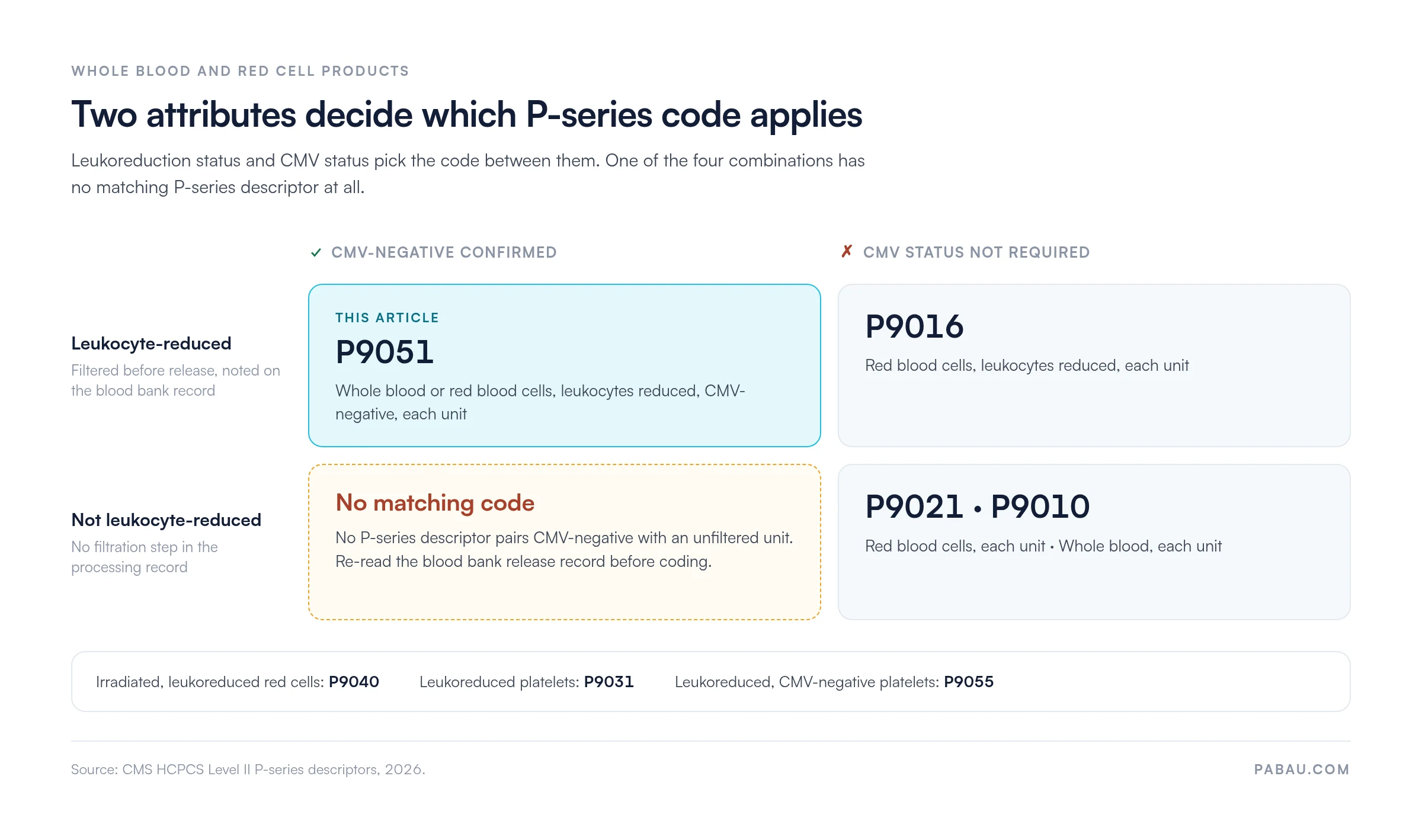
The table below sets the same codes out with their full descriptors and their two decisive attributes.
The most common substitution error is P9051 in place of P9016. Both cover leukoreduced red cells, but P9051 additionally requires CMV-negative documentation. When the chart carries no CMV-negative confirmation from the blood bank, P9016 is the correct code. Cross-check the descriptor against the AAPC HCPCS code reference before finalizing the claim.
Irradiation shifts the choice again. A leukoreduced unit that is irradiated but not CMV-negative is billed under P9040, so confirm both attributes on the blood bank record.
Strong documentation is the difference between a paid claim and a medical records request. For P9051, the chart must contain four layers of evidence, each supporting a different element of the code descriptor.
Medicare RAC reviews list blood product claims as a focus area, and incomplete transfusion records are the most cited deficiency. Diagnosis linkage is usually the thinnest layer. The ICD-10-CM diagnosis codes on the claim have to name the condition that makes a CMV-negative product necessary. All four layers belong in the chart before the claim goes out.
Create a blood product billing checklist tied to your blood bank workflow. Before the transfusion paperwork goes to billing, a staff member confirms four items. Physician order captured, CMV-negative notation present, blood bank release record attached, unit count reconciled. This one checkpoint prevents most P9051 denials.
Blood product billing involves more moving parts than most HCPCS claims. Code selection depends on processing attributes that live in the blood bank, not in the physician note. The supporting documentation spans at least four separate record types.
Because P9051 is contractor-priced, reimbursement tracking means comparing remittance data against a jurisdiction rate rather than a published national figure. Practice management software like Pabau keeps the documentation, the code, and the remittance in one place. That turns the comparison into a report rather than a spreadsheet exercise.
Billing teams working P-series codes need claims management without rework, where the descriptor and the blood bank record are checked in the same place. Pabau’s claims tools support HCPCS code lookup, structured documentation capture, and electronic claims submission.


Pabau’s claims management software supports HCPCS code lookup, documentation capture, and electronic claims submission. See how billing teams use Pabau to reduce denials on complex P-series codes.

P9051 pays when the chart proves all three attributes, and it denies when any one of them is missing. Two of the three live in the blood bank record, so reading that record before billing settles most of the code-selection question.
The trade-off worth remembering is that contractor pricing removes the national benchmark. You cannot confirm you were paid correctly from a fee schedule, only from your MAC’s own file and your remittance history. Build that check into the monthly close rather than the appeal.
Book a demo to see how Pabau keeps blood product documentation, code selection, and remittance reconciliation in one billing workflow.

Need to understand how denials are coded and tracked? Denial codes in medical billing covers CARC and RARC codes used by payers to explain claim adjustments and denials.
Want the revenue cycle context for blood product billing? What is revenue cycle management explains how claim submission, payment posting, and denial management fit together.
Looking to improve your clean claim rate across all HCPCS codes? Medical billing compliance outlines the documentation and coding standards that keep claims clean and audits manageable.
HCPCS Code P9051 is a Level II code for whole blood or red blood cells with two processing attributes. The unit must be leukocyte-reduced, meaning filtered to remove white blood cells. It must also come from a donor who tested seronegative for cytomegalovirus. P9051 is billed per unit, and both attributes must be documented in the chart.
P9016 covers red blood cells that are leukocytes reduced, each unit, with no CMV attribute in the descriptor. P9051 requires both leukoreduction and CMV-negative status. Use P9016 when the product is leukoreduced but the blood bank record does not confirm a CMV-seronegative donor. Substituting one for the other is the most common P-series coding error.
Yes. P9051 is billed per unit of whole blood or red blood cells transfused. If a patient receives two units in a single encounter, report two units of P9051. Each unit requires its own supporting documentation in the transfusion administration record.
P9051 is contractor-priced, so each Medicare Administrative Contractor (MAC) sets the allowable amount for its jurisdiction. No single national fee schedule rate exists for this code. Check your MAC’s published pricing file to find the rate for your region. Verify it again with each annual HCPCS update cycle.
The chart needs four layers. A signed physician order specifying a CMV-negative product, and a diagnosis supporting medical necessity such as immunocompromised status or active hematologic malignancy. It also needs a blood bank release record confirming CMV-seronegative status. Finally, a transfusion administration record documenting the unit given. Missing any layer creates a denial risk.
Medicare covers P9051 for covered beneficiaries when medical necessity is documented per MAC coverage determinations. Commercial coverage varies. Some plans require prior authorization for CMV-negative blood products, and eligibility criteria differ. Verify coverage and authorization with each payer before the transfusion to avoid post-service denials.