CCSD code H4430: Examination of rectum under anaesthetic
CCSD code H4430 pays for the examination alone CCSD code H4430 is the UK private...

Last Updated: Oct 20, 2026
P9039 is the HCPCS Level II code for red blood cells, deglycerolized, each unit.
Let Pabau's smart automation suggest the right codes, reduce claim denials, and keep your practice compliant—effortlessly.
Automate repetitive tasks and focus on what matters most—your patients.
Reduce coding errors and ensure compliance with the latest regulations.
Clean claims, fewer denials, and faster reimbursements.
Powerful insights and reporting to help your practice thrive.
HIPAA compliant SOC 2 certified GDPR-compliant Trusted by 4,000+ clinics worldwide

HCPCS Code P9039 describes red blood cells, deglycerolized, each unit. It is a P-series Level II code for units processed from previously frozen RBCs with the glycerol removed.
Deglycerolization happens before transfusion. Frozen RBCs are thawed, washed to remove the cryoprotective agent glycerol, then resuspended for clinical use.
Billing P9039 requires medical necessity documentation, a physician order, and correct unit reporting. The most common error is picking P9039 for a unit that was also leukoreduced or irradiated. Those units belong under P9054 or P9057.
P9038 sits next to P9039 in the code list but describes irradiated red blood cells, an unrelated process. Code adjacency in the P-series does not mean product similarity.
Practice management software like Pabau supports accurate HCPCS code selection and documentation workflows, reducing blood product billing denials.
HCPCS Code P9039 carries the official long description: Red blood cells, deglycerolized, each unit. The short description used on claims is Rbc deglycerolized.
The code is active under HCPCS Level II, maintained by the Centers for Medicare and Medicaid Services (CMS) and the HCPCS Workgroup.
P9039 sits in the P-series (P9000-P9999), the pathology and laboratory subsection of HCPCS Level II covering blood products and related supplies. P-series codes are supply codes rather than procedure codes, which changes how they are reported on the claim form.
Producing a deglycerolized unit takes more than thawing frozen blood. The process runs to several steps, and each one adds cost and time. That is why CMS maintains a separate HCPCS code for this product instead of grouping it with standard packed RBCs.
The freeze-thaw-wash sequence works as follows. Red blood cells intended for long-term storage are mixed with glycerol, a cryoprotective agent that prevents ice crystal formation during freezing. Frozen in this state, RBCs can be stored for up to 10 years. That storage window makes the method valuable for rare blood types and for emergency reserve supplies.
Before a patient can receive these cells, the glycerol must be removed. The product is thawed, then washed repeatedly until glycerol concentration falls below safe transfusion thresholds. The resulting product is what P9039 describes.
Clinically, deglycerolized RBCs cover three situations. Rare blood types have to be stored long-term. Autologous donations are banked before surgery. Some hemolytic conditions call for a washed product.
The AABB (formerly the American Association of Blood Banks) sets standards for blood product preparation, including deglycerolization protocols. The FDA regulates deglycerolized RBCs as a biological product requiring manufacturer licensure. That licensure sits separately from the billing code covering the supply itself.
Medicare reimburses P9039 for blood product transfusion services when medical necessity criteria are met. Reimbursement rates for blood products under HCPCS are set through the Medicare Physician Fee Schedule and adjusted annually by CMS.
Rates vary by geographic locality, payer, and the Medicare Administrative Contractor (MAC) jurisdiction handling the claim.
CMS updates fee schedules annually, and rates differ by location. Billing teams should verify current reimbursement amounts directly through the CMS Physician Fee Schedule lookup tool.
Never rely on a prior year’s rate when submitting current-year claims. The reimbursement for P9039 reflects both the blood product cost and the processing involved in deglycerolization.
Coverage may vary by MAC jurisdiction. Some MACs issue Local Coverage Determinations (LCDs) specifying clinical indications for blood product reimbursement. Check the applicable LCD for your jurisdiction before submitting a P9039 claim without a clearly documented clinical indication.
Always verify P9039 reimbursement rates through the CMS Physician Fee Schedule lookup for the current year and your specific MAC locality. Blood product rates change annually and geographic modifiers affect the final payment amount. Submitting with a prior year’s rate expectation is the easiest way to flag a billing discrepancy during a payer audit.
Accurate P9039 claims require specific documentation at every stage of the blood product lifecycle. Missing a single required element is one of the leading causes of denial for blood product codes. Build the checklist into the blood bank workflow before the claim leaves the facility.
Required documentation for a P9039 claim includes:
The unit billing rule is simple. Bill one line of P9039 for each unit of deglycerolized RBCs administered. Do not aggregate multiple units on a single line with an adjusted charge. Each unit should appear as a separate line item, or with the correct count in the quantity field.
Blood product billing errors fall into predictable patterns. Knowing the most common mistakes with P9039 is the fastest route to cleaner claims and fewer denials.
If a P9039 claim is denied, check the reason against our denial code reference before filing an appeal. The most common denial reasons for blood product codes are medical necessity (CO-50/CO-167) and coding discrepancies (CO-4/CO-11). Address the root cause in the appeal, not just the symptom.
The ICD-10-CM diagnosis codes paired with a P9039 claim must document the clinical reason the patient required deglycerolized red blood cells.
A non-specific or mismatched diagnosis is one of the fastest routes to a medical necessity denial. The crosswalk codes below are examples. Always verify against your MAC’s LCD and the clinical scenario before submitting.
Verify each crosswalk code against the CDC/NCHS ICD-10-CM web tool for the current fiscal year. Codes are updated annually, and one that is valid this year may be revised or made non-billable next year.
Where chronic blood loss is the documented cause, the pairing is usually D50.0. Pair every P9039 claim with the most specific current code the clinical record supports.
The P-series scatters its red blood cell codes across a wide numeric range. The codes that look adjacent are rarely the ones that get confused. P9038 sits directly before P9039 and describes an entirely different process.
The genuine mix-ups happen inside the deglycerolized family, where P9039, P9054, and HCPCS code P9057 all describe the same freeze-thaw-wash pathway. A unit washed to remove plasma proteins, never frozen and never glycerolized, is billed under HCPCS code P9022 instead.
The matrix below sorts the red cell codes by the processing steps that appear on the unit label. Verify current descriptions against the AAPC Codify HCPCS lookup or the annual CMS HCPCS update file before using any of them on a live claim.
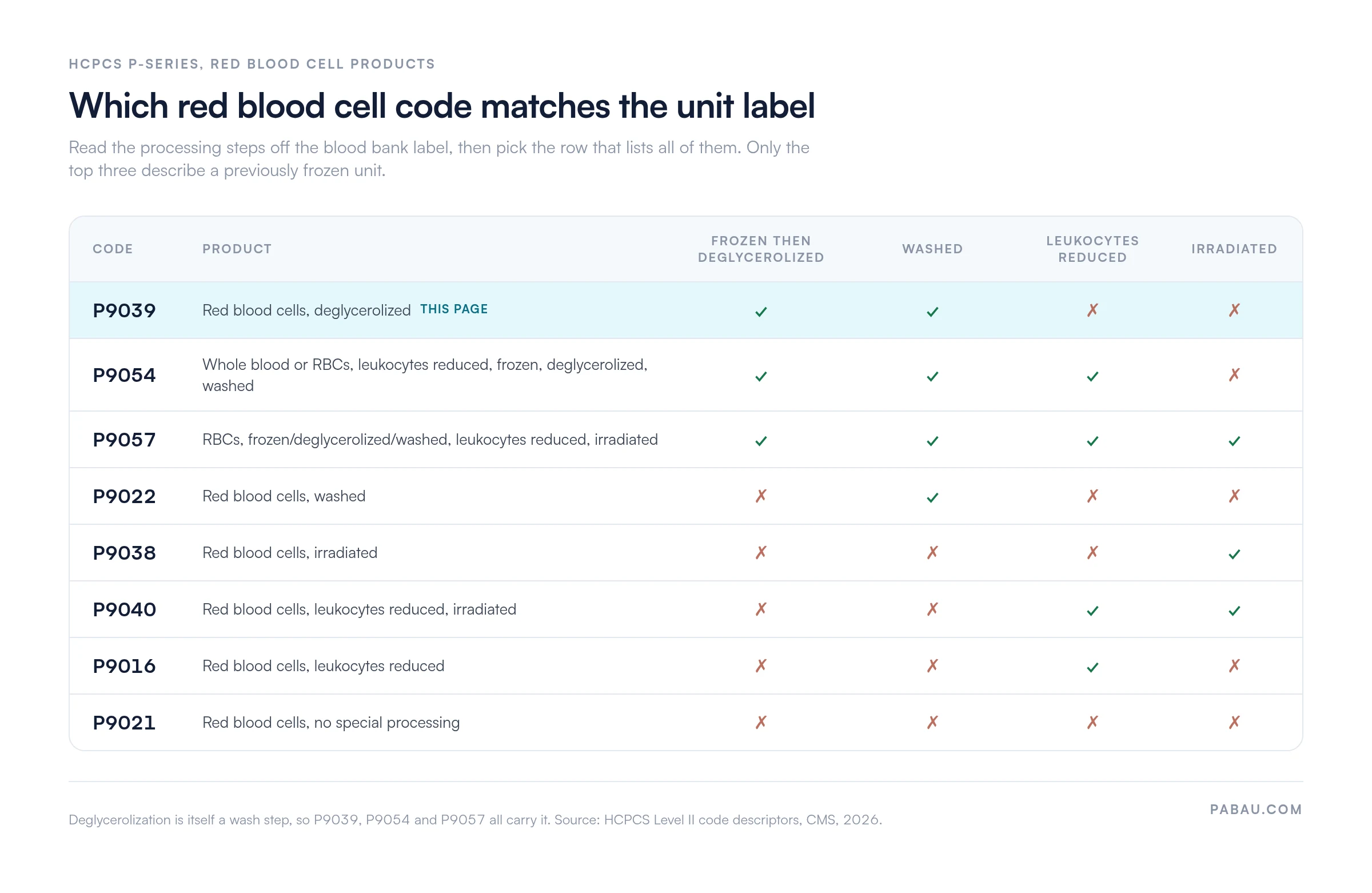
The table below carries each code’s full descriptor and the case it is meant for.
The distinction that most often causes rejection is P9039 against P9054 and P9057. All three products reach the patient the same way, and only the unit label records whether leukoreduction or irradiation was also performed. A unit that is leukoreduced and irradiated but never frozen belongs under P9040.
Build a crosswalk from product label terminology to HCPCS code into your charge capture workflow, so the check happens before the claim is transmitted.
HCPCS Level II codes are updated annually, with additions, revisions, and deletions effective January 1 each year. P9039 holds active status as a standing blood product code.
Its description has remained “Red blood cells, deglycerolized, each unit.” The wider P-series has grown around it. Later codes such as P9054 and P9057 describe more heavily processed versions of the same deglycerolized product.
Billing teams should verify P9039’s current status against the annual CMS HCPCS update file each January. The NLM Clinical Table Search API provides programmatic access to current HCPCS Level II code data, which helps teams building or maintaining billing systems.
Blood bank billing teams should check three things each January:
Give that January check a named owner. Blood product codes are low-volume work for most facilities, so a descriptor change slips past unnoticed until the denials arrive.
Blood product billing carries above-average denial risk. The order passes between the ordering physician, the blood bank, the transfusion nursing team, and the billing department. Every one of those handoffs is a point where a unit count, a product label, or a documentation element gets lost.
Practice management software like Pabau centralizes charge capture, documentation, and claim submission in one system. Our software for billing teams keeps HCPCS documentation and claim status together. Coders can verify code selection, attach the supporting clinical notes, and follow the claim without switching systems.

Facilities handling a high volume of blood product claims gain most from removing the manual re-entry between the blood bank record and the claim. That re-entry is where unit counts drift. Denial reporting matters just as much, because it surfaces the P9039, P9054, and P9057 mix-ups behind repeated rejections.
When you evaluate billing software for a facility that bills blood product codes, look for three things:
Those three turn one-off billing errors into fixes that hold.

Pabau’s claims management tools help billing teams document HCPCS codes accurately, track claim status, and manage denials. Fewer blood product claims get rejected on first submission.

The unit label decides this code, not the patient’s diagnosis and not where P9039 sits in the P-series. Build that check into charge capture, so leukoreduction and irradiation are read before anyone types a code. Denials across the deglycerolized family drop once that single step happens before submission.
The rest is documentation discipline. A physician order, a clear medical necessity note, and an exact unit count carry most P9039 claims through on first submission. To see how Pabau handles blood product documentation and claim tracking, book a demo.

Need to understand denial codes when P9039 claims are rejected? Medical billing fundamentals covers how claims move through the revenue cycle and where blood product codes most often fail.
Dealing with recurring claim rejections on blood product codes? Clean claim submission standards breaks down what payers require before a claim can be processed without manual review.
Want to understand how ICD-10 crosswalk decisions affect reimbursement? Revenue cycle management fundamentals explains how diagnosis code pairing affects claim approval rates and payment timing.
HCPCS Code P9039 bills for red blood cells, deglycerolized, each unit. The product is prepared from previously frozen RBCs by removing the cryoprotective agent glycerol before transfusion. It is used for rare blood types, pre-stored autologous donations, and cases where a washed red cell product is required.
Deglycerolized means the glycerol added as a cryoprotectant for long-term freezing has been removed. Red blood cells are frozen with glycerol to prevent ice crystal damage during storage. Before transfusion, the product is thawed and washed repeatedly to reduce glycerol concentration to safe levels, producing the deglycerolized unit billed under P9039.
P9039 is billed per unit on a CMS-1500 or UB-04 claim form. It needs a supporting ICD-10-CM diagnosis code establishing medical necessity. Medicare reimbursement rates vary by MAC locality and are updated annually. Verify current rates through the CMS Physician Fee Schedule lookup tool, then confirm coverage criteria against your MAC’s applicable LCD.
Yes, Medicare covers deglycerolized red blood cells billed under P9039 when medical necessity is documented and coverage criteria are met. Coverage is subject to the applicable MAC’s LCD requirements and geographic reimbursement rates. Some MACs issue specific coverage determinations for blood products. Check the LCD for your jurisdiction rather than assuming coverage.
All three describe a unit that was frozen with glycerol, thawed, and washed. P9039 stops there. P9054 covers whole blood or red blood cells that were also leukocyte-reduced. P9057 covers a unit that was leukocyte-reduced and irradiated as well. Read the processing steps off the blood bank label, then pick the code that lists all of them.
They are unrelated products. P9039 covers deglycerolized red blood cells, meaning previously frozen units that have been thawed and washed to remove glycerol. P9038 covers irradiated red blood cells, where the unit is treated with gamma or X-ray irradiation to prevent transfusion-associated graft-versus-host disease. The codes sit next to each other in the P-series, but the two processes do not overlap.
Five elements are required. You need a signed physician order specifying the transfusion indication, and clinical notes establishing medical necessity. You also need blood bank records showing the unit number and deglycerolized product label. Add a completed transfusion record with administration times, plus an accurate unit count in charge capture. Missing any of these is sufficient grounds for a Medicare medical necessity denial.