CCSD code H4430: Examination of rectum under anaesthetic
CCSD code H4430 pays for the examination alone CCSD code H4430 is the UK private...

Last Updated: Oct 20, 2026
L2010 is the HCPCS Level II code for knee ankle foot orthosis, single upright, free ankle, solid stirrup, thigh and calf bands/cuffs (single bar 'ak' orthosis), without knee joint, custom fabricated.
Every element of that descriptor decides the code. Change the upright count or add an articulating knee, and a different L-code applies. Medicare then layers three coverage tests on top, all of them set out in LCD L33686.
Let Pabau's smart automation suggest the right codes, reduce claim denials, and keep your practice compliant—effortlessly.
Automate repetitive tasks and focus on what matters most—your patients.
Reduce coding errors and ensure compliance with the latest regulations.
Clean claims, fewer denials, and faster reimbursements.
Powerful insights and reporting to help your practice thrive.
HIPAA compliant SOC 2 certified GDPR-compliant Trusted by 4,000+ clinics worldwide

L2010 is a custom-fabricated KAFO with a single upright, a free ankle, and a solid stirrup, supplied without a knee joint.
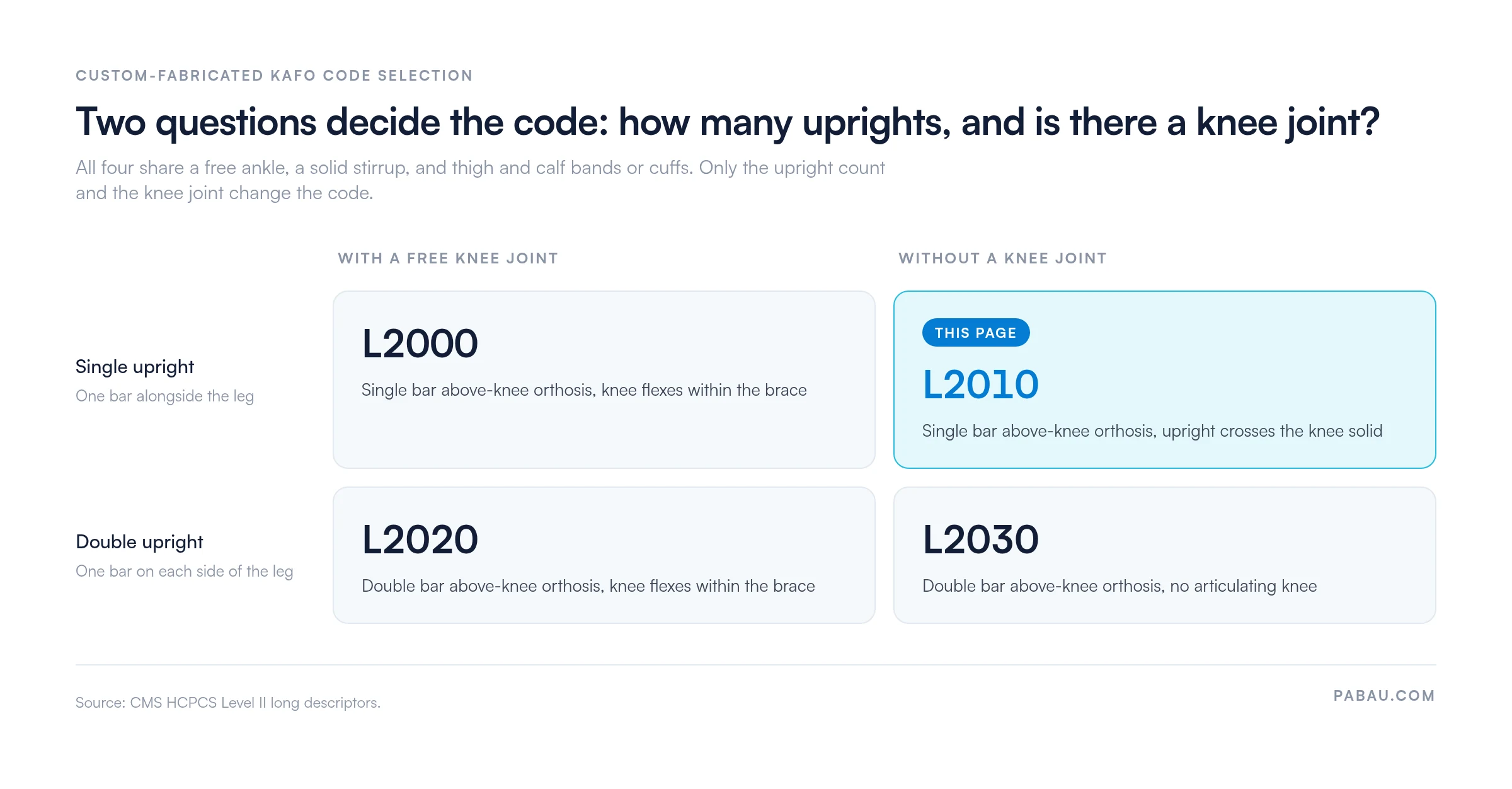
A second upright moves the claim to L2030, and an articulating knee joint moves it to L2000.
Medicare covers it under LCD L33686 for ambulatory patients who already qualify for an AFO and need extra knee stability.
Append the KX modifier only when the documentation on file already meets the LCD criteria, alongside an RT or LT laterality modifier.
Practice management software like Pabau tracks HCPCS L-codes, attaches the required documentation, and flags claims before they reach the payer.
The official CMS descriptor reads: knee-ankle-foot orthosis, single upright, free ankle, solid stirrup, thigh and calf bands/cuffs (single bar above-knee orthosis), without knee joint, custom-fabricated. The table below breaks the code down into the fields a biller needs at claim entry.
What “single upright” means: the upright is the metal bar running alongside the leg, from the thigh band down to the stirrup. L2010 has one such bar, which is why CMS calls it a single bar above-knee orthosis.
A device built with two bars, one on each side of the leg, is a double upright and bills as L2020 or L2030. Single and double refer to the number of uprights, not to layers of material or a method of fabrication.
Why “without knee joint” matters: L2010 has no articulating knee joint. The upright crosses the knee as a solid bar, so the knee does not flex within the brace.
That is the single feature separating L2010 from L2000, which carries the same single-upright build with a free knee joint. If the orthotist fitted an articulating knee joint, L2010 is the wrong code. Between them, those two questions sort the four custom-fabricated codes in this family.
HCPCS Level II is maintained by the Centers for Medicare and Medicaid Services (CMS). L2010 sits in the L2000 series, which covers lower-limb orthoses. Only enrolled DMEPOS suppliers may bill it to Medicare, so confirm your enrollment status with your Medicare Administrative Contractor (MAC) first.
L2010 is reimbursed under the Medicare DMEPOS fee schedule. Fee amounts change annually and vary by jurisdiction, so the table below covers the structure rather than dollar amounts. Verify current reimbursement in the CMS DMEPOS fee schedule files for your MAC and the applicable year.
Because L2010 is priced under the fee schedule rather than competitive bidding, the allowed amount is set nationally and adjusted by geographic locality. Some MACs also apply utilization guidelines that limit how often a replacement KAFO may be billed. Review your MAC’s local policy before you resubmit a replacement claim.
Verify the current-year DMEPOS fee schedule every January. CMS publishes the updated files before the effective date. Cross-check your billed amount against the fee schedule for your MAC’s jurisdiction before the first claim of the new year.
Coverage for L2010 runs through Local Coverage Determination L33686, which the four DME MACs administer. The LCD covers both ankle-foot orthoses (AFOs) and knee-ankle-foot orthoses. An L2010 claim has to clear three separate tests, in order.
Each test rules out a different reason for denial. Miss any one of them and the claim fails on medical necessity, even when the other two are documented.
L2010 is a custom-fabricated device, so the third test always applies. LCD L33686 accepts any one of five findings.
Three situations account for most medical-necessity denials on a KAFO claim.
Those summaries follow the DME MAC guidance on AFO and KAFO coverage. Read LCD L33686 and Policy Article A52457 in the Medicare Coverage Database for the full criteria and the diagnosis lists.
Every L2010 claim needs at least one ICD-10-CM diagnosis code from the LCD-related policy article’s code list. The code has to match the condition documented in the record. The table below lists the pairings that come up most often on KAFO claims.
Laterality matters. Where the diagnosis code offers left, right, or unspecified, pick the one that matches the limb being fitted. An unspecified code against a record naming the right or left limb is an inconsistency, and it invites a medical review request.
Our ICD-10-CM code index carries the full descriptors when you need to confirm one. Cross-reference your chosen code against the LCD list with the AAPC HCPCS code lookup before you submit.
LCD L33686 sets out what must sit in the medical record before the device is delivered. Missing or incomplete documentation is the leading reason KAFO claims fail a post-payment audit. Build these items into intake and delivery rather than assembling them after the claim goes out.
Keeping those records in the patient file, rather than in a shared drive, is what makes an Additional Documentation Request (ADR) survivable. Assembling five documents from four places rarely fits inside the response window.
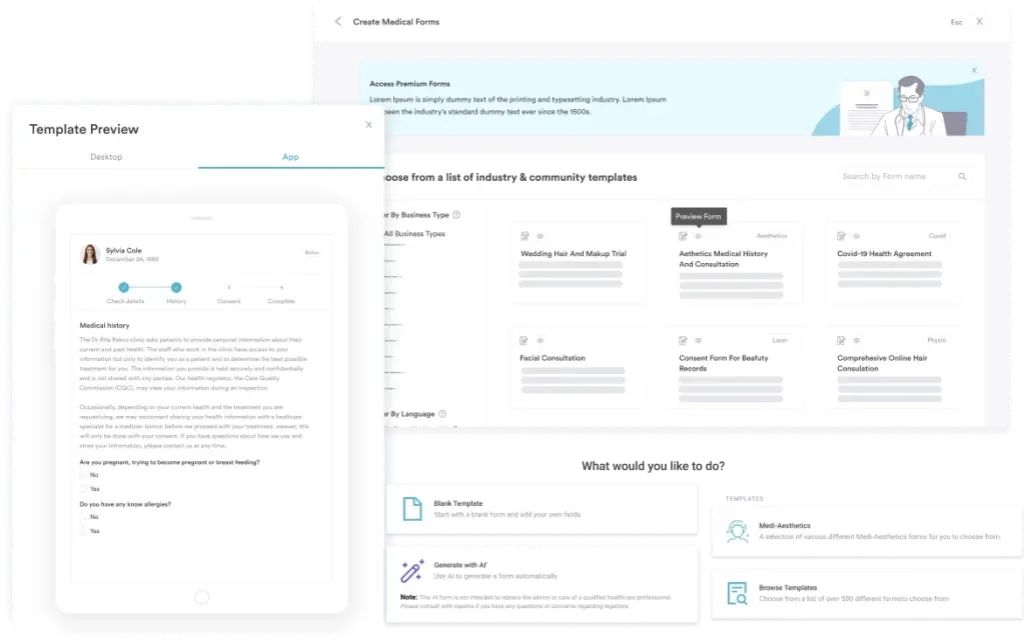
Attach the physician order and the clinical evaluation to the claim file at submission, not after. A MAC gives you 45 days to answer an ADR. Records already sitting on the claim turn that into a same-week reply.
Modifier errors are the second most common source of KAFO denials, after missing documentation. Medicare expects specific modifiers on every L2010 claim. They carry the device’s laterality and the supplier’s attestation about documentation.
KX modifier rule: append KX only when the documentation on file already satisfies the medical necessity criteria in LCD L33686. Appending it to an incomplete file is a false attestation. Modifier policy differs between jurisdictions, so confirm your MAC’s billing guidance before submission.
Bilateral billing: for bilateral KAFOs, bill two units on two line items, each with its own RT or LT modifier. Two units on one line without laterality modifiers is a routine rejection. A working denial management process catches that before the claim leaves the practice.
For device-specific coding questions, the Pricing, Data Analysis and Coding contractor (PDAC) verifies which L-code a product maps to. See the CGS Medicare coding verification guidance for how to request it.
L2010 is one of several KAFO codes running from L2000 to L2038. The L2040 to L2060 codes in the same range describe hip-knee-ankle-foot orthoses (HKAFOs), which add hip control and form a separate device class. Picking the wrong code from this group is a common billing error, because the descriptors read alike.
Fabrication method separates the group too. HCPCS code L2035 is the only prefabricated code between L2000 and L2038, and the only one with a size qualifier.
Two mistakes account for most L2000-series denials. The first is billing L2010 when the device has an articulating knee joint, which points to L2000. The second is billing a single-upright code for a device carrying two uprights, which points to L2020 or L2030.
Both are caught by the same habit. Read the orthotist’s fabrication notes against the descriptor before the claim is coded, not after the remittance advice arrives.
DMEPOS billing carries a heavier documentation trail than most outpatient claim types. The physician order, the clinical evaluation, proof of delivery, fitting notes, and the modifier attestation all have to be reachable the moment a payer asks.
Split those across paper files, a shared drive, and a separate billing system, and an ADR turns into a scramble. Practice management software like Pabau keeps the L-code, the documentation, and the claim status on the same patient record.
Our claims software for orthotists lets staff attach the order and the evaluation straight to that record. From there the claim moves through pending, submitted, processing, and paid in one view. Claims missing a required document get flagged before submission, so the shortfall surfaces in your queue rather than in an audit letter.
For a practice fitting orthoses alongside other services, one record structure covers both. The same patient file holds the treatment note, the L-code, and the claim, so nobody rekeys a diagnosis into a second system.
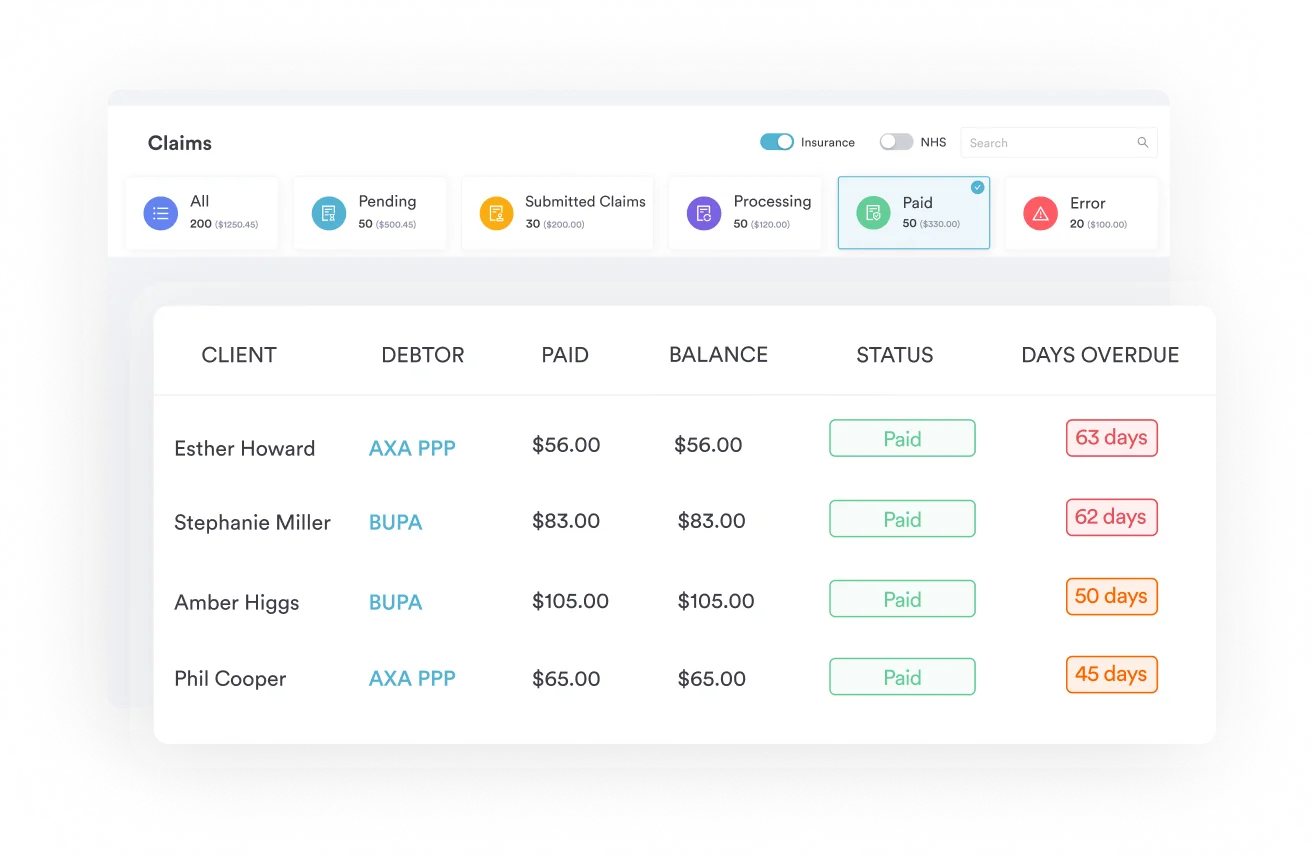

Pabau’s claims management tools help orthotic practices and DMEPOS suppliers track HCPCS L-codes, attach required documentation, and submit cleaner claims. See how Pabau supports your billing team.

Three checks decide an L2010 claim. Does the device match the descriptor, does the diagnosis sit on the LCD’s code list, and does the record hold what the modifiers attest to? Any one of them missing turns a clean claim into a denial and an appeal.
The trade-off worth remembering is where the work sits. Front-loading the descriptor check and the documentation costs a few minutes per fitting. Recovering a denied claim costs an appeal, an ADR response, and a redetermination the MAC has 60 days to decide.
Those checks belong in the billing workflow, not in one person’s head. Book a demo and we will walk an L-code claim through Pabau end to end.

Need a clear framework for managing medical billing compliance? Medical billing compliance guide covers the documentation and regulatory requirements that apply across DMEPOS and outpatient billing.
Want to understand how clean claims reduce denials? What makes a clean claim explains the elements payers check before processing payment, relevant to L2010 and all HCPCS submissions.
Looking for denial code references for DMEPOS claims? Denial codes in medical billing lists the most common remittance advice denial codes and how to respond to each one.
HCPCS Code L2010 describes a custom-fabricated knee-ankle-foot orthosis (KAFO) with a single upright, free ankle, and solid stirrup. It has thigh and calf bands or cuffs and is supplied without a knee joint. CMS lists it as a single bar above-knee orthosis, billed per orthosis under HCPCS Level II L-codes for DMEPOS claims.
The knee joint is the only difference. L2000 covers a single-upright KAFO with a free knee joint, while L2010 covers the same build supplied without one. Both are custom-fabricated single bar above-knee orthoses with a free ankle, solid stirrup, and thigh and calf bands. Bill L2010 only when the device has no articulating knee.
At minimum, a laterality modifier (RT for right, LT for left) is required to identify which extremity was fitted. The KX modifier must also be appended when the supplier has documentation on file confirming the claim meets LCD L33686 medical necessity criteria. If an Advance Beneficiary Notice (ABN) has been issued, append GA instead of KX.
The Medicare fee schedule amount for L2010 changes annually and varies by MAC jurisdiction. CMS publishes updated DMEPOS fee schedules each January on cms.gov. Look up the current-year fee using the CMS DMEPOS fee schedule files and select your geographic locality. Never rely on prior-year amounts for current claims.
Yes. LCD L33686 governs coverage for L2010, and a claim has to clear three tests. The device must qualify as a brace under the Medicare braces benefit. The patient must be ambulatory and need knee stability beyond what an AFO gives, and the record must support custom fabrication.
Required documentation includes a detailed written physician order signed before device delivery, plus clinical evaluation notes covering the diagnosis and functional limitation. You also need a signed proof-of-delivery record, orthotist fitting notes, and a Certificate of Medical Necessity where the MAC requires one. All records must be retained and available for audit or ADR response.