CCSD code H4430: Examination of rectum under anaesthetic
CCSD code H4430 pays for the examination alone CCSD code H4430 is the UK private...

Last Updated: Oct 20, 2026
L1940 is the HCPCS Level II code for ankle foot orthosis, plastic or other material, custom fabricated.
One distinction decides the code: custom fabricated versus custom fitted. It also covers fee schedule guidance, the modifiers Medicare expects, supporting ICD-10 codes, and the denial patterns that show up most often.
Let Pabau's smart automation suggest the right codes, reduce claim denials, and keep your practice compliant—effortlessly.
Automate repetitive tasks and focus on what matters most—your patients.
Reduce coding errors and ensure compliance with the latest regulations.
Clean claims, fewer denials, and faster reimbursements.
Powerful insights and reporting to help your practice thrive.
HIPAA compliant SOC 2 certified GDPR-compliant Trusted by 4,000+ clinics worldwide

HCPCS Code L1940 covers an ankle foot orthosis (AFO) of plastic or other material, custom fabricated from a model of the patient’s limb.
Custom fabrication is the qualifier that decides the code. The device must be built from an individualized cast or scan, with records proving it.
L1940 is most often miscoded as L1960, the posterior solid AFO. Design and fabrication method together decide which code is correct.
Medicare now uses one Standard Written Order. The completed order has to be in hand before the device is delivered to the patient.
Practice management software like Pabau helps DMEPOS suppliers attach supporting records, apply modifiers, and submit cleaner L1940 claims.
HCPCS Code L1940 is a Level II HCPCS code maintained by the Centers for Medicare and Medicaid Services (CMS). The official descriptor is: Ankle foot orthosis (AFO), plastic or other material, custom fabricated.
It sits within the HCPCS L-code series, which covers orthotic devices. Those devices are billed to Medicare Part B and Medicaid as DMEPOS, short for Durable Medical Equipment, Prosthetics, Orthotics, and Supplies.
The code applies to any rigid or semi-rigid brace that encompasses the ankle and foot, fabricated from a direct model of the patient’s limb. “Plastic or other material” is deliberately broad.
It covers thermoplastics, carbon fiber composites, and similar materials, as long as the custom fabrication requirement is met. What counts as custom fabrication is the part that decides whether the claim is payable.
CMS defines custom fabrication precisely, and meeting that definition is not optional for L1940 reimbursement. A custom fabricated device must be constructed from an individualized model of the patient’s residual limb or body part.
The model is taken by casting, scanning, or another accepted method. The finished orthosis reflects the patient’s specific anatomy and cannot be adjusted or applied directly from stock.
Two adjacent categories sit next to custom fabrication, and mixing them up is the most common source of L1940 denials.
Billing L1940 for a prefabricated or custom-fitted device is a false claim risk. PDAC, the DMEPOS Pricing, Data Analysis and Coding contractor, issues coding verification for orthotic products. Confirm a device’s correct code through PDAC verification before you bill it. Record the fabrication method at the point of service rather than reconstructing it later.
The Arizona AFO is the device most often associated with L1940 billing, and the most often miscoded. Noridian Healthcare Solutions, the DME MAC for Jurisdictions A and D, issued correct-coding guidance for Arizona-type AFOs because miscoding was so common.
An Arizona-type AFO is a lace-up brace that encompasses the ankle and foot, typically made from leather and metal or thermoplastic components. Whether it qualifies for L1940 depends entirely on how it was made, not on its name.
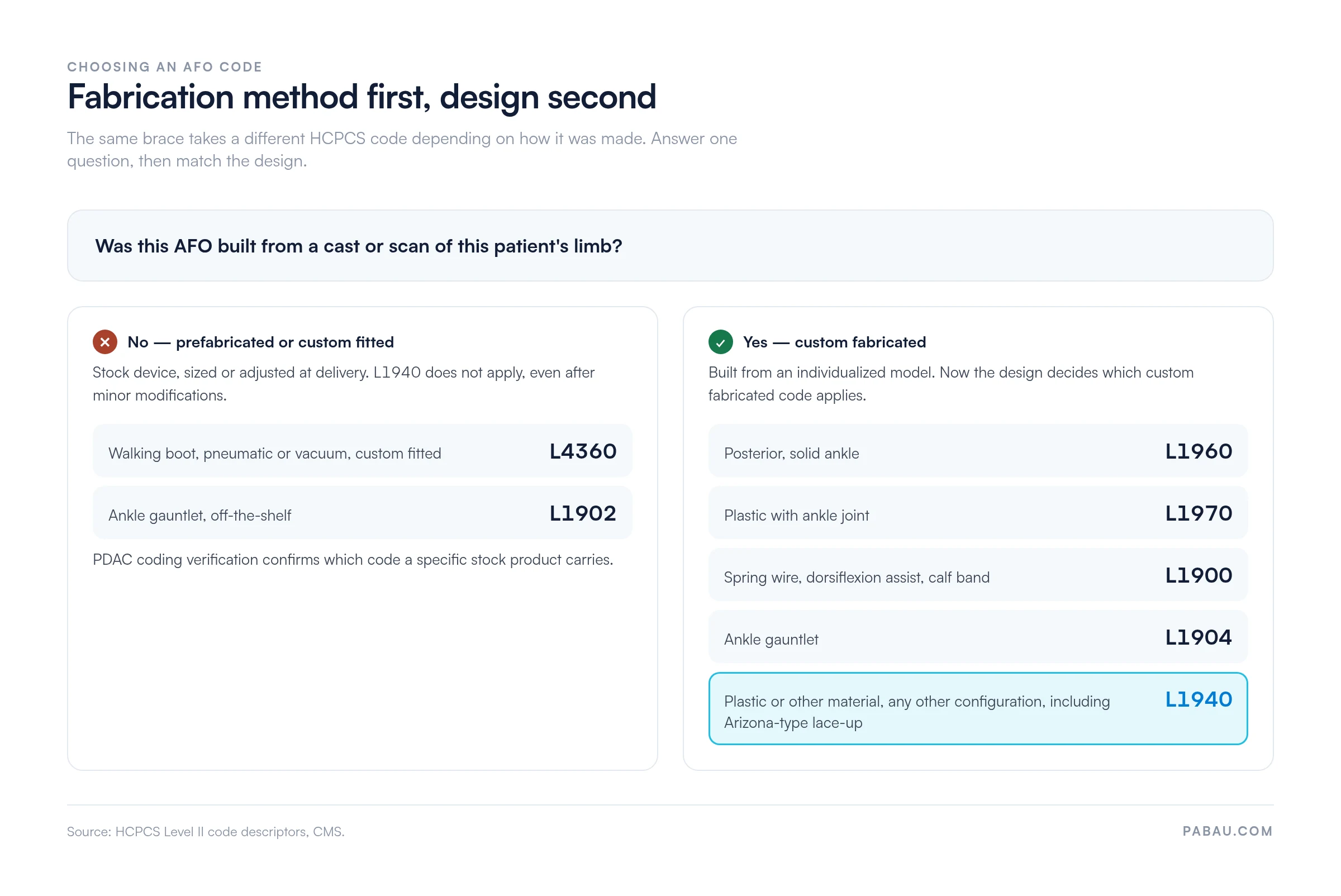
The most common coding error with L1940 is upcoding to it when L1960 or a prefab code applies. The second most common is undercoding a genuinely custom fabricated device. A prefabricated spiral AFO trimmed or molded to fit one patient belongs under HCPCS code L1951 instead. A comparison of the adjacent codes resolves most ambiguity.
The L1940 versus L1960 choice is the consequential one. Both describe custom fabricated AFOs. L1960 specifies a posterior solid design, while L1940 is the broader code for AFOs that do not match a more specific descriptor. If the device is posterior and solid, L1960 fits better. If the custom fabricated device ends just above the malleoli, HCPCS code L1907 applies.
If it has any other configuration, including the Arizona-type lace-up, L1940 is usually correct, provided custom fabrication is documented. The spiral, IRM-type plastic design is one exception, and a custom fabricated version of it bills under HCPCS code L1950. The diagram below runs the two questions in the order that decides the code.
Undercoding costs the supplier just as much as upcoding costs Medicare. A genuinely custom fabricated device billed as prefabricated is paid at the lower rate and rarely gets corrected.
Medicare reimbursement rates for L1940 vary by MAC jurisdiction and whether the claim falls within a DMEPOS competitive bidding area (CBA). CMS updates the DMEPOS fee schedule annually, so check current allowed amounts against the CMS DMEPOS fee schedule rather than relying on prior-year figures.
Several important reimbursement rules apply to L1940 specifically.
State Medicaid programs set their own fee schedules independently of Medicare, and commercial payers vary again. Verify the rate with each payer before you bill. Checking it at intake, before fabrication starts, tells the supplier what the device will return while the order can still be discussed.
Documentation failures are the leading cause of L1940 denials. CMS and Noridian both specify what must be on file before a claim goes out. A missing element creates audit exposure, so most suppliers run a DMEPOS intake checklist against every order.
Medicare covers L1940 when the patient has weakness, deformity, or instability of the foot and ankle. A custom fabricated AFO also has to be the appropriate clinical response. CMS policy guidance points to four groups of covered indications.
The records that carry this evidence hold protected health information, so store them under the same safeguards as the rest of the patient chart.
Medicare does not cover L1940 simply because a physician prescribes it. The clinical record must independently support that the condition meets the LCD-specified criteria. It must also show that a custom fabricated device is necessary rather than a less intensive alternative.
Audit your L1940 documentation before submission. Check that the SWO arrived before delivery and that the face-to-face evaluation notes are in the file. Check that the ICD-10 code matches the documented diagnosis and that the fabrication evidence has been retained. Append KX only where the file is complete. One missing element is enough for a full claim denial.
Correct modifier usage is not optional for L1940 claims billed to Medicare. Appending the wrong modifier, or omitting a required one, results in denial or payment suspension. The AAPC HCPCS code lookup provides additional modifier reference for HCPCS L-codes.
The KX modifier carries the most compliance risk. Appending KX certifies to Medicare that all required documentation is on file at the time of billing.
If a post-payment audit reveals missing records after a KX-modified claim was paid, the supplier faces potential overpayment recoupment and fraud referral. Append KX only when the full set is in the file: the SWO, the face-to-face notes, the medical necessity records, and the custom fabrication evidence.
ICD-10 diagnosis codes must reflect the patient’s documented clinical condition. The codes below are commonly associated with L1940 billing based on clinical coding practice and crosswalk references. Code selection must always match the treating physician’s documented diagnosis. Treat this table as a reference rather than a coding instruction.
Always select the most specific lateralized ICD-10 code available. Reach for an unspecified or bilateral code only when the clinical record genuinely lacks laterality.
Our ICD-10-CM code list covers the diagnosis codes that support medical necessity across orthotic and DMEPOS claims. Check status and specificity against the official ICD-10-CM files before you finalize the claim.
L1940 claims attract above-average scrutiny from Medicare contractors. Most denials trace back to a handful of root causes, each with a specific prevention step. Working through denial management strategies before submission costs far less than appealing afterward.
When a denial does arrive, read the reason code on the remittance advice before you rework anything. It tells you which of the categories above you are in, and a coding denial and a documentation denial need different corrections.
Suppliers who handle L1940 volume hit the same assembly problem before every submission. The signed order arrives separately from the face-to-face notes. Custom fabrication records live in a fabrication log. ICD-10 codes come from the referring physician’s system.
Pulling those four sources together by hand slows the claim down and leaves room for a missing modifier or a missing document. It also means the person submitting is rarely the person who fabricated the device.
Practice management software like Pabau keeps those records on the patient record instead of across four systems. Our claims management software lets you attach the order, the face-to-face notes, and the fabrication evidence to the patient record as they arrive. It prompts for modifier selection inside the claim workflow and routes the claim through a clearinghouse with HCPCS and CPT code catalogs built in.
So the person signing off the fabrication and the person submitting the claim are looking at the same file. Preparation gets shorter, and the omissions that trigger L1940 denials have fewer places to hide.
Capturing the L1940 code, the modifiers, and the supporting ICD-10 codes on the superbill at fabrication sign-off removes the reconstruction step entirely. The billing team inherits a complete claim instead of rebuilding one from separate records. A claim that goes out complete the first time costs less than the same claim recovered through an appeal.
Build a pre-submission checklist into your L1940 workflow. Confirm the SWO was received and dated before delivery. Confirm the face-to-face notes came from the treating physician. Confirm the fabrication evidence sits in the file. Confirm the ICD-10 code matches the documented diagnosis. Add KX only when every document is on file, and add a laterality modifier when the devices are bilateral. Run this as a billing gate and most L1940 denials never reach the payer.

Pabau holds the written order, the fabrication evidence, and the modifiers for an L1940 claim on the patient record. Your team submits through an integrated clearinghouse instead of rebuilding the paperwork.

L1940 rewards suppliers who settle the code before the device is made, not after it ships. If the cast or the scan is documented at the point of service, the rest of the claim follows from that record. If it is not, no modifier and no appeal will recover the claim later.
The trade-off worth remembering is speed against defensibility. Appending KX to move a claim along only helps if the file behind it would survive a post-payment review two years later.
If your team is rebuilding L1940 paperwork by hand before every submission, that is the part worth fixing first. Book a demo to see how Pabau keeps orthotic claim records and modifiers together on the patient file.

Want to see how clearinghouse submission works end to end? How Claim.MD works as a medical clearinghouse explains EDI claim routing, eligibility checks, and ERA processing.
Looking to tighten your revenue cycle? Revenue cycle management explained walks through the billing lifecycle from patient intake to payment posting.
Not sure what belongs on the superbill? What a superbill is and what it must contain breaks down the fields payers expect on every line.
Chasing a higher first-pass rate? What makes a claim a clean claim sets out the checks that keep a submission from bouncing back.
HCPCS Code L1940 is used to bill for a custom fabricated ankle foot orthosis (AFO) of plastic or other material. It applies when the device is constructed from an individualized model of the patient’s limb. It is billed primarily to Medicare Part B and Medicaid as a DMEPOS item by accredited orthotics suppliers.
Both L1940 and L1960 describe custom fabricated AFOs, but L1960 specifically describes a posterior solid ankle foot orthosis. L1940 is the broader code. It covers a custom fabricated AFO that does not fit the more specific posterior solid descriptor, including Arizona-type lace-up configurations. Use L1960 when the device is definitively posterior and solid in construction.
Billing L1940 to Medicare requires a completed Standard Written Order (SWO) signed by the treating physician before the device is dispensed. You also need documentation of a face-to-face evaluation and clinical notes supporting medical necessity. The file must show that the device was custom fabricated from a cast or scan of the patient’s limb. Since January 1, 2020 the SWO has replaced the separate detailed written order, so there is no second order document to collect before billing.
The KX modifier is appended when all documentation supporting medical necessity is on file and the claim meets LCD criteria. The GA modifier is used when an Advance Beneficiary Notice has been signed. GY applies when the item is not a covered Medicare benefit. GZ is used when denial is expected but no ABN was obtained. RT and LT modifiers specify laterality and are required for bilateral devices billed on the same date.
No. An Arizona-type AFO qualifies for L1940 only when it was custom fabricated from a cast or three-dimensional scan of the patient’s foot and ankle. If the Arizona AFO was ordered in a standard size and fitted to the patient at delivery, it is custom fitted or prefabricated. That device is billed under a different code, such as L4360. Documentation of the fabrication method is the determining factor.
Common ICD-10-CM codes paired with L1940 include M62.81 (muscle weakness), G35 (multiple sclerosis), and G82.20 (paraplegia). Others include M21.07x (valgus deformity of the ankle), G57.00 (sciatic nerve lesion causing foot drop), and G81.90 (hemiplegia). Always select the code that matches the patient’s documented diagnosis rather than using this list as a prescriptive guide.
Medicare reimbursement for L1940 varies by MAC jurisdiction and competitive bidding area. CMS updates the DMEPOS fee schedule annually, so check current allowed amounts against the CMS DMEPOS fee schedule rather than relying on prior-year data. Rates in competitive bidding areas may differ from national fee schedule amounts.