CPT Code 62284: Injection procedure for myelography
CPT Code 62284: official descriptor and procedure overview The American Medical ...

Last Updated: Oct 19, 2026
HCPCS Code L1500 was the HCPCS Level II code for a thoracic-hip-knee-ankle orthosis (THKAO) mobility frame of the Newington and parapodium types. CMS deleted it effective January 1, 2012, so it is not valid on any current claim.
L1500 is often mistaken for an ankle foot orthosis (AFO) code, but it never described an AFO. It covered a full-body standing and mobility frame, usually fitted to children. If you are billing a dorsiflexion-assist AFO, the code you need is in the L1900 range, most often L1971.

HCPCS Code L1500 described a THKAO mobility frame of the Newington and parapodium types. CMS deleted it effective January 1, 2012.
L1500 was never an ankle foot orthosis code. A prefabricated AFO with an ankle joint and dorsiflexion assist bills under L1971.
The whole THKAO group went at once. L1500, L1510, and L1520 were all deleted on the same date.
The code stayed valid only for dates of service through December 31, 2011, with no grace period.
No published crosswalk names one replacement, so the code you bill today depends on the device and on PDAC guidance.
L1500 sat in the L-series of HCPCS Level II codes, the range that covers orthotic and prosthetic devices. The Centers for Medicare and Medicaid Services (CMS) maintains that code set and updates it every year.
The descriptor names a device family by design type. Newington and parapodium frames were the reference designs, so any THKAO mobility frame built on that pattern fell under L1500.
HCPCS Code L1500 is deleted. It left the HCPCS Level II code set on January 1, 2012. It cannot be billed for any date of service after December 31, 2011.
CMS gave no grace period for the codes it discontinued in the 2012 update. Claims for dates of service on or before December 31, 2011 could still carry L1500, whatever the submission date.
In practice, L1500 now turns up only in inherited charge masters, old fee schedules, and legacy order templates. Each of those is worth cleaning out before it reaches a claim.
A thoracic-hip-knee-ankle orthosis supports the body from the trunk down through the hips, knees, and ankles. The mobility frame version pairs that support with a rigid base, so the patient can stand upright without holding on.
The Newington frame and the parapodium are the two designs the descriptor names. A parapodium has hip and knee joints that unlock, so a child can move between sitting and standing in the same device. Some designs also let the user shuffle or pivot short distances.
These patients still use standing and mobility frames today. The 2012 update retired their codes, so the same devices now bill under other code families.
L1500 sits a few hundred numbers below the AFO codes, which is why it gets confused with them. Billing an AFO under L1500 fails on two counts. The code is deleted, and it never covered an ankle device.
If the device in front of you is an AFO, match it to the current L1900-range code whose descriptor fits its construction. These are the codes most often confused with L1500.
L1971 is the closest match for a prefabricated AFO with an ankle joint and a dorsiflexion assist. A jointless plastic AFO, such as a posterior leaf spring design, points to L1930 instead. Always confirm the final choice against the current PDAC coding guidance.
The THKAO group held three codes, and CMS deleted all three on January 1, 2012. None of them survives as an active code, so none can serve as a replacement for the others.
The three codes split the group by what the frame let the patient do. L1500 covered frames built for supported mobility, L1510 covered static standing frames, and L1520 covered swivel walkers. You can confirm each status in the AAPC HCPCS code lookup.
No published crosswalk maps L1500 to a single current code. The right code depends on the device you furnish and on how PDAC classifies it.
Two current code families are the usual starting points. Check each against the device’s construction before it goes on a claim.
A frame billed as a stander falls under the durable medical equipment rules rather than the orthotics rules. Coverage for standers also varies widely by payer, so confirm it before you dispense. The diagram below sets both families beside the AFO codes covered earlier.
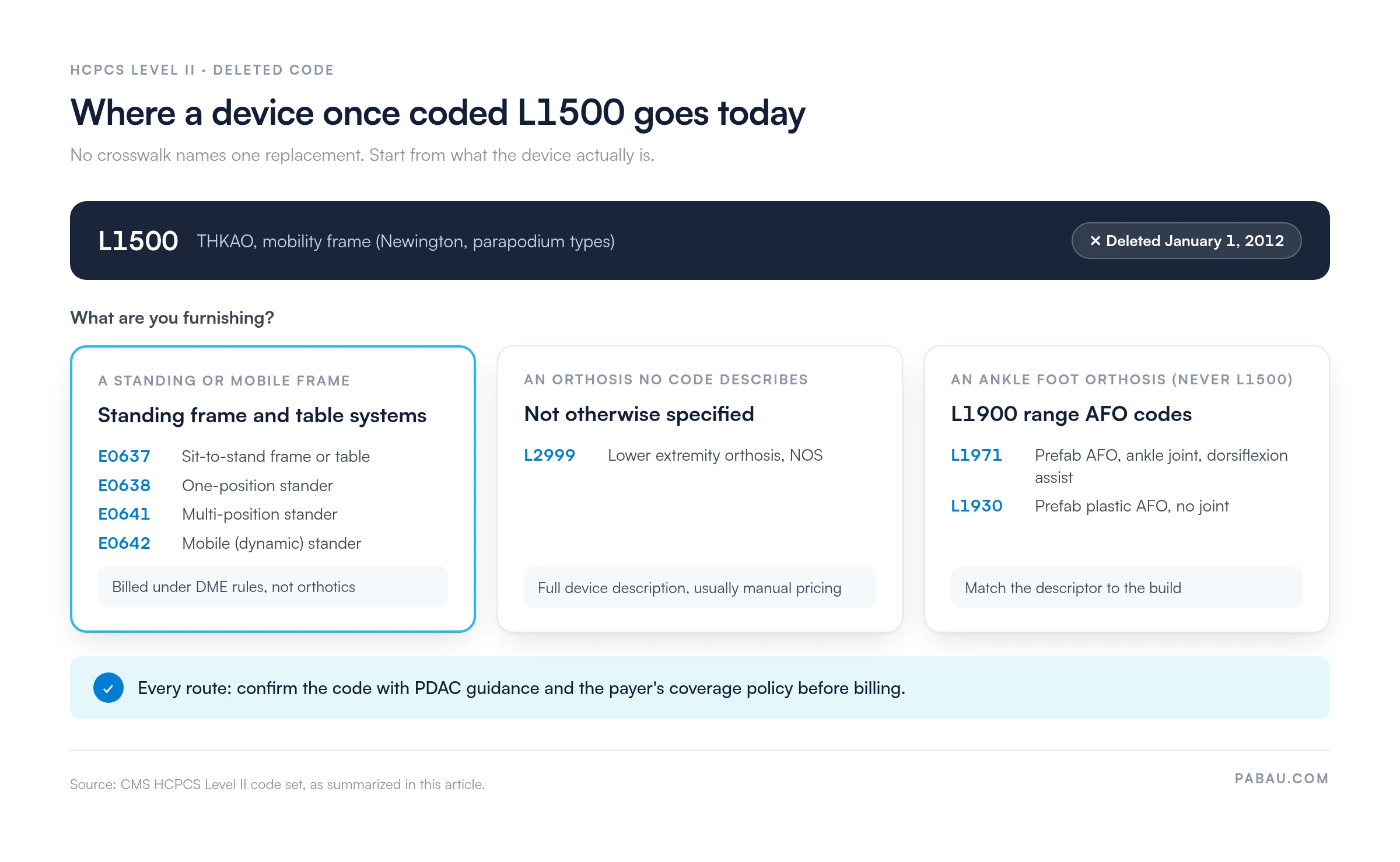
The check runs in a fixed order, and each step answers one question. Record the outcome so the next person who furnishes the same device can reuse it.
Once you have a current code, the claim needs the same records as any other DMEPOS item billed to Medicare. Most denials on these devices trace back to a missing order or thin medical record.
You will not need a certificate of medical necessity (CMN) or a DME information form (DIF). CMS stopped requiring both for all DMEPOS claims, for dates of service from January 1, 2023.
A deleted code survives longest where someone types it by hand. It sits in an old price list or order template and gets copied onto claims years after CMS retired it.
Practice management software like Pabau keeps the insurer, the policy, and the invoice on the patient record. Claims are pre-filled from the data already on that record, and medical claims management tracks each one after it goes out.
In the US, Pabau connects to Claim.MD, which submits claims electronically and posts remittances back to the matching invoice. A rejected orthotic or durable medical equipment claim surfaces within days, while the order is still fresh. Choosing the current code stays with your team.

Pabau keeps the insurer, the invoice, and the claim on one patient record and posts remittances back automatically. Your billing team sees a rejected DMEPOS claim within days and fixes it at the source.

If L1500 appears on a claim, a template, or a price list, remove it. The code has been dead since January 2012, and so have its two siblings, L1510 and L1520.
The fix depends on what you are billing. For a standing or mobility frame, find the current code through PDAC and the payer’s policy. For an ankle foot orthosis, move to the L1900 range, where L1971 covers the prefabricated jointed AFO with dorsiflexion assist.
Either way, fix the source before the claim leaves. A corrected template costs minutes, while a denied DMEPOS claim costs a resubmission and weeks of waiting. Book a demo to see how Pabau keeps DMEPOS claim data in one record from invoice to remittance.

Looking at a sibling THKAO code? HCPCS Code L1520 covers the deleted THKAO swivel walker and how to handle it on a claim.
Billing a prefabricated AFO with dorsiflexion assist? HCPCS code L1971 is the current code for that device and explains its documentation.
Want to know what a clean claim needs? What is a clean claim in medical billing walks through the elements a DMEPOS claim needs to clear adjudication.
Building a code-status check into your process? Medical billing compliance sets out the controls that keep retired codes out of submissions.
HCPCS Code L1500 is a deleted HCPCS Level II code for a thoracic-hip-knee-ankle orthosis (THKAO) mobility frame of the Newington and parapodium types. CMS deleted it effective January 1, 2012, so it cannot appear on a current claim.
No. L1500 was deleted on January 1, 2012 and was valid only for dates of service through December 31, 2011. With Medicare’s 12-month filing limit, no claim can carry it today.
No. L1500 described a full-body THKAO standing and mobility frame, not an AFO. A prefabricated AFO with an ankle joint and dorsiflexion assist bills under L1971, and other AFO designs fall elsewhere in the L1900 range.
No published crosswalk names a single replacement. Depending on the device, the current standing frame codes (E0637, E0638, E0641, and E0642) or L2999 may apply. Confirm the code through PDAC guidance and the payer’s policy before billing.
Yes. CMS deleted the whole THKAO group on January 1, 2012. L1510 covered a THKAO standing frame, with or without tray and accessories, and L1520 covered a THKAO swivel walker.
Medicare pays an enrolled, accredited DMEPOS supplier. That supplier can be a physician practice that has enrolled as one, so the prescribing practice does not have to refer out. The claim also needs a standard written order and supporting medical records.