CCSD code H4430: Examination of rectum under anaesthetic
CCSD code H4430 pays for the examination alone CCSD code H4430 is the UK private...

Last Updated: Oct 20, 2026

HCPCS Code L1520 described a thoracic-hip-knee-ankle orthosis (THKAO) swivel walker, and CMS deleted it effective January 1, 2012.
L1520 must not appear on a Medicare or Medicaid claim. Any claim carrying it is returned or denied at adjudication.
The THKAO group holds three codes, not four: L1500, L1510, and L1520. L1540 is not a valid HCPCS code.
No published crosswalk names one replacement for L1520, so the code you bill depends on the device you furnished.
Verify the replacement through the CMS annual HCPCS file, PDAC coding articles, and your DME MAC’s local coverage determination.
HCPCS Code L1520 was the HCPCS Level II code for a thoracic-hip-knee-ankle orthosis (THKAO) with a swivel walker mechanism. CMS deleted it effective January 1, 2012. It is not valid for claim submission, and it carries no current fee schedule amount.
The code still surfaces in older charts, inherited billing templates, and pre-authorization paperwork. This reference covers the device L1520 described and why the code was retired. It then walks through the current L1500-L1520 range and the Medicare rules that still govern THKAO orthoses.
L1520 sat in the L-series of HCPCS Level II, which covers orthotic and prosthetic procedures and devices. The Centers for Medicare and Medicaid Services (CMS) maintains HCPCS Level II and updates it annually. Within that set, L1520 belonged to the L1500-L1520 group describing THKAO devices.
Each code in the THKAO group describes a distinct device design rather than a distinct body part. L1520 covered the swivel walker variant, a frame that produces forward movement through trunk rotation instead of stepping. That mechanical detail is what decides which code applies to a given orthosis.
HCPCS Code L1520 is deleted. It left the HCPCS Level II code set on January 1, 2012 and cannot be submitted on Medicare or Medicaid claims.
Under CMS’s HCPCS program, deleted codes drop out of the annual update files and must not appear on claims dated after the deletion date. A claim carrying one is returned or denied at adjudication. The same rule applies to Medicare, Medicaid, and commercial payers that follow Medicare fee schedules.
For an orthotics supplier, the practical consequence is a rework cycle. The claim goes out, comes back denied, and someone researches the correct code weeks after the device was dispensed.
A thoracic-hip-knee-ankle orthosis is a full-body brace running from the thoracic spine through the hips, knees, and ankles. It is one of the most extensive orthoses prescribed in rehabilitation. Candidates are usually patients with spinal cord injury, spina bifida, or severe neuromuscular conditions affecting gait.
The swivel walker variant moves the patient forward through trunk rotation rather than reciprocal stepping. The patient shifts weight from side to side, and the footplates rotate forward in alternating sequence. That makes walking possible for someone who cannot lift a foot or flex a hip independently.
The swivel walker is a legacy design. Parapodiums and reciprocating gait orthoses (RGOs) took over most of its clinical role, which is a large part of why the code was retired.
No published crosswalk names a single replacement for L1520. The code you bill depends on the device you furnished and on current PDAC guidance, not on a one-to-one substitution.
The two surviving codes in the group are the place to start, and one of them is more than a numeric neighbor. L1500 covers mobility frames of the Newington and parapodium types. Those are the devices that displaced the swivel walker in clinical practice.
That makes L1500 the first candidate to test against PDAC guidance, not an automatic substitute. The device has to match the code’s published description before the code goes on a claim.
Getting this wrong costs staff time rather than dollars. A denied orthotic claim enters the same denial management queue as any other rejection. Reworking it costs more than checking the code before submission.
Submit a coding verification request to PDAC before you assign a replacement code for a retired THKAO device. PDAC coding opinions are the official guidance source for DMEPOS orthotic billing under Medicare.
The THKAO group holds three codes, not four. Each one describes a different device design, and the differences are mechanical rather than anatomical.
L1540 is not a valid HCPCS code. It never described a THKAO device, so any reference that lists it inside this range is wrong.
Verify the status of both surviving codes before you submit. The AAPC HCPCS code lookup and the CMS annual HCPCS update files show which codes in this range remain active. Statuses change with each annual update cycle.
Accurate selection inside the group matters because each code carries its own DMEPOS fee schedule amount. Billing a code that does not match the device creates a payment problem now and an audit exposure later.
Coders working a batch of orthotic claims rarely need only one L-code. Our HCPCS code guides cover the neighboring families and the documentation each one expects.
The replacement process runs in a fixed order, and each step settles one question. Skipping the PDAC step is a common source of a second denial on the same device.
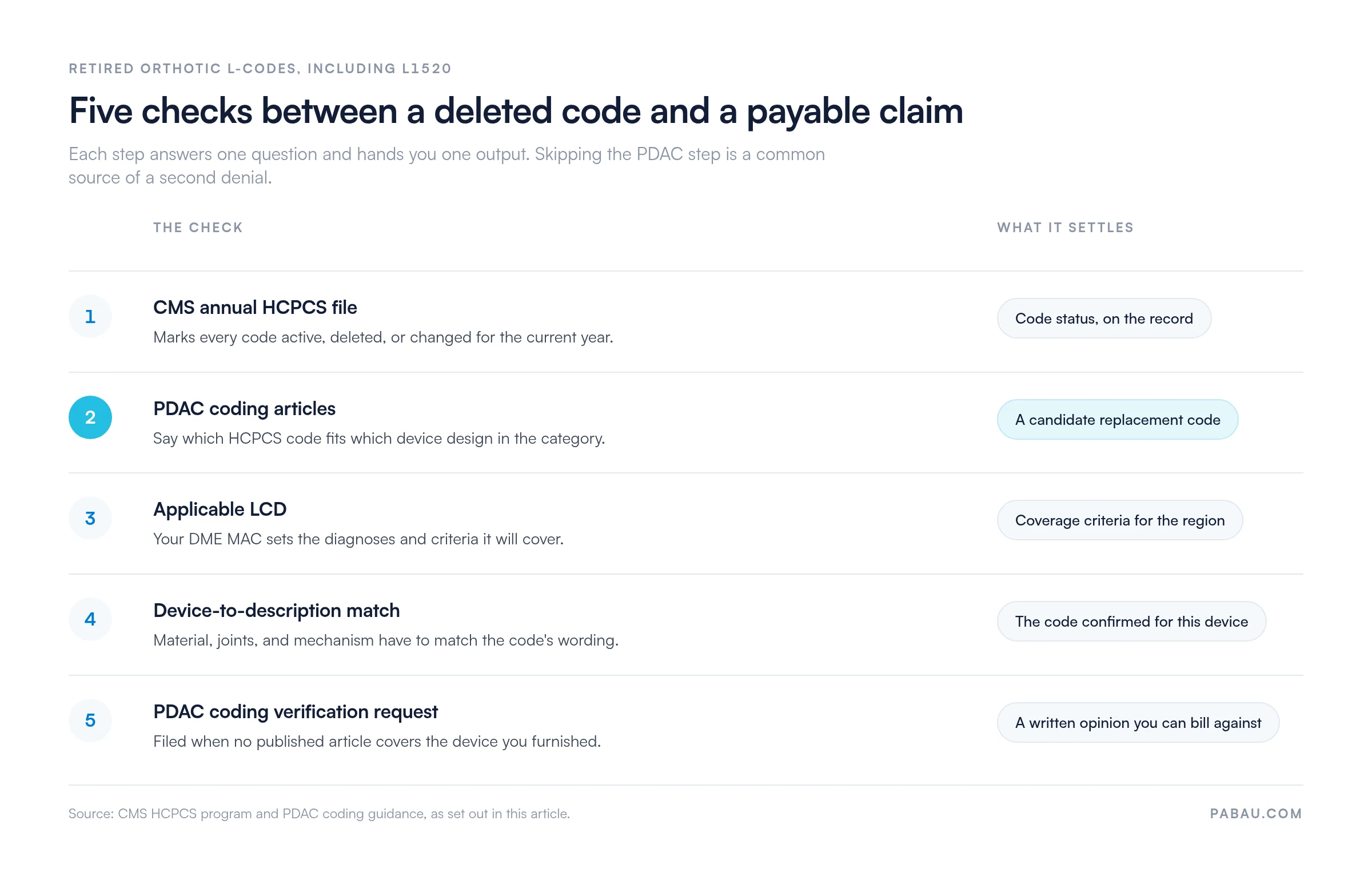
Run this sequence once per retired code and record the outcome where the billing team can find it. The next person who furnishes the same device should not repeat the research.
PDAC is the CMS-designated contractor that issues coding guidance for DMEPOS items, orthotic L-codes included. Its coding articles state which HCPCS code applies to which device, based on construction and function.
That guidance is not optional for Medicare billing. A supplier who bills a THKAO orthosis under a code the applicable PDAC article does not support risks denial and recoupment.
Coverage criteria for THKAO devices vary between those two jurisdictions, so confirm which one applies before you rely on a coverage policy.
Where those checks live matters as much as who runs them. Connecting orthotic coding to medical claims management software keeps the insurer, the invoice, and the code in one record. That removes the re-keying step where a retired code usually survives.
Re-check HCPCS code status in your billing system every January, when CMS releases the annual updates. A retired code that clears internal review in the spring will still fail a MAC audit in the fall.
L1520 is gone, but the Medicare framework for THKAO devices as a category still stands. Selecting a current code is only half the work. The claim also has to carry the documentation the DMEPOS benefit requires.
THKAO orthoses billed to Medicare fall under the DMEPOS benefit, which covers durable medical equipment, prosthetics, orthotics, and supplies. Five requirements decide whether the claim survives.
Medicaid coverage for THKAO devices varies widely by state. A code that Medicare pays is not automatically covered, or paid at the same rate, under a state Medicaid program. Confirm with the state agency before billing.
High-volume DMEPOS billers get more from a pre-submission checkpoint than from a stronger appeals process. The code, the order, and the LCD criteria all get checked once, before the claim leaves.
In most orthotics practices the code lives in more than one place. Someone types it on the invoice, someone copies it into the claim form, and the rest is institutional memory. When CMS retires a code, the memory is what fails first.
Practice management software like Pabau keeps the insurer, the policy, and the invoice on the patient record. A claim is then built from one source instead of re-keyed at submission. Validation checks run before it can be sent, and the Send button stays disabled while a required detail is missing.
In the US, Pabau connects to Claim.MD, so claims go out electronically and remittances post back against the right invoice. That turns a denied orthotic claim into something your team sees this week rather than next quarter. Which code to bill is still a human judgment, but the workflow around it stops repeating the same mistake.

Pabau keeps the insurer, the invoice, and the code on one patient record, runs validation checks before submission, and posts remittances back automatically. Orthotics teams see a denial the week it happens instead of at the next reconciliation.

If L1520 is on a claim you are about to send, take it off. The device it described is still prescribed, but the code has been dead since January 2012, and no crosswalk will rescue it.
The work that replaces it is short. Pull the current CMS HCPCS file, read the PDAC article for the device category, and check the LCD for your jurisdiction. Where the published guidance runs out, file a verification request and bill against the written answer.
The trade-off worth remembering is timing. Ten minutes of verification before dispensing is cheaper than an appeal three months later. It is also the only version of this job you get to do once. Book a demo to see how Pabau keeps orthotic claim data in one record from invoice to remittance.

Wondering how superbills support DMEPOS documentation? How superbills work in medical billing explains the billing documentation that backs an orthotic device claim.
Want to know what a clean claim needs? What is a clean claim in medical billing walks through the elements a DMEPOS claim needs to clear MAC adjudication.
Building a code-status check into your process? Medical billing compliance sets out the controls that keep retired codes out of submissions.
HCPCS Code L1520 is a deleted HCPCS Level II orthotic code that described a thoracic-hip-knee-ankle orthosis (THKAO) with a swivel walker mechanism. CMS deleted it effective January 1, 2012, so it cannot be submitted on Medicare or Medicaid claims.
HCPCS Code L1520 is deleted. It was retired from the CMS HCPCS Level II code set and must not be used on claims dated after January 1, 2012. Claims carrying it are denied automatically by Medicare administrative contractors.
No published crosswalk names a single replacement for L1520. Verify current valid codes through the PDAC contractor’s coding articles, the current CMS HCPCS update file, and the LCD from your DME MAC. The two surviving codes in the L1500-L1520 range are the likely candidates, but the right code depends on the device furnished.
Start with the current PDAC coding article for THKAO devices to identify the applicable active HCPCS code. Confirm the LCD coverage criteria with your DME MAC. Check that you hold DMEPOS supplier accreditation and that a detailed written order is on file. If no published article covers the device, ask PDAC for a coding verification.
PDAC stands for Pricing, Data Analysis and Coding Contractor. CMS designates PDAC to publish coding guidance for DMEPOS items, including orthotic L-codes. For Medicare billing, the PDAC opinion on which code applies to a device is binding. That makes it the first reference to check when replacing a deleted code like L1520.
Medicare may cover a THKAO swivel walker under a current active code, depending on the device furnished and the applicable LCD criteria. Coverage is not guaranteed and varies by diagnosis, medical necessity documentation, and DME MAC jurisdiction. Verify coverage through the applicable LCD and PDAC guidance before dispensing.