CPT code 51797: Intra-abdominal voiding pressure add-on
What CPT code 51797 covers CPT code 51797 is the add-on code for intra-abdominal...

Last Updated: Oct 19, 2026
L0972 is the HCPCS Level II code for an LSO with a corset front. The device is a lumbar-sacral orthosis that pairs a fabric corset closure with support for the lumbosacral spine.
Medicare Part B covers it as a prefabricated orthosis when a physician documents medical necessity. Two checks drive code selection. The brace must stop below the thoracic spine, since L0970 and L0974 cover thoracic-lumbar-sacral devices. Its front must be a fabric corset rather than the rigid panels that define L0650.
Let Pabau's smart automation suggest the right codes, reduce claim denials, and keep your practice compliant—effortlessly.
Automate repetitive tasks and focus on what matters most—your patients.
Reduce coding errors and ensure compliance with the latest regulations.
Clean claims, fewer denials, and faster reimbursements.
Powerful insights and reporting to help your practice thrive.
HIPAA compliant SOC 2 certified GDPR-compliant Trusted by 4,000+ clinics worldwide

L0972 is the HCPCS Level II code for a lumbar-sacral orthosis with a fabric corset front.
The brace must stop below the thoracic spine, because L0970 and L0974 cover thoracic-lumbar-sacral devices.
Medicare Part B pays the claim only when the record proves medical necessity and the supplier appends the KX modifier.
Incomplete paperwork causes most denials, and the detailed written order and face-to-face note are the usual missing pieces.
Pabau, our practice management software, pre-fills the CMS-1500 from the patient record and sends the claim through Claim.MD.
HCPCS code L0972 covers a lumbar-sacral orthosis, or LSO, that closes at the front with a fabric corset. The corset laces up or fastens with hook-and-loop straps. It compresses the abdomen and supports the lumbosacral spine while the patient keeps some controlled movement.
The brace covers the lumbar and sacral spine only. It does not reach the thoracic spine, and that boundary separates L0972 from the TLSO corset codes. More claims turn on that one detail than on the rest of the descriptor.
No national coverage determination governs L0972. The HCPCS file gives it a coverage indicator of carrier judgment. Your Medicare Administrative Contractor decides each claim against the spinal orthoses policy for your jurisdiction.
Four spinal orthosis codes sit close enough to be confused, and picking the wrong one is a familiar audit trigger. Two checks settle it every time. Look at how far up the spine the brace reaches, then look at how its front is built.
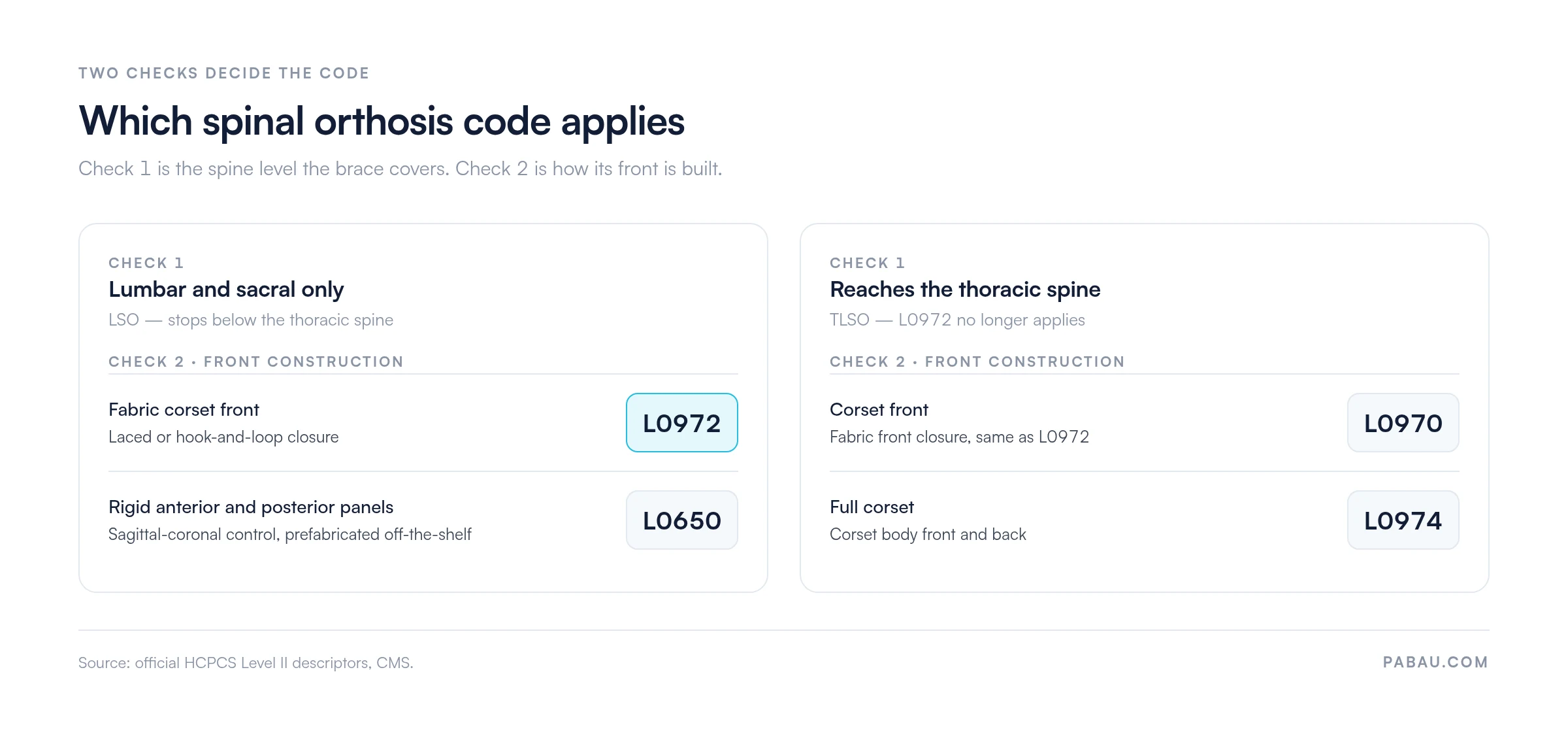
L0970 is the closest neighbor, and it is not the rigid option. It is also a corset-front brace. What changes is the spine it covers, because L0970 is a thoracic-lumbar-sacral orthosis. Once the device extends above the lumbar spine, L0972 no longer applies.
The rigid option is L0650. Its descriptor calls for rigid anterior and posterior frame or panels, sagittal-coronal control, prefabricated off the shelf.
A device with a fabric corset front never belongs on that line. Per the CMS HCPCS Level II code set guidance, the code must describe the device dispensed rather than the device ordered.
Those four codes describe the orthosis itself. Accessories dispensed with it carry their own codes, such as L0980 for a pair of peroneal straps.
Medicare Part B covers L0972 when the beneficiary meets the medical necessity criteria in LCD L33790, the DME MAC policy for spinal orthoses. Policy Article A52500 carries the billing and documentation rules that sit alongside it.
Coverage is never automatic. The treating physician has to document a condition that warrants the brace. That record must be on file before the supplier appends the KX modifier. The policy looks for significant functional impairment of the lumbar spine, with conservative treatment alone falling short.
Covered diagnosis lists move. Your Medicare Administrative Contractor sets them and revises them periodically. Check the current effective policy for your jurisdiction, not a copy saved last year.
The diagnosis has to explain why this patient needs a brace. The codes below commonly support medical necessity for L0972 under the spinal orthoses policy. Treat the list as a starting point, not a covered list, because each MAC publishes its own.
Two of these have caught billers out. M54.5 was deleted in October 2021, so a claim carrying it is rejected on the code alone. M48.06 went the same way and was replaced by the two claudication-specific codes above.
Confirm each one against the ICD-10-CM codes library and your MAC’s current covered list, or cross-check it in the AAPC HCPCS code reference.
Here is how that looks in practice. A patient coded M48.062 can walk less than a block before her legs give out, and six weeks of physical therapy has not changed it.
The physician’s note records the walking limit, the therapy course and the order for a corset-front LSO. That record is what supports the KX modifier, not the diagnosis code by itself.
Medicare sets the L0972 allowable through the DMEPOS fee schedule, which CMS updates every year. The rate shifts by state, and it shifts again depending on whether the claim comes from a Competitive Bidding Area.
Outside a bidding area, the standard fee schedule applies. Inside one, the contracted bid rate replaces it and usually runs lower. Look up the current figure on the CMS DMEPOS fee schedule page, matched to the beneficiary’s ZIP code and the date of service.
Then post every remittance against that number. A payment landing short of the allowable often means the line priced against a bidding-area rate for the wrong ZIP code. That is worth catching while the appeal window is still open, and it is easy to miss if payments are only reconciled in total.
Modifiers are not optional on an L0972 Medicare claim. Each one tells the MAC something specific about coverage, and the wrong one triggers a rejection or a post-payment review.
KX carries legal weight. Appending it when the documentation does not genuinely support medical necessity is a false attestation under the False Claims Act. Use it only when the detailed written order, the physician notes and the face-to-face documentation are all on file and meet the policy criteria.
Before you send L0972 with KX, read the file once end to end. Confirm the physician order, the detailed written order, the face-to-face note and the clinical justification are all sitting there. A five-minute check costs far less than reworking a denied claim two months later.
Paperwork causes more L0972 denials than coding does. Policy Article A52500 sets the minimum record Medicare expects, and every piece has to exist before the claim goes out. Collecting it after a denial is harder to defend and draws closer review.
Keep all of it for at least seven years from the date of service. A post-payment audit asks for the complete set, and one missing element is enough to trigger a repayment demand.
Traditional Medicare does not routinely require prior authorization for L0972. That can change by MAC jurisdiction or through a CMS prior authorization model, so confirm it rather than assume it.
Commercial plans are stricter. Anthem, Cigna, Aetna and UnitedHealthcare generally require prior authorization for spinal orthoses. Anthem’s coverage policy CG-OR-PR-06 names it explicitly, and covers corset-front LSOs for lumbar spinal stenosis, degenerative disc disease and post-surgical stabilization.
Medicare Advantage plans set their own rules, which can differ sharply from traditional Medicare. A beneficiary in an Advantage plan who receives the brace without plan-required authorization is denied. What traditional Medicare would have done with the same claim makes no difference.
Check eligibility and benefits before every dispensing event, not once a year. Authorization rules move at plan level and change with the plan year.
L0972 denials repeat themselves. The table below pairs the eight patterns DME MACs see most often with the check that prevents each one.
The replacement row catches experienced billers more than any other. Medicare gives an orthosis a reasonable useful lifetime of five years. CMS runs an approved audit topic aimed squarely at spinal orthoses replaced inside that window.
The most common finding is a replacement billed under a different HCPCS code than the original. Swapping L0972 for a neighboring code does not restart the clock.
Before you submit, run down this list:
That is the same discipline behind submitting a clean claim on any code. Settle the coding, the documentation, the modifiers and the payer rules before the claim leaves the practice, and there is far less to appeal afterwards.
Only a DMEPOS-accredited supplier may bill L0972 to Medicare. The requirement comes from 42 CFR Part 424. A non-accredited entity that submits the claim is denied automatically and can be referred for fraud review.
Accreditation comes from a CMS-approved organization, which reviews quality management standards, complaint procedures and operational compliance. The Accreditation Commission for Health Care and The Joint Commission accredit most DMEPOS suppliers.
Accreditation has to be live at the moment of billing. Claims submitted during a lapse are void, and the lapse usually surfaces in an audit long after the money has been banked. Put the expiry date in the calendar each year. It attaches to the supplier number rather than the treating clinician, which is how it gets left to run out.
Most DMEPOS billing runs across three systems. The patient record lives in one, the claim gets typed into another, and remittances are reconciled in a spreadsheet. Every retype is another chance to send L0972 with the wrong diagnosis attached.
Pabau, our practice management software, keeps those steps in one place. The HCPCS code attached to the service lands on the CMS-1500 charge line, and the ICD-10 slots are seeded from the patient’s recorded problem list.
Built-in ICD-10-CM and HCPCS lookup libraries sit behind a search icon, so a coder can check a descriptor without leaving the claim.
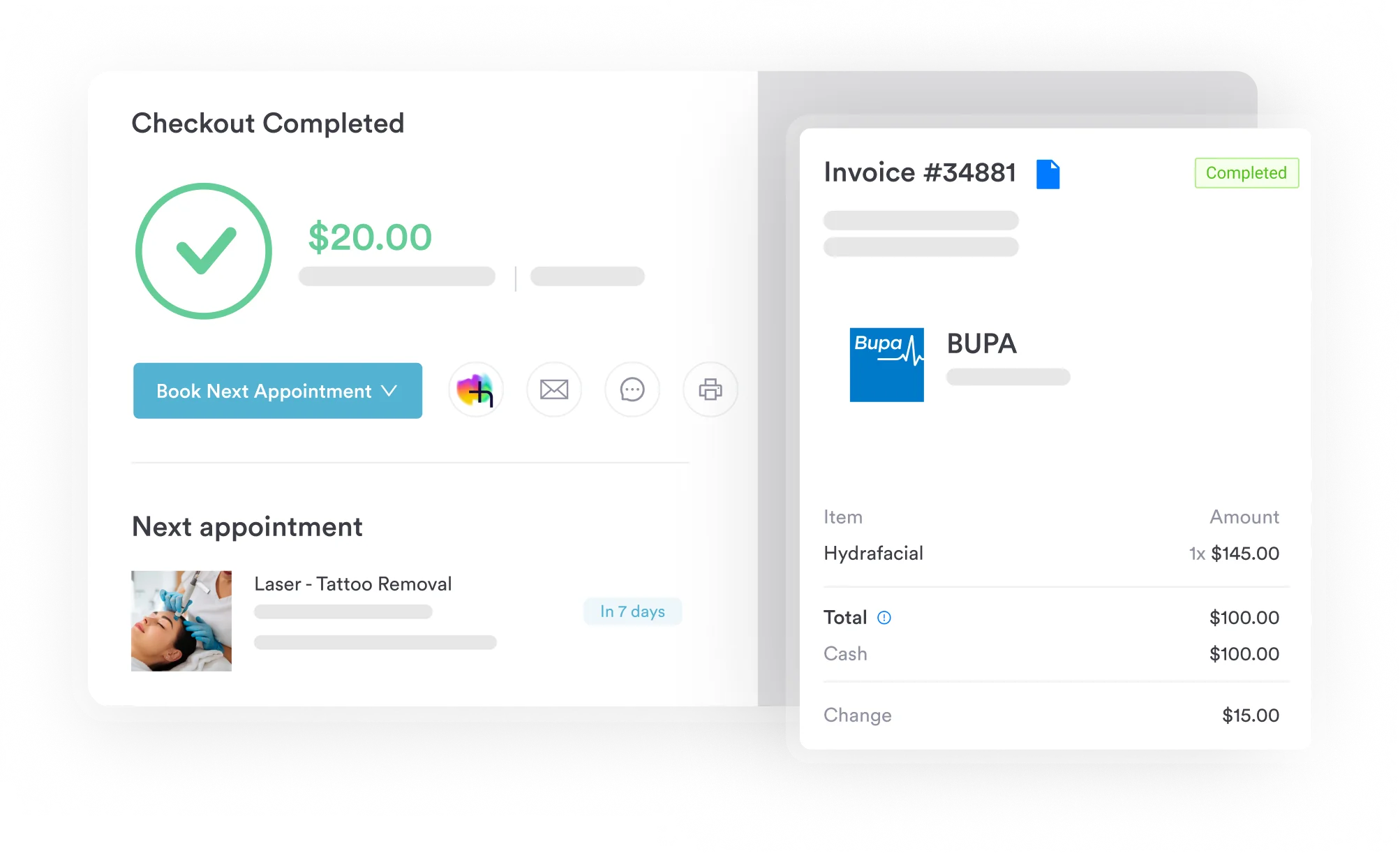
Before a claim can be sent, Pabau checks that the required claim fields are complete. United States claims then go out through Claim.MD, which returns real-time eligibility checks, claim-status tracking and electronic remittance posting against the patient record.
Our claims management software handles the pipeline, not the coding decision. You still pick L0972 and the modifier set from the record in front of you. What disappears is the retyping, the chasing and the guesswork about where a claim currently sits.

Pabau pre-fills the CMS-1500 from the patient record and checks the required claim fields are complete. United States claims then go out through Claim.MD, with eligibility checks and remittance posting built in.

L0972 is a narrow code with a simple test behind it. The brace stops at the lumbar and sacral spine, and its front is a fabric corset. Get those two right and the coding argument is over.
What is left is the file. Almost every denial on this code traces back to an order, a note or a date that was missing when the claim went out. A five-minute review before submission is the cheapest fix available, and it works on the replacement trap too.
Book a demo to see how Pabau moves a DMEPOS claim from the patient record to Claim.MD without a second system in the middle.

Not sure what a denial code is telling you? Denial codes in medical billing decodes the reason codes that come back on DMEPOS remittances.
Need to work a denial rather than rebill it? Denial management in healthcare sets out how to triage, appeal and track denials before the filing window closes.
Want to read a remittance line by line? Electronic remittance advice explains how ERA files map each payment decision back to the claim line it belongs to.
Curious how the clearinghouse fits in? Pabau’s Claim.MD clearinghouse integration covers how claims are validated before they ever reach the MAC.
Building an audit-ready billing process? Medical billing compliance covers the documentation standards that keep DMEPOS claims defensible years later.
The policy expects conservative treatment to fall short first. That is not a fixed course of therapy with a set number of visits. It means the record shows what was tried and why it did not work.
As a purchase. Orthoses are not rental items under Medicare, so there is no monthly rental line and no rental-to-purchase conversion. One unit of service covers the brace supplied on that date.
Only when an Advance Beneficiary Notice was signed before dispensing and the line carries the GA modifier. Without a signed notice, the GZ modifier applies and the patient cannot be charged for the brace.
No. RT and LT identify right and left body parts, and a spinal orthosis is neither. Use the coverage modifiers instead, which are KX, GA, GY and GZ.
The accredited DMEPOS supplier submits the claim under its own supplier number. The treating physician writes the order and documents the face-to-face exam. A practice that dispenses braces itself has to cover both roles.