CPT Code 31653: EBUS With 3+ Mediastinal Stations
CPT code 31653: Official descriptor and clinical scope CPT code 31653 is the pro...

Last Updated: Oct 20, 2026
K0884 is the HCPCS Level II code for power wheelchair, group 4 standard, multiple power option, sling/solid seat/back, patient weight capacity up to and including 300 pounds.
Medicare Part B pays K0884 as a capped-rental item once the beneficiary meets the medical necessity criteria in LCD L33789. Most DME MAC jurisdictions require prior authorization before the chair is delivered. They also cover the neighboring K-codes and the modifier that belongs on each of the 13 rental months.
Let Pabau's smart automation suggest the right codes, reduce claim denials, and keep your practice compliant—effortlessly.
Automate repetitive tasks and focus on what matters most—your patients.
Reduce coding errors and ensure compliance with the latest regulations.
Clean claims, fewer denials, and faster reimbursements.
Powerful insights and reporting to help your practice thrive.
HIPAA compliant SOC 2 certified GDPR-compliant Trusted by 4,000+ clinics worldwide

HCPCS code K0884 describes a group 4 standard power wheelchair with multiple power options and a sling or solid seat and back. The weight limit is 300 lb.
Medicare Part B covers K0884 as durable medical equipment when medical necessity is documented per LCD L33789, including a face-to-face evaluation by the treating physician.
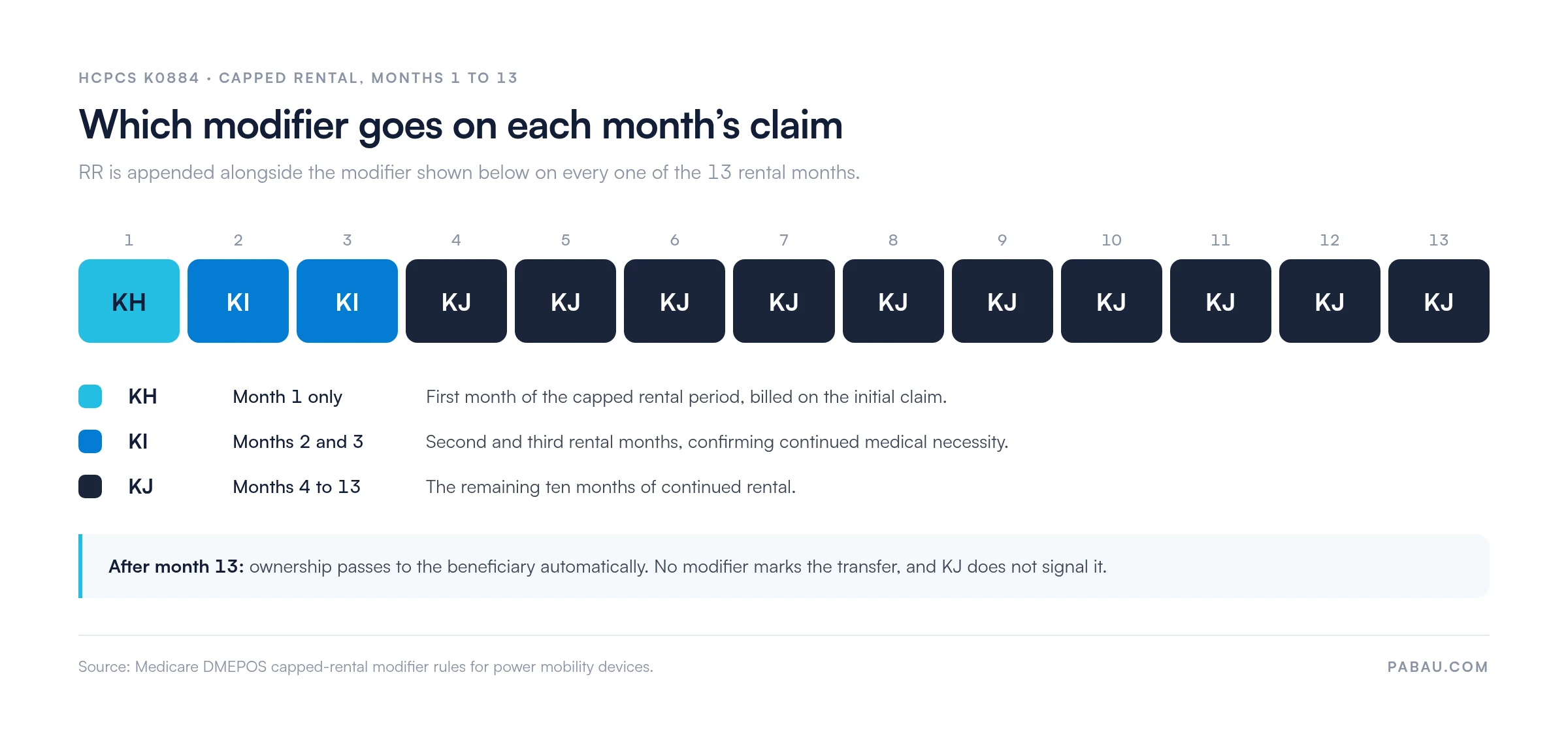
Across the 13-month capped rental, KH goes on month 1, KI on months 2 and 3, and KJ on months 4 to 13. RR is appended every month.
Most DME MAC jurisdictions require prior authorization for K0884 before delivery, and an incomplete file is the leading cause of denial.
Practice management software like Pabau tracks each authorization and rental month, so every K0884 claim goes out with the right modifier.
Group 4 classification explained: CMS classifies power wheelchairs into groups 1 through 4 based on the device’s drive system capabilities, speed, stability, and obstacle-handling features. Group 4 devices support patients who need a more maneuverable chair for varied terrain or complex seating needs.
Within group 4, the “standard” designation on K0884 means a sling or solid seat and back. The chair serves patients up to 300 pounds. K0885 covers the same chair with a captain’s chair instead. K0886 is the heavy-duty version for patients between 301 and 450 pounds.
Multiple power option meaning: “Multiple power option” indicates the chair has power-driven features beyond basic propulsion. Examples include power tilt, recline, elevating leg rests, and standing systems. These options must be clinically justified and documented separately if billed under accessory codes.
Medicare reimburses K0884 under the DMEPOS fee schedule, which CMS updates annually. Rates vary by MAC jurisdiction and geographic locality, so the figures below represent general ranges drawn from published fee schedule data. Verify current payment amounts against the CMS DMEPOS fee schedule files for your MAC region before submitting claims.
Medicare Part B pays 80% of the approved allowable after the annual deductible is met. The beneficiary or a secondary insurer covers the remaining 20% coinsurance. Rates change with each new calendar year, and the 2026 fee schedule files are available directly from CMS.
Download the CMS DMEPOS fee schedule file for your MAC jurisdiction at the start of each calendar year. Cross-reference K0884 allowable amounts against what your contracts specify. A difference between your contracted rate and the Medicare allowable is a common source of billing shortfalls that go unnoticed until year-end reconciliation.
Medicare Part B covers K0884 when the claim meets the medical necessity criteria in Local Coverage Determination LCD L33789. That LCD is the governing policy for power mobility devices. Meeting these criteria before the chair is ordered, rather than after, protects against denial on medical necessity grounds. Coverage for a group 4 device turns on two findings. The record must show a functional limitation, and it must show that a less complex mobility device will not meet the need.
Group 4 is a higher-complexity device category, and CMS expects simpler options to have been considered and ruled out. If a patient could functionally use a group 2 or group 3 device, K0884 will likely be denied regardless of physician preference.
Across a caseload of PMD orders, that checklist is hard to keep in a spreadsheet. A billing team running audit-ready claims management can see which K0884 files still lack a signed order or an approved prior authorization. That check happens before the claim reaches the MAC.
Incomplete documentation is the leading cause of K0884 claim denials. Medicare does not rely on the physician’s clinical judgment alone. Every element of the medical necessity case has to be visible in the written record before the claim is filed.
Keep all of this in the beneficiary’s file for at least seven years. An auditor reviews what the file contains and nothing more. Keeping it complete is a regulatory obligation rather than a billing preference.
CMS operates mandatory prior authorization for power mobility devices, group 4 wheelchairs included, under its Medicare PMD prior authorization program. Most DME MAC jurisdictions require PA for K0884 before delivery. Submitting a claim without an approved PA, where one is required, results in automatic denial.
Check your MAC’s current PA list, or the AAPC HCPCS code reference, before ordering. Medicare Advantage plans may impose additional or different requirements. Flagging PA status on every K0884 order before delivery removes this denial category almost entirely.
Choosing the correct code in this series means knowing how each one differs from K0884. The distinctions turn on three things: patient weight capacity, seat and back type, and whether the chair carries a single or a multiple power option. Misclassifying a chair here is a common audit trigger, because auditors compare the billed code against the device specifications in the DPD.
K0884 and K0886 describe the same chair type at different weight ratings. K0886 is the heavy-duty version, built for patients between 301 and 450 pounds, so the choice between the two follows the documented patient weight. Neither code carries a rehabilitation designation or a separate evaluation requirement.
The other pairing worth checking is K0884 against K0885. Both are group 4 standard chairs with multiple power options and the same 300 lb capacity, and only the seat differs. Billing K0884 for a chair that meets the K0885 specification is the mismatch auditors find most often.
Medicare requires a supporting ICD-10-CM diagnosis code on every K0884 claim. The diagnosis must reflect a documented condition that causes the mobility limitation. A code that does not map to one is a fast path to denial. The diagnoses below are among those most frequently paired with group 4 power wheelchair claims, because they produce the functional limitations LCD L33789 describes.
This is not an exhaustive list. Many other musculoskeletal, neurological and cardiopulmonary diagnoses qualify under LCD L33789 when they produce documented functional limitations. The code has to match the patient’s documented diagnosis, not whatever a crosswalk tool returns first. Our ICD-10-CM code library sets out the chapter structure these mobility diagnoses come from.
Before finalizing the diagnosis code on a K0884 claim, cross-check it against your MAC’s LCD L33789 policy article. A diagnosis that looks reasonable clinically may still be absent from the LCD’s covered diagnosis list. Mismatched codes account for a large share of group 4 wheelchair denials and are almost entirely preventable.
Group 4 power wheelchair claims attract heightened scrutiny from MACs and from Medicare’s CERT program. The tips below address the denial patterns that appear most often in DME supplier audit reports. Sound denial management starts with knowing where a claim breaks down before it reaches the payer.
The three rental modifiers map onto fixed month ranges, and billing KI on month 1 is the single most common modifier error on this code. The timeline below shows which one belongs on each claim.
Tracking each K0884 claim through the full rental lifecycle, from PA approval to the month-13 ownership transfer, is demanding for a busy DME billing team. A pre-submission check that confirms the modifier, the diagnosis and the PA number catches most of the patterns in the table above.
Most DME billing teams track the K0884 rental clock in a spreadsheet that sits beside the billing system. The PA approval lives in one folder, the signed order in another, and the month count in someone’s head. One missed month, or a KI billed on month 1, becomes a denial that has to be appealed.
Pabau keeps the claim, the document trail and the schedule in one patient record. Each K0884 order carries its prior authorization number, its face-to-face note, its detailed product description and its proof of delivery in the same file. The rental month is counted from the delivery date, so the modifier on the next claim follows from the record rather than from memory.
For the billing team that means fewer rework hours. Claims go out with the right modifier the first time, and an audit request is answered from one file instead of four.

Pabau keeps each K0884 order’s prior authorization, documentation and rental month in the patient record, so claims leave with the right modifier. See how it works for your team.

Billing K0884 correctly rests on two checks. The code has to match the device specification on the detailed product description, and the file has to be complete before the chair is delivered.
Patient weight decides between K0884, K0886 and K0880. Seat type decides between K0884 and K0885. Get those two right, keep the modifier honest across all 13 rental months, and the appeal queue shrinks without anyone working it harder.
The trade-off worth remembering is timing. Almost every fix on this code costs minutes before delivery and weeks after it. Book a demo to see how Pabau holds the authorization, the documentation and the rental clock behind each K0884 claim in one place.

Need to understand how claim denials are coded and appealed? Denial management in healthcare explains the CARC/RARC denial code structure and how to build an effective appeal workflow.
Submitting electronic claims for DME equipment? 837P electronic claim file covers the EDI format used for professional DME claims, including loop and segment requirements for HCPCS codes.
Reconciling Medicare payments after the claim pays? Electronic remittance advice (ERA) explains how 835 transaction sets work and how to match Medicare payments against DMEPOS allowables.
Looking for a complete medical billing software comparison? Best medical billing software in the US reviews the platforms DME suppliers and healthcare practices use to manage claims end-to-end.
HCPCS code K0884 covers a power wheelchair, group 4 standard classification, with multiple power options and a sling or solid seat and back. The patient weight capacity runs up to and including 300 pounds. Medicare Part B covers it as durable medical equipment once the beneficiary meets the medical necessity criteria in LCD L33789. That includes a documented mobility impairment and a completed face-to-face evaluation.
The 2026 Medicare allowable for K0884 varies by MAC jurisdiction. It also varies by whether the chair is billed as a capped rental or as a lump-sum purchase. Under capped rental, Medicare pays roughly 10% of the purchase allowable per month across the first three months, then continues monthly payments through month 13. Verify current rates against the CMS DMEPOS fee schedule file for your MAC region, as rates change annually.
K0884 requires a face-to-face evaluation note from the treating physician and a signed written order completed before delivery. The file also needs a detailed product description matching the K0884 long description. Add a signed proof of delivery and supporting clinical records of the mobility limitation. A prior authorization approval letter must also be retained in the claim file for most MAC jurisdictions.
Yes, K0884 requires prior authorization under Medicare’s mandatory PA program for power mobility devices in most DME MAC jurisdictions. Submitting a K0884 claim without an approved PA results in automatic denial. Medicare Advantage plans may impose additional or different PA requirements; verify with the specific plan before ordering the chair.
K0884 and K0886 describe the same group 4 chair type at different weight ratings. K0884 is the standard variant, rated for a patient weight capacity up to and including 300 pounds. K0886 is the heavy-duty variant, rated for patients between 301 and 450 pounds. The choice between them follows the documented patient weight and the device specification on the detailed product description, not clinical complexity.
KH goes on month 1 of the capped rental period only. KI goes on months 2 and 3. KJ goes on months 4 through 13, and ownership transfers to the beneficiary automatically after month 13 rather than because of KJ. RR is required on every DME capped-rental claim and is appended alongside KH, KI or KJ.
Commonly paired diagnoses include G35 (multiple sclerosis), G12.21 (ALS), G80.0 (spastic quadriplegic cerebral palsy), G82.20 (paraplegia), and M05.79 (rheumatoid arthritis with rheumatoid factor). The ICD-10-CM code must match the patient’s documented diagnosis and appear on the covered diagnosis list in LCD L33789. A diagnosis not on the LCD’s covered list will result in denial regardless of clinical appropriateness.
Yes, K0884 is covered under Medicare Part B as durable medical equipment when medical necessity criteria are met. Medicare pays 80% of the approved DMEPOS allowable after the annual deductible; the beneficiary or a secondary insurer covers the remaining 20% coinsurance. Coverage requires compliance with LCD L33789, a valid written order, and prior authorization from the beneficiary’s MAC.