CCSD code H4430: Examination of rectum under anaesthetic
CCSD code H4430 pays for the examination alone CCSD code H4430 is the UK private...

Last Updated: Oct 20, 2026
K0842 is the HCPCS Level II code for power wheelchair, group 2 standard, multiple power option, captains chair, patient weight capacity up to and including 300 pounds.
One rule matters more than the rest. Medicare requires an approved prior authorization before the chair reaches the patient. A claim sent without one denies on arrival, however strong the clinical notes are.
For billing staff and DME suppliers, that single step decides whether a high-value item gets paid for. Below, the descriptor comes first, then coverage, the paperwork, and the codes K0842 gets mistaken for.
Let Pabau's smart automation suggest the right codes, reduce claim denials, and keep your practice compliant—effortlessly.
Automate repetitive tasks and focus on what matters most—your patients.
Reduce coding errors and ensure compliance with the latest regulations.
Clean claims, fewer denials, and faster reimbursements.
Powerful insights and reporting to help your practice thrive.
HIPAA compliant SOC 2 certified GDPR-compliant Trusted by 4,000+ clinics worldwide

HCPCS code K0842 covers a group 2 standard power wheelchair with multiple power options, captains chair seating, and a 300-pound weight limit.
Medicare requires an approved prior authorization before delivery, and a claim without the affirmation number is denied automatically.
CMS classifies K0842 as a complex rehabilitative power wheelchair nationally, so the category is not a jurisdiction-by-jurisdiction judgment call.
At first furnishing the beneficiary elects a lump-sum purchase or a capped rental, recorded with modifier BP or BR.
Noridian and CGS are the only two DME MAC contractors, so there are two sets of local coverage rules, not four.
HCPCS code K0842 is an active HCPCS Level II national code, maintained by CMS and valid for the 2026 billing year.
Its official descriptor reads: power wheelchair, group 2 standard, multiple power option, captains chair, patient weight capacity up to and including 300 pounds.
The K-series of HCPCS covers DMEPOS items that have no home in the CPT system. Every word in a K-code descriptor works as a billing condition. The chair on the delivery truck has to match all of them.
Read the descriptor as four separate tests. Miss one and the code is wrong, even when the other three line up.
Medicare Part B covers HCPCS code K0842 as durable medical equipment when the beneficiary meets the local coverage determination’s medical necessity criteria.
The test is about the home. A cane, a walker, or a manual wheelchair must be unable to solve the mobility problem.
The power chair also has to be usable inside the residence. Coverage is never automatic, and the requirements a reviewer looks for stay consistent across the country even where the wording differs.
Medical necessity wording varies by jurisdiction, so pull the current local coverage determination before you commit to a code. Only two contractors process DME claims today. Noridian handles jurisdictions A and D, and CGS handles B and C.
Palmetto GBA and WPS administer other Medicare work, but neither is a DME MAC. Neither one publishes a power mobility policy that applies to your claim, so a citation to either is worth checking twice.
HCPCS code K0842 sits on the CMS required prior authorization list for DMEPOS. The supplier has to hold an approved decision before the chair leaves the warehouse. Deliver first and the claim is denied, with no appeal route that repairs the sequence.
A reviewer works through those steps in order, checking dates before reading the clinical narrative. The chart below shows the gate that each step has to clear.
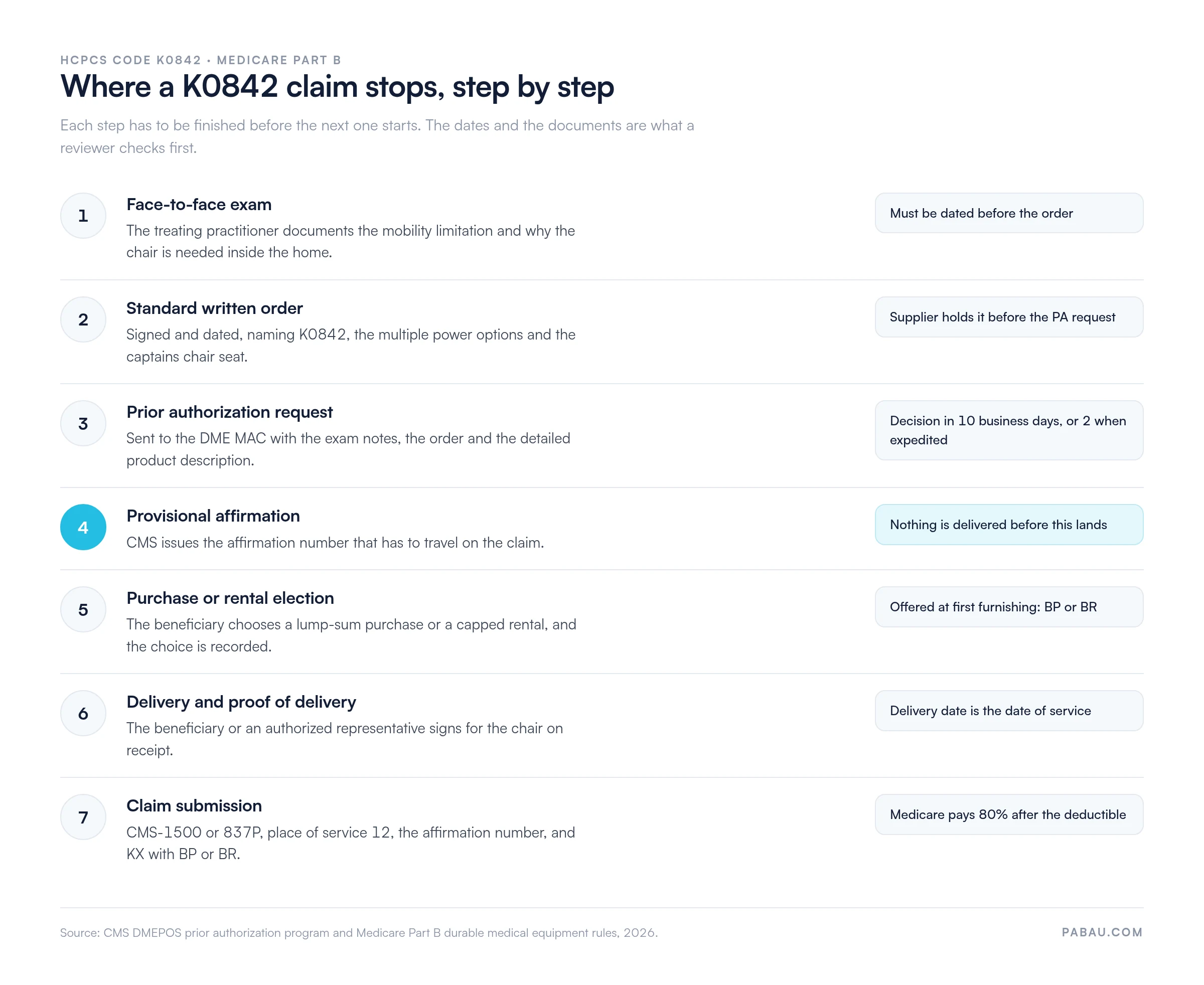
CMS revises the required prior authorization list periodically. Confirm K0842’s current status on CMS.gov’s HCPCS page before you rely on last year’s workflow.
Track affirmation expiry dates in the same place you track delivery dates. A K0842 affirmation is valid for a set window. Miss it and the request goes back in, with no guarantee of a second approval. Building that date into the ordering workflow costs far less than a resubmission.
Documentation is the strongest defense a K0842 claim has. Incomplete or inconsistent records are the most common reason DMEPOS claims fail a post-payment review. Every required document belongs in the file before the chair ships.
Records need to be legible, consistently dated, and easy to retrieve. Auditors can ask for a K0842 file up to five years after the claim was paid. Keep it intact long after the payment clears.
Reviewers rarely start with the clinical narrative. They compare dates. The examination has to predate the order, the order has to predate the request, and the affirmation has to predate delivery. When one of those pairs runs out of sequence, the rest of the file stops mattering.
CMS classifies HCPCS code K0842 as a complex rehabilitative power wheelchair. That classification carries a payment rule which surprises a lot of billing teams. At first furnishing, the supplier has to offer the beneficiary a choice between a lump-sum purchase and a capped rental.
The election is recorded with a modifier. BP means the beneficiary chose to buy, and BR means they chose to rent. Treating K0842 as rental-only, the way a standard power wheelchair is handled, skips a step the supplier owes the patient.
Beyond the election, the arithmetic is ordinary Part B. Medicare pays 80% of the allowed amount once the annual deductible is met. The beneficiary or a supplemental plan covers the remaining 20%.
Rates come from the CMS DMEPOS fee schedule, not the physician fee schedule. The physician tool covers CPT services and will not return a K-code.
Pull current figures from the CMS DMEPOS fee schedule, which is locality-specific and updated each January.
Exact dollar amounts are left out here on purpose. They move every January and differ by locality. A figure quoted in an article is stale before most readers reach it.
Take a beneficiary who has met the annual deductible and elects to rent. The supplier bills K0842 with KX, BR, and RR, plus the affirmation number, for each rental month. Medicare pays 80% of the monthly allowable and the patient owes the other 20%.
Had the same patient elected purchase, the claim would carry BP and NU instead, on a single line. Same code, same documentation, different payment shape.
Modifiers, place of service, and a handful of claim-level fields carry most of the denial risk. Get them right and the claim becomes boring, which is the goal.
A modifier tells Medicare why this claim exists and what the beneficiary decided. Omitting a required one, or attaching one the file does not support, is the most common error on DMEPOS claims.
Modifier choices carry compliance risk, not only payment risk. KX on a thin file, or GA without a properly executed notice, can turn the claim into a false one. Run modifier selection past your compliance lead before it becomes routine.
Run this check before the claim goes out. Each question maps to a denial that turns up again and again.
When a K0842 claim does deny, work the reason code before you rebill. A structured approach to denial management keeps one sequencing error from repeating across every chair you ship this quarter.
K0842 sits in a block of power wheelchair codes. Four elements separate them. The group tier, the number of power options, the seat type, and the weight capacity all move the code. Most miscoding happens on the last two.
Match the manufacturer’s product description against the descriptor element by element before you pick a code. A mismatch between the billed code and the delivered chair counts as a documentation error, and it invites an overpayment demand.
The HCPCS code library gives the other K-codes in this block the same treatment. For a fast descriptor check, the AAPC HCPCS lookup is searchable by range.
CMS classifies K0842 as a complex rehabilitative power wheelchair. The category is national and fixed. It covers K0835 through K0843 and K0848 through K0864, so no MAC decides whether your chair belongs in it.
That settles the payment question, which is where the classification bites hardest. It does not settle who has to be in the room for the evaluation, or what your accreditation covers. Those still vary, so check them locally.
Power wheelchair codes draw more audit attention than most physician services. RAC, CERT, and MAC reviews return to them year after year. Build the documentation habit before the claim volume arrives.
Save the local coverage determination as a PDF on the day you submit, with the date in the filename. Policies get revised. When a review lands two years later, the version you actually relied on is the one that defends the claim.
Most billing teams run this work across three or four systems. The clinical notes live in one place, the order paperwork in another, and the payment side in a spreadsheet. Reconciling them is where the hours go.
Practice management software like Pabau puts the record and the money in the same file. Forms, signed documents, and treatment notes attach to the patient. Invoices, insurer submissions, and remittances sit against that same record.
A partly paid claim then shows up as unpaid, instead of hiding inside a batch total. Pabau’s claims software for practices submits insurance claims through regional integrations, including Claim.MD in the United States.
The prior authorization step above still belongs to your MAC workflow. What Pabau takes off the team is the chasing that follows a submitted claim.
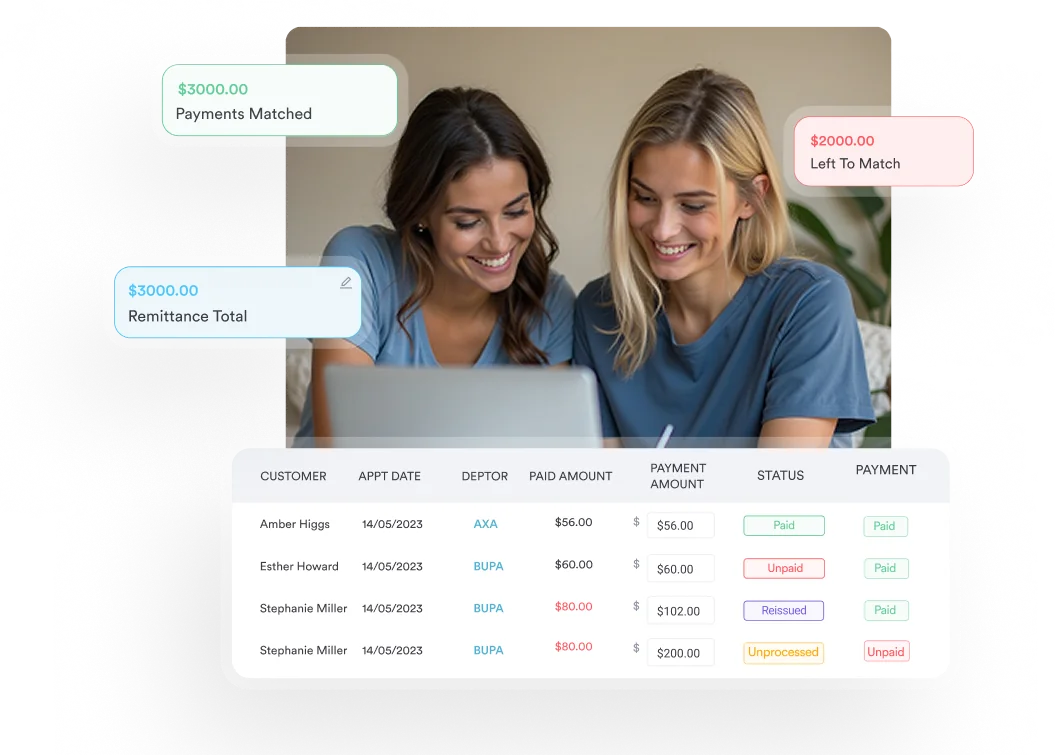

Pabau brings patient records, forms, invoices, and insurer submissions together, so your team stops reconciling claims across separate systems. Remittances match back against the patient record, which makes an underpayment visible the same day.

HCPCS code K0842 is not difficult to bill. It has an order of operations, and that order is where most claims fail. The sequence runs examination, order, affirmation, delivery, then claim. Keep those five in line and the rest is arithmetic.
Two details are worth holding onto. Whether K0842 or a heavy-duty code applies comes down to the 300-pound limit. The purchase-or-rental offer belongs to the patient, so your billing workflow should ask rather than assume.
Once the claim is out the door, the work shifts to tracking what gets paid. Book a demo to see how Pabau keeps patient records, invoices, and insurer payments in one place for your billing team.

What separates K0842 from its closest neighbor? HCPCS code K0838 covers the heavy-duty captains chair configuration that billing teams reach for by mistake.
Need the prior authorization workflow end to end? The prior authorization process walks through submission, timelines, and what to do when a request comes back non-affirmed.
Working a stack of denied claims? Denial management in healthcare sets out how to read reason codes, fix the root cause, and appeal without guessing.
Billing Medicare beyond durable medical equipment? Medicare billing explains the parts, the enrollment rules, and the submission mechanics behind every Part B claim.
Getting ready for an audit request? Medical billing compliance covers the record-keeping and audit-readiness standards a billing team is held to.
No. The durable medical equipment benefit requires the chair to be used in the beneficiary’s home. A hospital or skilled nursing facility does not count as a home. An assisted living residence can qualify. Check the patient’s residence before the order goes in.
No. CMS retired the certificate of medical necessity and the DME information form for items furnished on or after January 1, 2023. A standard written order, signed and dated by the treating practitioner, takes their place. The face-to-face note still has to support it.
Medicare applies a reasonable useful lifetime of five years to power wheelchairs. A replacement inside that window is usually paid only after loss, theft, irreparable damage, or a documented change in the patient’s condition. Normal wear on its own will not clear it.
Yes, once the beneficiary owns the chair. Labor and replacement parts are billed with their own HCPCS codes rather than under K0842. During a rental period, repairs and maintenance stay the supplier’s responsibility and are not separately payable.