CCSD code H4430: Examination of rectum under anaesthetic
CCSD code H4430 pays for the examination alone CCSD code H4430 is the UK private...

Last Updated: Oct 20, 2026
K0014 is the HCPCS Level II code for other motorized/power wheelchair base.
The official CMS descriptor reads: Other motorized/power wheelchair base. K0014 is a Level II HCPCS code maintained by the Centers for Medicare and Medicaid Services (CMS). It sits in the K-series, which covers wheeled mobility and related DME equipment. The code is active for the 2026 billing year.
The K-series splits in two. K0001 through K0009 are the manual wheelchair codes, running from a standard wheelchair through hemi, lightweight, heavy duty, custom, and other manual bases.
K0010 through K0013 are the power wheelchair base codes, and K0014 sits directly after them as the residual option. That residual scope makes the code necessary and easy to misuse.
Let Pabau's smart automation suggest the right codes, reduce claim denials, and keep your practice compliant—effortlessly.
Automate repetitive tasks and focus on what matters most—your patients.
Reduce coding errors and ensure compliance with the latest regulations.
Clean claims, fewer denials, and faster reimbursements.
Powerful insights and reporting to help your practice thrive.
HIPAA compliant SOC 2 certified GDPR-compliant Trusted by 4,000+ clinics worldwide

HCPCS Code K0014 describes an other motorized/power wheelchair base that no more specific K-series code covers.
K0014 is a residual code, so reach for it only after checking every descriptor from K0010 through K0013.
Medicare Part B covers K0014 as durable medical equipment, and payment turns on documented medical necessity.
Power wheelchairs need a signed written order on file before delivery, and CMS stopped accepting Certificates of Medical Necessity in 2023.
Pabau’s claims management software helps DME suppliers track K0014 documentation and submit cleaner claims.
Medicare Part B covers power wheelchairs, including those billed under HCPCS Code K0014, as durable medical equipment under the DME benefit. Coverage is not automatic. CMS and the relevant Medicare Administrative Contractor (MAC) apply specific eligibility conditions before approving a claim.
The patient must have a mobility limitation that significantly impairs their ability to participate in mobility-related activities of daily living (MRADLs) within the home. That limitation must not be adequately addressed by a cane, walker, or manual wheelchair.
The claim also carries the diagnosis that explains the mobility limitation, drawn from the current ICD-10-CM codes. That diagnosis has to match what the practitioner recorded at the face-to-face evaluation, because a reviewer reads the two together.
Medicaid programs and commercial payers often follow similar criteria, but coverage rules vary by state and plan. Always confirm coverage requirements with the specific payer before submitting a K0014 claim.
K0014 is a residual code. It applies only after the supplier has confirmed the base misses every descriptor in the K0010 to K0013 range. Using K0014 when a more precise code exists is a coding error, and it will likely produce a denial or an audit flag.
The supplier also has to record why the equipment misses every more specific descriptor. That rationale belongs in the supplier file before the claim goes out, not after a reviewer asks for it.
Prior authorization for power wheelchairs is required by many MACs. Check your MAC’s specific policies. Submitting without required authorization is a common reason K0014 claims are denied before adjudication even begins.
Before billing K0014, run through the K0010 to K0013 descriptors with the equipment’s specification sheet in hand. Document in writing exactly which descriptor criteria the equipment fails to meet. This file note protects the supplier in a post-payment audit, and it answers the question MACs ask most often during additional development requests.
Reimbursement rates for HCPCS Code K0014 are set through the CMS Durable Medical Equipment, Prosthetics, Orthotics, and Supplies (DMEPOS) fee schedule.
Rates vary by MAC jurisdiction and are updated annually. The figures below reflect general guidance. Always verify the current allowable against the live CMS fee schedule lookup tool for your jurisdiction before submitting a claim.
The published fee schedule rate is not always the amount paid. Competitive bidding program rules, contract supplier status, and beneficiary cost-sharing all shape the final reimbursement.
For current 2026 K0014 allowable amounts, query the CMS DMEPOS fee schedule directly or contact your MAC. Published rates can change mid-year through quarterly updates. Working from cached fee schedule data without checking the effective date is one of the most common reimbursement errors in DME billing.
Documentation failures are the primary cause of K0014 claim denials. Medicare’s Local Coverage Determinations (LCDs) for power mobility devices set out what has to be on file before a claim will be paid. Both the treating practitioner and the DME supplier contribute to that file.
Assemble every required document before submission rather than scrambling to answer an Additional Documentation Request (ADR). The documentation burden for power wheelchairs is heavier than for most other DME categories.
The order those documents arrive in decides the claim. Three of them have to exist before the wheelchair leaves the warehouse, and the rest are held by the supplier for audit.
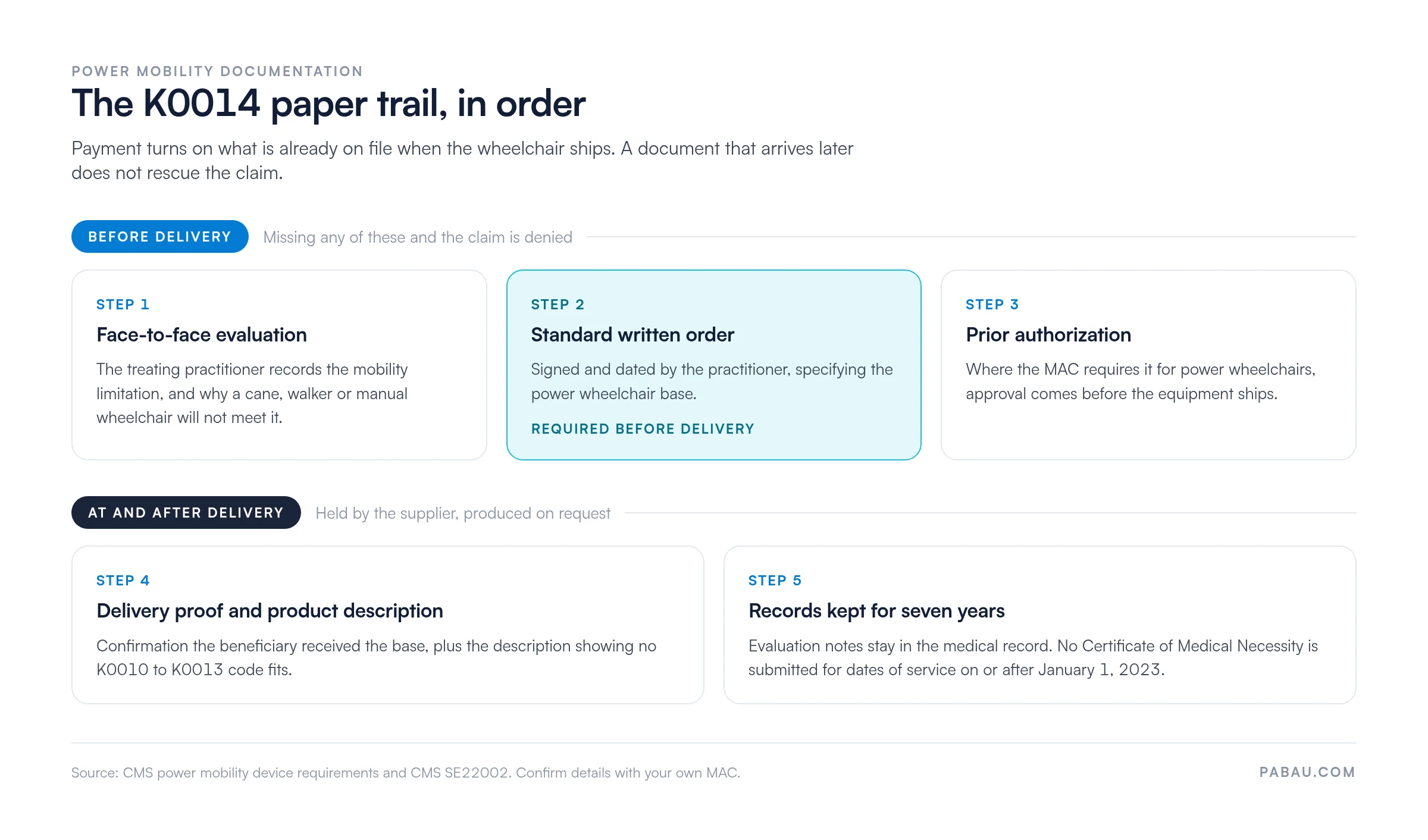
The rules changed here more recently than most billing teams realize. CMS discontinued Certificates of Medical Necessity and DME Information Forms for dates of service on or after January 1, 2023. MACs no longer accept them on a claim, so a workflow still chasing a signed CMN is chasing a form nobody will read.
The treating practitioner’s notes must be kept on file by the supplier for a minimum of seven years. They have to be available on request during an audit. A common audit trigger is a written order signed by someone other than the practitioner who performed the face-to-face evaluation.
Effective denial management for K0014 starts long before the claim goes out. Suppliers who check documentation completeness at order intake consistently run lower ADR and denial rates than those who check only at billing.
K0014 closes the K0010 to K0014 power wheelchair run. To pick the correct code, the supplier has to know what each preceding descriptor covers. The manual wheelchair codes K0001 through K0009 are a separate group, and a powered base never belongs in it.
Always verify code descriptors against the current CMS HCPCS Level II file. Descriptor language is updated annually, and a prior-year descriptor will not justify a current-year code selection during an audit.
Create a one-page internal reference sheet for your billing team that lists K0010 to K0014 with the key differentiating features. When a power wheelchair order comes in, the team can check the specification sheet against the reference before assigning a code. That habit reduces K0014 misuse, and it flags the cases that genuinely need K0014 documentation before anyone assumes a more specific code applies.
K0014 claims fail most often at two points: missing documentation at submission, and incorrect code selection. Both are workflow problems rather than coding-knowledge problems. A billing team that knows K0014 well still loses claims when documentation tracking breaks down between order intake and submission.
Practice management software like Pabau closes both routes to a denial. Its claims management software lets suppliers attach the written order, the product description, and the face-to-face evaluation notes to the patient record. Billing staff then work from one file when the claim is ready to go out.
The platform flags incomplete records before submission, so fewer claims leave the building only to come back as ADRs.
For practices billing several DME codes alongside clinical services, Pabau keeps the whole billing workflow in one system. Prior authorization status sits with the patient record instead of a separate spreadsheet. That matters for K0014, where authorization is often required and the paper trail runs long.

Pabau’s claims management software helps DME suppliers track K0014 documentation, manage prior authorizations, and submit cleaner claims with fewer denials. See it in action.

HCPCS Code K0014 is one of the more documentation-intensive codes in the power wheelchair range. Every claim needs a paper trail explaining why the patient needs a power wheelchair. It also has to show why no more specific K-series code fits the equipment supplied.
The single change that prevents the most K0014 denials costs nothing: move the written order to the front of the process. Get it signed before delivery, keep the evaluation notes in the medical record, and an audit request becomes a filing exercise instead of an appeal. Book a demo to see how Pabau tracks K0014 documentation before a claim ever leaves the building.

Need a framework for managing clean claims across DME codes? Clean claim best practices covers the documentation and submission steps that reduce denials across HCPCS billing categories.
Dealing with K0014 denials after submission? Denial codes in medical billing explains the most common remittance advice codes and how to build a systematic appeals process.
Want to understand how prior authorization fits into your revenue cycle? Revenue cycle management fundamentals outlines each stage from order intake to final payment, including where DME authorization fits.
HCPCS Code K0014 is a Level II HCPCS code for a motorized or power wheelchair base. It applies when no more specific code in the K0010 to K0013 range describes the equipment. DME suppliers reach for it when a power wheelchair base falls outside the standard-weight, programmable-control, lightweight portable, and custom categories. It is billed to Medicare Part B and other payers as durable medical equipment.
K0014 covers an other motorized/power wheelchair base for Medicare Part B beneficiaries with a documented mobility limitation. The limitation must prevent them from performing mobility-related activities of daily living in the home. It must also be one that a cane, walker, or manual wheelchair cannot adequately address. Medicare typically pays 80% of the allowed amount after the Part B deductible, and the beneficiary owes the 20% coinsurance.
Billing K0014 requires a face-to-face clinical evaluation by the treating practitioner and a standard written order specifying the power wheelchair base. That order must be signed and on file before delivery, because power mobility devices sit on the CMS Written Order Prior to Delivery list. You also need a detailed product description explaining why K0014 applies, delivery confirmation, and prior authorization where the MAC requires it. CMS no longer accepts a Certificate of Medical Necessity for dates of service on or after January 1, 2023. Supporting records must be retained for a minimum of seven years.
K0010 through K0013 each describe a specific class of power wheelchair base, defined by frame weight, programmable controls, portability, or custom construction. K0014 is the residual code, used only when the equipment matches none of those descriptors. That residual scope makes documentation especially important, because the supplier has to explain why the base falls outside every preceding category.
Prior authorization requirements for K0014 vary by Medicare Administrative Contractor (MAC) jurisdiction. Many MACs require prior authorization for power wheelchairs as a condition of payment. Confirm the requirements with your own MAC before delivering the equipment and submitting a claim. Noridian administers Jurisdictions A and D, while CGS Administrators covers Jurisdictions B and C.
The most common K0014 denial reason is a written order that was not obtained before delivery. Close behind is a face-to-face evaluation that was never performed, or never documented in time. Claims also fail when required prior authorization is missing. Two more causes are using K0014 although a more specific code applies, and a file that never explains why K0010 to K0013 fall short. Reviewing denial management practices helps suppliers catch these issues before submission.