CCSD code H4430: Examination of rectum under anaesthetic
CCSD code H4430 pays for the examination alone CCSD code H4430 is the UK private...

Last Updated: Oct 20, 2026
J7313 is the HCPCS Level II code for injection, fluocinolone acetonide, intravitreal implant (iluvien), 0.01 mg.
That brand name is the whole rule. Yutiq is the other fluocinolone acetonide implant, and it has had its own code, J7314, since 2019. Bill one under the other and the claim comes back.
Wrong units and mistyped NDCs fail more quietly. The line still pays, just at a fraction of what the implant cost.
Let Pabau's smart automation suggest the right codes, reduce claim denials, and keep your practice compliant—effortlessly.
Automate repetitive tasks and focus on what matters most—your patients.
Reduce coding errors and ensure compliance with the latest regulations.
Clean claims, fewer denials, and faster reimbursements.
Powerful insights and reporting to help your practice thrive.
HIPAA compliant SOC 2 certified GDPR-compliant Trusted by 4,000+ clinics worldwide

HCPCS code J7313 covers one brand only, Iluvien, the 0.19 mg fluocinolone acetonide implant from ANI Pharmaceuticals (Alimera Sciences).
One unit equals 0.01 mg, so a single Iluvien implant bills as 19 units on the claim line.
Yutiq has carried its own code, J7314, since October 1, 2019, and Retisert bills under J7311 at 59 units.
Medicare expects modifier JZ on the J7313 line to attest that no drug was discarded.
Iluvien’s label expanded on March 14, 2025 and now covers chronic non-infectious posterior uveitis as well as diabetic macular edema.
J7313 is a Level II drug code maintained by the Centers for Medicare and Medicaid Services (CMS). Its current descriptor reads:
Injection, fluocinolone acetonide, intravitreal implant (Iluvien), 0.01 mg
CMS put the brand name in the descriptor on purpose. Three products share the same active ingredient, and the code is how a payer tells them apart on a claim line.
Those look-alikes are J7314 and J7311. All three describe fluocinolone acetonide in an intravitreal implant, and they differ by product, dose, and unit count. The dose drives the unit math, so a wrong code carries a wrong quantity with it.
Yutiq launched in early 2019 without a product-specific code. For a few months, practices billed it under J7313, whose descriptor was brand-neutral at the time. CMS then created J7314 for Yutiq, effective October 1, 2019, and revised J7313 to name Iluvien.
The guidance written during that short window never came down. North Carolina Medicaid, for one, published Yutiq billing instructions under J7313 in April 2019, and that bulletin still surfaces in search results. It predates J7314 by six months.
Payer policy has moved the other way since. UnitedHealthcare’s commercial drug policy for intravitreal corticosteroid implants, effective August 1, 2026, lists J7311, J7312, and J7313, and removed J7314 outright. ANI also shifted US promotion from Yutiq to Iluvien during 2025, once the expanded Iluvien label covered the same uveitis indication.
J7314 is still an active HCPCS code, so a Yutiq implant still belongs on it. What has ended is any reason to reach for J7313 when the product in the applicator was Yutiq.
Divide the milligrams administered by 0.01 to get the units. One Iluvien implant holds 0.19 mg, so the J7313 line reads 19. ANI’s own billing and coding guide gives the same figure.
Each neighboring implant runs the same arithmetic against a different dose. Ozurdex is the one to watch, because its billing unit is 0.1 mg rather than 0.01 mg.
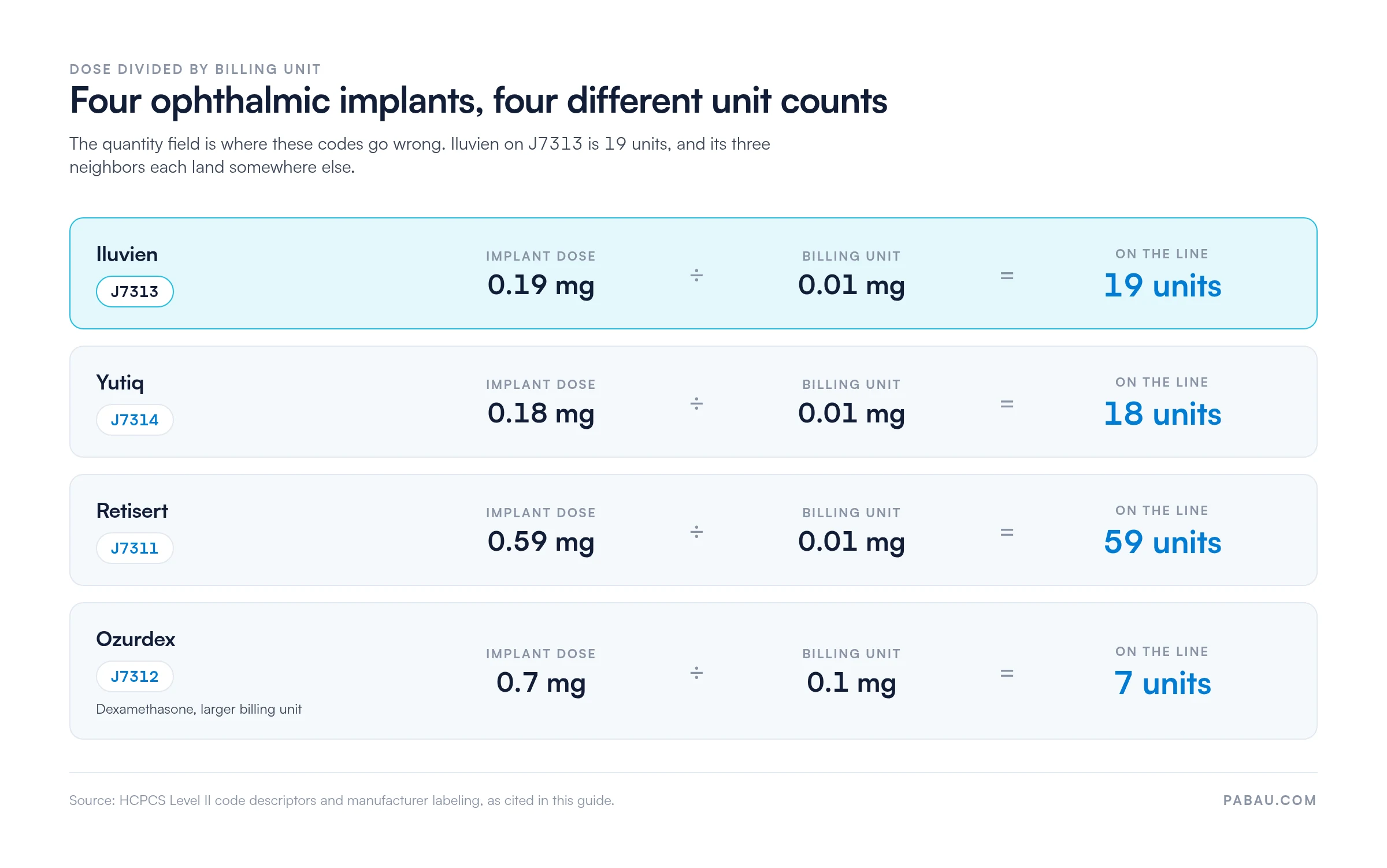
Billing 1 unit is not a rounding error. It asks the payer for 0.01 mg of a 0.19 mg implant. The line then pays roughly a nineteenth of what the drug cost the practice, and the remittance gives no reason.
There is no partial dose to worry about. Iluvien ships as a single-dose, preloaded applicator, so the quantity on the line is always 19. Treating both eyes on the same day means two implants and 38 units.
Iluvien was a diabetic macular edema (DME) product for its first decade on the US market. On March 14, 2025, the FDA approved an expanded label that added chronic non-infectious uveitis affecting the posterior segment of the eye.
That change matters at the claim level. Coding references written before 2025 still describe Iluvien as DME-only. A biller following one of them may reject a legitimate uveitis claim before it reaches the payer.
For DME, Iluvien is indicated in patients already treated with a course of corticosteroids. Those patients must not have had a clinically significant rise in intraocular pressure. That wording is a documentation requirement, not clinical background.
So record the prior steroid course and the IOP readings that followed it. Commercial reviewers ask for both, and an appeal built on a chart that shows neither tends to fail.
The 2025 addition covers chronic non-infectious uveitis of the posterior segment. Document that the uveitis is non-infectious in origin, because that one word separates a payable claim from a denied one.
This is the indication Yutiq was built for, which is why the two products now blur together in billing. The code on the line, rather than the diagnosis, tells the payer which implant went in.
The ICD-10 code carries the medical necessity for a J7313 claim. ANI publishes the code families it expects for each indication, and both sets are laterality-specific. Report to the highest level of specificity the record supports.
Both tables below cover the codes ANI names directly. When a chart falls outside them, the wider ICD-10-CM code reference covers the neighboring families.
The E08, E09, E10, and E13 categories carry the same four rows for the other diabetes types. Watch the tail of the code. One that reads without macular edema will not support a DME claim, however accurate the retinopathy grade is.
ANI’s guide lists further H30 subcategories for focal, peripheral, and generalized chorioretinal inflammation. Payer coverage lists are narrower than the label, so check the local coverage determination or the plan’s drug policy before you order the implant.
Iluvien arrives as a single-dose applicator, so nothing is left over to discard. CMS still wants that stated on the claim, and the modifier is how you state it.
Since July 1, 2023, Medicare has required either JW or JZ on separately payable Part B drugs in single-dose containers. From October 1, 2023, a claim that omits the modifier can come back as unprocessable, and you correct it and resubmit.
Bilateral cases need a decision before submission. Payers differ on whether the administration goes out with modifier 50 or as separate LT and RT lines. Confirm the plan’s rule rather than assuming it.
Medicare Part B pays separately payable drugs at average sales price plus 6%. CMS republishes the ASP pricing file every quarter, so the allowed amount for J7313 moves four times a year. The formula is ASP multiplied by 1.06.
Check the current quarter before you order. Under buy-and-bill the practice pays for the implant first and gets reimbursed only after the claim processes. A price that has moved since last quarter comes straight off the margin.
Commercial rates work differently. Some plans pay a percentage of average wholesale price rather than ASP, which changes the acquisition math. Reading the remittance line by line is how billing teams catch the difference.
Put the CMS ASP pricing file on a quarterly calendar reminder, dated a week before your usual reorder. Checking the current allowed amount takes minutes. It is also the last point in the cycle where you can still act on a price change.
In a physician office, place of service 11, the practice buys the implant and bills both J7313 and the administration code. The administration pays at the non-facility rate, which includes the practice expense of doing the procedure.
In a hospital outpatient department or an ambulatory surgical center, the facility buys and bills the implant. The physician bills only the administration, at the facility rate. Hospitals report the drug under revenue code 0636 and the procedure under 0361.
Buy-and-bill means the practice purchases the implant, administers it, then bills for the drug and the procedure. Six steps protect the money, and they run in this order.
A complete charge sheet at step five saves the back-and-forth at step six. One clean submission beats two appeals.
Take a patient with type 2 diabetes and moderate nonproliferative retinopathy with macular edema, right eye. She has already had a course of corticosteroids, with no clinically significant IOP rise. The physician implants Iluvien in the office.
Two lines, one diagnosis, one modifier. Swap the right eye for the left and only two fields move, the diagnosis to E11.3312 and RT to LT. Treat both eyes the same day and the drug quantity totals 38.
If the remittance comes back at roughly a nineteenth of the drug cost, the quantity field is where to look first.
Medicare fee-for-service generally does not require it. Almost every other payer does, and the requirements split three ways.
Published criteria show how specific this gets. UnitedHealthcare’s commercial policy, effective August 1, 2026, treats Iluvien as proven for chronic non-infectious posterior uveitis.
It is also proven for DME after a prior corticosteroid course with no clinically significant IOP rise. The policy caps the dose at one implant per eye and the authorization at 60 days.
That 60-day window is short enough to expire between approval and the surgery date. So build the expiry check into scheduling rather than into the day of service.
Each of these turns up in ophthalmology billing regularly, and each has a fix that takes less time than the appeal.
The line is quantity-driven, not product-driven. Put the unit count on a reference card at the charge-capture step, next to the 18 for J7314 and the 59 for J7311.
Yutiq belongs on J7314 at 18 units, and has done since October 2019. Anyone working from a 2019 payer bulletin will get this wrong, so date-check the source before you trust it.
Retisert holds 0.59 mg and bills under J7311 at 59 units. Same active ingredient, different product, different code, and a quantity three times larger.
A missing wastage modifier can send the claim back as unprocessable rather than denied, which means it never enters the appeal queue. Make JZ a required field on the charge line for this code.
Two versions of this show up. One is a retinopathy code that reads without macular edema. The other is a laterality mismatch, where the diagnosis names the right eye and the operative note names the left.
J7313 pays for the implant only. Leave the administration CPT code off the claim and you forfeit the procedure payment quietly, because the drug line still pays on its own.
J7313 covers the drug alone. You bill the injection separately, and the neighboring J-codes exist so a payer can tell four ophthalmic implants apart.
Ozurdex is the odd one out here, because it carries dexamethasone rather than fluocinolone. It bills under J7312 at 0.1 mg per unit, so a 0.7 mg implant is 7 units.
The administration code is worth a second look. Most payers and the American Academy of Ophthalmology point to CPT 67028 for an injected implant. ANI’s billing guide lists both 67027 and 67028, and shows 67027 on its sample claim form. Check the policy before the first claim of the year goes out.
Set your billing system to reject a J7313 charge line that has no administration code attached to the same date of service. The drug line pays fine on its own, so a missing injection code can go unnoticed for months.
One pass over the charge line catches most of what goes wrong above. Six of these take seconds, and the other two take a phone call.
A line that fails this pass is cheaper to fix now than to appeal in six weeks.
Most ophthalmology practices record the implant in one system and build the claim in another. Someone reads the note, works out the units, and retypes the NDC into a billing screen. Each hop is a chance to lose a digit.
Practice management software like Pabau closes that hop. The treatment note, the diagnosis, the product used, and the invoice sit in one client record.
From there, claims management software builds the claim from what the clinician documented. In the US, claims route through Claim.MD, and eligibility checks, claim status, and remittance posting land against the same record.
It does not make the coding decisions for you. Pabau will not choose the modifier or judge whether the diagnosis supports the indication. No software replaces a biller who has read the payer policy. What it removes is the retyping between the record and the claim.
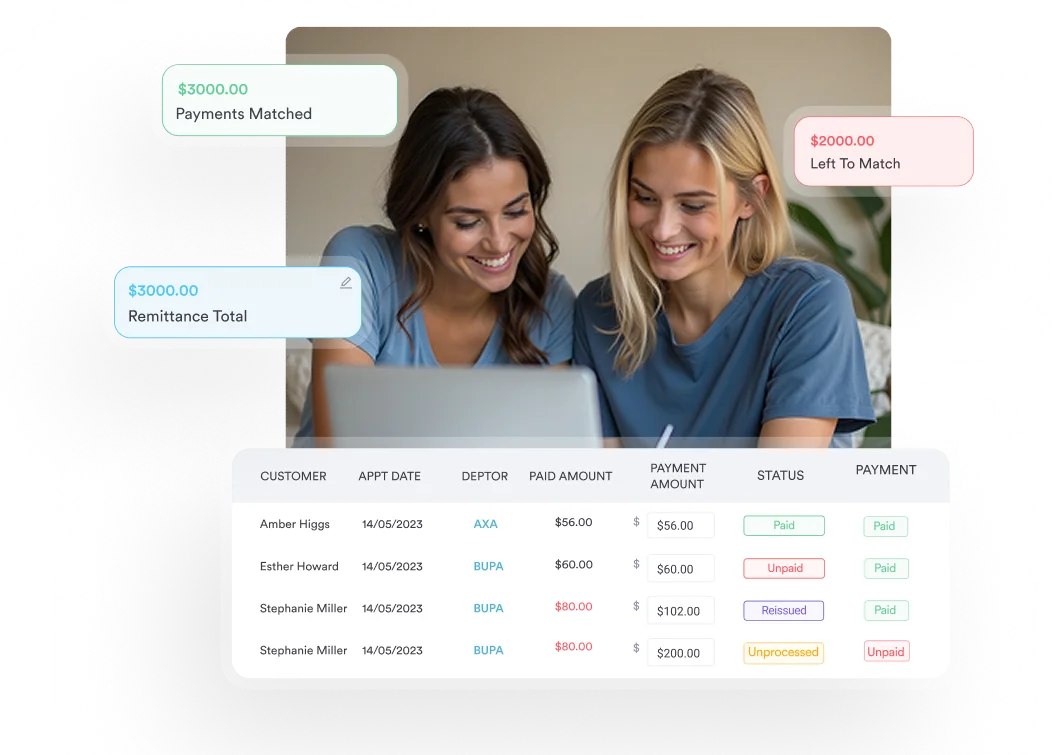

Pabau keeps the treatment note, the diagnosis, and the invoice in one client record, then submits the claim electronically. Your billers work from what the clinician documented instead of retyping it into a second system.

J7313 is a simple code with one expensive trap in it. The descriptor names Iluvien, and only Iluvien, at 19 units per implant. Yutiq has billed under J7314 since 2019, whatever a surviving 2019 bulletin says.
The rest is routine. Put JZ on the line and match the diagnosis to the indication and the eye. Check the quarterly ASP before you order, and bill the administration code alongside the drug.
Get those four right and J7313 stops being a denial risk. To see how Pabau carries an implant administration straight through to a submitted claim, book a demo.

Want to see how a drug claim reaches the payer? Medical claims clearinghouse overview explains how electronic claims route from practice to payer, and where J-code lines stall.
Working a J7313 denial right now? Denial codes in medical billing covers the remittance reason codes you will see and how to answer each one.
Billing the dexamethasone implant instead? HCPCS code J7312 sets out the Ozurdex unit math, modifiers, and diagnosis pairing.
Checking coverage before you order the implant? Insurance eligibility verification walks through the benefit checks that stop a buy-and-bill purchase from stranding.
Reconciling what Medicare paid? Electronic remittance advice explains how to read an ERA line by line and spot an underpaid drug line.
J7313 bills the Iluvien fluocinolone acetonide intravitreal implant, 0.19 mg. One unit equals 0.01 mg, so a single implant is reported as 19 units.
No. Yutiq has had its own code, J7314, since October 1, 2019, and it bills at 18 units. Any guidance pairing Yutiq with J7313 predates that code.
JZ. It attests that no drug was discarded, which is always the case with a single-dose implant. Medicare has required JW or JZ on these lines since July 1, 2023.
Laterality-specific diabetic retinopathy codes with macular edema, such as E11.3211, or posterior uveitis codes such as H30.021 and H44.111. Payer policies list narrower sets.
Average sales price plus 6%, recalculated each quarter from the CMS ASP pricing file. Check the current quarter before each purchase, because the rate moves four times a year.
CPT 67028 for the intravitreal injection, with LT or RT to show the eye treated. ANI’s billing guide also lists 67027, so confirm which one the payer wants.
Medicare fee-for-service generally does not. Medicare Advantage, Medicaid, and commercial plans usually do, and commercial criteria often cap the authorization at 60 days and one implant per eye.