CCSD code H4430: Examination of rectum under anaesthetic
CCSD code H4430 pays for the examination alone CCSD code H4430 is the UK private...

Last Updated: Oct 20, 2026
J7300 is the HCPCS Level II code for intrauterine copper contraceptive (paragard).
The companion codes are CPT 58300 for insertion, CPT 58301 for removal, and ICD-10-CM Z30.430 for the encounter itself. Most J7300 denials trace back to a mismatched diagnosis code, an unverified prior authorization, or a payer bundling the device into the insertion payment.
Let Pabau's smart automation suggest the right codes, reduce claim denials, and keep your practice compliant—effortlessly.
Automate repetitive tasks and focus on what matters most—your patients.
Reduce coding errors and ensure compliance with the latest regulations.
Clean claims, fewer denials, and faster reimbursements.
Powerful insights and reporting to help your practice thrive.
HIPAA compliant SOC 2 certified GDPR-compliant Trusted by 4,000+ clinics worldwide

HCPCS code J7300 reports one Paragard T 380A copper IUD device, billed separately from the insertion or removal CPT code.
CPT 58300 reports the insertion and CPT 58301 reports the removal. Both may appear on the same claim as J7300.
ICD-10-CM Z30.430 is the primary diagnosis code for an IUD insertion encounter; Z30.432 covers removal.
Practice management software like Pabau supports J7300 and companion CPT submission with built-in coding workflows for OB/GYN practices.
HCPCS code J7300 is a Level II HCPCS code that identifies one unit of the intrauterine copper contraceptive device, sold as Paragard T 380A. The Centers for Medicare and Medicaid Services (CMS) publishes it under the J-code category. That category covers drugs and devices given by a route other than oral. J7300 is active for the 2026 code year and carries a Type of Service designation of 9 (Other Items). One unit equals one device.
The code is used in both physician office and outpatient hospital settings. It reports the device rather than the clinical service of placing it. That distinction answers the question coders ask most often about this code. J7300 and the insertion CPT code go on the same claim, because they represent two separate billable events.
Billing J7300 correctly means pairing it with the right procedure CPT code on the same claim. The device code covers the Paragard unit. The CPT code covers the clinical service performed.
Some payers attempt to bundle J7300 into the CPT 58300 allowable. The ACOG LARC Quick Coding Guide confirms that the device and the insertion service are separately reportable. If a payer downcodes or bundles, document the device acquisition cost and appeal using the modifier and documentation guidance below.
Every J7300 claim requires a supporting ICD-10-CM diagnosis code. The primary code depends on the service performed at the encounter. Missing or mismatched diagnosis codes are one of the top denial triggers for J7300 claims.
Z30.430 is the primary diagnosis code for the vast majority of J7300 claims. Z30.09 may appear as a secondary code when contraceptive counseling was furnished at the same encounter. It should never replace Z30.430 as the primary. The full ICD-10-CM code set lists the rest of the Z30 contraceptive management family, including the codes for surveillance and complications.
Medicare Part B may cover J7300 when it is medically necessary, but coverage is not automatic. CMS publishes no National Coverage Determination that treats contraception as a preventive benefit for fee-for-service beneficiaries. The ACA preventive services mandate applies mainly to commercial plans. Coverage is instead assessed locally, through Local Coverage Determinations (LCDs) that vary by jurisdiction.
Verify the applicable LCD policy before billing. Always check the CMS Physician Fee Schedule lookup tool for the current Medicare allowable for J7300. Rates are updated annually, so a figure carried over from last year’s fee schedule will misstate what the claim actually pays.
The buy-and-bill model applies to J7300 in most physician office settings. The practice acquires the Paragard device, provides it to the patient, then bills the payer using J7300. Under Medicare Part B, reimbursement is typically tied to Average Sales Price (ASP) plus a percentage markup. Contracted commercial rates vary, so the margin on each device differs by payer.
Under the ACA’s preventive services mandate, non-grandfathered commercial health plans must cover all FDA-approved contraceptive methods with no cost-sharing. Paragard is one of them, so J7300 and CPT 58300 should be covered at 100% for most commercially insured patients. No copay or deductible applies when the claim is coded correctly.
Two categories of plans are exempt. Grandfathered plans existed before March 23, 2010 and have not made significant benefit reductions since. Many large self-insured employer plans also opt out, particularly those with religious or moral objections. For patients on either kind of plan, cost-sharing applies.
Verifying the patient’s benefits before the appointment avoids a coverage conversation after the procedure has already happened. When a practice bills J7300 with an office visit E/M code on the same date, some payers require a modifier or separate documentation. Check the individual payer’s billing manual for its same-day billing rules.
Prior authorization requirements for J7300 vary widely by payer. Many commercial insurers waive PA for contraceptive devices under the ACA mandate, but Medicaid managed care plans and some commercial plans still require pre-authorization. Always verify with the individual plan before scheduling the procedure.
Modifier usage is payer-specific. Verify requirements with each plan and document the justification for every modifier in the patient record. A claim that goes out clean the first time avoids the back-and-forth that delays reimbursement by weeks.
Before the first J7300 claim of the year, run an eligibility check for every scheduled IUD patient. Payer policies on prior authorization and cost-sharing for J7300 can change at the annual plan reset. Finding a lapsed benefit before the device is opened is far easier than appealing a retroactive denial afterward.
Complete documentation separates a paid J7300 claim from a denial or an audit finding. Payers commonly require evidence that the device was physically provided, medically indicated, and recorded in the patient chart. Standardized intake documentation cuts the preparation time for each IUD encounter.
These elements must be present before the claim is submitted, not assembled after a payer requests an audit. Building the documentation checklist into the pre-procedure workflow is the most reliable way to keep it consistent. An intake template with J7300-specific fields lets billing staff pull every required element without working from memory.
Contraceptive counseling provided at the same visit should be captured under Z30.09 as a secondary code, with a matching note in the encounter record. Reproductive health records also carry heightened privacy expectations, so restrict chart access the way the practice’s HIPAA policy requires.
Accurate LARC coding requires distinguishing copper IUDs from hormonal IUDs. The levonorgestrel-releasing IUD codes share the same CPT insertion and removal codes as J7300. Only the HCPCS device code changes, and picking the wrong one is among the most common errors on IUD claims. Dose and approved duration are what separate the five device codes.
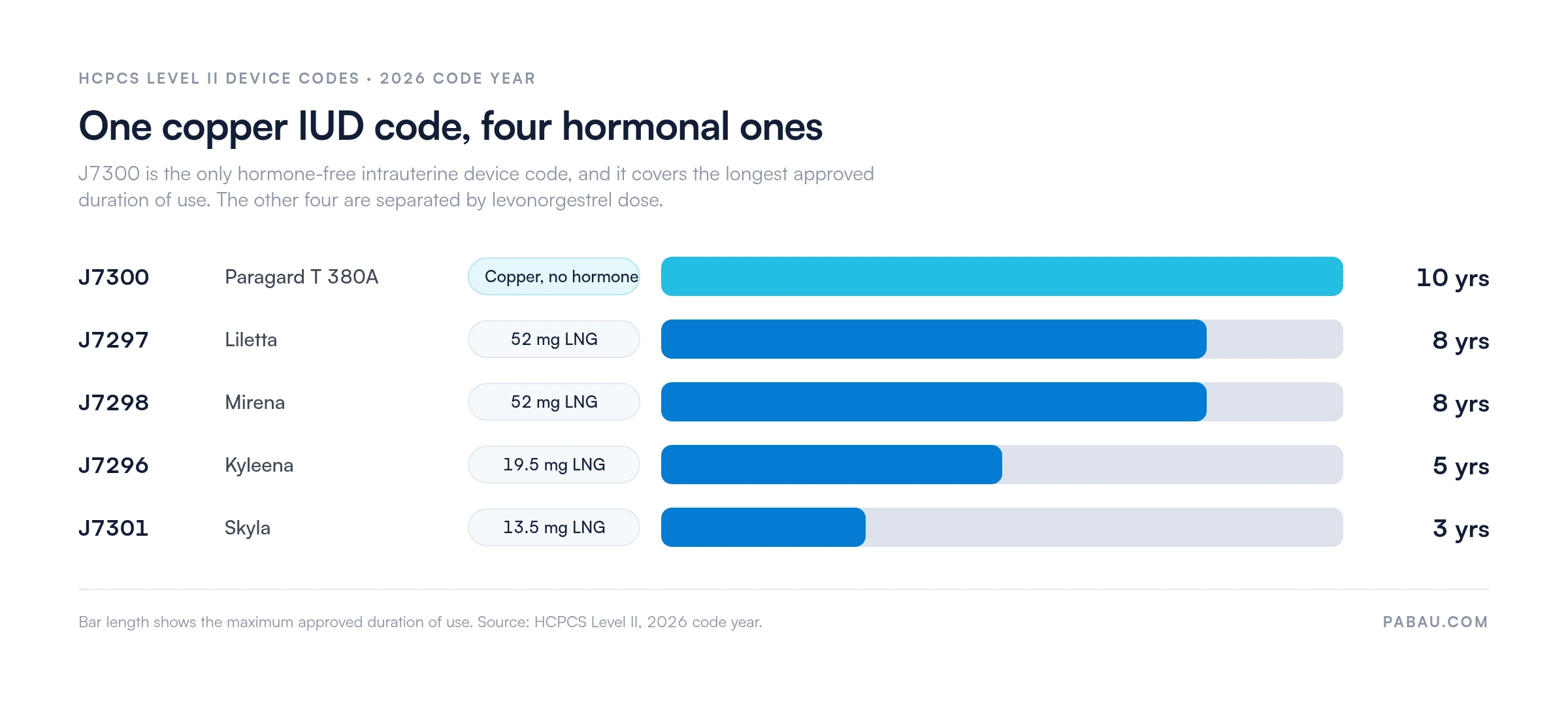
The insertion CPT code, 58300, is the same for every IUD type. The device code is where the claim differs. Practices that stock both copper and hormonal IUDs should build device-specific charge capture, so the J-code follows the device recorded in the procedure note.
The denial reasons below are the ones that recur on J7300 claims, with the correction or appeal route for each. Most of them are preventable at the point of scheduling rather than at the point of appeal.
A structured denial management process catches these patterns before they accumulate. Practices billing J7300 regularly should track denials by reason code month over month. If the same root cause appears more than three times in a quarter, the workflow is the problem rather than the individual claim.
Pabau’s claims management software gives OB/GYN billing teams denial tracking dashboards, so the pattern shows up in a report rather than a quarterly write-off.
Set a recurring quarterly audit on all J7300 claims. Pull every claim, sort by denial reason code, and compare the result against the table above. Two causes account for most J7300 denial clusters. One is missing device documentation, and the other is prior authorization that was never verified.
A J7300 claim usually touches three systems before it gets paid. The device lot number sits in the procedure note, the authorization number in a spreadsheet, and the claim status in a clearinghouse portal. Reconciling them is manual work that often starts only after a denial arrives.
Pabau holds the encounter, the procedure note, and the claim in one record. Charge capture pulls J7300 and CPT 58300 from the documented procedure, so the device code and the service code leave together. Eligibility results and authorization numbers attach to the appointment, where the front desk can see them before the patient is in the chair.
Denials come back into the same record with their reason codes attached. That gives an OB/GYN billing team the month-over-month view described above, without anyone rebuilding it from a claims export. Every Pabau subscription includes the full feature set, so claims management is not a separate tier.

Pabau’s claims management tools support OB/GYN billing workflows, including companion code pairing, eligibility checks, and claim tracking. Your team spends less time chasing denials.

J7300 rewards the practice that does its checking before the device is opened. Verification, the authorization number, and the lot number each cost a few minutes at the front end. Recovering any of them on appeal costs weeks.
The trade-off worth remembering is that copper and hormonal IUDs look identical on the CPT side of the claim. The device code and the documentation behind it are what tell them apart.
If the practice places Paragard more than occasionally, the quarterly denial audit is the single change that pays for itself. Book a demo to see how Pabau tracks J7300 claims from charge capture to remittance.

Need a broader medical billing foundation? What is medical billing explains the end-to-end revenue cycle process for clinical practices handling device-based billing.
Concerned about claim denials stacking up? Denial codes in medical billing covers CARC denial reason codes and how to act on them at the claim level.
Need the document behind the claim? Superbill covers the charges, codes, and provider details a payer expects on a patient-submitted claim.
HCPCS code J7300 bills for one intrauterine copper contraceptive device, the Paragard T 380A. It applies in a physician office or outpatient setting. The code reports the device alone. The insertion and removal procedures are billed separately, using CPT 58300 and CPT 58301.
ICD-10-CM Z30.430 (encounter for insertion of intrauterine contraceptive device) is the primary diagnosis code for most J7300 claims. Z30.432 covers removal encounters and Z30.433 covers removal with reinsertion. Z30.09 may appear as a secondary code when contraceptive counseling is provided at the same visit.
Yes, J7300 and CPT 58300 may be billed on the same date of service. They represent two distinct billable events, the device and the insertion procedure. Some payers attempt to bundle them. Use modifier 59 on J7300 and cite ACOG’s LARC coding guidance when appealing a bundling denial.
Medicare Part B may cover J7300 when medically necessary, but coverage is not guaranteed by a national coverage determination. Coverage depends on the applicable Local Coverage Determination (LCD) from the regional MAC. Practices should verify the LCD before billing and consider appending modifier KX when required by the MAC.
J7300 is the code for the Paragard T 380A copper IUD, which contains no hormone. J7301 is the code for Skyla, the 13.5 mg levonorgestrel-releasing IUD. Mirena is J7298 and Liletta is J7297, so neither belongs under J7301. Both devices use CPT 58300 for insertion, so confirm the device from the procedure note and package label before billing.
It depends on the payer. Most ACA-compliant commercial plans do not require prior authorization for J7300 under the contraceptive mandate. Medicaid managed care plans and some commercial plans do require PA. Always verify with the individual plan before the procedure date, document the PA number, and include it on the claim if obtained.