

HCPCS code E0198: Water pressure pad billing guide
HCPCS code E0198 is a water pad for a standard mattress HCPCS code E0198 is the ...

Last Updated: Oct 13, 2026
22585 is the CPT code for arthrodesis, anterior interbody technique, including minimal discectomy to prepare interspace (other than for decompression); each additional interspace.
It is an add-on code, so it is reported only with 22554 (cervical below C2), 22556 (thoracic) or 22558 (lumbar). A three-level anterior cervical fusion takes one primary code and two units of 22585. The wrong count, or the wrong parent code, produces a CARC 4 or B15 denial on first submission.
Let Pabau's smart automation suggest the right codes, reduce claim denials, and keep your practice compliant—effortlessly.
Automate repetitive tasks and focus on what matters most—your patients.
Reduce coding errors and ensure compliance with the latest regulations.
Clean claims, fewer denials, and faster reimbursements.
Powerful insights and reporting to help your practice thrive.
HIPAA compliant SOC 2 certified GDPR-compliant Trusted by 4,000+ clinics worldwide

CPT 22585 is an AMA-designated add-on code, always reported alongside a primary anterior interbody fusion code and never billed standalone.
Valid primary codes are 22554 (cervical below C2), 22556 (thoracic) and 22558 (lumbar); pairing with the wrong primary triggers an automatic claim denial.
CPT 22551 is never a valid primary for 22585. It is the decompression-inclusive cervical code, and it pairs only with its own add-on, 22552.
As an add-on code, 22585 is modifier 51 exempt. Appending modifier 51 signals a separate procedure and invites a payment reduction.
Medicare coverage for lumbar fusion runs through a MAC-specific LCD, so check each diagnosis against the policy that applies in your region.
CPT Code 22585 describes arthrodesis, anterior interbody technique, including minimal discectomy to prepare the interspace (other than for decompression); each additional interspace. The American Medical Association (AMA) publishes it within the Musculoskeletal System section of the CPT code set. It is an add-on code, so the AMA designates it for use only alongside a specified primary procedure code.
The procedure prepares an intervertebral space through minimal discectomy, removing just enough disc material to allow graft placement. The surgeon then fuses the adjacent vertebrae using an anterior or anterolateral approach. The minimal discectomy is incidental to the fusion, not a separate decompressive procedure.
That distinction decides how the operative note should read. A note describing the discectomy as a separate decompressive intervention invites payer scrutiny about unbundling, even when the surgeon did nothing of the kind.
CPT 22585 may be reported only with 22554, 22556 or 22558, in the same operative session as that primary. An add-on code reports a service that is always performed with a defined parent procedure. The primary captures the first interspace, and 22585 captures each one after it.
CPT 22551 is not one of them. That code describes the same anterior approach performed with decompression of the spinal cord and/or nerve roots, including osteophytectomy, at cervical levels below C2. It carries its own add-on, CPT 22552, for each additional interspace. Pairing 22585 with 22551 links an add-on to a primary it was never built for, and the claim edits out.
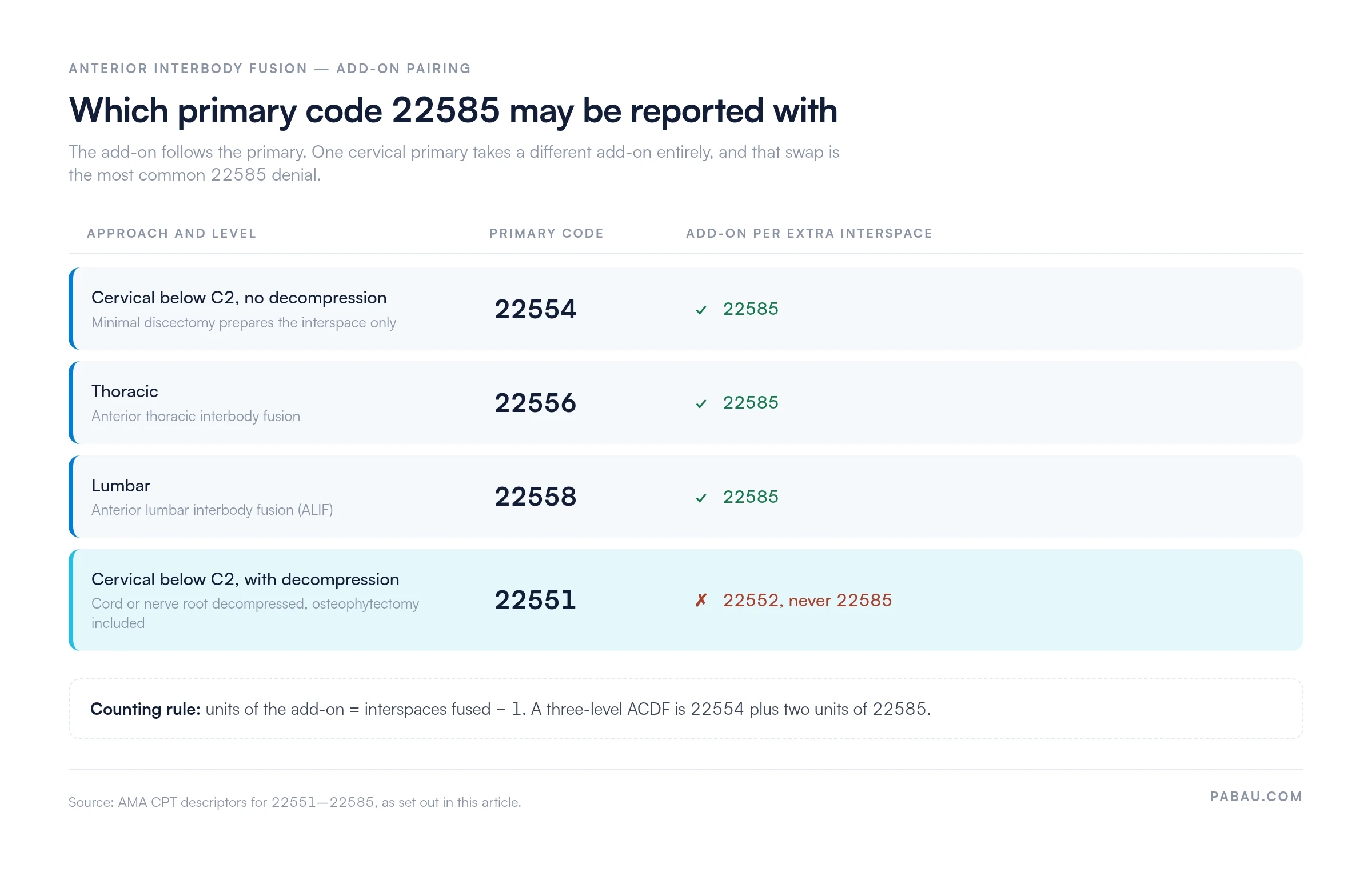
A two-level ACDF at C5-C6 and C6-C7 lists 22554 for the first interspace and 22585 for the second; a three-level fusion adds a second unit. The same logic applies with 22556 in the thoracic spine and 22558 in the lumbar spine.
No other primary code authorizes 22585. Pairing it with posterior fusion codes (22612, 22633), decompression-only codes (63030), or 22551 generates a claim edit under CMS add-on code policy — the payer reads the linkage as incorrect and denies the line. Check the current pairings in the CMS National Correct Coding Initiative add-on code edit file each quarter.
The anterior approach means the surgeon reaches the spine from the front of the body rather than from the back. That is through the neck for cervical cases, and through the abdomen for lumbar cases. The approach decides which CPT code family applies. Anterior interbody codes (22551, 22552, 22554, 22556, 22558, 22585) and posterior fusion codes (22612, 22614, 22633) are not interchangeable.
Billers sometimes confuse 22585 with 22552, and the difference is clinical. 22585 covers additional interspaces where the discectomy only prepares the space for the graft, so its primary is 22554, 22556 or 22558. 22552 covers additional cervical interspaces where the surgeon also decompressed the cord or nerve roots, so its primary is 22551. The operative report language decides which pair applies.
Report one primary code, then one unit of 22585 for every additional interspace fused in the same approach and the same operative session. Counts are based on interspaces, the space between two adjacent vertebrae, and not on individual vertebrae.
Example: a three-level ACDF at C4-C5, C5-C6 and C6-C7, with no separate decompression. The sequence is 22554 (C4-C5, primary level), then 22585 (C5-C6, second level), then 22585 (C6-C7, third level). Two units of 22585 appear on the claim.
Before submitting a multilevel spine claim, reconcile the level count in the operative report with the imaging and the anesthesia record. A discrepancy between any two of those three sources is one of the most common reasons a MAC requests additional documentation on a 22585 claim. Build a pre-submission checklist that cross-references all three.
Add-on codes carry a specific modifier profile. Getting it wrong delays payment, whether by omitting a required modifier or by appending one that does not apply. AMA CPT Appendix A is the definitive reference for the definitions below.
Medical necessity for anterior interbody fusion must be supported by a documented primary diagnosis. For Medicare, the coverage rules sit in a Local Coverage Determination issued by your Medicare Administrative Contractor (MAC). Lumbar fusion is covered under a lumbar spinal fusion LCD such as L37848, and the policy number varies by MAC jurisdiction. Commercial payers often adopt similar criteria, though the covered code lists differ. The AAPC’s CPT-to-ICD-10 crosswalk tool is a practical way to confirm diagnosis-to-procedure pairings.
Two of those families need a sixth character before they are billable. M50.12 and M50.22 are category-level codes, so the claim must carry M50.121-M50.123 or M50.221-M50.223 to name the level. A four-character code on the line is rejected as invalid rather than denied on medical necessity.
Always list the primary diagnosis first on the claim. Secondary diagnoses such as radiculopathy or myelopathy may be required to satisfy LCD criteria, especially for multilevel fusions where medical necessity thresholds are higher.
Medicare pays for 22585 through the Medicare Physician Fee Schedule (MPFS). Rates are adjusted by locality using CMS-assigned geographic practice cost indices (GPCIs). The figures below are the 2026 national values from the CMS relative value file. Verify them against the current MPFS for your own MAC locality before using them in revenue projections.
There is no separate non-facility rate to look up. CMS carries no non-facility practice expense value for 22585, so the facility figures above apply wherever the procedure is performed. That is consistent with the clinical reality, since anterior interbody fusion is done in a hospital or an ambulatory surgery center.
The payment figure uses the 2026 non-qualifying conversion factor of $33.4009. Practices that meet the qualifying alternative payment model criteria are paid on a conversion factor of $33.5675. That puts the same 8.61 total RVUs at roughly $289.02 per unit. Multilevel cases multiply that figure by the number of add-on units on the claim.
The operative report is the claim’s evidentiary foundation. For an anterior interbody fusion using 22585, it has to document six specific elements to withstand payer review. Practices working to clean claim submission standards run this checklist as part of pre-submission scrubbing.
Spine claims produce higher denial rates than most other surgical specialties, and most 22585 denials trace to a handful of avoidable errors. Each one below is caught at the pre-claim review stage rather than after a rejection lands. The denial codes reference maps the CARC and RARC codes a payer returns when one of these slips through.
Medicare guidance for lumbar spine fusion flows through the MAC’s own LCD, such as L37848 in the jurisdictions that publish it. The criteria are consistent in shape. They ask for six weeks or more of failed conservative treatment, imaging that confirms structural pathology, and a covered diagnosis. Cervical fusion sits under separate policies that also vary by MAC region. Verify the applicable LCD for your geographic area through your MAC’s website.
Commercial payers add another layer. Most major plans require prior authorization for any spinal fusion, including multilevel procedures where 22585 appears. Authorization requests typically ask for the primary diagnosis, imaging results, a record of failed conservative therapy, and the proposed procedure codes. Securing authorization without listing 22585 creates a mismatch that can end in denial even when the primary code is approved.
A biller reviewing a multilevel anterior fusion claim tracks four separate judgments at once. Those are the add-on pairing, the level count, the modifier profile, and the ICD-10 crosswalk. Most of that reconciliation happens by hand, against a printed operative report and a payer policy opened in another tab. One missed element produces a denial that costs the practice weeks of delayed payment.
Practice management software like Pabau keeps the encounter, the clinical documentation and the claim on one patient record. Nobody rebuilds the case from three systems before it goes out. Pabau’s claims management software checks the submission details a payer needs, sends the claim, and tracks its status through to payment.
The coding judgment stays with your coder, which is where it belongs on a spine claim. What changes is the chasing. A rejected 22585 line surfaces in the same view as the rest of the week’s submissions. Your team works a short list instead of reconstructing which claims went out.

Pabau keeps the operative documentation, the coded claim and the payer response on one patient record, then tracks each submission through to payment. Your billing team spends less time working out where a claim went.

CPT Code 22585 is a narrowly defined add-on. It is valid only alongside 22554, 22556 or 22558, and it is modifier 51 exempt. It is never reported with 22551, which has its own add-on in 22552. Three habits do most of the work for a billing team. Get the level count right and pair 22585 with the correct primary. Then confirm the prior authorization covers the full code set.
The trade-off worth remembering is that none of this is caught by the claim form. It is decided in the operative note, weeks before anyone bills it. The fix belongs with the surgeon’s dictation template as much as with the coder. Book a demo to see how Pabau keeps spine documentation and claim status in one place for your billing team.

Want to understand how clearinghouse validation reduces claim denials? Pabau’s Claim.MD clearinghouse integration explains how pre-submission scrubbing catches submission errors before payers see them.
Need a reference on denial management workflows? Denial codes in medical billing covers the most common CARC and RARC denial codes spine billers encounter.
Looking for eligibility verification guidance before submitting surgical claims? Insurance eligibility verification walks through how to confirm coverage and prior authorization status before a spine claim goes out.
CPT Code 22585 is an add-on code that reports anterior interbody arthrodesis at each additional interspace beyond the first level. It is always reported alongside a primary anterior interbody fusion code: 22554 for cervical below C2, 22556 for thoracic, or 22558 for lumbar. It is never billed as a standalone procedure.
Yes. CPT Appendix D formally designates 22585 as an add-on code, which means it can never be billed alone. A primary anterior interbody fusion code must appear on the same claim, for the same operative session: 22554, 22556 or 22558. CPT 22551 is not a valid primary, because it pairs with its own add-on, 22552.
CPT 22585 can be reported once for each additional interspace fused beyond the first level. A two-level fusion requires one unit of 22585, and a three-level fusion requires two units. Payer maximum units per claim may vary, so confirm with your MAC or commercial payer for multilevel procedures above three levels.
No. CPT 22585 cannot be billed without a primary procedure code. Submitting it without 22554, 22556 or 22558 on the same claim results in an automatic denial. The payer’s claims processing system flags add-on codes with no parent code present.



