

HCPCS code E0198: Water pressure pad billing guide
HCPCS code E0198 is a water pad for a standard mattress HCPCS code E0198 is the ...

Last Updated: Oct 13, 2026
T1025 is the HCPCS Level II code for intensive, extended multidisciplinary services, billed per diem. The official descriptor covers those services provided in a clinic setting to children with complex medical, physical, mental and psychosocial impairments.
It is used almost exclusively by Prescribed Pediatric Extended Care (PPEC) facilities. These programs serve medically fragile children who need more care than standard day care provides, but not inpatient admission. One unit covers one calendar day, and only state Medicaid programs pay it.
Let Pabau's smart automation suggest the right codes, reduce claim denials, and keep your practice compliant—effortlessly.
Automate repetitive tasks and focus on what matters most—your patients.
Reduce coding errors and ensure compliance with the latest regulations.
Clean claims, fewer denials, and faster reimbursements.
Powerful insights and reporting to help your practice thrive.
HIPAA compliant SOC 2 certified GDPR-compliant Trusted by 4,000+ clinics worldwide

HCPCS code T1025 is a per diem code, not a per-visit code. One unit equals one calendar day of PPEC services.
T1025 is a Medicaid code only. Medicare does not recognize T-series codes and will deny any T1025 claim.
A physician-signed care plan and a daily attendance record are the two documents most frequently cited in PPEC audits.
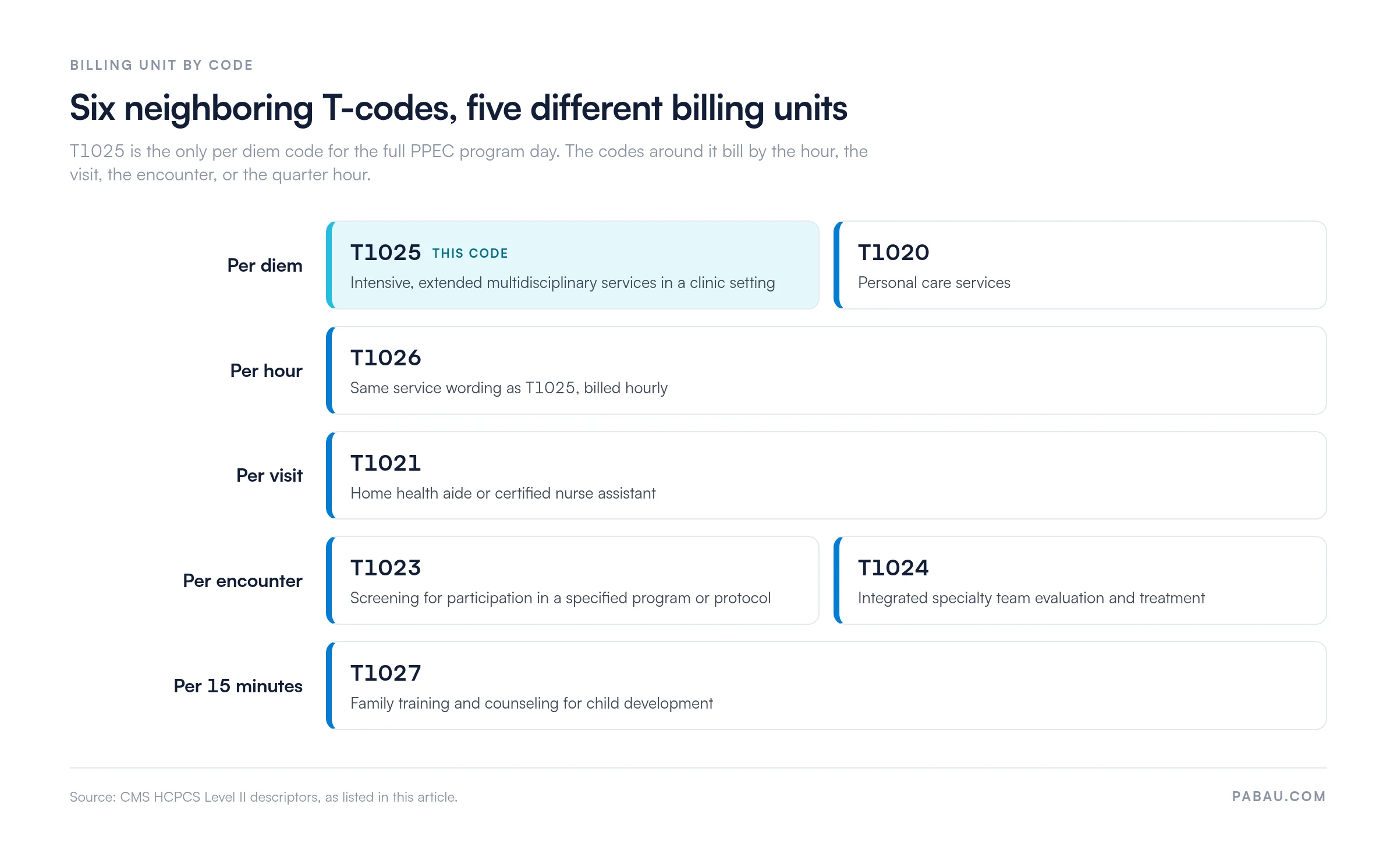
The codes around T1025 bill on different units, so T1026 pays per hour and T1024 pays per encounter.
Pabau’s claims management software supports HCPCS code entry, Medicaid claim preparation, and auditable daily service documentation.
HCPCS code T1025 is a Level II code billed per diem for intensive, extended multidisciplinary services. CMS defines those services as provided in a clinic setting to children with complex medical, physical, mental and psychosocial impairments. The code took effect on January 1, 2000 and remains valid for 2026 billing.
T1025 sits within the T-series of HCPCS Level II codes, the range T1000-T5999. The Centers for Medicare and Medicaid Services (CMS) maintains that range for use by state Medicaid agencies.
Unlike CPT codes or J-codes, T-series codes have no Medicare applicability. State Medicaid programs use them to pay for services the AMA’s CPT system does not describe.
A Prescribed Pediatric Extended Care (PPEC) facility is a licensed, medically supervised day program for children who are medically fragile or technology-dependent. These children need intensive nursing and therapeutic services during daytime hours. PPEC sits between home nursing care, which is often insufficient or unsustainable, and pediatric inpatient admission, which is clinically unnecessary for stable but complex patients.
Children who qualify typically have diagnoses such as bronchopulmonary dysplasia, cerebral palsy, spina bifida, tracheostomy dependency, or complex seizure disorders. The multidisciplinary team usually includes registered nurses, respiratory therapists, physical therapists, occupational therapists, speech-language pathologists, and social workers. All of them coordinate care under a physician’s direction.
T1025 is billed per diem, meaning one unit of service equals one full calendar day of PPEC attendance. A child attending PPEC five days in a given week generates five units of T1025. Billing staff who default to per-visit logic submit one claim line per therapy session. That use of the code is incorrect and will trigger overpayment audits.
Per diem billing bundles every service delivered that day into a single daily rate. Fee-for-service billing instead links each billable event to a specific procedure. The T1025 claim reflects the child’s attendance, not a count of individual services.
Each state’s Medicaid program sets the reimbursement rate for T1025, not CMS federally. No national Medicare fee schedule equivalent exists for T-series codes. States with mature PPEC programs publish explicit per diem rates in their Medicaid fee schedules. States without a recognized PPEC program may publish no rate at all.
Use the CMS Physician Fee Schedule lookup to confirm whether a national rate exists for HCPCS Level II codes. Then cross-reference the relevant state Medicaid agency portal for T1025-specific rates. State Medicaid usually returns an 835 remittance transaction that maps each T1025 claim line to the contracted daily rate.
Important: Specific dollar amounts change with each state’s annual Medicaid rate update. Verify current rates directly from the state Medicaid fee schedule before quoting reimbursement figures to a facility.
T1025 is a Medicaid code. No Medicare coverage exists for T-series HCPCS codes, and any T1025 claim submitted to Medicare will be denied. Medicaid managed care organizations (MCOs) in a state with a PPEC program may cover T1025, though prior authorization rules and rates vary by plan. Verifying the child’s eligibility before each service period prevents the most common coverage-related denials.
Documentation is the area most frequently cited in PPEC audits. The code covers an entire day of intensive services. Payers therefore expect the record to substantiate the child’s medical necessity and the daily delivery of coordinated care. Incomplete documentation drives most retrospective claim denials and recoupment demands.
Structured digital forms for attendance and care-plan documentation reduce the risk of missing fields during an audit. Timestamped entries stored against the child’s record also make retrieval faster when a payer asks for proof.
State Medicaid programs take medical billing compliance seriously for PPEC, given the high per diem cost of these services. Any discrepancy between the daily attendance record and the claim date of service is an automatic audit flag.
Run a weekly reconciliation between your attendance log and your billing queue before submitting T1025 claims. A billed date with no matching attendance record is the fastest path to a full retrospective audit.
Every T1025 claim must carry an ICD-10-CM diagnosis code that establishes medical necessity for the PPEC level of care. The diagnosis should reflect the child’s primary medically complex condition, not an incidental finding. Each code below comes from the ICD-10-CM code set and reflects a population PPEC facilities typically serve.
State Medicaid programs may restrict which ICD-10 codes qualify for T1025 coverage. Cross-reference diagnosis codes against the state’s published PPEC coverage policy before billing. The AAPC HCPCS code lookup includes crosswalk tools that help identify pairing restrictions.
Several T-series codes are used alongside or instead of T1025, and they do not share a billing unit. The grouping below shows which unit each one bills on, which is where most crosswalk errors start. The NLM Clinical Table Search API carries the current CMS description for every T-code.
T1025 claims are denied more often than most HCPCS codes, because coders unfamiliar with PPEC apply standard outpatient logic to a per diem program. The errors below repeat across a full month of billing, so each one compounds quickly.
Each claim line needs complete patient demographics, a valid NPI, and a diagnosis code that passes the state’s medical necessity criteria. Add T1025 as the procedure code only once those are in place.
PPEC facilities carry a documentation load that most practice management tools were not built to handle. Per diem billing needs daily attendance records tied to individual patient profiles, Medicaid-specific claim formats, and PA renewal tracking across a high-acuity pediatric caseload. Generic billing software treats every claim line as a fee-for-service encounter, which does not match how T1025 works.
Practice management software like Pabau handles HCPCS code entry, Medicaid claim preparation, and structured documentation for complex care settings. Pabau’s claims management software flags pending PA renewals and incomplete daily records before a claim batch is submitted. That gives a PPEC facility time to correct the record before the claim leaves, rather than after a recoupment demand arrives.
A superbill built from each child’s daily attendance record gives the facility a structured internal document that maps attendance to the T1025 claim line. It simplifies audit response and keeps the billing cycle traceable from service delivery to payment posting.

Pabau helps pediatric care facilities manage HCPCS claims, daily documentation, and Medicaid billing workflows in one place. See how it works for your team.

Most PPEC facilities lose money on T1025 through record-keeping rather than coding. A physician order, a current care plan, and a signed attendance record have to line up for every day billed, for every child enrolled.
Build the weekly reconciliation habit before caseload volume grows. Catching one unmatched date of service each week costs a few minutes. Finding sixty of them during a retrospective audit puts months of payments at risk.
Pabau’s claims management platform supports the structured documentation and HCPCS billing workflows that PPEC facilities need. Book a demo to see how it handles Medicaid claim preparation for complex pediatric caseloads.

Want to understand the full revenue cycle? Revenue cycle management fundamentals explains how per diem billing fits into the cycle from eligibility to payment posting.
Concerned about claim denials? Denial codes in medical billing breaks down the most common denial reason codes and how to respond to each one.
HCPCS code T1025 is a Medicaid billing code billed per diem. Its official descriptor covers intensive, extended multidisciplinary services provided in a clinic setting to children with complex medical, physical, mental and psychosocial impairments. Prescribed Pediatric Extended Care (PPEC) facilities are the primary users. They serve medically fragile children who need nursing and therapeutic care in a structured day program.
T1025 is a Medicaid code only. Medicare does not recognize T-series HCPCS codes, and any T1025 claim submitted to Medicare will be denied. CMS maintains the T1000-T5999 range for state Medicaid programs to cover services CPT does not describe.
T1025 is billed per diem, so one unit equals one full calendar day of PPEC attendance. Billing multiple units for a single date of service is incorrect. So is billing one unit per therapy session, and both will trigger claim edits or audit findings.
A T1025 claim needs a physician order authorizing PPEC services and an individualized care plan. It also needs proof of the child’s Medicaid eligibility and medical necessity. Daily attendance records for each billed date and progress notes from nursing and therapy staff complete the file. Where a Medicaid MCO is the payer, prior authorization approval must also be on file.
Florida, Mississippi, Texas, and Kentucky have the most established PPEC Medicaid programs with published T1025 rates. Coverage in other states varies widely, and some have no recognized PPEC benefit at all. Contact the state Medicaid agency directly to confirm whether T1025 is payable in a specific jurisdiction.
Closely related codes include T1020 (personal care services, per diem) and T1021 (home health aide or certified nurse assistant, per visit). T1023 covers screening for participation in a specified program or protocol, per encounter. T1024 covers evaluation and treatment by an integrated specialty team for multiple or severely handicapped children, per encounter. T1026 carries the same service wording as T1025 but is billed per hour, and T1027 covers family training and counseling, per 15 minutes.



