

HCPCS code E0198: Water pressure pad billing guide
HCPCS code E0198 is a water pad for a standard mattress HCPCS code E0198 is the ...

Last Updated: Oct 13, 2026
20670 is the CPT code for removal of implant; superficial (e.g., buried wire, pin, or rod)(separate procedure).
It sits in the Musculoskeletal System section of the American Medical Association's CPT code set, in the 20100-29999 series. Most often it covers Kirschner wire (K-wire) removal after fracture fixation.
The separate procedure designation drives most 20670 denials. The code bundles into any related major procedure performed in the same session. Inside a prior repair's global period it needs modifier 78 or 79. Where the implant sat below the deep fascia, CPT 20680 applies instead.
Let Pabau's smart automation suggest the right codes, reduce claim denials, and keep your practice compliant—effortlessly.
Automate repetitive tasks and focus on what matters most—your patients.
Reduce coding errors and ensure compliance with the latest regulations.
Clean claims, fewer denials, and faster reimbursements.
Powerful insights and reporting to help your practice thrive.
HIPAA compliant SOC 2 certified GDPR-compliant Trusted by 4,000+ clinics worldwide

CPT Code 20670 describes superficial implant removal (wire, pin, or rod) and is designated a separate procedure under AMA guidelines.
20670 bundles when it is performed alongside a related major procedure in the same session. Bill it independently only when the removal stands alone.
Modifier 58, 78, or 79 is required when billing 20670 inside the global period of a prior procedure.
Pabau’s claims management software submits 20670 claims through the Claim.MD clearinghouse and tracks every payer response in one place.
CPT Code 20670 is a musculoskeletal procedure code. Its official AMA descriptor reads: Removal of implant; superficial (e.g., buried wire, pin, or rod)(separate procedure). The code belongs to the Introduction or Removal subsection of the Musculoskeletal System chapter (CPT codes 20100-29999). The parenthetical “(separate procedure)” is a clinical designation rather than a payment instruction. It tells you the code describes work that belongs to a larger operative session when a related major procedure happens at the same time.
“Superficial” in the context of CPT 20670 means the implant lies above the deep fascia and can be retrieved without dissection into muscle or bone. No formal surgical incision through deep tissue layers is required. A K-wire protruding through the skin after a distal radius fracture repair is the textbook example.
When the implant is embedded below the deep fascia, or when its removal requires deep dissection, CPT 20680 applies instead. Choosing the wrong code between the two is a common audit trigger.
CPT 20680 is the deep implant removal counterpart to 20670. It covers hardware embedded below the deep fascia, where retrieval calls for formal dissection. Choosing between the two is the most consequential decision in hardware removal billing. Reimbursement for 20680 runs notably higher, because the operative work is greater.
CPT 20680 carries a 90-day global period, while 20670 carries a 10-day global. Selecting 20680 for an implant that was superficial does more than up-code the encounter. It opens a 90-day window that constrains every related claim the practice files afterward.
Seven modifiers are commonly applied with CPT 20670, depending on clinical context. According to AAPC coding references, choosing the wrong modifier, or omitting a required one, is the leading cause of preventable 20670 claim denials.
Important: Modifier 59 should not be appended reflexively. The National Correct Coding Initiative (NCCI) requires a genuinely distinct procedural service, meaning a different anatomical site, different operative session, or different indication. Appending 59 without clinical justification is a documented audit trigger that the NCCI Policy Manual addresses directly.
Medicare reimbursement for CPT Code 20670 varies by place of service and geographic locality. The CMS Physician Fee Schedule lookup tool is the authoritative source for current rates. The dollar figures below are approximate national averages. Verify them against the current MPFS for your MAC jurisdiction before you bill.
The non-facility rate runs higher because Medicare’s fee schedule builds practice expense RVUs into an office-based payment. In a hospital outpatient or ambulatory surgery center, the facility bills separately for overhead, so the physician component is reduced accordingly. Always verify your locality-specific rate through the CMS MPFS lookup before quoting reimbursement to practice leadership. Reconciling each remittance against that expected rate is how underpayments on 20670 get caught early.
Verify your CPT 20670 reimbursement rates quarterly. The CMS Physician Fee Schedule updates annually on January 1, and some MAC jurisdictions release mid-year corrections. Billing at last year’s rates without checking means you may be under-collecting or, worse, over-billing.
Every CPT 20670 claim requires a paired ICD-10-CM diagnosis code that establishes medical necessity for the removal. The diagnosis pointer on the claim links each procedure code to the diagnosis that supports it. The ICD-10-CM code index carries the full tabular detail behind each family below.
ICD-10-CM codes update annually. Verify each pairing against the current CDC/NCHS tables for the fiscal year in which the service occurs. Incorrect diagnosis-procedure pairings can trigger claim edits that delay payment and require manual resubmission.
CPT Code 20670 carries a 10-day global period. The harder scenario arises when the removal falls inside the 90-day global period of a prior major procedure. An open reduction and internal fixation (ORIF) is the common example. Billing 20670 without a modifier in that window triggers automatic denial, which comes back as claim adjustment reason code (CARC) 97. Which modifier applies depends on why the removal happened and where it took place.
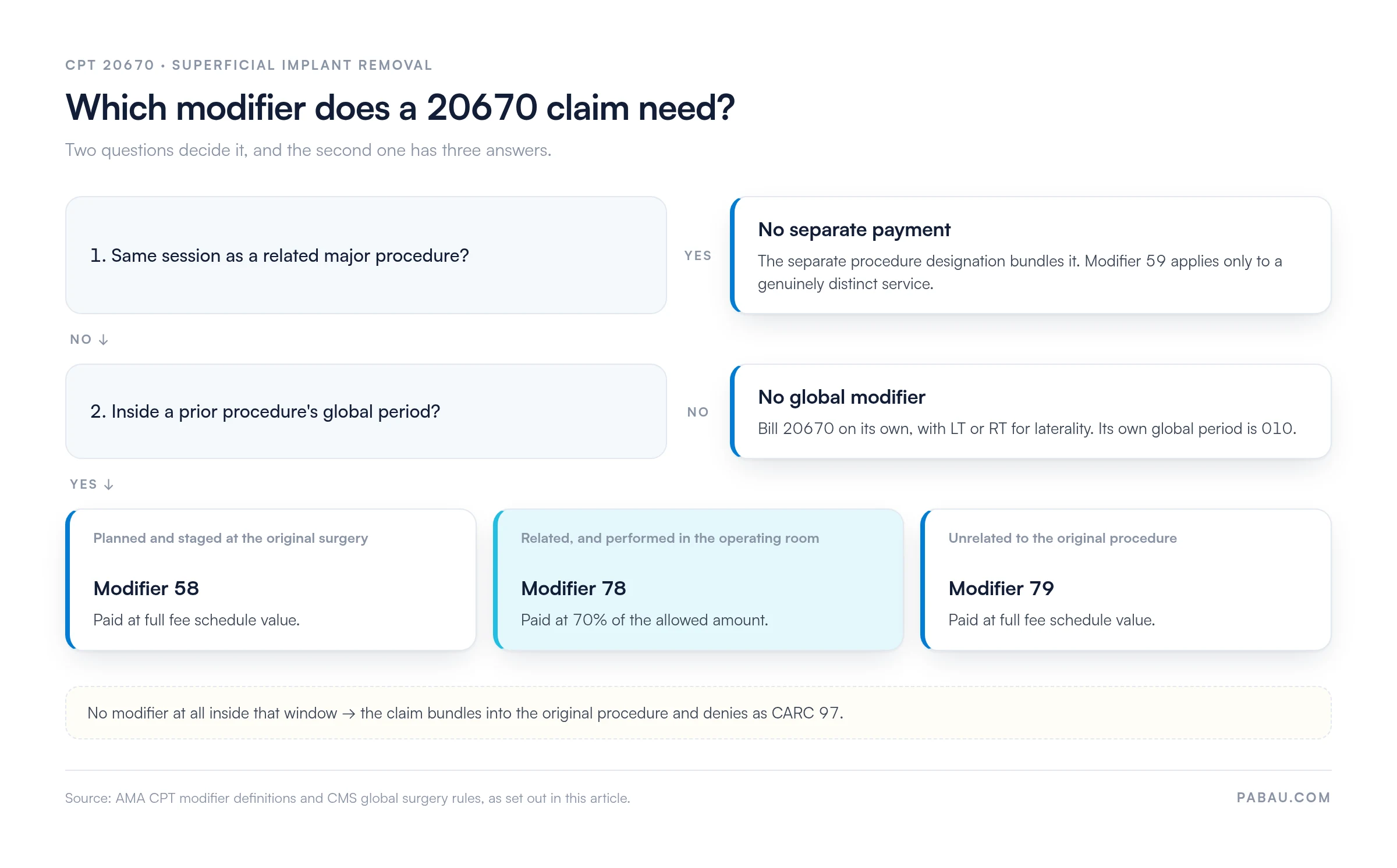
A common scenario: A patient undergoes percutaneous pinning (CPT 26727) for a phalangeal fracture with a 90-day global period. K-wire removal four weeks later falls inside that global window. Without modifier 78 or 58, the CPT 20670 claim bundles into the original procedure and pays nothing.
The operative note for CPT Code 20670 has three jobs. It must support medical necessity, confirm that the implant was superficial, and identify the hardware removed. Vague documentation, such as “hardware removed” with no specifics, is the most common reason 20670 claims survive initial processing but fail retrospective audit. Strong revenue cycle management depends on documentation that passes review without addenda.
A complete operative note also captures anesthesia type (local vs. sedation) and fluoroscopic guidance if used. Fluoroscopic guidance is not bundled with 20670 by default, so if imaging was used and separately billed, document it distinctly.
Medicare generally does not require prior authorization for CPT 20670, but commercial payers vary significantly. Local coverage determination (LCD) policy for superficial implant removal is inconsistent across Medicare Administrative Contractors (MACs) and private insurers. A practice that schedules the removal without checking eligibility can reach billing and find the payer wanted an authorization. Building a payer policy check into the pre-authorization workflow is what prevents that.
CPT 20670 is one of several hardware removal codes in the musculoskeletal chapter. Orthopedic and physical therapy practices need the full family in view to code each encounter accurately. The table below covers the codes most often referenced alongside 20670.
When documenting K-wire removal after a distal radius fracture, note the wire gauge, count (e.g., ‘three 0.062-inch K-wires’), and specific sites of insertion and removal. This level of specificity satisfies medical necessity requirements and makes audit responses straightforward.
Orthopedic and surgical practices billing CPT 20670 hit the same three problems. Global period conflicts, thin modifier documentation, and mismatched diagnosis pointers account for most of the denials. Those are coding decisions, and no software makes them for you. What practice management software like Pabau changes is what happens after the coder decides.
Pabau’s streamlined claims management keeps the CPT code, the modifier, and the paired ICD-10 diagnosis on one record from the charge through to submission. Claims go out electronically through Claim.MD, our US clearinghouse partner, and every payer response comes back to the same screen. A 20670 denial is visible the day it posts, next to the claim it belongs to.
Coding, charting, and claim submission happening in one system removes the re-keying step between them. The 20670 charge, its modifier, and its diagnosis travel together to the clearinghouse, so nobody retypes them onto a separate claim form. Fewer hand-offs means fewer of the transcription errors that turn a clean encounter into a rejected claim.

Pabau holds the CPT code, modifier, and diagnosis on one record and submits the claim through Claim.MD. Every payer response lands back on the same screen.

CPT Code 20670 is easy to identify and easy to mis-bill. The separate procedure designation, the superficial-versus-deep line against 20680, and the global period modifiers are where orthopedic billing errors concentrate. Get the operative note specific and the modifier right, and a billable encounter becomes a paid one.
The trade-off worth remembering is time. Documenting implant depth and hardware detail at the point of care costs a minute. Reconstructing it for an auditor two years later costs far more. Book a demo to see how Pabau keeps 20670 coding, documentation, and claim submission in one workflow.

Need to understand how clean claims reduce denials? Clean claim submission covers the elements every orthopedic claim needs to pass payer edits on first submission.
Want a guide to navigating the US claims clearinghouse landscape? Medical claims clearinghouse explains how clearinghouses validate, route, and track claims on your behalf.
Managing billing compliance across a surgical practice? Revenue cycle management walks through the end-to-end billing process from patient registration to payment posting.
CPT Code 20670 is a musculoskeletal procedure code for removal of a superficial implant, such as a buried wire, pin, or rod. It is designated a separate procedure. It applies when the implant lies above the deep fascia and can be removed without formal deep tissue dissection.
Yes, but only with the correct modifier. Use 78 when the removal is related and performed in the OR. Use 79 when it is unrelated, and 58 when it was planned and staged at the original surgery. Billing without a modifier during the global period causes automatic denial.
CPT 20670 takes LT or RT for laterality, 51 for multiple procedures, and 59 for a distinct procedural service. Inside a prior global period it takes 58, 78, or 79. Modifier 59 needs documentation of a genuinely distinct service and should never be appended by default.
Commonly paired ICD-10-CM codes include T84.199A and T84.290A for mechanical hardware complications, and T84.619A for an infected fixation device. Z96.7 reports retained bone hardware, and M96.89 covers other postprocedural musculoskeletal complications. Always verify pairings against the current fiscal year’s ICD-10-CM tables.



