CPT Code 62284: Injection procedure for myelography
CPT Code 62284: official descriptor and procedure overview The American Medical ...

Last Updated: Oct 19, 2026
J7131 is the HCPCS Level II code for hypertonic saline solution, 1 ml.
Claims management software that links drug administration records to billing codes catches both of those before the claim leaves the practice. Indeed, this reference covers the code descriptor, Medicare reimbursement methodology, the NDC crosswalk, the ICD-10 diagnoses that support medical necessity, and the billing guidelines. It closes with the denial patterns worth building a pre-submission check around.
Let Pabau's smart automation suggest the right codes, reduce claim denials, and keep your practice compliant—effortlessly.
Automate repetitive tasks and focus on what matters most—your patients.
Reduce coding errors and ensure compliance with the latest regulations.
Clean claims, fewer denials, and faster reimbursements.
Powerful insights and reporting to help your practice thrive.
HIPAA compliant SOC 2 certified GDPR-compliant Trusted by 4,000+ clinics worldwide

HCPCS Code J7131 describes hypertonic saline solution, 1 ml, given by nebulizer for respiratory conditions or by IV infusion.
Medicare Part B pays J7131 at ASP plus 6% under Average Sales Price methodology, which CMS updates every quarter.
The code is billed per 1 ml, so the units on the claim must equal the volume administered during the encounter.
Indeed, a blank NDC line and a miscalculated unit count are the two denial triggers worth a pre-submission check.
Practice management software like Pabau links the administration record to the claim line. As a result, the units, the NDC, and the diagnosis code the clinician documented carry forward without re-entry.
HCPCS Code J7131 describes hypertonic saline solution, 1 ml. It sits in the J-code section of HCPCS Level II. That code set is maintained by the Centers for Medicare and Medicaid Services (CMS). J-codes cover drugs and biologicals given by a route other than oral. In fact, the drug is sodium chloride (NaCl) in a hypertonic concentration, meaning stronger than the 0.9% isotonic saline used in standard IV fluids.
The unit of service carries most of the billing risk. J7131 is priced per 1 ml, so the number of units submitted must equal the total volume in milliliters actually administered during the encounter.
Hypertonic saline is given primarily by nebulizer for respiratory conditions and, less often, by IV infusion for specific clinical indications. Overall, the code is active for 2026 per current CMS HCPCS files. Verify code status against the current CMS HCPCS release when you process claims, since status can change between annual updates.
The table below summarizes the key administrative attributes of HCPCS Code J7131 as sourced from CMS HCPCS data. So, verify effective dates and pricing indicators against the current CMS HCPCS annual release before submitting claims.
Medicare Part B reimburses HCPCS Code J7131 using the Average Sales Price (ASP) methodology. Under ASP pricing, CMS sets the allowable at ASP plus 6% and updates it quarterly from manufacturer-reported sales data. Because the rate is recalculated every quarter, a dollar figure printed in a reference guide can be out of date within 90 days. Therefore, verify the current allowable against the quarterly ASP drug pricing file published by CMS, which is the pricing source for Part B drugs.
Payment also varies by Medicare Administrative Contractor (MAC) jurisdiction. Each MAC processes claims for a specific region. So, its local coverage determinations (LCDs) decide whether a J7131 claim is payable under a given ICD-10 diagnosis. Therefore, providers billing across several states need to check each MAC’s LCD for hypertonic saline before they submit.
Correct unit reporting is the single most important billing rule for J7131. Because the code is priced per 1 ml, the units billed must match the volume of hypertonic saline administered. For instance, a 4 ml nebulizer treatment requires 4 units. A 30 ml IV volume requires 30 units.
Rounding down, or reporting a flat unit of 1 no matter the volume, is a common cause of underpayment. In contrast, rounding up beyond what was administered creates an overpayment and a compliance exposure. Review how your superbill captures administered volume at the point of care, so nobody has to rebuild it from memory during billing.
All four fields on the claim line come off the same administration note. They have to agree with each other; otherwise, the payer will not pay the line.
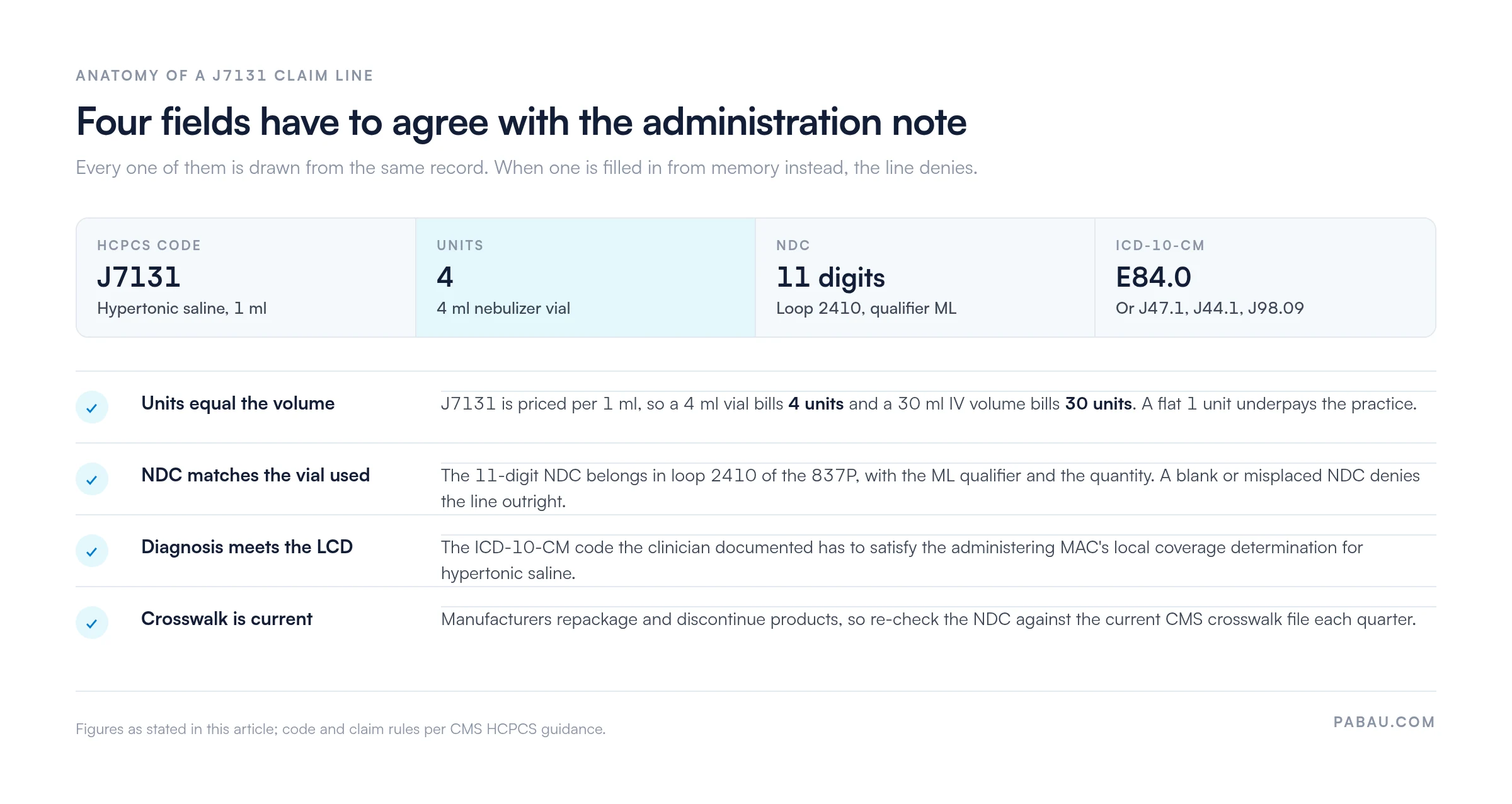
The National Drug Code (NDC) crosswalk identifies which sodium chloride products map to HCPCS Code J7131. So, payers use the NDC to confirm that the product billed matches the code descriptor. The authoritative source is the CMS NDC crosswalk file, updated periodically as manufacturers are added, discontinued, or repackaged. The table below lists sample entries. Therefore, verify against the current CMS crosswalk file before submitting claims, as NDC availability changes.
Biller note: Manufacturer discontinuation is common with hypertonic saline NDCs. A product that mapped to J7131 last quarter may carry a new NDC if the manufacturer repackaged it or transferred labeling rights. So, build a quarterly NDC check into your billing workflow, cross-referenced against the AAPC HCPCS code lookup.
A J7131 claim without a supported ICD-10 diagnosis code will deny for lack of medical necessity. The applicable diagnoses are the ones where hypertonic saline inhalation or infusion is clinically indicated under the relevant MAC LCD. In fact, respiratory conditions account for most J7131 claim volume, and the codes below are the ones that appear most often on those claims.
Important: LCD coverage criteria for hypertonic saline vary by MAC jurisdiction and are revised periodically. Therefore, always verify the applicable ICD-10 codes against your MAC’s current LCD before submitting claims. The ICD-10-CM code set is maintained by the CDC/NCHS ICD-10-CM web tool, which is the authoritative source for code definitions and updates.
Under the buy-and-bill model, the provider purchases hypertonic saline from a drug distributor, administers it in-office, and bills the payer using HCPCS Code J7131. The model is common in infusion suites and outpatient practices. Thus, it needs a documentation protocol that captures every step from drug receipt through administration.
Consult your MAC for specific documentation requirements. Avoid stating drug acquisition costs or profit margins in the clinical record, since that creates compliance exposure under buy-and-bill audit standards.
Prior authorization (PA) requirements for J7131 vary by payer and by MAC jurisdiction. Under Part B, Medicare does not always require prior authorization for hypertonic saline. Some MACs do have LCDs that require specific documentation before a claim is processed. However, commercial payers impose PA requirements more often, mainly for home nebulizer use.
Record PA decisions and approval reference numbers in the patient record before the claim goes out. Otherwise, an approval nobody wrote down is an appeal nobody can win.
Before submitting a J7131 claim for home nebulizer use, call the payer’s provider line to confirm whether PA is required for that specific patient’s plan. Indeed, commercial insurer PA policies for drug codes change during annual formulary reviews and may differ from what a payer’s general website states.
J7131 has a narrow descriptor, covering one drug, one unit of measure, and one primary route. However, it still generates steady denial volume across billing teams, and most of those denials are preventable. This section documents the four failure patterns that account for the bulk of them.
Handling these before submission beats appealing them afterwards. A two-step pre-bill check catches the two highest-volume reasons a J7131 line comes back. First, the step reads the volume off the administration note. Second, it checks the NDC against the current crosswalk file. Reading the remittance advice matters too, since the denial codes a payer returns tell you which of the four patterns you are actually dealing with.
Coders working with J7131 frequently meet adjacent codes covering other sodium chloride formulations and related infusion drugs. The table below is a quick reference for cross-coding decisions. In fact, one of these codes is no longer billable, as covered further below.
Coding note: J7130 is the one to watch. It described a hypertonic saline vial formulation and is still confused with J7131 in older coding references. CMS deleted the code from HCPCS effective January 1, 2012, so it is no longer a valid alternative to J7131 and cannot be billed. Any chargemaster line, fee schedule, or claim template that still carries J7130 needs remapping to J7131, or to whichever code matches the product actually administered.
Run a one-time search of your chargemaster and fee schedule for J7130. The code was deleted at the start of 2012, so any line still mapped to it will reject. Indeed, hypertonic saline charges built from an old template are the usual place it survives, and nobody notices until the remittance advice comes back.
Most J7131 rework starts when a second person re-enters data. A nurse records 4 ml in the treatment note, and the vial’s NDC sits in the drug log. The biller then assembles the claim from both records a day or two later. As a result, every hand-off is a chance for the units and the NDC to drift apart from what was given.
Practice management software like Pabau keeps those records together. The administration is charted against the patient’s appointment, and the drug, the volume, and the NDC stay attached to that record. When the charge is raised, the units come from the volume that was charted. In addition, the diagnosis code the clinician documented carries forward onto the claim.
Pabau does not select the diagnosis or decide which HCPCS code applies. Those are clinical and coding decisions, and they stay with the clinician and the coder. Instead, what the software removes is the second keystroke, where a 30 becomes a 3 and an NDC field is left empty.
A J7131 line then reaches the payer with its four fields already in agreement. Billers can spend their review time on the LCD question, which genuinely needs judgment, instead of checking whether the units match the note.

Pabau keeps drug administration records and HCPCS billing codes in one system. So, J7131 units, NDC data, and the diagnosis code your clinician documented carry through to the claim without re-entry.

J7131 rarely fails on coverage. Instead, it fails because a figure reached the payer in a form the administration note does not support. Two checks stop most of that. First, compare the unit count against the note. Second, compare the NDC against the current quarterly crosswalk.
Put those checks in the billing workflow rather than the appeals workflow. A denied J7131 line costs more in staff time than the drug itself is worth. The second submission is no more likely to be right than the first. Overall, practices that keep charting and billing in one system get the unit check without doing anything extra, because the number is never typed twice.
Book a demo to see how Pabau handles drug billing for infusion and nebulizer practices.

Billing another J-code with the same NDC rules? HCPCS code J0694 covers cefoxitin billing units, NDC reporting, and the denial patterns that follow them.
Need to understand how drug billing flows through a clearinghouse? Medical claims clearinghouse guide explains how 837P claims are validated and routed to payers.
Building a revenue cycle process for your infusion practice? What is revenue cycle management walks through the full billing cycle from charge capture to payment posting.
HCPCS Code J7131 is used to bill for hypertonic saline solution, 1 ml. It covers nebulizer administration for respiratory conditions such as cystic fibrosis and bronchiectasis, and IV infusion when clinically indicated. Also, it is a Medicare Part B covered drug code under the J-code category for drugs administered other than orally.
Medicare reimburses J7131 at ASP plus 6%, where ASP is the Average Sales Price reported by the drug manufacturer. CMS updates it quarterly, so the dollar amount changes four times a year. Therefore, verify the current rate against the CMS quarterly ASP drug pricing file before submitting claims.
Bill J7131 per milliliter administered via nebulizer. If 4 ml of hypertonic saline is given, submit 4 units of J7131. Include the 11-digit NDC for the specific sodium chloride product used, with the unit qualifier ML and the quantity administered. In addition, attach the supporting ICD-10-CM diagnosis code and the administering provider’s documentation of medical necessity.
The unit of service for J7131 is 1 ml. The number of units billed on the claim must equal the exact volume of hypertonic saline administered in milliliters. Otherwise, submitting a flat unit of 1 no matter the volume administered is a billing error that can result in underpayment or denial.