CCSD code H4430: Examination of rectum under anaesthetic
CCSD code H4430 pays for the examination alone CCSD code H4430 is the UK private...

Last Updated: Oct 20, 2026
J3246 is the HCPCS Level II code for injection, tirofiban hcl, 0.25 mg.
The code sits in the J3000-J3999 range, which covers drugs given by routes other than oral. It replaced the terminated code J3245 on January 1, 2005, and remains current for 2026 billing. Three fields decide whether the claim pays: the unit count, the NDC, and the waste modifier.
Let Pabau's smart automation suggest the right codes, reduce claim denials, and keep your practice compliant—effortlessly.
Automate repetitive tasks and focus on what matters most—your patients.
Reduce coding errors and ensure compliance with the latest regulations.
Clean claims, fewer denials, and faster reimbursements.
Powerful insights and reporting to help your practice thrive.
HIPAA compliant SOC 2 certified GDPR-compliant Trusted by 4,000+ clinics worldwide

HCPCS Code J3246 reports injection of tirofiban HCl (Aggrastat) at 0.25 mg per billing unit.
Divide the total milligrams administered by 0.25 to get the unit count, so 5 mg bills as 20 units.
Medicare Part B covers J3246 when the drug is medically necessary, and pays separately payable doses at 106% of ASP.
In an ambulatory surgical center the drug is bundled into the facility payment, so it is not separately payable there.
Report JZ when nothing is discarded, or JW for the discarded amount, on every single-dose container claim.
These are the code’s defining attributes as published in the HCPCS Level II file.
According to the Centers for Medicare and Medicaid Services (CMS), HCPCS Level II J-codes are maintained every year. Billers should check code status each January using the CMS HCPCS release files before filing claims for the new year.
Tirofiban (Aggrastat) is a glycoprotein IIb/IIIa receptor antagonist. It blocks platelet aggregation by preventing fibrinogen from binding to the GP IIb/IIIa receptor on activated platelets. Clinically, it is used in acute coronary syndrome (ACS), including unstable angina and non-ST-elevation myocardial infarction (NSTEMI). It usually runs as a continuous intravenous infusion in the hospital or the cardiac catheterization lab.
J-codes exist just for drugs given by non-oral routes: injection, infusion, or inhalation. Tirofiban is given intravenously and is not self-administered, so it falls outside CPT procedure code reporting. An HCPCS Level II J-code is what captures the drug cost on the claim. Billing teams cannot use a CPT code to represent the drug itself. J3246 is the only HCPCS code assigned to tirofiban HCl at the 0.25 mg billing unit.
Do not provide clinical dosing guidance to patients based on billing reference materials. The FDA-approved prescribing information for Aggrastat governs dosing. This article covers billing and coding context only.
Unit calculation is the single most frequent source of claim errors on J3246. Each billing unit equals 0.25 mg of tirofiban HCl. To determine the correct number of units, divide the total milligrams given by 0.25.
Formula: Units billed = Total mg administered ÷ 0.25 mg per unit
Tirofiban infusions in ACS protocols often run at weight-based rates over 30 minutes for loading, followed by a maintenance infusion. The billing team needs the total milligrams from the administration record, not the infusion rate. Pull the recorded total from the medication administration record (MAR) before calculating units.
When a single-dose container is not fully used, the remainder is drug waste. Modifier JW or JZ must be appended to reflect waste status (see the Modifiers section below). Under-billing units because the container was not empty is a documentation error that reduces reimbursement.
Pull tirofiban unit counts directly from the medication administration record before filing J3246. If the MAR shows a weight-based dose for a 72 kg patient at 0.15 mcg/kg/min, convert it to total mg over the infusion period. Then divide by 0.25. Never estimate from the container size alone.
Medicare Part B covers J3246 when tirofiban is medically necessary and supported by a documented diagnosis. Payment for separately payable Part B drugs comes from the quarterly CMS ASP Drug Pricing File, not the Physician Fee Schedule. That file sets the payment limit at 106% of the drug’s average sales price.
CMS republishes the file every quarter, so check the current limit rather than last quarter’s figure. Payment mechanics also differ by setting. A hospital outpatient department bills under the Outpatient Prospective Payment System. That system packages a drug into the procedure payment when its per-day cost falls below the packaging threshold. A physician office is paid from the same ASP file by its Medicare Administrative Contractor.
Drugs bought through the 340B program are paid at that same ASP plus 6% rate. The ASP minus 22.5% reduction that once applied to 340B-acquired drugs under OPPS ended in 2023. A fee schedule still carrying that cut understates what the claim should pay.
J3246 is not separately payable in the ambulatory surgical center (ASC) setting, based on the CMS ASC payment indicator. This means the drug cost is bundled into the ASC facility payment rather than paid as a separate line item. Check the current 2026 ASC indicator against the CMS ASC fee schedule before billing in this setting. Indicators are updated every year under the OPPS/ASC final rule.
Medicare requires medical necessity to be shown on every J3246 claim. The claim must include ICD-10-CM diagnosis codes that align with the FDA-approved indications for tirofiban. Local Coverage Determinations (LCDs) issued by Medicare Administrative Contractors (MACs) may specify covered diagnoses for your region. Check the applicable MAC LCD before filing, as coverage criteria vary by contractor.
The NDC-to-HCPCS crosswalk maps the National Drug Code (NDC) printed on the tirofiban label to J3246 for claim submission. Many payers require the 11-digit NDC on the claim alongside the HCPCS code, so it has to be captured when the drug is given. Practice management software like Pabau records the NDC with the drug charge, which supports cleaner claims management and removes the manual lookup later.
Each manufacturer uses its own NDC number. The same drug from different manufacturers carries different NDC numbers, and all of them map to J3246. Generic tirofiban has been available in the US since 2023, so a pharmacy may hold brand and generic stock at the same time. Always report the NDC from the container actually used, not a reference NDC.
The NLM Clinical Tables HCPCS API and the FDA NDC directory both work for checking current NDC numbers against HCPCS codes. NDC data changes with formulation updates, so check the crosswalk at least once a year and whenever a supplier changes.
Modifiers tell the payer something about how the drug was used that the base code alone does not capture. For J3246, three modifiers are most commonly relevant. Applying the wrong modifier, or leaving out a required one, can trigger a denial or a compliance audit.
CMS built the JW/JZ pair to create an auditable record of drug waste at the single-dose container level. JZ has been required since July 1, 2023 on claims for separately payable Part B drugs from single-dose containers where nothing was discarded. JW reports the discarded amount on its own line when part of the container is not used.
Tirofiban is supplied in single-dose premixed bags, so one of the two modifiers belongs on every claim where the drug is paid separately. Neither modifier applies when the drug is packaged into a facility payment, because there is no separately payable line to attach it to. Multi-dose container policies differ by payer, so check the MAC’s guidance before applying either modifier outside the single-dose case.
Every J3246 claim needs at least one ICD-10-CM diagnosis code establishing medical necessity. Tirofiban’s FDA-approved indication is acute coronary syndrome, so the codes below are the ones that usually support the claim. Coverage still depends on the applicable MAC’s Local Coverage Determination. Check the recorded diagnosis against the ICD-10-CM code library before the claim goes out.
Always confirm covered diagnoses against your MAC’s LCD and any applicable National Coverage Determination (NCD) before sending the claim. The code should match the physician’s recorded diagnosis, not a general cardiovascular category code. Two denial codes recur on drug claims. CO-4 says the procedure is inconsistent with the modifier used, and CO-167 says the diagnosis is not covered.
Most J3246 denials come from four common mistakes, and each one lives in a different field of the claim line. The diagram below shows what each field should carry and how it fails.
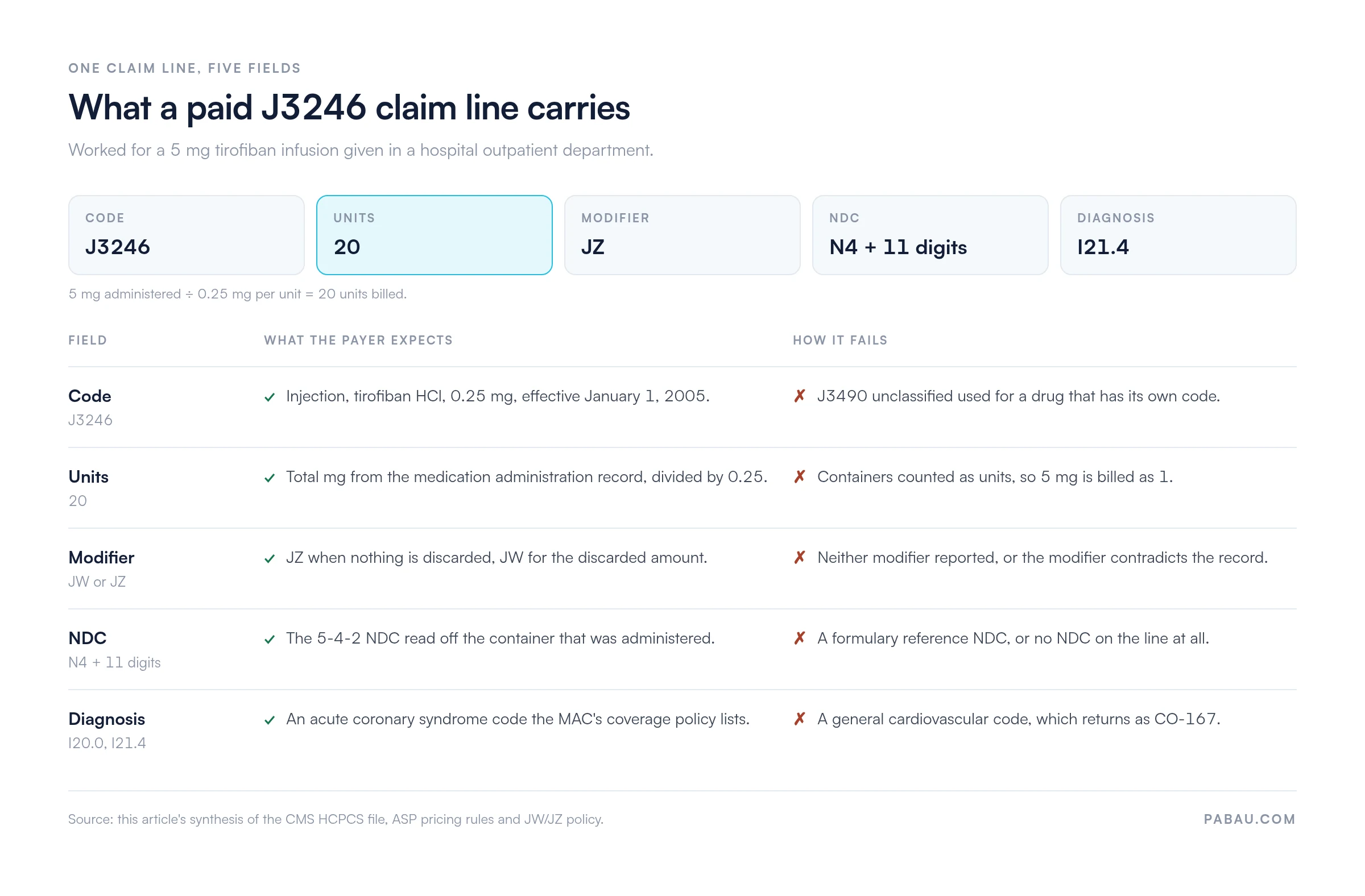
Billing one unit when 20 should have been billed is the most costly error on J3246 claims. It happens when billers record units as the number of containers used rather than the number of 0.25 mg increments given. The MAR is the only reliable source for total mg; container count does not equal billing units.
Many commercial payers and some Medicare fee-for-service contractors require the NDC reported alongside J3246. A claim submitted without one may be returned as unprocessable rather than denied, which delays payment without producing a denial code that explains why. A clean claim carries the code, the units, the NDC and the modifier on the same line.
Contractors have been editing claims for correct JW and JZ use since October 2023. A separately payable J3246 line without one of them can be rejected outright. Using JW when nothing was discarded, or JZ when drug was discarded, creates a compliance risk if the claim is audited. The modifier has to match the administration record.
In the hospital outpatient department, some drugs are packaged with the facility fee under OPPS rules rather than paid on their own line. Billing J3246 separately when it is packaged into the APC payment for a same-day procedure produces an improper payment. Review the applicable APC assignment before listing the drug as a separate line item in facility billing.
Run a quarterly audit of J3246 claims by pulling all filings from the past 90 days and checking unit counts against MAR totals. A single billing pattern error repeated across dozens of infusion claims can trigger a payer audit. Catching it internally is always less costly than a post-payment review.
Most drug injection errors happen before billing ever sees the claim. The total milligrams sit in the medication administration record, and the NDC sits on the container. The waste note stays with the nurse who ran the infusion. Billing then rebuilds all three from a chart hunt or a phone call.
Pabau, our practice management software, keeps those details on the charge itself. Staff record the drug, the units given, the NDC and the waste status at the point of care. The charge then carries all four into the claim. No one retypes a number between the record and the payer.
For a billing team, that means fewer lines returned for a missing NDC or a mismatched modifier. The month-end rework list gets shorter too. It also leaves an audit trail that matches the administration record, which is what a post-payment review asks for.

Track HCPCS J-code units, capture NDC numbers, and submit clean claims for drug injections. Pabau’s claims management workflow keeps billing accurate from documentation through reimbursement.

Three fields decide a J3246 claim. Take the unit count from the medication administration record, the NDC from the container that was used, and the modifier from the waste note. Each one is easy to check at the moment the drug is given, and guesswork an hour later.
So build the check into the administration step rather than the billing queue. A biller working two days later cannot see how much drug reached the patient, and a rebuilt number is what an audit finds first. Book a demo to see how Pabau captures drug units, NDCs and waste modifiers at the point of care.

Need to understand how drug injection billing fits into your broader revenue cycle? What is revenue cycle management covers the full claim lifecycle from charge capture through payment posting.
Struggling with claim rejections on drug codes? Denial codes in medical billing explains the most common payer reason codes and how to respond to each.
Want to reduce manual steps in your drug injection billing workflow? Best medical billing software compares platforms built for US clinical billing, including HCPCS J-code support.
HCPCS Code J3246 is used to bill for the injection of tirofiban hydrochloride (HCl), 0.25 mg per unit. It is the HCPCS Level II J-code assigned to tirofiban, a glycoprotein IIb/IIIa receptor antagonist (brand name Aggrastat) used in acute coronary syndrome management. Billers submit this code when tirofiban is administered intravenously in a covered outpatient or hospital setting.
Bill one unit of J3246 for each 0.25 mg of tirofiban HCl administered. Divide the total milligrams documented in the medication administration record by 0.25 to get the correct unit count. For example, 5 mg administered equals 20 units of J3246.
Yes, J3246 is covered under Medicare Part B when tirofiban is medically necessary and supported by an appropriate ICD-10-CM diagnosis. Coverage and payment rates vary by facility setting (physician office versus hospital outpatient). Separately payable doses are priced from the quarterly CMS ASP Drug Pricing File at 106% of average sales price.
J3246 takes JW when part of a single-dose container is discarded, and JZ when the whole container is administered. Modifier 59 applies when J3246 is billed alongside another service and has to be distinguished from it. Apply JW or JZ to reflect waste status, and keep the documentation consistent with the modifier.