CCSD code G5100: Bypass of duodenum billing guide
CCSD code G5100 bills a bypass that leaves the duodenum in place CCSD code G5100...

Last Updated: Oct 16, 2026
58611 is the CPT code for ligation or transection of oviduct(s) when done at the time of cesarean delivery or intra-abdominal surgery. The plus sign marks it as an add-on, so it always appears next to a primary procedure code.
Two avoidable mistakes cause most denials on this code. One is billing it without a primary cesarean code. The other is missing the Medicaid sterilization consent window, which normally runs 30 days.
Let Pabau's smart automation suggest the right codes, reduce claim denials, and keep your practice compliant—effortlessly.
Automate repetitive tasks and focus on what matters most—your patients.
Reduce coding errors and ensure compliance with the latest regulations.
Clean claims, fewer denials, and faster reimbursements.
Powerful insights and reporting to help your practice thrive.
HIPAA compliant SOC 2 certified GDPR-compliant Trusted by 4,000+ clinics worldwide

CPT 58611 is an add-on code for tubal ligation at cesarean delivery or intra-abdominal surgery. It always rides on a primary code such as 59510.
Modifier -80 covers an assistant surgeon and -62 covers co-surgeons, while -51 never belongs on an add-on code.
Medicare does not cover elective sterilization under NCD 230.3, so 58611 is payable only when a non-sterilization diagnosis makes the procedure medically necessary.
Medicaid requires the federal sterilization consent at least 30 days before surgery, dropping to 72 hours for premature delivery or emergency abdominal surgery.
Medicare pays about $65 for 58611 in 2026, based on 1.95 total RVUs and a work RVU of 1.41.
CPT code 58611 reports ligation or transection of the oviducts during a cesarean delivery or another open intra-abdominal operation. The American Medical Association files it under Incision Procedures on the Oviduct/Ovary, the 58600 to 58615 range.
The plus sign in front of the code is the part that decides how it gets billed. An add-on code never stands alone on a claim. It has to appear next to the primary code for the surgery during which the ligation happened.
That single rule explains most 58611 rejections. The rest come down to consent paperwork, and the table below is the short version of both.
Report 58611 when the tubal ligation happens in the same operative session as a cesarean section or another open abdominal case. It does not apply to a standalone sterilization, and it does not apply to a laparoscopic approach. Both of those have their own codes.
Three situations account for nearly every legitimate 58611 claim.
Worked through as claims, the split looks like this.
The primary code is almost always a cesarean delivery code, and it belongs on the same claim. Submit 58611 by itself and the payer rejects it as an unbundled add-on, without ever reading the notes.
The operative report is where a 58611 claim is won or lost. Your coder reads it, pulls the primary cesarean code, then adds 58611 underneath. The scrubber checks the pairing, the clearinghouse forwards it, and the payer adjudicates both lines together.
If the primary line is missing or wrong, 58611 drops out before a human ever sees it. The pairing works only when the delivery code itself is right, so check how 59510 is built before you lean on it.
Modifier -51 never goes on 58611. Add-on codes are exempt from it by definition, and appending it invites a payment reduction. That leaves -80 and -62, and each one answers a different question about who did the work.
Check your payer contract before billing 58611 with modifier -80. Medicare generally covers an assistant surgeon for this procedure, but commercial payers vary. Some require a separate authorization for assistant surgeon services on sterilization procedures.
Approach decides the code. 58611 is open surgery through an abdominal incision, so a laparoscopic sterilization belongs somewhere else entirely. The three codes that get confused with it are 58670, 58671 and 58661.
58661 causes the most trouble of the four, because it removes tissue rather than interrupting it. Sterilization is often the reason for a laparoscopic salpingectomy, but the code still describes a removal. If the operative note says the tubes were tied or divided laparoscopically, the answer is 58670 or 58671.
The AAPC CPT code lookup carries the current descriptors if you want to check one at the desk.
Medicare does not pay for elective sterilization. NCD 230.3 excludes it, so 58611 is covered only when a non-sterilization diagnosis makes the procedure medically necessary.
That matters less often than it sounds, since few Medicare beneficiaries are having cesarean deliveries. It matters a great deal for dual-eligible patients, where the Medicaid side carries the coverage and the paperwork.
The sterilization consent rule is a Medicaid rule, not a Medicare one. It lives in 42 CFR 441.258, and it has exceptions that a lot of billing teams never get told about.
The standard window is 30 days between the patient’s signature and the procedure. Sign it 29 days out and the claim is not payable, whatever the chart says. Two situations shorten that window, and one outer limit closes it.
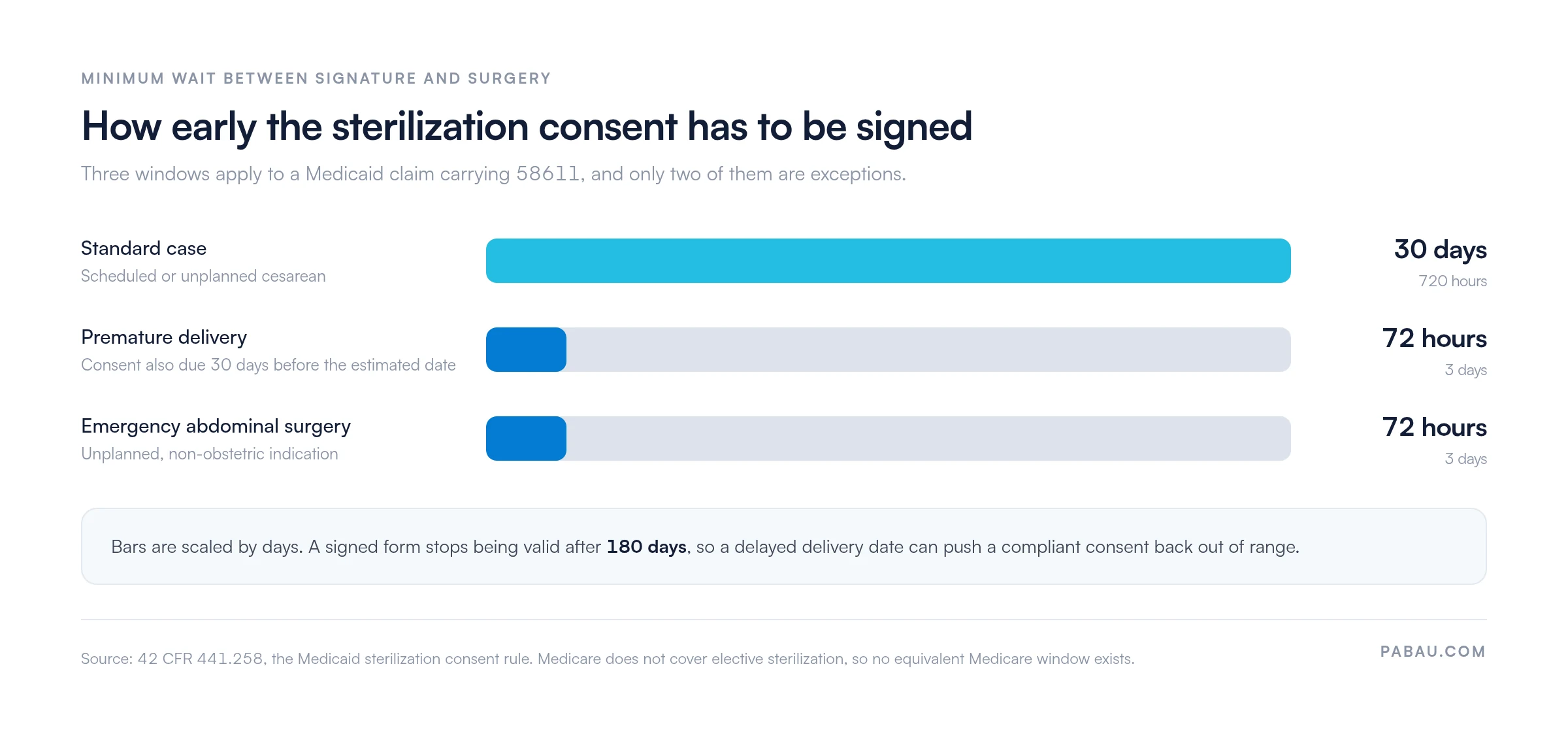
A premature delivery drops the requirement to 72 hours, provided the form was signed at least 30 days before the estimated delivery date. Emergency abdominal surgery drops it to 72 hours as well. Only those two situations shorten the window, so a rescheduled elective cesarean does not qualify.
The form carries conditions beyond the calendar. The patient must be at least 21 years old at signing, mentally competent, and not institutionalized. It also has to be in her own language, or come with an interpreter’s certification.
Medicare’s 2026 national payment for 58611 is roughly $65. That comes from 1.95 total RVUs, of which 1.41 is work RVU.
The figure is low because the add-on only pays for the extra effort of the ligation. The cesarean delivery itself is already being paid on the primary line. Geographic practice cost index adjustments then move the number by locality.
For your own area, run the code through the CMS physician fee schedule lookup. Commercial rates usually land between 110% and 150% of the Medicare amount, depending on your contract. Your remittance data is the only place to confirm what you are being paid.
A 58611 claim rests on four pieces of documentation, and an audit will ask for all of them. Missing one is usually fatal, because the fix has to exist before the surgery, not after the denial.
Run this before the claim leaves your practice. It takes under a minute, and it catches the denials that cannot be appealed later.
Every 58611 claim needs at least one ICD-10-CM code explaining why the sterilization happened. Z30.2 does that job on most of them. The rest depends on why the cesarean was performed, and those codes come out of the delivery record.
ICD-10-CM updates every October 1, so check that Z30.2 and its companions are still active before you bill.
58611 denials repeat. The same six problems produce most of them, and each one gets caught before submission rather than on appeal. Reading the remittance advice tells you which one you hit, since medical billing denial codes map every rejection to a cause.
Run an internal audit of your 58611 claims every quarter. Pull every claim carrying this code, then check three fields. Look at the consent date against the procedure date, the primary code on the same claim, and the ICD-10 diagnosis used. Denial patterns on 58611 repeat across patients, so one fix usually clears a batch.
Sterilization consent usually lives on paper, or in a shared spreadsheet somebody updates by hand. The form gets signed at a prenatal visit, then sits in a folder until somebody goes looking for it at claim time. By then the delivery date has moved twice.
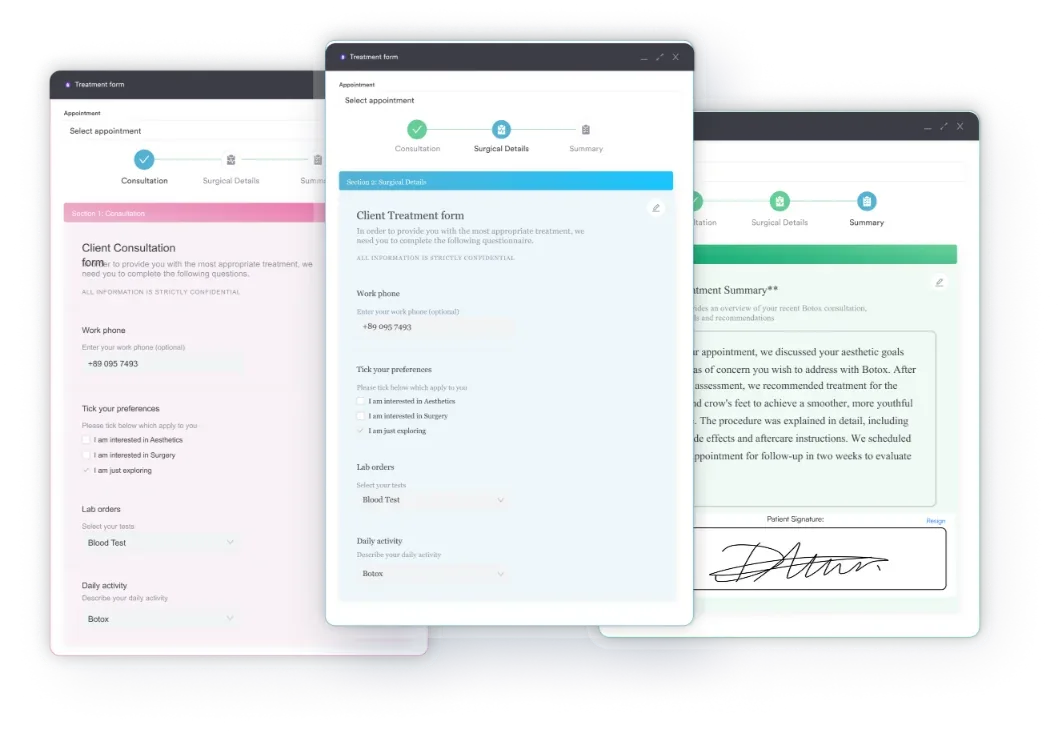
Pabau puts that form on the patient record instead. Patients complete the sterilization consent digitally, and the signature is date-stamped the moment they submit it. Your billing team can then check the window without hunting through a folder.
Charting, coding and submission all happen in the same system, which keeps the operative note and the claim from drifting apart. Billing runs from that record through our claims software for OB-GYN practices, which submits both lines and tracks what comes back.
The outcome is fewer consent-timing denials, and less time spent rebuilding claims that were never appealable in the first place.

Pabau tracks sterilization consent dates, stores the operative documentation, and submits clean claims for procedures like CPT 58611. Book a demo to see the workflow end to end.

58611 is not a complicated code, but it is an unforgiving one. The pairing and the consent date have to be right before the claim goes out, because neither can be argued back afterwards.
Build both checks into the pre-submission step rather than the appeals queue. Practices that do this stop seeing the same denial reason every quarter. Their OB-GYN revenue also stops depending on who remembered to file a form.
Getting the dates and the documentation into one place is most of the work. Book a demo to see how Pabau handles sterilization consent and claim submission for OB-GYN practices.

Need the full picture of how an OB-GYN claim gets paid? What medical billing involves walks through the process from the encounter to the remittance.
Seeing the same denial reason every quarter? Denial management in healthcare sets out how to build an appeals process that closes the loop.
Coding the delivery as well as the ligation? ICD-10 code O82 explains the cesarean delivery encounter code and when it belongs on the claim.
Want fewer rejections before they ever reach the payer? What a clean claim contains covers the checks that get a claim paid on first pass.
No. 58611 carries a ZZZ global indicator, so it has no global period of its own. It sits inside the global period of the primary procedure it is billed with.
No. The descriptor reads oviduct(s), so the code already covers one tube or both. Report a single unit whether the surgeon ligates one tube or two.
CPT 58605 covers postpartum ligation or transection performed during the same hospitalization as the delivery. It is a standalone code, so it needs no primary procedure beside it.
180 days. If the procedure slips past that date, the patient signs a new form. A delivery date that moves is the usual reason a compliant consent expires.
The patient must be at least 21 years old on the day she signs, mentally competent, and not institutionalized. Consent taken during labor or childbirth does not count.