

CCSD code G5100: Bypass of duodenum billing guide
CCSD code G5100 bills a bypass that leaves the duodenum in place CCSD code G5100...

Last Updated: Oct 16, 2026
50590 is the CPT code for lithotripsy, extracorporeal shock wave. It covers one complete ESWL session on a kidney or upper-ureteral stone, no matter how many shock waves the urologist delivers. Billers cannot split a session across claim lines.
The code carries a 90-day global period, so routine post-operative visits are already paid for. Two errors sink most 50590 claims. The first is a diagnosis code the payer's policy will not accept. The second is a place of service that does not match where the patient was treated. Both are fixable at scheduling.
Let Pabau's smart automation suggest the right codes, reduce claim denials, and keep your practice compliant—effortlessly.
Automate repetitive tasks and focus on what matters most—your patients.
Reduce coding errors and ensure compliance with the latest regulations.
Clean claims, fewer denials, and faster reimbursements.
Powerful insights and reporting to help your practice thrive.
HIPAA compliant SOC 2 certified GDPR-compliant Trusted by 4,000+ clinics worldwide

CPT code 50590 covers one complete ESWL session on a kidney or upper-ureteral stone, however many shock waves are delivered
A 90-day global period applies, so routine post-procedure visits inside that window are not separately billable
N20.0, N20.1, and N20.2 are the primary ICD-10-CM codes paired with 50590, and an unsupported diagnosis is the leading denial cause
Place of service has to match where the patient was physically treated, or the payment gets recouped later
Practice management software like Pabau pre-fills the claim from the patient record and holds it until every required field is complete
CPT code 50590 covers one complete session of extracorporeal shock wave lithotripsy, better known as ESWL. It sits in the Surgery section of the American Medical Association’s CPT code set, under the Urinary System subsection.
Within that subsection it falls under lithotripsy and ablation procedures on the kidney, codes 50590-50593. The official short descriptor is “Lithotripsy, extracorporeal shock wave.”
A laparoscopic kidney operation belongs to a different family, the kidney laparoscopy codes 50541-50549, where a partial nephrectomy is CPT code 50543.
One session is one unit, whether the urologist delivers 500 shock waves or 5,000. You cannot split a session across two claim lines, and you cannot bill per shock wave.
The CMS Physician Fee Schedule assigns 50590 a 90-day global period, shown as indicator 090. Routine post-operative visits inside that window are bundled into the global payment.
ESWL earns its code when the stone is small enough to fragment and soft enough to break apart. In practice that means a kidney or upper-ureteral stone, roughly 4 mm to 20 mm.
The patient also has to be a poor candidate for ureteroscopy or percutaneous nephrolithotomy. Medical necessity is the first thing a payer reviews, so the note has to carry that reasoning.
Indications that support billing CPT code 50590 include:
Size and composition work together, and the chart below shows where the two lines fall.
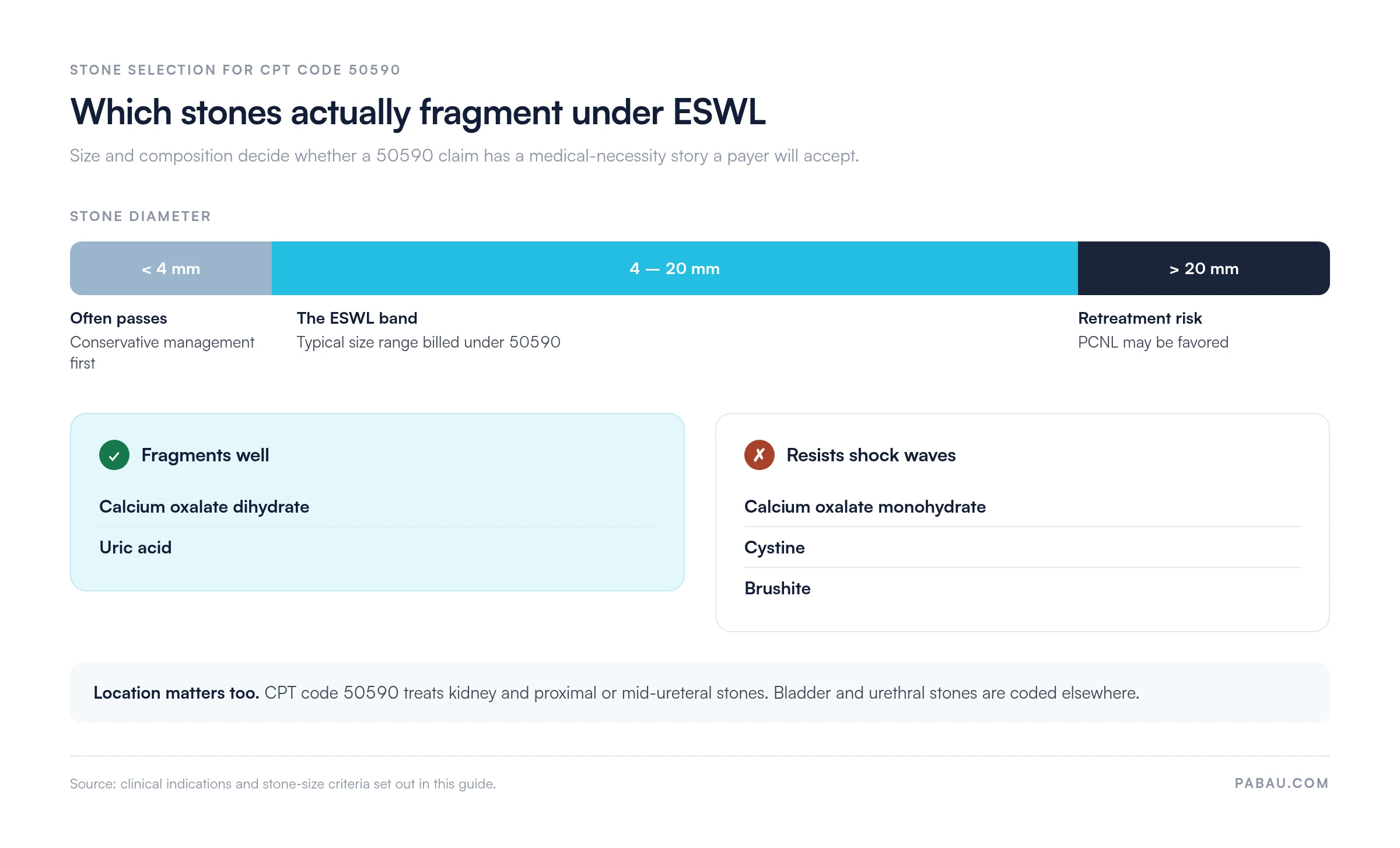
Payer coverage policies vary. Some commercial plans set size or location limits that Medicare Local Coverage Determinations never mention. Check the payer’s own policy before billing 50590 for a stone sitting at the edge of these criteria.
N20.0, N20.1, and N20.2 are the diagnosis codes that support CPT code 50590 in almost every case. Each claim needs one that establishes medical necessity, and an unsupported diagnosis is the top denial trigger on ESWL.
Browsing the ICD-10-CM code library helps when the imaging report describes an obstruction alongside the stone.
Use the most specific code the documentation supports. N20.0 and N20.1, paired with the correct laterality modifier, make up the combination billed most often. Verify the current Local Coverage Determination before assuming a pairing is covered.
Medicare pays two different amounts for CPT code 50590, and the setting decides which one applies. The split reflects how practice expense is allocated under the Medicare Physician Fee Schedule.
Pull the current work, practice expense, and malpractice RVUs for your locality, then apply your geographic practice cost indices and the year’s conversion factor.
Then track what the payer actually sends against that allowable. Electronic remittance advice files carry the adjustment reason codes that explain a short payment.
They are the fastest way to spot a systematic underpayment on 50590 before it becomes a quarter’s worth of write-offs.
Facility billing applies when ESWL happens in a hospital outpatient department or an ambulatory surgical center. The physician bills the professional component, which covers the work RVU, the malpractice RVU, and a reduced facility practice expense RVU.
The facility bills its own overhead separately. Non-facility billing applies in an office, where the practice absorbs the full overhead and the allowable is higher to compensate.
Audit your place of service (POS) code before the claim goes out. Submitting POS 11 for a procedure performed in a hospital outpatient department creates an overpayment. You will have to refund it, and it can trigger a compliance review. Match the POS code to where the patient was physically treated.
Modifier choice on CPT code 50590 comes down to three questions. Which side was treated, how complex was the case, and is this a repeat session? Answer those from the operative note and the modifier picks itself.
Here is how the bilateral question plays out. A patient has stones in both kidneys, treated in one session on March 4. Medicare wants a single line, 50590 with modifier -50, paid at roughly 150% of the unilateral allowable.
A commercial plan that rejects -50 wants two lines instead, 50590-LT and 50590-RT, each priced on its own. Same procedure, same note, two different claim forms.
The National Correct Coding Initiative, or NCCI, decides which services fold into CPT code 50590 and when a modifier can override the edit. CMS refreshes the tables every quarter. Check the current NCCI edit tables before billing any combination on the same date of service.
Services that generally bundle into CPT code 50590 include:
Ureteral stent placement, CPT 52332, is sometimes done in the same session to ease stone passage or relieve obstruction. Whether the two codes can be billed together on one date depends on the current edit status and on whether modifier -59 genuinely applies. Check the live tables rather than assuming separate billing is allowed.
Both codes describe lithotripsy, and only one of them involves a scope. CPT 52356 is ureteroscopy with lithotripsy, where the urologist passes a scope into the ureter and fragments the stone from inside the urinary tract. CPT code 50590 delivers shock waves from outside the body, with no endoscopic access at all.
Billing 50590 when the operative report describes a ureteroscopy is a coding error with compliance consequences. The surgeon’s documentation settles which code applies, not the procedure name the scheduler typed.
Stone management rarely stops at one code. Knowing what sits around CPT code 50590 in the care pathway keeps you from underbilling one claim and unbundling the next.
A 50590 claim rests on four documents. Imaging, an operative note, a medical necessity statement, and a post-procedure note all belong in the chart before the charge is released.
Incomplete records are the second most common denial trigger on ESWL, behind diagnosis pairing, so clean claim submission starts here rather than at the clearinghouse.
Every CPT code 50590 claim should be supported by:
This takes under a minute per claim, and it catches the errors that cost weeks.
Traditional Medicare does not routinely require prior authorization for CPT code 50590. Many commercial insurers and Medicare Advantage plans do, and those requirements change from year to year. Check the plan at scheduling, not on the morning of the procedure.
Commercial payers usually ask for three items:
Most of what decides a 50590 claim happens before a coder ever opens it. Here is the path a clean one takes.
Two steps carry most of the risk. Scheduling decides whether an authorization exists at all, and charge capture decides whether the diagnosis matches the imaging. Tighten those two and the rest of the path runs mostly on rails.
A high denial rate on CPT code 50590 almost always traces back to the same short list. Each one has a fix that sits upstream of the claim.
Run a monthly denial report filtered to CPT 50590 and sort it by denial reason code. If CO-4 (incorrect procedure or modifier) dominates, your modifier selection workflow needs a checklist. If CO-11 (diagnosis inconsistent with procedure) leads the list, your ICD-10 template for ESWL is missing covered codes. Fix the root cause, not the individual claims.
Denials on 50590 rarely come from a hard coding question. They come from a missing authorization, a diagnosis the payer will not accept, or a place of service nobody checked. All three sit in the patient record long before the claim exists.
Practice management software like Pabau keeps those details in one place. Pabau offers claims management that pre-fills the CMS-1500 from the patient record. The CPT code attached to the service lands on the charge line, and the ICD-10 slots come from the recorded problem list.
Built-in ICD-10-CM and CPT lookup libraries sit behind a search icon on the claim, so a biller can check N20.1 without opening another tab. The claim stays locked until the required fields are complete, which catches a missing authorization code while there is still time to chase it.
On the US pipeline, claims go out through Claim.MD, which returns real-time eligibility results, claim status, and ERA remittance data.
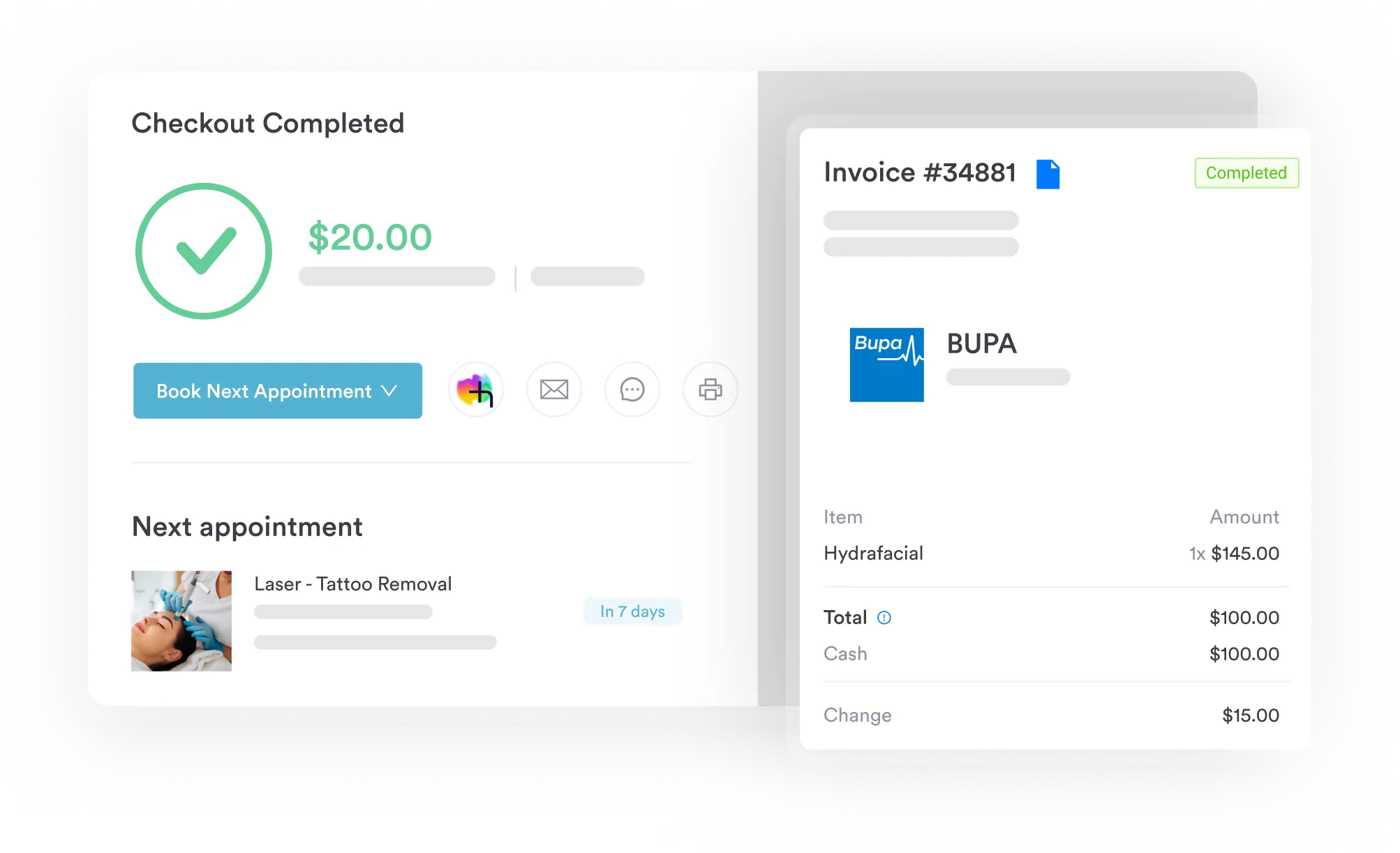
Denial tracking then closes the loop. Repeated 50590 denials show up grouped by payer and reason code. That lets you fix the template or the scheduling prompt behind them, instead of reworking claims one at a time.

Pabau pre-fills urology claims from the patient record, checks that every required field is complete, and tracks denials by code. See how it fits your billing workflow.

Nothing about CPT code 50590 is complicated on its own. The trouble is that four inputs all have to agree. The diagnosis, the place of service, the modifier, and the operative note each have to match what happened in the room. Miss one and a straightforward procedure sits in the denial queue for weeks.
Practices that clear 50590 first time are the ones checking those four at scheduling and at charge capture, not at appeal. Build the habit into the workflow and the ESWL denial rate drops on its own.
Book a demo to see how Pabau keeps a urology claim’s diagnosis, modifier, and place of service straight before it reaches the payer.

Need to understand how denials are categorized? Denial codes in medical billing explains the most common CARC codes and how to respond to each one.
Want to improve your first-pass claim rate? Clean claim submission covers the elements every claim must have before it reaches a payer.
Looking for a broader RCM framework? Revenue cycle management explained walks through the process from eligibility check to payment posting.
Denials piling up by payer? Denial management in healthcare sets out how to work appeals by root cause instead of claim by claim.
Worried about an audit on a surgical code? Medical billing compliance covers the documentation standards that hold up under payer review.
Yes, when imaging shows residual fragments after the first session. Append modifier -76 to the second claim and attach the imaging that supports it. The 90-day global period does not block a repeat lithotripsy session, but it does bundle the routine follow-up visits around it.
Yes, when an independent anesthesia provider delivers it. They report the anesthesia code for extracorporeal shock wave lithotripsy, 00872 with a water bath or 00873 without one. Monitoring performed by the operating urologist is bundled into 50590 and is not separately payable.
The code reflects where the patient was physically treated, not who owns the equipment. A mobile unit parked at a hospital outpatient department is still POS 22, and one used inside an ambulatory surgical center is POS 24. Office billing under POS 11 requires the practice to own or lease the lithotripter.
No. ESWL under 50590 treats stones in the kidney and the upper ureter. Bladder calculi are treated endoscopically and reported with the litholapaxy codes, 52317 or 52318, depending on stone size. Coding 50590 for a bladder stone will not survive a payer review.



