CPT Code 62284: Injection procedure for myelography
CPT Code 62284: official descriptor and procedure overview The American Medical ...

Last Updated: Oct 19, 2026
J3110 is the HCPCS Level II code for injection, teriparatide, 10 mcg.
Per the CMS HCPCS overview, Level II J-codes cover drugs, biologicals, and supplies that CPT does not. J3110 falls under this system because teriparatide is a physician-administered injectable, not a self-administered drug covered under Part D.
Let Pabau's smart automation suggest the right codes, reduce claim denials, and keep your practice compliant—effortlessly.
Automate repetitive tasks and focus on what matters most—your patients.
Reduce coding errors and ensure compliance with the latest regulations.
Clean claims, fewer denials, and faster reimbursements.
Powerful insights and reporting to help your practice thrive.
HIPAA compliant SOC 2 certified GDPR-compliant Trusted by 4,000+ clinics worldwide

HCPCS code J3110 describes injection of teriparatide at 10 mcg per unit. It is used for Medicare and Medicaid billing of Forteo and Bonsity under buy-and-bill.
The standard daily dose of 20 mcg equals 2 units of J3110 per administration, so billing quantity must match administration records exactly.
Medicare Part B reimburses J3110 at ASP plus 6% for physician-administered injections. Rates update quarterly, so check the current CMS ASP file before billing.
Modifier JZ became mandatory on July 1, 2023, and claims carrying neither JW nor JZ have been subject to rejection since October 1, 2023.
Practice management software like Pabau flags a unit mismatch, prompts for JW or JZ, and tracks prior authorization before the claim goes out.
Teriparatide is a recombinant parathyroid hormone (PTH) analogue. Bisphosphonates slow bone resorption, while teriparatide stimulates osteoblast activity to increase bone formation. The FDA has approved it for adults at high risk of fracture, and the label names three groups:
Two products use HCPCS code J3110. Forteo, manufactured by Eli Lilly, is the original brand. Bonsity is a 505(b)(2) version of Forteo, approved as a therapeutic equivalent rather than a licensed biosimilar.
The distinction matters when a payer policy names biosimilars specifically. Teriparatide is a small molecule that clears the FDA on the drug pathway, so Bonsity holds an NDA rather than a biologics license. Both products share the same J-code, so payers tell them apart by the National Drug Code (NDC) on the claim.
Each unit of J3110 represents 10 mcg of teriparatide. The FDA-approved standard daily dose is 20 mcg, administered subcutaneously once daily. This means practices bill 2 units of J3110 per standard administration.
Billing quantity must match what was administered and documented in the patient record. Over-billing units relative to the administered dose is a common audit trigger for buy-and-bill injectable claims.
Medicare Part B reimburses HCPCS code J3110 under the buy-and-bill model at the Average Sales Price (ASP) plus 6%. This formula is standard for Part B physician-administered drugs, covering the practice’s acquisition cost plus a handling margin. ASP rates update quarterly. Verify the current rate against the CMS Physician Fee Schedule lookup before billing, because an older figure will not reflect current payment.
Those quarterly updates decide the cash flow on every buy-and-bill purchase. A rate change mid-quarter can squeeze the margin when a practice has already bought inventory at the prior ASP.
Reconciliation follows the same calendar. Medicare’s remittance advice reflects the J3110 payment at the rate for the date of service, not the billing date. Reconcile against the quarter in which the service was rendered.
Verify the current J3110 ASP payment rate before each new billing quarter. CMS publishes updated ASP drug pricing files quarterly at cms.gov. A practice billing at last quarter’s rate may under-recover costs if ASP has risen, or trigger a query if it has dropped.
Under buy-and-bill, the practice buys teriparatide from a specialty pharmacy or distributor and stores it on site. Staff administer it to the patient, then bill J3110 to Medicare or the patient’s insurer.
Medicare Part D works differently. The patient collects the drug from a retail pharmacy, so the practice carries no acquisition cost and no inventory risk.
Most buy-and-bill denials on injectable drugs come down to paperwork. A claim goes out with no proof of acquisition on file, or it bills more units than the practice purchased. Either one becomes a recoverable overpayment once a payer audits the record.
Teriparatide is billed under Part B when a clinician administers it in the office. If the patient self-administers at home, Part D usually covers the drug through the pharmacy benefit, and J3110 does not apply.
Every J3110 claim requires a paired ICD-10-CM diagnosis code that establishes medical necessity. Teriparatide is indicated for osteoporosis with high fracture risk, so the relevant codes sit in the M80 and M81 series. Payers may deny a claim where the diagnosis does not justify teriparatide over first-line bisphosphonate therapy.
Select the most specific code available, and include the encounter qualifier on fracture claims (initial, subsequent, sequela). Full descriptions and encounter characters for each of these sit in the ICD-10 code library. Code M81.0 is the most frequently paired diagnosis on teriparatide claims started for high fracture risk without an acute fracture.
Modifiers directly affect payment and audit risk for J3110 claims. Using the wrong modifier, or omitting a required one, is among the fastest paths to a denial or a post-payment audit.
CMS phased the waste modifiers in over three dates, which still catches practices out. JZ was optional from January 1, 2023, then became mandatory on July 1, 2023. Claims for single-dose container drugs carrying neither JW nor JZ have been subject to rejection since October 1, 2023.
Document the container size, the amount administered, and any discarded amount in the patient record. That record is what supports the modifier you chose if a payer questions it later.
Place of service: J3110 billed from a physician office uses POS 11. Hospital outpatient settings use POS 22. The POS affects the Medicare payment rate, since the facility fee may be separate in a hospital-based setting.
Traditional Medicare fee-for-service does not require prior authorization for J3110. Medicare Advantage plans and commercial payers almost always require it for teriparatide, given its cost next to first-line osteoporosis therapies. Criteria vary by plan year and payer, so treat the list below as illustrative.
Verifying the patient’s benefits before the first administration confirms whether prior authorization is required and what the payer wants to see. A J3110 claim submitted without a required authorization will deny, and retroactive approval on appeal is never guaranteed.
CMS requires National Drug Code (NDC) reporting on all Part B drug claims, including J3110. The NDC identifies the product, the manufacturer, and the package size. That lets CMS check whether the billed HCPCS code matches the drug dispensed.
NDC numbers can change when manufacturers update packaging. Source the NDC from the product invoice or the current prescribing information rather than memorizing a number. Format it on the claim in 11-digit format (5-4-2) with no dashes.
By this point every field on the J3110 claim line has a rule attached. Each value also has to agree with a record the practice already holds.
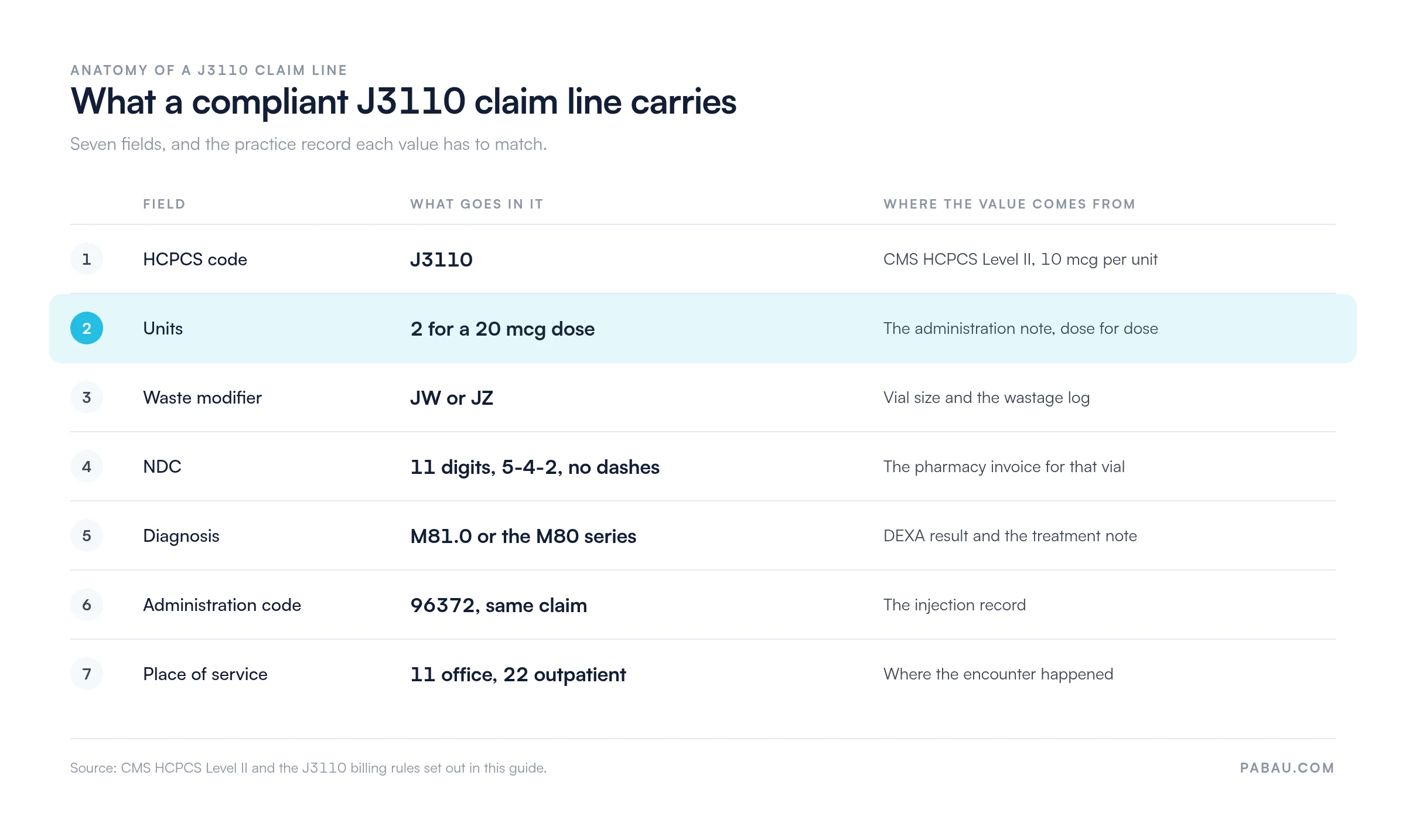
J3110 does not stand alone on most teriparatide claims. Administration codes and fallback codes appear alongside it, depending on the billing scenario. Knowing which companion code belongs on the claim prevents unbundling errors and missed line items.
Verify the current code description and status against the AAPC HCPCS code lookup before each billing cycle.
Reference code sites tell you what J3110 means. They do not help a practice bill it correctly across a high volume of patients. Practice management software like Pabau closes that distance with cleaner claims management at charge entry.
Unit validation is the first check. A coder entering 1 unit when the administered dose needs 2 units gets flagged before submission. The same workflow carries the full J3110 line onto the superbill, including units, modifier, NDC, and the paired ICD-10 code.
The practical difference is catching J3110 billing errors at charge entry, before a denial comes back from Medicare or a Medicare Advantage plan.
Book a demo with Pabau to see how the claims workflow handles buy-and-bill injectable drugs in a practice setting.

Pabau’s claims management tools support HCPCS J-code entry, quantity validation, modifier prompts, and prior authorization tracking. See how it handles buy-and-bill workflows in a live demo.

Before administering teriparatide for the first time, confirm payer-specific prior authorization requirements by checking the patient’s plan formulary directly. Medicare Advantage plans vary significantly in their criteria for J3110, and approval timelines can run several days. Start the authorization at the time of DEXA scan results, not at the injection appointment, and you avoid last-minute delays.
J3110 itself is a one-line lookup. The work sits in keeping the units, the modifier, the NDC and the diagnosis in agreement with what the chart says.
A practice that settles those four values at charge entry rarely argues about them again. A practice that settles them after a denial pays for the same claim twice, in staff time.
One trade-off is worth remembering. ASP moves every quarter, and inventory bought at last quarter’s price does not move with it. Check the rate before each billing quarter and the buy-and-bill margin holds. Book a demo to see how Pabau keeps a J3110 claim line consistent from the treatment note through to the remittance.

Need guidance on the full medical billing lifecycle? What is medical billing covers the end-to-end billing workflow from charge capture through remittance reconciliation.
Dealing with repeated J-code claim denials? Denial management in healthcare outlines systematic strategies for reducing denial rates on high-cost injectable drug claims.
Want to understand how clearinghouses fit into HCPCS billing? Medical claims clearinghouse guide explains how claims are validated and routed before reaching Medicare and commercial payers.
HCPCS code J3110 is a Level II HCPCS J-code for injection of teriparatide, 10 mcg. It covers Medicare Part B and Medicaid billing of Forteo and Bonsity, the injectable osteoporosis treatments. Bonsity is a 505(b)(2) equivalent of Forteo rather than a licensed biosimilar. The code applies to physician-administered injections under the buy-and-bill model.
Two units of J3110 are billed for the standard 20 mcg daily dose, since each unit represents 10 mcg. Billing quantity must match the administered dose documented in the patient record exactly.
Traditional Medicare fee-for-service does not require prior authorization for J3110. Medicare Advantage plans and most commercial payers do require it. They typically look for a confirmed osteoporosis diagnosis, bisphosphonate failure or intolerance, and documented high fracture risk. Criteria vary by payer and plan year.
The most common ICD-10-CM codes used with J3110 are M81.0 (age-related osteoporosis without current pathological fracture) and the M80 series (osteoporosis with pathological fracture). Z87.310 (personal history of osteoporosis fracture) may be added as a secondary code when clinically relevant.
Both Forteo and Bonsity share the same HCPCS code J3110. Payers distinguish between them using the National Drug Code (NDC) reported on the claim. Use the NDC from the product dispensed, taken from the pharmacy invoice or current manufacturer labeling.
Every J3110 claim needs either JW or JZ. JW reports drug discarded from a single-dose container, and JZ attests that none was discarded. JZ was optional from January 1, 2023 and mandatory from July 1, 2023, with claim rejections from October 1, 2023. Modifier 25 applies when a separately identifiable E&M service happens on the same day as the injection.