CCSD code H4430: Examination of rectum under anaesthetic
CCSD code H4430 pays for the examination alone CCSD code H4430 is the UK private...

Last Updated: Oct 20, 2026
J2792 is the HCPCS Level II code for injection, rho d immune globulin, intravenous, human, solvent detergent, 100 iu.
HCPCS code J2792 bills for injection of Rho D immune globulin, intravenous, human, solvent detergent, 100 IU. It is a Level II HCPCS drug code maintained by the Centers for Medicare and Medicaid Services (CMS). One billing unit equals 100 IU administered.
The brand product billed under this code is WinRho SDF, marketed by Saol Therapeutics. The "solvent detergent" designation refers to the viral inactivation step used in manufacturing. That step is what separates J2792 from the intramuscular Rho D formulations, which carry their own HCPCS codes.
Let Pabau's smart automation suggest the right codes, reduce claim denials, and keep your practice compliant—effortlessly.
Automate repetitive tasks and focus on what matters most—your patients.
Reduce coding errors and ensure compliance with the latest regulations.
Clean claims, fewer denials, and faster reimbursements.
Powerful insights and reporting to help your practice thrive.
HIPAA compliant SOC 2 certified GDPR-compliant Trusted by 4,000+ clinics worldwide

HCPCS code J2792 bills for injection of Rho D immune globulin, intravenous, human, solvent detergent, per 100 IU.
The brand product billed under this code is WinRho SDF, marketed by Saol Therapeutics.
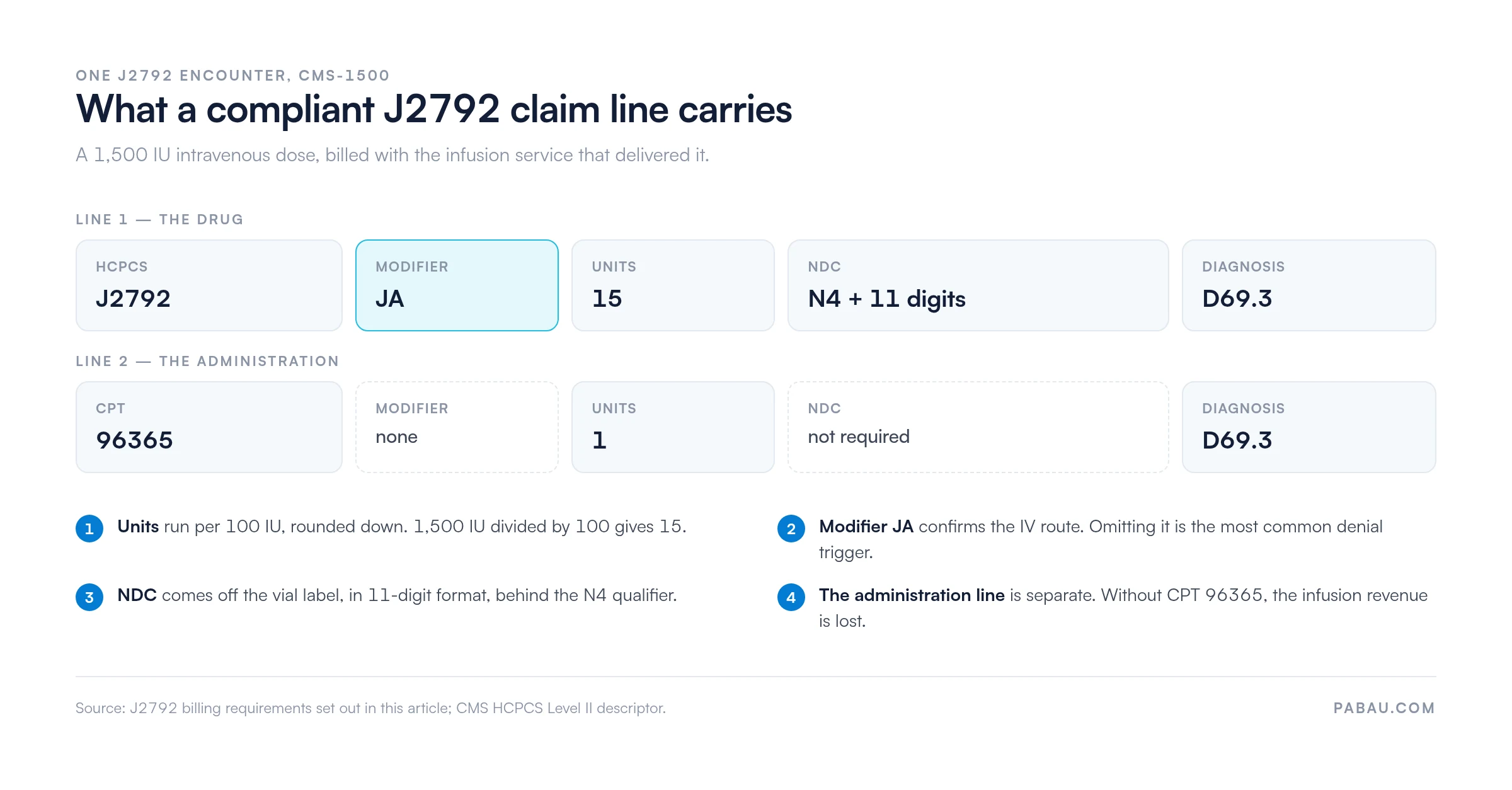
Divide the dose in IU by 100 to get the units, and always round down to the nearest whole unit.
Modifier JA confirms the intravenous route, and leaving it off is one of the most common denial triggers for J2792.
Pabau’s claims management software captures dose, route, and NDC as the infusion happens, so the J2792 line arrives pre-populated.
J2792 is covered for two clinical indications, and both come from the product labeling rather than from a code-specific coverage policy. There is no national coverage determination for J2792. Medicare pays it under the Part B benefit for drugs furnished incident to a physician’s service.
Coders often reach for the immune globulin billing article that governs polyvalent IVIG products. That article’s code list runs J1459 and J1552 through J1577, and J2792 is not on it. Check your own MAC’s drug and biologic billing guidance instead, using the CMS coverage determination process. Then read the indications against the approved WinRho SDF labeling.
Immune thrombocytopenic purpura (ITP). WinRho SDF IV raises platelet counts in Rh-positive, non-splenectomized patients with ITP. That clinical boundary is narrow and it is worth reading twice. Coverage applies to Rh-positive patients who still have a spleen, so billing J2792 for an Rh-negative or post-splenectomy patient is a coverage violation.
Rh isoimmunization prophylaxis. J2792 is also covered for suppression of Rh isoimmunization in Rh-negative pregnant patients. It applies after an Rh-incompatible transfusion or an obstetric event as well. The specific obstetric scenario determines which ICD-10-CM code applies.
The O36.01 codes are not billable at the category level. Each one needs a 7th character identifying the fetus before a payer will accept it. Use 0 for a single gestation or an unspecified fetus. Use 1 through 5 to identify a fetus in a multiple gestation, and 9 for other fetus. Submitting O36.011 on its own returns an invalid-code rejection rather than a medical necessity denial.
Pairing J2792 with an unsupported diagnosis is a leading cause of medical necessity denials for this drug. Check the current descriptors against our ICD-10-CM codes reference, because CMS revises these categories every October.
Medicare Part B reimburses J2792 at the Average Sales Price (ASP) plus 6% in physician office and non-facility settings. ASP-based rates update quarterly, so the payment per 100 IU unit changes four times a year. Never reuse a rate from a previous quarter without checking the current CMS Physician Fee Schedule or the CMS ASP drug pricing files.
When a remittance pays less than expected on J2792, check the pricing period before you appeal. The rate that applies is the one in force on the date of service, not the one in force when the claim was keyed. A dose given on March 31 and billed on April 2 still prices to the first-quarter file.
Verify J2792 reimbursement rates at the start of each calendar quarter using the CMS ASP Drug Pricing Files. Set a calendar reminder for January 1, April 1, July 1, and October 1. Using a prior quarter’s rate in your cost-of-care calculations is a reliable way to miscalculate buy-and-bill margins.
Reimbursement rates differ by setting, and so does the claim form. Hospital outpatient departments (HOPDs) and ambulatory surgery centers (ASCs) bill J2792 on a UB-04 using specific bill type and revenue codes. Physician offices bill the same drug on a CMS-1500 with no bill type or revenue code at all.
Getting J2792 right takes three things in the right sequence. Count the units accurately, put the NDC on the claim line, and attach the correct modifier. Build those checks into the pre-submission workflow rather than catching them on remittance review.
A single J2792 encounter produces two claim lines, and the drug line carries four fields that all have to agree with the administration record. The breakdown below maps a 1,500 IU dose across both lines.
Build a J2792 charge capture checklist into the infusion nursing workflow. Confirm the dose in IU, the NDC read off the vial, the IV route, the JA modifier, and the administration CPT. A 30-second pre-billing checklist eliminates the majority of J2792 denials before the claim is ever submitted.
Each billed unit represents 100 IU of Rho D immune globulin administered. Always round down to the nearest 100 IU increment. Rounding up is overbilling.
Medicare requires the National Drug Code (NDC) on all Part B drug claims. For J2792, report the WinRho SDF NDC in 11-digit format with the N4 qualifier on the claim line. The NDC must match the specific package administered, not a generic drug identifier. Pull it from the vial label at the time of administration rather than from a reference sheet.
Some Medicaid plans impose NDC format requirements that differ from Medicare’s N4 qualifier convention. Always check the payer-specific billing manual before submitting J2792 claims to a state Medicaid program. NDC errors on Part B drug claims are a consistent audit trigger.
J2792 is usually administered through the buy-and-bill model. The practice or infusion suite purchases WinRho SDF directly and administers it on site. It then bills Medicare Part B for the drug and the administration service separately.
Acquisition cost is fixed on the day you buy the vial, while reimbursement follows the ASP rate in force on the date of service. That timing difference is where buy-and-bill margin is won or lost. A vial bought in one quarter and infused in the next is paid at the newer rate. Purchasing and billing therefore have to watch the same calendar.
The drug code bills for the drug itself. A separate CPT administration code bills for the service of delivering it. For IV infusion of WinRho SDF, the right administration code depends on duration and context.
Confirm with payer-specific policies whether the chemotherapy administration codes (the 96413 series) apply when J2792 is given in a setting that mainly performs chemotherapy infusions. Some payers require the therapeutic infusion codes above regardless of the setting.
Rho D immune globulin has four HCPCS codes covering different products, doses, and routes. Billing the wrong one for the route actually used is among the cleaner claim edits payers run. The IV and IM mix-up between J2792 and J2790 is the most common one in practices that administer both.
Two of these codes describe a dose and two describe a product, which is where coders go wrong. J2788 and J2790 are dose-based and intramuscular, so a standard obstetric prophylaxis dose falls to one of them. J2791 and J2792 are product-based, at 100 IU per unit each. J2791 covers Rhophylac by either route, and J2792 covers WinRho SDF given intravenously.
Billing J2792 for an intramuscular administration is both a coding error and a modifier mismatch, since JA would be wrong on the line. WinRho SDF is also the formulation approved for IV use in ITP treatment, which is why J2792 carries indications the obstetric prophylaxis codes do not.
A J2792 claim needs the medical record to support both the covered indication and the units billed. Medicare’s rules for drugs furnished incident to a physician’s service sit in the Medicare Benefit Policy Manual, Chapter 15. Incomplete documentation is a frequent reason for recovery at post-payment audit, even where the claim paid on first submission.
Practices that capture this at the point of administration, rather than reconstructing it for billing later, see far fewer documentation denials. Structured intake and clinical note workflows inside practice management software are the most reliable way to catch a missing field before the claim goes out. The clean claim standard means every required field is populated on the first submission.
J2792 claims have a predictable set of denial patterns. Most are avoidable with process controls rather than coder knowledge. The errors below cluster around unit counts, missing identifiers, and modifier selection.
Practices that administer several physician-administered drugs gain the most from connecting clinical documentation directly to the billing output. Auto-populating the charge line from the administration record removes the manual transcription step where most unit-count and modifier errors appear.
In most practices the infusion nurse records the dose in the clinical note, and a biller re-enters it into the claim hours or days later. The NDC gets copied from a reference sheet instead of the vial. The JA modifier depends on someone remembering the route. Every hand-off is a chance for the claim and the record to drift apart.
Practice management software like Pabau keeps both in one place. The administration record captures the dose in IU, the route, and the NDC while the infusion is happening. Pabau’s claims management software then builds the J2792 line from that record. The units follow the documented dose instead of a second entry of it.
The outcome is fewer unit-count corrections and fewer rejections for a missing identifier. Your billers spend their time on the claims that genuinely need a human, rather than re-typing figures the clinical team already recorded.

Pabau captures dose, route, and units at the point of care, pre-populating claim fields for physician-administered drugs. Less manual data entry, fewer unit-count denials, and cleaner claims from the first submission.

J2792 is a narrow code with predictable requirements, and the difficulty in billing it is procedural rather than clinical. Units are counted per 100 IU and rounded down. The NDC comes off the vial, JA goes on the drug line, and the administration CPT is billed beside it.
None of those steps is hard on its own. They go wrong when the clinical record and the claim live in separate systems, because then each field has to be carried across by hand. Closing that distance is worth more than any single coding rule on this page.
If your infusion volume is growing, fix the hand-off before it becomes an audit finding. Book a demo to see how Pabau turns an infusion record into a J2792 claim line without the re-typing.

Need to understand how clearinghouses process J-code claims? Medical claims clearinghouse overview covers how HCPCS drug codes are validated and routed to payers.
Struggling with insurance eligibility before administering WinRho SDF? Insurance eligibility verification explains how to confirm Part B coverage before the infusion appointment.
Want a structured revenue cycle framework for infusion services? Best medical billing software in the US reviews platforms that support physician-administered drug billing workflows.
HCPCS code J2792 bills for injection of Rho D immune globulin, intravenous, human, solvent detergent, per 100 IU administered. The brand product is WinRho SDF. It covers two Medicare Part B indications: treatment of immune thrombocytopenic purpura (ITP) in Rh-positive, non-splenectomized patients, and suppression of Rh isoimmunization in Rh-negative patients.
Bill one unit of J2792 for every 100 IU administered, always rounding down to the nearest 100 IU increment. For example, a 1,500 IU dose = 15 units (J2792 x15); a 1,750 IU dose = 17 units (J2792 x17, not 18).
Modifier JA (administered intravenously) is required on J2792 claims, because J2792 is the intravenous formulation. Omitting JA is one of the most common denial triggers for this code. Never use modifier JB with J2792. No US HCPCS code describes subcutaneous Rho D immune globulin, so there is no subcutaneous alternative to move the charge to.
J2790 covers Rho D immune globulin given intramuscularly at a full dose of 300 mcg (1,500 IU), typically for standard obstetric Rh prophylaxis. J2792 covers the intravenous, solvent-detergent formulation (WinRho SDF) at 100 IU per unit, used for ITP treatment and IV Rh isoimmunization suppression. Route and dose basis are the distinction, and billing J2792 for an IM administration is a code-route mismatch.
Report the WinRho SDF NDC for the specific package administered, pulled from the vial label at the time of administration. Report it in 11-digit format using the N4 qualifier on the claim line. Medicare requires NDC reporting on all Part B drug claims, and a missing or incorrect NDC will cause the claim to be rejected before processing.
Yes. Medicare Part B pays J2792 as a drug furnished incident to a physician’s service, for the indications in the WinRho SDF labeling. There is no national coverage determination for the code, and it does not appear on the immune globulin billing article that governs polyvalent IVIG products. Your MAC’s drug and biologic billing guidance applies instead, and the claim still needs a supported ICD-10-CM diagnosis.
CPT 96365 (IV infusion, therapeutic, initial hour) is the standard administration code paired with J2792. CPT 96366 may be added for infusion time past one hour. CPT 96367 applies when J2792 is given as a sequential infusion following a different IV drug. Confirm payer-specific policies on administration code selection before submitting.