CCSD code H4430: Examination of rectum under anaesthetic
CCSD code H4430 pays for the examination alone CCSD code H4430 is the UK private...

Last Updated: Oct 20, 2026
J2355 is the HCPCS Level II code for injection, oprelvekin, 5 mg.
The code belongs to the J-code series of HCPCS Level II, which CMS maintains for drugs given by a route other than oral. J-codes are not CPT codes. They appear on CMS-1500 and 837P professional claims, and they pay on ASP-based methodology rather than the physician fee schedule's relative value units. Sending J2355 down the RVU path is how a claim ends up priced wrong.
For oncology and infusion practices, J2355 is a niche code with high stakes on every line. A single unit error or a missing modifier can produce a denial, or an overpayment recoupment request from a Medicare Administrative Contractor (MAC). Both trace back to the clinical record rather than the claim form, which is why cleaner claims management starts at documentation.
Let Pabau's smart automation suggest the right codes, reduce claim denials, and keep your practice compliant—effortlessly.
Automate repetitive tasks and focus on what matters most—your patients.
Reduce coding errors and ensure compliance with the latest regulations.
Clean claims, fewer denials, and faster reimbursements.
Powerful insights and reporting to help your practice thrive.
HIPAA compliant SOC 2 certified GDPR-compliant Trusted by 4,000+ clinics worldwide

HCPCS code J2355 describes Injection, oprelvekin, 5 mg, a recombinant interleukin-11 used to prevent severe thrombocytopenia following myelosuppressive chemotherapy.
Neumega, the brand of oprelvekin sold in the US, has been discontinued, so confirm the product is available before you bill J2355.
Billing is per 5 mg unit administered, and reporting fewer units than the dose given is the most common error on J2355 claims.
Medicare Part B pays J2355 at ASP plus a percentage add-on, and the rate changes quarterly, so check the current CMS ASP file.
Pabau’s claims management software tracks J-code units, modifiers, and documentation requirements so oncology and infusion practices can submit J2355 claims cleanly the first time.
The table below summarizes the key descriptor fields coders need before placing J2355 on a claim. These match the official CMS HCPCS code file and are current as of the 2026 code year. Always verify effective and termination dates against the current annual HCPCS release, as CMS can modify or retire codes in any given fiscal year.
A note on drug availability: Neumega (oprelvekin) has been discontinued and is no longer marketed in the US. HCPCS code J2355 itself stays active for 2026, so residual or backorder stock can still be billed against it. Confirm the product is available before you bill, and check whether your MAC has issued a local coverage determination (LCD) for this code. An LCD supersedes general guidance.
CMS also deletes codes mid-year through quarterly HCPCS updates, so check those releases too. The agency deleted HCPCS code J2310 for naloxone hydrochloride injection effective July 1, 2025, with no grace period and no direct crosswalk.
Medicare Part B covers injectable drugs furnished incident to a physician’s service when they meet medical necessity criteria. HCPCS code J2355 falls in this category. Oprelvekin is a Part B drug rather than a Part D drug, because it is typically given in an outpatient setting instead of at home.
Before submitting a J2355 claim, verify that the patient’s Part B coverage is active for the date of service. A lapse in Part B enrollment produces a denial that no amount of resubmission will fix.
CMS reimburses Part B drugs using Average Sales Price (ASP) methodology. The quarterly CMS Physician Fee Schedule lookup publishes ASP-based payment limits by HCPCS code. For J2355, the allowable is ASP plus a percentage add-on. That add-on is typically 6% for drugs outside the competitive acquisition program, and policy updates can change it.
ASP rates update quarterly, in January, April, July and October. The figure in effect when you submit may differ from the rate at the start of the year. Always pull the current quarter’s CMS ASP drug pricing file before finalizing your expected reimbursement. Billing on a prior quarter’s rate does not protect you from recoupment if an audit finds you were overpaid.
The electronic remittance advice (ERA) is where a J2355 payment gets explained. It shows the allowed amount, the contractual adjustment, and the patient responsibility. If the allowed amount differs from your expected ASP calculation, read the remittance before you call the MAC. The difference is often a quarterly rate change rather than a processing error.
Download the CMS ASP Drug Pricing Files directly from CMS.gov at the start of each quarter. Create a simple lookup spreadsheet mapping J-code HCPCS numbers to their current ASP allowable. Share it with your billing team so no one submits a J2355 claim using last quarter’s rate by mistake.
Oprelvekin is dosed at 50 mcg/kg of body weight, given subcutaneously once daily. HCPCS code J2355 is built around a 5 mg unit, so the units billed must match the milligrams administered. A 75 mg dose reports as 15 units. Under-reporting units is a documentation error. Over-reporting them without clinical justification is a compliance risk, and both surface during MAC audits.
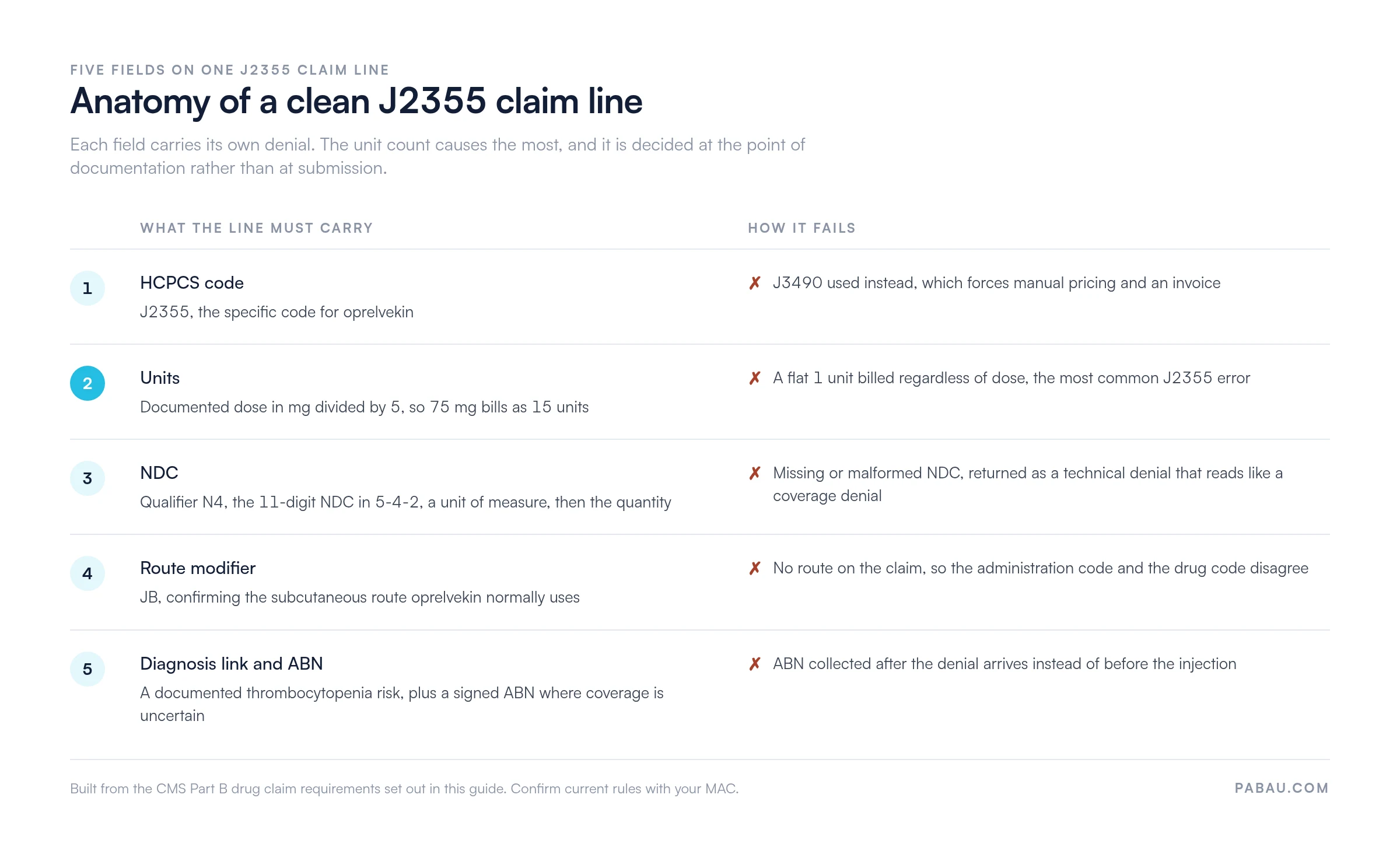
Five fields decide whether a J2355 line pays, and each one fails differently. The sections below take them in turn.
Modifiers clarify the circumstances of drug administration and can affect reimbursement or audit outcomes. The most frequently used modifiers with J-codes like J2355 include:
Always check with your MAC for current modifier guidance. CGS Medicare and Noridian Medicare publish quarterly HCPCS update bulletins that include modifier changes affecting J-code series billing.
Medicare requires that the medical record support medical necessity for J2355. At minimum, documentation should include:
Structured intake forms and clinical note templates capture these elements in one workflow. That cuts the back-and-forth when a MAC requests documentation during a post-payment review. The supporting ICD-10-CM diagnosis codes belong in that note as well, since the diagnosis is what carries medical necessity. A complete administration record is the first line of defense in an audit.
Most J2355 denials trace back to three specific failure points:
Chasing denials after submission costs far more staff time than preventing them at documentation. Build a pre-claim checklist specific to J2355: Units correct, NDC present, modifier appended, diagnosis linked, and an ABN on file where coverage is uncertain.
Where the injection is administered changes both the claim form used and the reimbursement logic. HCPCS code J2355 can be billed across several care settings. The place of service (POS) code on the claim must match where the service occurred. Mismatching POS codes is a frequent audit flag for Part B drug claims.
The ASC payment status indicator for J2355 is set in the annual OPPS/ASC final rule. CMS can classify a drug as separately payable in ASCs, bundled into the facility payment, or excluded from ASC payment entirely. Because this designation can change year-to-year, always verify the current indicator before billing J2355 in an ASC setting. The AAPC HCPCS code reference and CMS’s annual payment rule summaries are reliable sources for current ASC status.
Medicare requires providers to report the National Drug Code (NDC) alongside J2355 on every claim line. The NDC identifies the exact drug product dispensed, including the manufacturer, package configuration, and size. CMS maintains an NDC-to-HCPCS crosswalk file that maps oprelvekin NDC numbers to J2355. That file is updated quarterly, alongside the ASP pricing release.
On the CMS-1500 form, or the 837P electronic claim, the NDC follows a fixed format that the table below sets out. A claim submitted without a properly formatted NDC rejects at the clearinghouse, or draws a technical denial from the MAC. That happens when the correct NDC data is not in the billing system at the moment the claim is created.
Verify the exact NDC for the product you are dispensing against the current CMS NDC-to-HCPCS crosswalk file on CMS.gov. NDCs change when manufacturers update packaging or labeler assignments. The NDC on last year’s claim may not match the vial on the shelf today.
When billing oncology and infusion claims, J2355 rarely appears in isolation. The following codes appear in the same billing contexts and are worth having mapped in your charge description master (CDM) or billing software alongside J2355.
Do not substitute J3490 (Unclassified drugs) for J2355 when billing oprelvekin. J3490 requires an invoice and often triggers a manual pricing determination that delays payment. J2355 remains the specific reportable code, so use it while it is active and appropriate. Code specificity at this level is what separates a clean claim from a reworked one.
Map J2355 alongside its common companion CPT codes (96365, 96401) in your billing software as a linked charge group. When a nurse documents a subcutaneous oprelvekin injection, the system should prompt for both the drug code and the administration code. That way neither one drops off the claim at charge capture.
Accurate J-code billing depends on the system that captures the data at the point of care. The unit count, the NDC, the route modifier, and the diagnosis link all have to reach the claim. None of them should need manual re-entry from a paper log or a disconnected dispensary record.
Practice management software like Pabau connects clinical documentation directly to the billing queue. When a practitioner records an oprelvekin injection in the patient record, the dose, date, route, and NDC travel with the claim line. No separate billing entry is needed. That connection is where most J-code unit errors disappear. The system derives units from the documented dose, instead of asking a biller to convert milligrams by hand.
J-code accuracy sits alongside eligibility checks, prior authorization tracking, and ERA reconciliation in the revenue cycle. Pabau brings those touchpoints into one platform. An oncology nurse’s administration note then feeds the claim rather than starting a paper trail for billing to chase.
A clean claim for HCPCS code J2355 rests on three elements:
Pabau’s validation checks flag a missing field before the claim leaves the practice. The most common J2355 denial triggers get caught at the source rather than on a remittance three weeks later.

Pabau’s claims management tools help infusion and oncology practices track drug units, append modifiers, and submit clean claims for HCPCS J-codes including J2355. See how the workflow fits your practice.

Most J2355 denials come down to documentation rather than coverage: A wrong unit count, a missing NDC, an unlinked diagnosis, or a stale ASP rate. Each one is decided before the claim is built, in the clinical note.
Neumega’s discontinuation changes the order of operations rather than the code. J2355 stays active for 2026, so residual stock is still billable. Confirm the product is available first, then check the unit math against the documented dose.
Pabau connects the clinical note to the billing queue, so unit calculations, NDC capture, and modifier selection happen without manual re-entry. If your infusion or oncology practice is losing time to J2355 rework, book a demo to see how the workflow fits your team.

Need a framework for reducing claim denials across your practice? Denial management in healthcare walks through the root-cause categories and the operational fixes that reduce denial rates over time.
Want to understand how drug claims move through the revenue cycle? What revenue cycle management involves explains the end-to-end process from eligibility verification to ERA reconciliation.
Looking for a superbill template that captures J-code details? The superbill guide covers what fields are required for Part B drug claims and how to structure your charge capture forms.
HCPCS code J2355 is the billing code for Injection, oprelvekin, 5 mg. Oprelvekin (brand name Neumega) is a recombinant interleukin-11 used to prevent severe thrombocytopenia in adults at high risk following myelosuppressive chemotherapy. When a provider administers oprelvekin in an outpatient or office setting, J2355 is the code that bills the drug. It goes on a CMS-1500 or 837P claim.
Bill one unit of J2355 for each 5 mg of oprelvekin administered. A 50 mg dose equals 10 units; a 75 mg dose equals 15 units. The unit count must match the documented dose in the patient record. Billing a flat 1 unit regardless of the actual dose is the most common error on J2355 claims and a frequent trigger for MAC audits.
Yes. Medicare Part B generally covers J2355 when oprelvekin is given in an outpatient or physician-office setting, and when the record supports medical necessity. Coverage is not automatic: The diagnosis must meet CMS criteria, and the drug must be FDA-approved for the indicated use. The provider also has to check current local coverage determination (LCD) policies from their MAC before submitting.
Medicare reimburses J2355 at ASP (Average Sales Price) plus a percentage add-on, typically ASP + 6% for drugs not acquired through the competitive acquisition program. The specific dollar amount changes quarterly when CMS publishes updated ASP drug pricing files. Check the current quarter’s CMS ASP file or the CMS Physician Fee Schedule lookup tool for the exact allowable amount before billing.
NDC codes for oprelvekin (Neumega) map to J2355, but the specific NDC numbers depend on the manufacturer, labeler, and package configuration. CMS publishes a quarterly NDC-to-HCPCS crosswalk file that lists all active NDCs for each J-code. Always verify the NDC for the product you are dispensing against the current CMS crosswalk file. A prior-year reference is not safe, because NDC assignments change when packaging is updated.
The ASC payment status for J2355 is set annually in the CMS OPPS/ASC final rule. CMS may classify the drug as separately payable in an ASC, bundled into the facility payment, or excluded from ASC payment. This designation can change each year. Verify the current ASC payment indicator in the most recent OPPS/ASC final rule, or in the CMS HCPCS code file. Do that before billing J2355 in an ambulatory surgery center.