CCSD code H4430: Examination of rectum under anaesthetic
CCSD code H4430 pays for the examination alone CCSD code H4430 is the UK private...

Last Updated: Oct 20, 2026
J2260 is the HCPCS Level II code for injection, milrinone lactate, 5 mg.
Let Pabau's smart automation suggest the right codes, reduce claim denials, and keep your practice compliant—effortlessly.
Automate repetitive tasks and focus on what matters most—your patients.
Reduce coding errors and ensure compliance with the latest regulations.
Clean claims, fewer denials, and faster reimbursements.
Powerful insights and reporting to help your practice thrive.
HIPAA compliant SOC 2 certified GDPR-compliant Trusted by 4,000+ clinics worldwide

HCPCS Code J2260 covers injection of milrinone lactate, 5 mg, billed as one unit per 5 mg administered.
Medicare Part B pays J2260 at ASP plus 6%. Rates change every quarter, so check the current CMS ASP file before you bill.
NDC reporting is required by most payers. A missing NDC or the wrong package size is the most common denial trigger for J2260.
Practice management software like Pabau supports J-code claim submission, tracking, and remittance reconciliation in one billing workflow.
HCPCS Code J2260 is the CMS Level II HCPCS code for injection of milrinone lactate, 5 mg. Each unit of J2260 represents exactly 5 mg of milrinone lactate administered by injection. The code is active and billable for calendar years 2025 and 2026.
Milrinone lactate is a phosphodiesterase III (PDE3) inhibitor and inotropic agent. It is used for the short-term management of acute decompensated congestive heart failure. The drug increases cardiac contractility and reduces vascular resistance, which helps patients who respond poorly to standard heart failure therapy.
Because it requires intravenous administration and careful hemodynamic monitoring, milrinone is almost always given in a supervised clinical setting. Most clinical guidelines do not support chronic outpatient use.
Its appearance on a claim signals a high-acuity cardiac patient, which Medicare and commercial payers treat as requiring documented medical necessity. Without a clear record of the clinical indication and the administered dose, denial is likely.
Medicare Part B covers HCPCS Code J2260 when milrinone is administered as a physician-administered drug in an outpatient setting. Coverage depends on medical necessity, so the claim must be supported by the patient’s diagnosis, the indication for the drug, and the administered dose.
Medicare Administrative Contractors issue Local Coverage Determinations (LCDs) that define the coverage criteria in each jurisdiction. Check the applicable MAC policy before billing, because the documentation an LCD expects varies.
J2260 payment follows the ASP model rather than a fixed fee. Under Medicare Part B, physician-administered drugs are reimbursed at the Average Sales Price (ASP) plus 6%. CMS updates the ASP Drug Pricing File quarterly, so the reimbursement rate for J2260 changes four times per year.
The J2260 payment rate is not a fixed annual figure. Because it is tied to the ASP+6% methodology, it moves with manufacturer pricing and the CMS quarterly update. To check the current amount, open the Medicare Part B ASP drug pricing files. Look up HCPCS code J2260 in the file for the current quarter.
For practices billing J2260 often, tracking ASP changes across quarters matters for cost accounting. A 10 mg dose reimbursed at one ASP rate in the first quarter may pay differently in the third. Build a quarterly review of the ASP file into your revenue cycle calendar to avoid revenue leakage.
Bookmark the CMS ASP Drug Pricing File page and calendar a quarterly reminder to pull the updated file. For J2260 and other Part B injectable drugs, even a small ASP shift can meaningfully affect reimbursement when doses are large or administration is frequent.
Under Medicare Part B, J2260 follows the buy-and-bill model for physician-administered drugs. The practice purchases the drug, administers it, and then bills the payer to recover the cost plus reimbursement. The distance between acquisition cost and the ASP+6% payment rate decides whether the practice earns a margin or absorbs a loss.
The billing sequence for a buy-and-bill J2260 claim runs as follows:
The NDC (National Drug Code) crosswalk is a mandatory component of J2260 claims for most payers, including Medicare. The NDC identifies the drug product, manufacturer, and package size administered. Because several manufacturers supply milrinone lactate, the NDC on the claim must match the vial pulled from your dispensing inventory.
According to available product data, manufacturers currently supplying milrinone lactate products that map to J2260 include Pfizer, Fresenius Kabi, and Baxter. That list changes with manufacturing contracts and supply availability. Verify each mapping against the current ASP NDC-HCPCS crosswalk file, which CMS publishes quarterly alongside the ASP pricing file.
When reporting NDCs on a CMS-1500 form, place the NDC in box 24, line A, following the N4 qualifier. On electronic 837P claims, NDC information goes in the drug identification segment (LIN, CTP, and MEA loops). Your billing team should confirm the format requirements with your clearinghouse or the payer’s EDI companion guide.
A clean J2260 claim depends on what the clinical record captures at the point of administration. Document the drug name, the dose in mg, the administration route, the date, and the supervising provider. The claim also needs a diagnosis drawn from the ICD-10-CM codes that support medical necessity for milrinone.
Without those elements, the claim lacks the medical necessity support that Medicare and most commercial payers require.
J2260 is billed per 5 mg. Divide the total administered milrinone dose by 5 to determine the correct unit count, then round to the nearest whole unit and document the calculation. Billing more units than the dose supports is an overcoding error, and billing fewer leaves reimbursement on the table.
The conversion below covers the doses this article works through, so you can check a unit count at a glance.
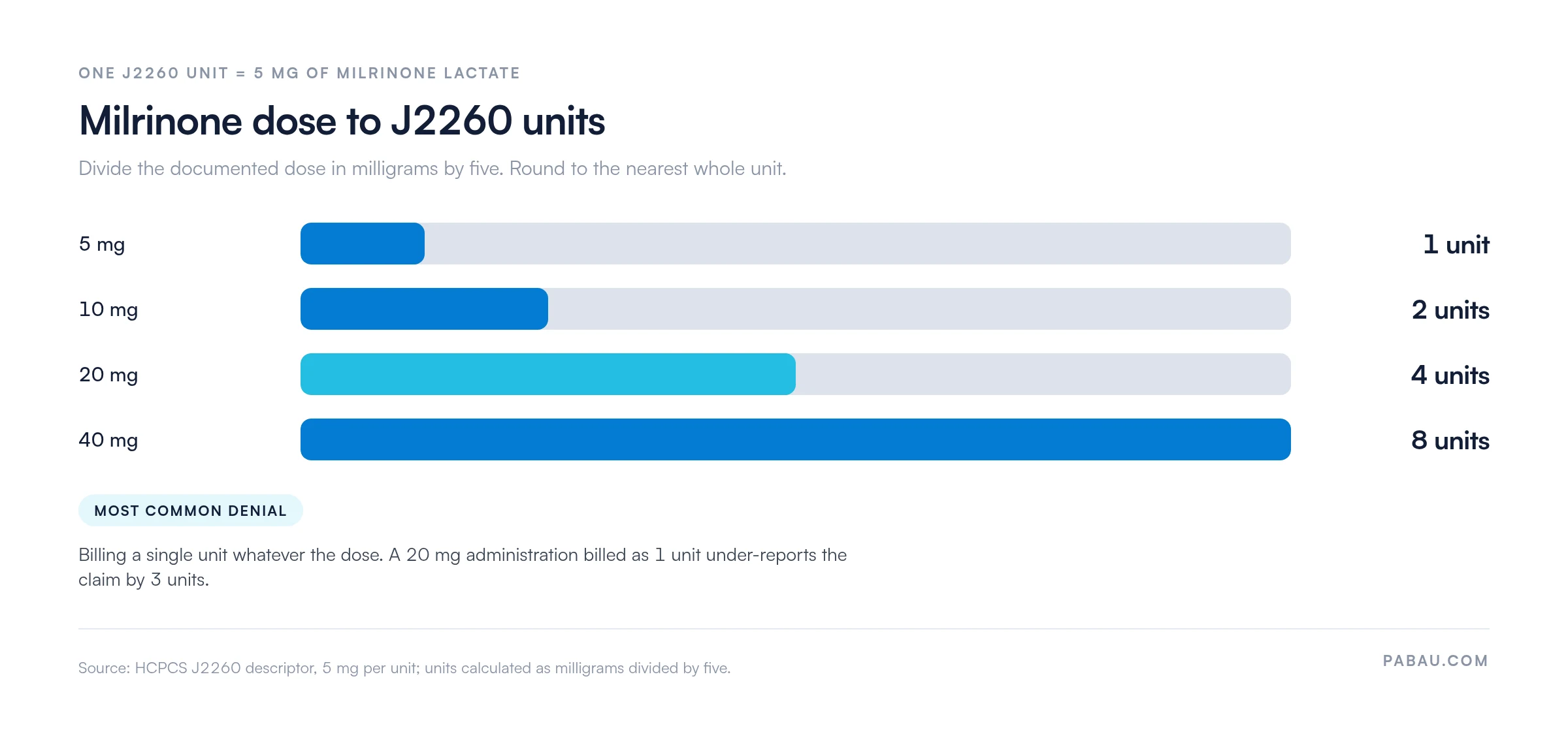
Example: a patient receives 20 mg of milrinone lactate. That is 20 divided by 5 = 4 units of J2260.
J2260 denials cluster around a handful of mistakes. Knowing them upfront prevents most of the rework that drives up denial management costs for cardiology and infusion practices.
Coverage rules for J2260 vary by payer and jurisdiction. Medicare Administrative Contractors may hold different LCD policies, and commercial plans often add prior authorization requirements that Medicare does not impose. Before administering milrinone in any setting, confirm coverage and authorization with the specific payer.
For a Medicare-enrolled patient, that check includes Part B injectable drug benefits, not only the office visit.
For commercial payers, obtain written authorization before administering milrinone outside an inpatient setting. Document the authorization number on the claim and in the patient chart before the infusion begins.
For Medicaid and commercial plans, request a coverage determination in writing before the infusion date. Verbal authorizations for high-cost injectable drugs are difficult to defend on appeal if the payer later denies the claim.
When billing for cardiac and cardiovascular injectable drugs alongside milrinone, coders frequently need adjacent J-codes. The table below covers the most commonly paired codes. For a broader search of injectable drug codes, use the AAPC HCPCS code lookup.
Practices billing injectable drugs like milrinone usually capture the dose, the NDC, and the unit count on paper first, then retype them into the claim. Every retype is a chance for the unit count to drift away from the documented dose.
Pabau’s claims management software keeps claim submission, status tracking, and remittance reconciliation in one workflow next to the patient record. Validation covers claim fields such as membership numbers and authorization codes. Your coders still own the J2260 unit count and the NDC on the claim line.
For cardiology and infusion practices handling Part B drug billing, that means fewer places for a claim to stall between administration and payment. Book a demo to see how the workflow handles injectable drug claims.

Pabau’s claims management tools help practices submit J-code claims, track their status, and reconcile remittances in one workflow. See how Pabau supports your billing team.

J2260 is a low-volume code with high-cost consequences. Two habits prevent most of its denials. Calculate the units from the documented dose every time, and pull the NDC from the vial you administered.
The quarterly ASP cycle is the part practices underestimate. Milrinone bought above the current ASP turns a clean claim into a loss, so the review calendar matters as much as the coding. Book a demo to see how Pabau keeps injectable drug claims moving from administration to payment.

Need a framework for reducing claim denials across your practice? Denial management in healthcare covers the systematic approach to preventing, tracking, and appealing payer rejections.
Want to understand how injectable drug claims fit into the broader billing cycle? What is revenue cycle management explains the end-to-end process from charge capture to payment posting.
Looking to tighten your documentation before claim submission? Superbill documentation outlines what needs to be captured at the point of care to support a clean claim.
HCPCS Code J2260 is the Level II billing code for injection of milrinone lactate, 5 mg. Use it to bill milrinone given by intravenous injection in an outpatient hospital, physician office, or infusion center. It applies mainly to patients with acute decompensated congestive heart failure.
Medicare Part B reimburses J2260 at ASP (Average Sales Price) plus 6%. CMS updates the ASP Drug Pricing File every quarter, so the exact reimbursement rate changes four times per year. Always verify the current quarter’s ASP file on CMS.gov before estimating reimbursement for milrinone claims.
Several manufacturers supply milrinone lactate products that map to J2260, including Pfizer, Fresenius Kabi, and Baxter. Each carries distinct NDC codes by package size and concentration. The correct NDC to report is the one from the specific vial administered, not a generic placeholder. Verify current NDC-to-HCPCS mappings against the CMS NDC crosswalk file, as manufacturer product lines change.
Yes. J2260 covers both milrinone lactate injection and milrinone pre-mixed in 5% dextrose. There is no separate HCPCS code for the pre-mixed bag formulation. Bill J2260 for either product based on the mg administered, and report the NDC of the specific product used.