CCSD code H4430: Examination of rectum under anaesthetic
CCSD code H4430 pays for the examination alone CCSD code H4430 is the UK private...

Last Updated: Oct 20, 2026
J1290 is the HCPCS Level II code for injection, ecallantide, 1 mg.
One unit is one milligram, and the standard dose is 30 mg. A full treatment episode is therefore 30 units, not one. That single multiplication is where most J1290 claims go wrong.
Let Pabau's smart automation suggest the right codes, reduce claim denials, and keep your practice compliant—effortlessly.
Automate repetitive tasks and focus on what matters most—your patients.
Reduce coding errors and ensure compliance with the latest regulations.
Clean claims, fewer denials, and faster reimbursements.
Powerful insights and reporting to help your practice thrive.
HIPAA compliant SOC 2 certified GDPR-compliant Trusted by 4,000+ clinics worldwide

HCPCS Code J1290 is defined as ‘Injection, ecallantide, 1 mg’ and covers Kalbitor, a plasma kallikrein inhibitor for acute hereditary angioedema attacks.
Bill 30 units of J1290 per treatment episode. The standard 30 mg dose is three 10 mg/mL vials, which equals 30 individual 1 mg units.
Medicare Part B reimburses J1290 at ASP plus 6% under buy-and-bill. Rates move every quarter, so check the CMS ASP drug pricing file before billing.
D84.1 is the only ICD-10-CM code that supports the claim, and it has no subcategories to code to.
Practice management software like Pabau submits and tracks the claim electronically, but the unit count and diagnosis still come from what you documented.
HCPCS Code J1290 is an active Level II HCPCS code maintained by the Centers for Medicare and Medicaid Services (CMS). Its official long descriptor is: Injection, ecallantide, 1 mg.
The code covers a single milligram of ecallantide, the active ingredient in Kalbitor. Each billing unit represents 1 mg of the drug, so the units you report are the milligrams you gave.
Ecallantide is a recombinant plasma kallikrein inhibitor. During an acute HAE attack, excess plasma kallikrein cleaves kininogen to produce bradykinin, which drives the swelling and pain of an attack. Ecallantide blocks that process directly.
The clinical picture matters for billing because it decides two fields. It sets which ICD-10 code supports medical necessity, and it sets which place-of-service code applies. Kalbitor is given subcutaneously in a practice or hospital equipped to manage anaphylaxis, so the setting you record drives the rate you are paid.
The unit multiplier is the most consequential detail on the claim. J1290 is defined per 1 mg of ecallantide. The typical dose for an acute HAE attack is 30 mg, delivered as three subcutaneous injections of 10 mg each. That means 30 units of J1290 per treatment episode.
If a prescriber gives a partial dose, bill the milligrams actually administered rather than the standard 30. A 20 mg dose is 20 units. Record the administered dose in the patient chart so the units on the claim have something behind them.
Every J1290 claim needs a supporting ICD-10-CM diagnosis code that establishes medical necessity. For hereditary angioedema that code is D84.1. Without it, Medicare and commercial payers deny the claim for lack of medical necessity.
D84.1 has no subcategories, so it is already the most specific code available for hereditary angioedema. Code it at four characters and move on. Check coverage criteria against your MAC’s local coverage determination (LCD) before billing, since those criteria are revised from time to time.
Medicare Part B covers J1290 under the buy-and-bill model. The practice purchases Kalbitor, administers it, then bills Medicare for reimbursement. The basis is Average Sales Price plus 6% (ASP+6%), the standard CMS methodology for separately payable Part B drugs.
ASP rates are recalculated every calendar quarter, so a per-unit dollar figure published here would go stale within weeks. Pull current amounts from the quarterly ASP drug pricing file on cms.gov, or from the ASP rates your Medicare Administrative Contractor (MAC) publishes. The Physician Fee Schedule does not price separately payable Part B drugs, so it is the wrong tool for this code.
Medicare pays differently depending on the place of service. In a non-facility setting such as a physician office, the practice bills the drug and the administration code separately and receives the drug allowable. In a hospital outpatient department, the facility bills the drug through the Outpatient Prospective Payment System (OPPS). The physician then bills only the professional component of the administration.
Confirm the place-of-service code against the record before you submit, because a mismatch is a common audit trigger. Claim software that validates required fields, such as authorization details, catches the paperwork errors before the payer does.
For ambulatory surgery center (ASC) billing, each HCPCS code carries an ASC payment status indicator. It determines whether the drug is separately payable or packaged into the procedure payment. Check the current CMS OPPS addendum for J1290’s indicator. If the code is packaged, the ASC receives no separate drug payment. If it is separately payable, the ASC bills J1290 at the applicable ASC rate. Re-check the indicator each year, because CMS updates ASC payment status with every OPPS rule.
Always download the current CMS quarterly ASP drug pricing file directly from cms.gov before the start of each new quarter. Set a calendar reminder for January, April, July, and October. Stale ASP data is one of the fastest ways to leave money on the table or trigger a compliance review on high-cost injectables like ecallantide.
Medicare Part B drug claims require the National Drug Code (NDC) alongside the HCPCS code. The NDC identifies the specific drug, manufacturer, and package size dispensed. For Kalbitor, it must match the product purchased from the distributor.
Report the NDC in the LQ qualifier field on the CMS-1500 claim form, or in the 837P electronic equivalent. The format is qualifier LQ, the 11-digit NDC, unit qualifier UN, then the quantity dispensed. Missing or malformed NDC reporting is a leading cause of rejection on Part B drug claims. Pull the number from the Kalbitor vial label at the time of administration and record it with the dose and lot number.
NDC rules differ between Medicare Part B and Medicaid, and some state Medicaid programs add their own reporting requirements. Verify Part B rules with your MAC and Medicaid rules with your state authority. Knowing how 837P electronic claim files carry the NDC fields helps billing staff avoid the formatting errors that delay payment.
Other HCPCS J-codes treat hereditary angioedema through different mechanisms. Knowing them helps billers confirm they are using J1290 for ecallantide, and not a neighboring code that belongs to a different drug.
Never substitute J3490 for J1290 when billing ecallantide. J3490 requires manual review and a written description of the drug, which adds processing time and denial risk. The AAPC HCPCS code lookup confirms current J-code assignments for any HAE therapy.
Five failure points generate most J1290 denials and underpayments. Each one sits on a specific claim field, and each has a fix that belongs in charge entry rather than in appeals. The table below maps the six fields on the claim line to what goes wrong on each.
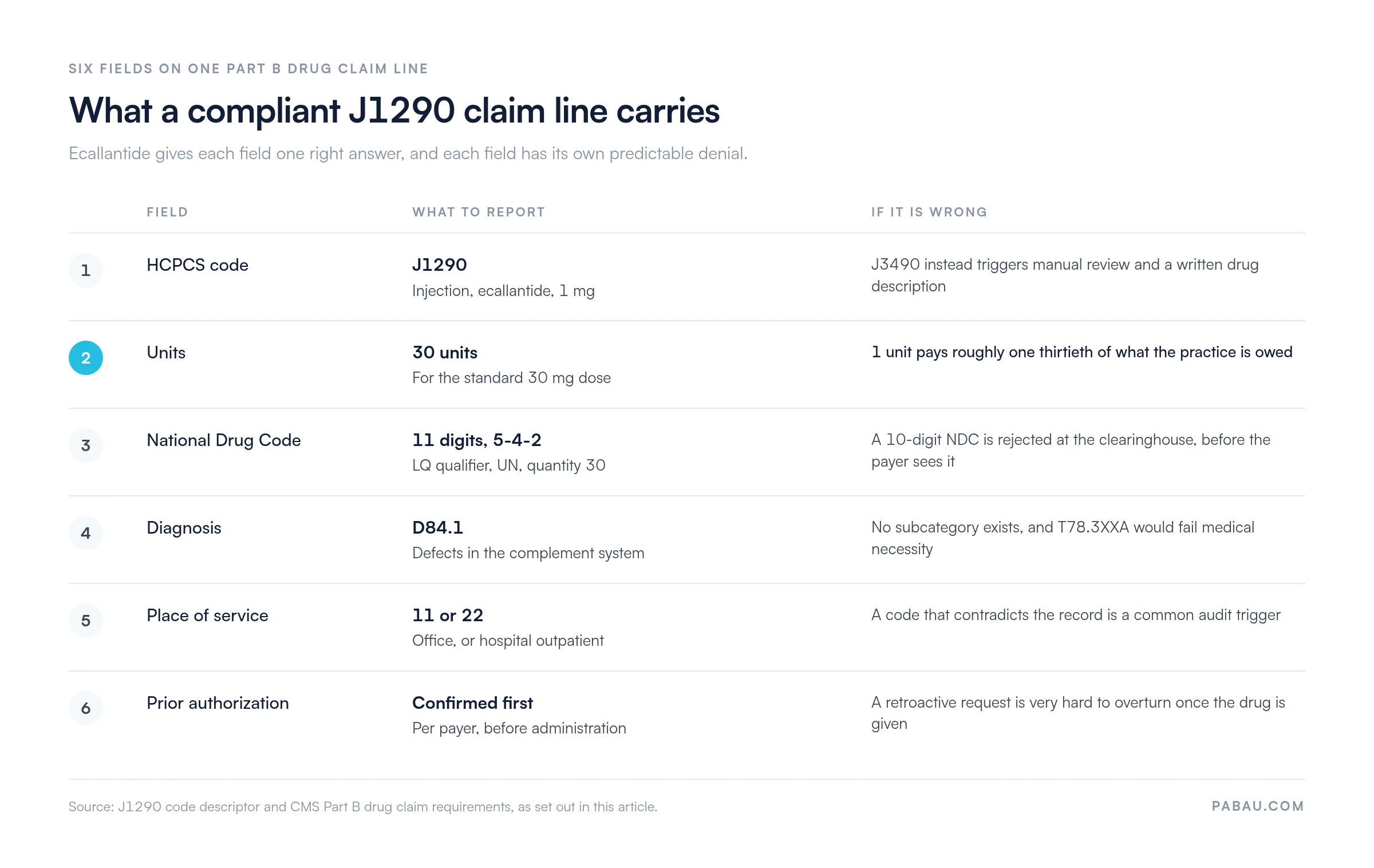
This is the most frequent J1290 billing error. Staff unfamiliar with unit-based J-codes enter 1 as the quantity, reading it as one treatment rather than 30 mg administered. The claim then pays roughly a thirtieth of what the practice is owed. Convert milligrams to units before submitting, and make that conversion a required verification step in charge entry.
A Part B drug claim that omits the NDC is rejected at the clearinghouse, before the payer ever sees it. Reporting 10 digits instead of 11 does the same. The NDC must be in 11-digit 5-4-2 format, with the LQ qualifier and the correct unit quantity. Read it off the physical vial label at the time of administration and put it in the visit record.
Submitting J1290 without D84.1 produces a medical necessity denial. The code must be present, valid for the date of service, and documented in the clinical record. An angioedema code that does not specify hereditary origin will not do, so T78.3XXA for allergic angioedema fails the test. Learn how denial codes map back to specific documentation problems, so you can tell which field caused a given rejection.
Reporting a place-of-service code that differs from the actual setting creates a conflict between the clinical record and the claim. A physician office billing with POS 22 for hospital outpatient will be paid at a lower rate than expected, or flagged for review. Confirm the POS code before each J1290 submission, especially when Kalbitor is given in a treatment room that different staff might classify differently.
Prior authorization (PA) requirements for J1290 vary by payer. Medicare does not universally require PA for ecallantide, but commercial insurers and Medicaid managed care plans often do. Give Kalbitor before obtaining PA from a plan that requires it and the resulting denial is very hard to overturn. Verify PA requirements with the specific payer before each acute-treatment episode, given the per-episode cost of this drug.
Electronic submission through the 837P transaction set is standard for Medicare Part B J1290 claims. Every claim line needs five things:
Read the remittance advice closely when a claim is adjusted. The reason code tells you which field failed, and whether you can still resubmit inside the timely filing window.
For Medicaid, confirm whether your state wants the 837P or a paper CMS-1500. Medicaid NDC rules and PA requirements differ from Medicare and from state to state. Build a review step for high-cost specialty drugs into the submission routine, and run it on every claim rather than only the first.
Commercial payers typically reimburse J1290 as a percentage of Average Wholesale Price (AWP) or Wholesale Acquisition Cost (WAC), or at a contracted rate. Check the contract terms for each major payer in your practice’s payer mix. The same claim can be worth very different amounts across two contracts.
In most practices, a J1290 claim is assembled twice. Someone records the dose, the vial NDC, and the diagnosis in the chart, then someone re-keys those values into a billing system. Every re-keying is a chance to type 1 where the chart says 30.
Practice management software like Pabau closes that second entry step. Its claims management software pulls what is already on the patient record into a pre-filled claim. It checks that required fields are populated, then submits and tracks the claim electronically. Remittances post back against the invoice.
Your coder still owns the units and the diagnosis, and nothing here picks a code for you. What changes is how much of the claim is transcription, and how quickly a rejected J1290 line reaches the person who can fix it.

Pabau pulls the dose and record data your team already captured into a pre-filled claim, then submits and tracks it electronically. Your billers chase fewer rejections on high-cost injectables.

J1290 rewards a boring claim. Bill milligrams as units, and report the NDC exactly as the vial prints it. Attach D84.1 without hunting for a more specific code, because there is not one.
The rest is calendar work. Re-check the ASP file each quarter, confirm PA per payer before the drug is given, and keep the place of service matched to the record. Practices that treat those as scheduled tasks stop discovering J1290 problems in their denial reports.
Book a demo to see how Pabau submits and tracks specialty drug claims. Your billers get to spend their time on the claims that need a human.

Need to understand how medical billing workflows integrate with practice management? Revenue cycle management explained walks through the financial workflow from eligibility check to payment posting.
Tracking denial patterns on drug claims? Denial management in healthcare covers how to identify root causes and build systematic correction workflows.
Billing another high-cost specialty biologic? HCPCS Code J1299 applies the same unit math and ASP pricing rules to eculizumab (Soliris).
HCPCS Code J1290 bills for injection of ecallantide (Kalbitor), 1 mg. Ecallantide is a plasma kallikrein inhibitor indicated for acute attacks of hereditary angioedema (HAE) in patients 12 years and older. Each unit of J1290 represents 1 mg administered.
30 units of J1290 are billed per standard treatment episode. The typical dose is 30 mg of ecallantide, given as three 10 mg/mL vials. J1290 is defined per 1 mg, so each milligram administered equals one unit billed. Bill the milligrams actually given if the dose differs from 30 mg.
Yes, Medicare Part B covers J1290 under the buy-and-bill model when medical necessity is established with a valid hereditary angioedema diagnosis (D84.1). Reimbursement is calculated at ASP+6%, with rates updated quarterly by CMS. Coverage criteria may also be subject to MAC local coverage determinations.
The NDC for Kalbitor must be pulled from the physical product label at the time of administration, as lot-specific NDCs can vary. Report the 11-digit NDC (in 5-4-2 format) in the LQ qualifier field on the CMS-1500 form or the 837P electronic claim. Never use a generic or published NDC without verifying it against the actual vial used.
J1290 coverage in an ASC depends on the code’s current ASC payment status indicator in the CMS OPPS addendum. If the indicator shows separately payable, the ASC bills J1290 at the applicable ASC rate. If packaged, no separate drug payment applies. Check the current CMS OPPS rule annually as ASC payment status can change.