HCPCS Code G0163: Skilled nursing observation and assessment
What is HCPCS Code G0163? HCPCS Code G0163 is a deleted Level II code for skille...

Last Updated: Oct 15, 2026
J1299 is the HCPCS Level II code for injection, eculizumab, 2 mg.
CMS introduced it on April 1, 2025 to replace J1300, which measured the same drug in 10 mg units. Divide the administered milligram dose by 2 to get the units to report.
Every unit count on every eculizumab claim is now five times larger than it used to be. Eculizumab also runs to annual treatment costs above $600,000 per patient, so a stale unit multiplier moves tens of thousands of dollars per infusion.
Let Pabau's smart automation suggest the right codes, reduce claim denials, and keep your practice compliant—effortlessly.
Automate repetitive tasks and focus on what matters most—your patients.
Reduce coding errors and ensure compliance with the latest regulations.
Clean claims, fewer denials, and faster reimbursements.
Powerful insights and reporting to help your practice thrive.
HIPAA compliant SOC 2 certified GDPR-compliant Trusted by 4,000+ clinics worldwide

HCPCS Code J1299 is the current Level II billing code for injection, eculizumab, 2 mg, given by intravenous infusion under the brand name Soliris
J1299 took effect on April 1, 2025 and replaced J1300, which CMS deleted on March 31, 2025 along with the Q5139 biosimilar code
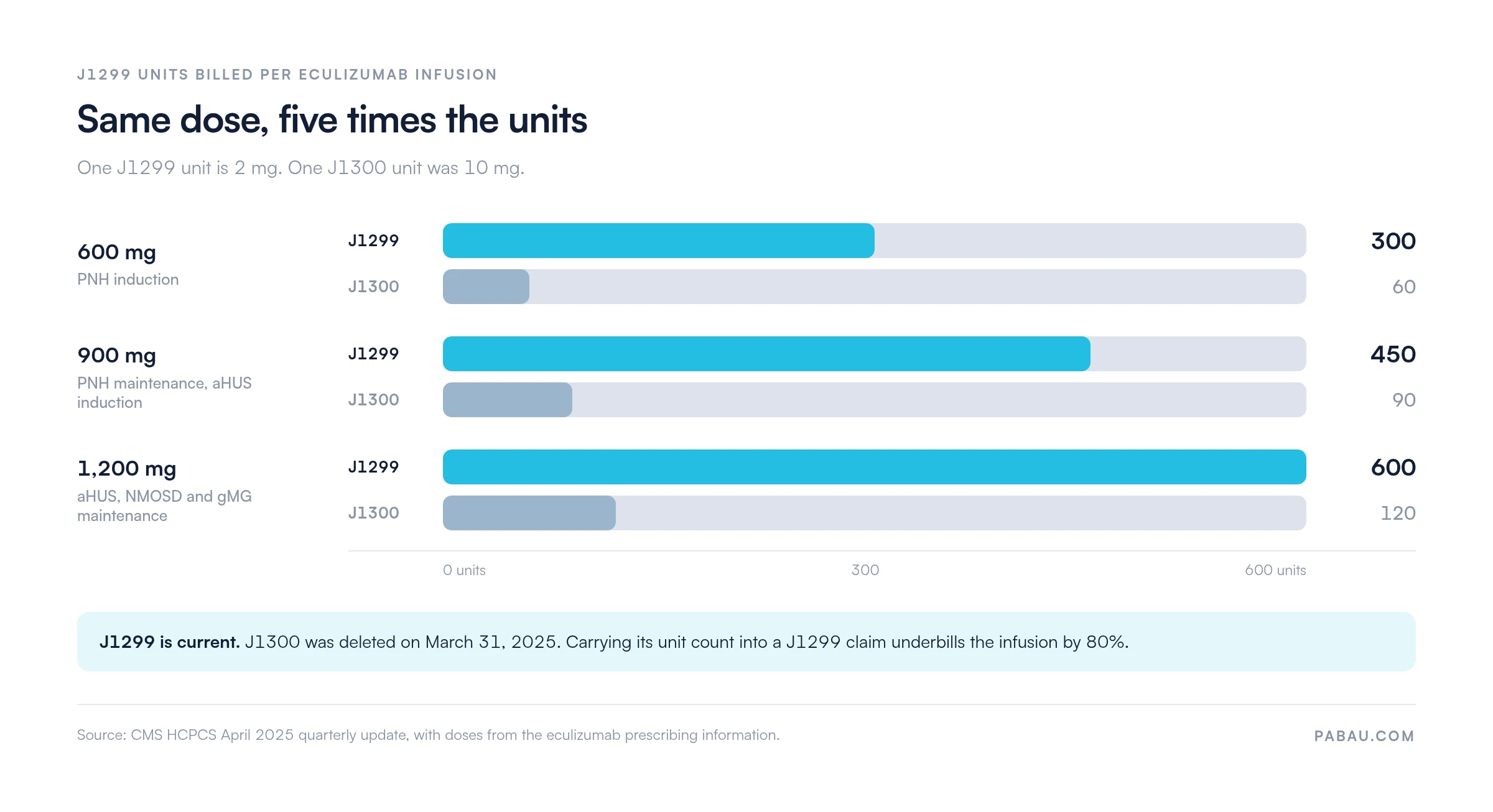
One unit of J1299 equals 2 mg, so a 900 mg PNH maintenance dose comes to 450 units rather than 90
Eculizumab biosimilars now have their own codes: Q5151 for EPYSQLI (eculizumab-aagh) and Q5152 for BKEMV (eculizumab-aeeb), both at 2 mg per unit
Pabau’s claims management software keeps the HCPCS code, the unit count, and the ICD-10-CM code on the infusion appointment itself
HCPCS Code J1299 is the official CMS HCPCS Level II code covering injection, eculizumab, 2 mg, administered by intravenous infusion. It falls in the J-code range, which covers physician-administered drugs and biologics under the buy-and-bill reimbursement model.
The code descriptor is precise. Each reportable unit corresponds to exactly 2 mg of the drug, and that unit-based structure drives every billing calculation covered below. Confirm the administered dose in milligrams first, because the rest of the billing process rests on it.
J1300 described eculizumab in 10 mg units and was valid from January 1, 2008 through March 31, 2025. The April 2025 HCPCS quarterly update deleted it and introduced J1299, which describes the same drug in 2 mg units.
The product, the label, and the dosing stayed the same. Only the billing denominator changed, and that single change carries serious financial weight. A 900 mg maintenance dose was 90 units under J1300. The same dose is 450 units under J1299.
A biller who carries the old unit count into the new code underbills by 80%. The claim will often pay anyway, which is what makes the error hard to spot.
Timely filing has now caught up with the change. Medicare gives providers 12 months from the date of service to submit a claim. The last valid J1300 date of service was March 31, 2025, so that window closed at the end of March 2026.
In practice, J1300 should no longer appear on any new claim you send. It belongs only on corrected claims, reopenings, and appeals. Those must be tied to a date of service on or before March 31, 2025.
Search your practice management system and your charge master for the string J1300 before your next infusion cycle. Any surviving charge template, superbill line, or saved claim favorite will keep producing 10 mg unit counts. Replace each one with J1299 and recheck the unit multiplier while you are in there.
Eculizumab is a complement C5 inhibitor manufactured by Alexion Pharmaceuticals, now part of AstraZeneca Rare Disease. It blocks the terminal complement pathway, preventing the destruction of red blood cells and endothelial damage in conditions driven by complement dysregulation.
HCPCS Code J1299 covers eculizumab billing across its FDA-approved indications. Billers need to know which diagnosis drives the claim, because the ICD-10-CM codes and dosing regimens differ by indication. Linking the wrong diagnosis to the claim is one of the most common reasons denials occur on this drug.
Each of these conditions requires distinct clinical documentation for prior authorization and claims adjudication. Verify the specific payer’s local coverage determination (LCD) or coverage policy for eculizumab before submitting.
Unit miscalculation is the top source of claim errors on HCPCS Code J1299. One unit equals 2 mg, so divide the administered dose in milligrams by 2 to get the number of units to report. The chart below sets the three standard eculizumab doses against both unit counts.
The dosing schedule varies by indication. PNH patients follow an induction phase before transitioning to maintenance. aHUS, NMOSD, and gMG dosing differ again.
The table below shows typical dosing from the FDA-approved prescribing information, along with the corresponding J1299 unit count. Always confirm the exact dose administered and document it in the medical record before calculating units.
Important: dosing protocols in the table above reflect typical FDA-labeled schedules and are provided for billing unit calculation purposes only. They do not constitute prescribing guidance. Some patients receive adjusted doses based on body weight or clinical response. The administered dose in the medical record controls the unit count, not the typical schedule.
Two details trip teams up on this code. First, modifier JW reports the amount of a single-dose vial that was discarded rather than administered. A fully discarded vial takes JW for the entire quantity. Modifier JZ is the opposite attestation, confirming that no drug was wasted.
Second, the 2 mg unit size does not divide evenly into every vial. Soliris ships as a 300 mg single-dose vial, which is 150 units. A 900 mg dose therefore draws three vials and bills 450 units.
Audit your infusion notes before claim submission. The dose administered in milligrams must match the units billed. Divide the charted mg amount by 2, then confirm the quotient equals the units on the claim. A 900 mg dose requires exactly 450 units of J1299. Any discrepancy between the infusion record and the claim is an immediate audit red flag.
Medicare Part B reimburses eculizumab under the buy-and-bill model using Average Sales Price (ASP) methodology. The reimbursement rate is ASP plus 6%, which represents the drug cost plus a dispensing and handling allowance. CMS publishes updated ASP pricing quarterly, typically in January, April, July, and October.
Read the published rate carefully. It is now expressed per 2 mg unit. The payment amount printed against J1299 is roughly a fifth of the figure your team remembers from J1300. The total allowed amount per infusion is unchanged, because the smaller per-unit rate is multiplied by five times as many units.
Eculizumab’s ASP rate is one of the highest in the Part B drug schedule. Orphan drug status and rare indications keep it there.
Never hardcode a specific dollar amount into billing reference materials. The quarterly files from CMS are the authoritative source, and rates change. Build a quarterly ASP review into the practice’s own code update routine instead.
Medicaid reimbursement rates vary by state. Commercial payer rates are negotiated contractually and may differ significantly from Medicare ASP. Always verify the payer-specific reimbursement policy before administering the drug.
Every J1299 claim requires a supporting ICD-10-CM diagnosis code that establishes medical necessity. The code must match both the patient’s documented diagnosis and the indication for which eculizumab was prescribed.
Payers cross-reference the diagnosis code against their coverage policies for complement C5 inhibitors. A mismatch, or a non-specific code used where a more specific one exists, will typically trigger a denial.
D59.3 itself is a parent category code and is not billable. A claim submitted at that level gets rejected. Code aHUS to D59.31 for the infection-associated form, or D59.32 for the hereditary, complement-mediated form.
ICD-10-CM must be coded to the highest level of specificity available. The codes listed above are the primary options, and the list is not exhaustive. The full tabular list may carry a more specific code for the patient’s documented presentation.
Verify applicable codes against the CDC/NCHS ICD-10-CM web tool and the payer’s current LCD before claim submission.
Prior authorization is required by most commercial payers for eculizumab, and requirements vary by plan year, payer, and indication. An infusion given before the authorization lands usually goes unpaid, whatever the medical necessity.
Medicare Advantage plans have their own prior authorization rules, separate from traditional Medicare. Traditional fee-for-service Medicare does not require prior authorization for eculizumab under current policy. Local coverage determinations from Medicare Administrative Contractors still set documentation requirements that work as a de facto qualification gate.
Confirm the rules with the administering MAC before the first infusion. Each payer’s criteria then sit inside the practice’s own prior authorization process, so a renewal gets raised before the current approval expires.
Document the prior authorization number on the claim and retain the approval in the patient’s record. Where a denial cites a missing or expired authorization, read the denial code before re-submitting rather than resending the same claim.
On a drug this expensive, an audit is decided by the medical record rather than the claim form. Every figure on the claim line should trace back to a dated entry in the chart.
Build the list below into the pre-submission check. The evidence then exists before the claim goes out, rather than after a payer asks for it.
Keep the infusion note and the claim line in the same system wherever you can. Re-keying a dose from a clinical note into a billing screen is the point where the unit count usually goes wrong.
The April 2025 update reorganized the whole complement inhibitor family. Two FDA-approved eculizumab biosimilars now carry their own Q-codes, both measured in 2 mg units to match J1299.
Ravulizumab (Ultomiris), a longer-acting C5 inhibitor from the same manufacturer, keeps its own J-code at 10 mg per unit. Billing J1299 for a biosimilar product or for ravulizumab is an error, however similar the mechanism of action is.
Note the mixed unit sizes in that table. J1299, Q5151, and Q5152 all bill in 2 mg units, while J1303 still bills in 10 mg units.
A team that standardizes on one divisor across the whole complement inhibitor family will get ravulizumab claims wrong. Check the descriptor for the specific code every time.
Biosimilar eculizumab is not automatically interchangeable with Soliris without an FDA interchangeability designation. Do not assume a biosimilar may be substituted at the pharmacy level based on manufacturer labeling alone. The prescriber’s intent and the FDA interchangeability status govern substitution decisions.
Confirm the code assigned to any biosimilar product before billing. The AAPC HCPCS code lookup and the CMS HCPCS file both carry it.
Build a complement inhibitor crosswalk into your billing team’s code update checklist, and review it quarterly rather than annually. The eculizumab family moved on an April HCPCS update, so an annual-only review would have missed it by nine months. Record the code, the unit size, and both the effective and deleted dates for J1299, Q5151, Q5152, and J1303.
Eculizumab claims fail more often than most drug codes. Five elements have to align: the code, the units, the diagnosis, the prior authorization, and the place of service. Each one is a distinct failure point.
A saved charge template or a superbill line that still reads J1300 will produce a rejection on any current date of service. Fix it at the source rather than on each claim. Search every charge master, appointment template, and claim favorite for J1300 and replace it with J1299.
The new descriptor created a fresh version of an old error. Billing 90 units for a 900 mg dose was correct under J1300. The same count underbills by 80% under J1299. Billing the milligram figure itself, 900, overbills by the same margin in reverse.
Always divide the administered milligrams by 2 and document the calculation alongside the infusion record. Practices that keep that conversion inside accurate claims management software catch the discrepancy before submission.
A prior authorization that lapsed between approval periods is treated the same as no authorization at all. Flag re-auth deadlines at least 30 days before the current period ends. Track PA numbers, approval dates, and expiry dates in a dedicated field on the patient’s billing record. PA tracking belongs in the pre-service check, alongside eligibility.
Using a general hemolytic anemia code instead of D59.5 for PNH will fail medical necessity review. Submitting D59.3 for aHUS fails for a different reason, because that code is a non-billable category. The diagnosis must match the prescribing physician’s documentation, coded to the highest specificity available.
Read the denial codes to expect on these rejections. CO-4 and CO-50 are both common on specialty drug claims.
Using J1299 to bill ravulizumab or an eculizumab biosimilar is an incorrect code assignment. Payers cross-reference the NDC on the claim against the HCPCS code. If the NDC belongs to EPYSQLI but the claim shows J1299, the claim will deny.
Each product has its own code, whether that is Q5151, Q5152, or J1303. A claim pays first time when the code, the NDC, and the dose all name the same product.
Read the remittance advice on returned claims as a set rather than one at a time. A repeating denial pattern points at an upstream process change instead of another round of rework.
In most infusion practices the dose lives in one place and the claim in another. A nurse charts 900 mg in the clinical note. A biller reads that note, converts it to units by hand, and types the result into a claim screen.
When the unit size changed in April 2025, every one of those manual conversions went wrong until someone noticed. Practice management software like Pabau keeps the appointment, the clinical record, the insurer, and the invoice on one patient file.
Billing staff attach the HCPCS code, the unit count, the ICD-10-CM code, and the prior authorization status to the infusion appointment itself. The claim is then built from that record instead of re-keyed at submission, and validation checks run before it goes out.
In the US, Pabau connects to Claim.MD, so claims go out electronically and remittances post back against the right invoice. A short-paid eculizumab claim then surfaces this week rather than at the next reconciliation. Which code to bill is still a human judgment. The workflow around it stops repeating the same mistake on every subsequent infusion.

Pabau’s claims management tools attach HCPCS codes, billing units, ICD-10-CM codes, and prior authorization status to infusion appointments. The unit count on the claim then matches the dose in the chart.

The J1300 to J1299 switch is the kind of change that keeps paying out for a while before it costs anything. An underbilled claim adjudicates cleanly, so the practice finds it in a revenue review months later. Search the charge master for J1300 today instead.
The rest of the claim has not changed. It still needs an aligned ICD-10-CM diagnosis, an active prior authorization, and a documented dose. The NDC has to match the product given. The habit worth adding is a quarterly code review rather than an annual one, because this change arrived on an April update.
Pabau keeps HCPCS codes, unit counts, and claim submission on one patient file, which removes the manual step where these errors start. Book a demo to see how it handles a buy-and-bill drug like eculizumab.

Need to understand how claims reach a payer? Medical claims clearinghouse overview explains how electronic claims are routed, validated, and returned to practices after adjudication.
Seeing denials you can’t explain? Revenue cycle management fundamentals covers the end-to-end process from charge capture through payment posting and denial resolution.
Want the claim to pay first time? What makes a clean claim sets out the fields payers check before a high-cost drug claim is adjudicated.
Reworking the same denials every month? Denial management in healthcare shows how to group denials by cause and fix the process upstream.
HCPCS Code J1299 is the Level II billing code for injection, eculizumab, 2 mg. Eculizumab is a complement C5 inhibitor given by intravenous infusion under the brand name Soliris. It took effect on April 1, 2025 and replaced J1300. Billers use it to report the drug cost for Medicare Part B and other payers under the buy-and-bill model.
Yes. CMS deleted J1300 (injection, eculizumab, 10 mg) effective March 31, 2025 and introduced J1299 (injection, eculizumab, 2 mg) effective April 1, 2025. The drug and its labeling did not change, only the billing unit size. J1300 applies only to dates of service on or before March 31, 2025.
Divide the administered dose in milligrams by 2, because one unit of J1299 equals 2 mg. A 600 mg PNH induction dose is 300 units. A 900 mg PNH maintenance dose is 450 units. A 1,200 mg aHUS maintenance dose is 600 units. Always base the count on the dose documented in the infusion record.
Medicare Part B reimburses J1299 at ASP plus 6% per 2 mg unit, updated quarterly through the CMS ASP Drug Pricing Files. The per-unit figure is about a fifth of the old J1300 rate, because the unit is a fifth of the size. Download the current file from cms.gov before each billing period to confirm the applicable rate.
Primary ICD-10-CM codes include D59.5 for paroxysmal nocturnal hemoglobinuria (PNH). For atypical hemolytic uremic syndrome (aHUS), use D59.31 or D59.32, because the parent code D59.3 is not billable. NMOSD uses G36.0, and generalized myasthenia gravis uses G70.00 or G70.01. The diagnosis must match the documented indication and be coded to the highest available specificity.
EPYSQLI (eculizumab-aagh) is billed under Q5151 and BKEMV (eculizumab-aeeb) under Q5152, both effective April 1, 2025 and both measured in 2 mg units. Q5152 replaced the deleted Q5139. Ravulizumab (Ultomiris) is a different drug billed under J1303 in 10 mg units. Never report a biosimilar or ravulizumab under J1299.