CCSD code H4430: Examination of rectum under anaesthetic
CCSD code H4430 pays for the examination alone CCSD code H4430 is the UK private...

Last Updated: Oct 20, 2026
J1171 is the HCPCS Level II code for injection, hydromorphone, 0.1 mg.
Hydromorphone injections no longer bill under J1170.
CMS deleted that code effective September 30, 2024, and replaced it with HCPCS code J1171, which became billable on October 1, 2024. The descriptor tightened from “up to 4 mg” to “0.1 mg”, so the unit math changed on every claim.
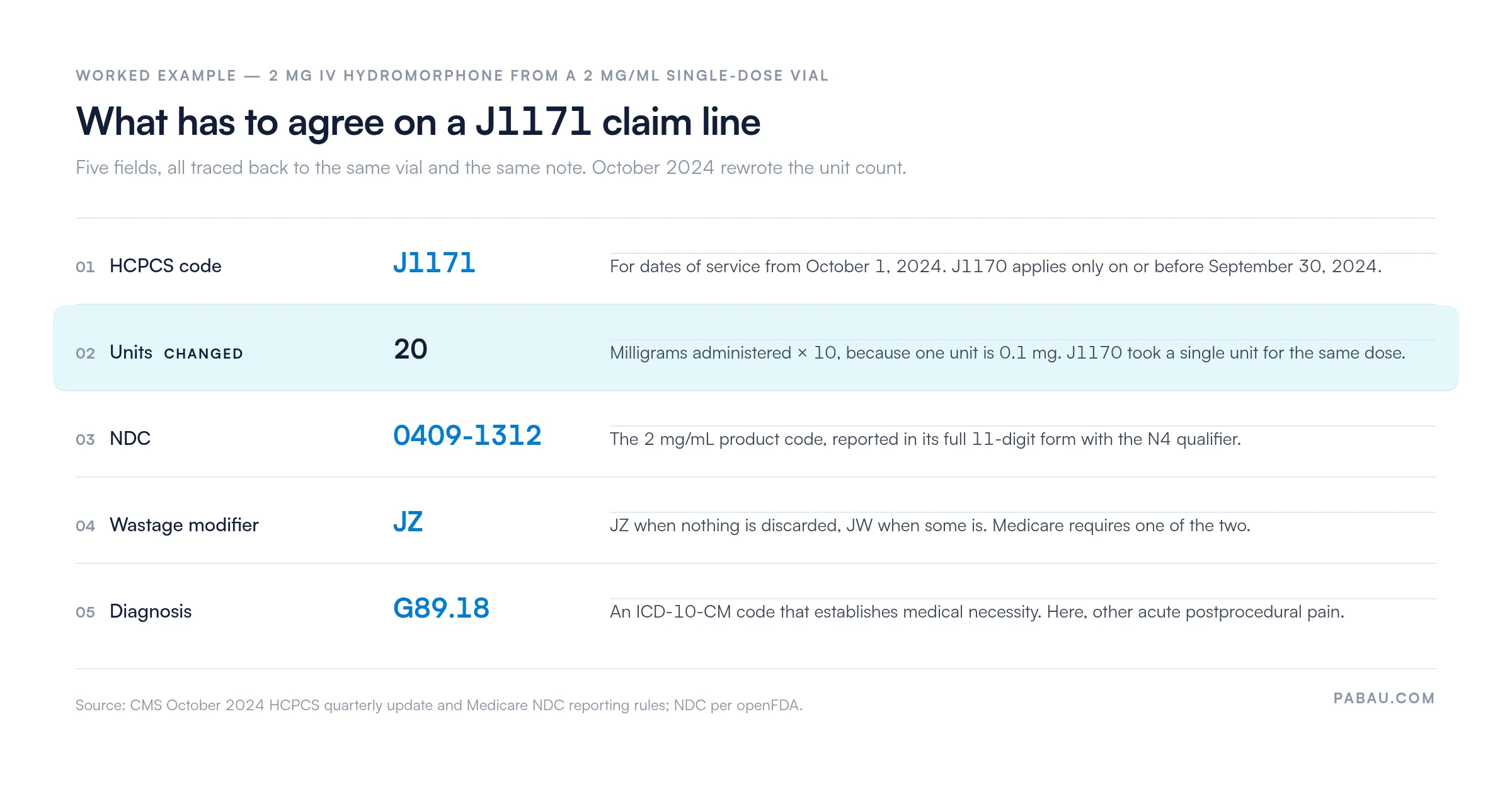
The unit change is where these claims break most often. A 2 mg dose was a single unit under the old code. Under J1171 the same dose is 20 units. On a physician-administered drug the code, the units, and the NDC all have to agree on the line.
Let Pabau's smart automation suggest the right codes, reduce claim denials, and keep your practice compliant—effortlessly.
Automate repetitive tasks and focus on what matters most—your patients.
Reduce coding errors and ensure compliance with the latest regulations.
Clean claims, fewer denials, and faster reimbursements.
Powerful insights and reporting to help your practice thrive.
HIPAA compliant SOC 2 certified GDPR-compliant Trusted by 4,000+ clinics worldwide

HCPCS code J1171 (injection, hydromorphone, 0.1 mg) is the active code for injectable hydromorphone, effective October 1, 2024.
J1170 (injection, hydromorphone, up to 4 mg) was deleted effective September 30, 2024, and claims carrying it are returned unprocessed.
One J1171 unit equals 0.1 mg, so a 2 mg dose bills as 20 units rather than the single unit J1170 took.
J3490 is no longer an appropriate fallback for hydromorphone, because a specific replacement code now exists.
Every J1171 claim needs the 11-digit NDC from the vial administered plus either the JW or the JZ wastage modifier.
Pabau’s claims management software captures drug name, NDC, dose, and route at the point of care, so the claim matches the record.
CMS retired J1170 in the October 2024 quarterly HCPCS update, with a deletion date of September 30, 2024. The same update added J1171 for the same drug at a finer billing increment. Medicare Administrative Contractors including CGS and Noridian published the change. State Medicaid programs issued crosswalk bulletins mapping the discontinued code to its replacement.
One date causes recurring confusion. Some code references list J1171 with a January 1, 2025 date, which is simply the first annual codebook year that printed it. The effective and billable date is October 1, 2024. Some practices held fourth-quarter 2024 claims while waiting for a 2025 start date. Those claims should have gone out under J1171.
For any date of service on or before September 30, 2024, J1170 remains the correct code on a corrected claim or an appeal. Code selection follows the date the drug was administered, not the date you file.
HCPCS code J1171 is the Level II code assigned to the injection of hydromorphone, 0.1 mg. The Centers for Medicare and Medicaid Services (CMS) maintains HCPCS Level II codes for drugs, supplies, and other items that CPT does not cover. J-codes specifically cover physician-administered injectable drugs billed on the CMS-1500 claim form or its electronic equivalent.
The table below summarizes the key attributes of J1171 as maintained in the CMS HCPCS code files.
Multiply the milligrams administered by ten. One unit of J1171 equals 0.1 mg, so 1 mg is 10 units and 2 mg is 20 units. This is the single largest behavioral change from the old code, where any dose up to 4 mg collapsed into one unit.
The table below converts the doses outpatient practices give most often. Report units for the amount actually administered to the patient, and report any discarded amount separately with the JW modifier.
Doses that fall between 0.1 mg increments still need a whole number of units. A 0.75 mg dose is 7.5 units of drug. Most payers require you to round that to the nearest reportable unit under their own policy. Check your MAC’s guidance rather than rounding by habit, and document the administered milligrams precisely so the two figures can be reconciled.
Sweep your charge master for every line item still keyed to J1170 or priced per 4 mg increment. Convert the hydromorphone entry to J1171 at 0.1 mg per unit. Then re-test your three most common doses against the new unit count before the next claim batch goes out. A charge master left on the old increment reports units that no longer match the dose given, which is an underreporting finding in an audit.
Hydromorphone is a potent opioid analgesic and a Schedule II controlled substance under the Drug Enforcement Administration’s classification system. It is roughly five to eight times more potent than morphine on a milligram-per-milligram basis. Typical outpatient doses run from 0.2 mg to 2 mg, well below the old 4 mg ceiling. The 0.1 mg unit in J1171 describes the drug far more accurately.
Dilaudid is the primary brand name for injectable hydromorphone. Generic versions from multiple manufacturers also carry National Drug Codes that crosswalk to J1171. Clinical use cases for injectable hydromorphone in outpatient settings include acute pain management in oncology, post-procedural pain, and palliative care where oral opioids are insufficient.
Hydromorphone is a Schedule II controlled substance, so the practice administering it must hold DEA registration. It must also comply with state pharmacy regulations and keep detailed controlled substance logs. These requirements operate independently of the HCPCS billing process. They still shape the documentation that supports medical necessity on claims.
Medicare reimburses J1171 under the Average Sales Price (ASP) methodology. CMS calculates ASP quarterly from manufacturer-reported sales data, then sets the payment rate at ASP plus 6%. That 6% add-on covers the practice’s acquisition cost, handling, and storage overhead for the drug.
Compare payment per dose, not per unit, when you review the transition. The J1171 per-unit rate covers 0.1 mg, so it is a fraction of the old J1170 per-unit rate that covered up to 4 mg. A rate that looks like a steep cut on a fee schedule line usually resolves once you multiply it by the correct unit count.
Payment rates change each quarter. The applicable rate is set by the quarter in which the drug is administered, not the quarter in which the claim is submitted. Pull current ASP pricing from the CMS average sales price files before setting internal charge amounts.
Tracking reimbursement across quarters matters for practices that routinely administer injectable drugs. Small shifts in ASP affect net margin on every administered dose.
Medicaid and commercial payers set their own rates independently of Medicare ASP methodology. Some managed care plans reimburse at a percentage of Medicare ASP. Others apply a fixed fee schedule or require prior authorization before the drug is administered. Verify payer-specific policy before administering a controlled substance injectable.
CMS requires every claim for a physician-administered drug to carry the 11-digit National Drug Code (NDC) of the product administered. Report the NDC with the N4 qualifier in loop 2410 of the 837P electronic transaction. On the paper CMS-1500 form it goes in the shaded portion of box 24.
The crosswalk for J1171 includes multiple NDC numbers covering different manufacturers, concentrations, and package sizes. The table below lists product codes from one common manufacturer, with the unit count each vial produces. The claim itself carries the full 11-digit code from the vial, so add the package segment printed on the label. Verify the crosswalk against current CMS quarterly NDC files rather than cached practice data.
Billing unit calculation: One unit of J1171 covers 0.1 mg of hydromorphone. A 2 mg dose is 20 units. A 6 mg dose is 60 units. Reporting a single unit for any dose above 0.1 mg was normal practice under J1170. It now underreports the drug given, and it fails a records-to-claim reconciliation.
Every J1171 claim must include at least one ICD-10-CM diagnosis code that establishes medical necessity. Medicare Administrative Contractors may apply Local Coverage Determinations that specify which diagnoses support coverage for injectable opioids. The most commonly accepted diagnoses fall into acute and chronic pain categories.
Sequence the diagnosis codes to reflect the condition driving the encounter. When a patient presents for cancer pain management, code the underlying neoplasm first and the pain (G89.3) as a secondary diagnosis. Sequencing errors are a leading cause of medical necessity denials on J-code claims. Our ICD-10-CM codes reference carries the full descriptor and the coding notes for each diagnosis above. Appeals on these cases usually need the clinical note as supporting documentation.
Documentation for J1171 serves two functions. It satisfies payer audit requirements, and it supports the clinical record if the claim is reviewed. Practices must keep a contemporaneous record of the administration that matches the billing data on the claim, including the unit count.
For Schedule II injectables, the clinical record and the controlled substance log must both support the dose billed. An inconsistency between the two is an audit finding.
Modifiers give the claim line context that affects payment and audit risk. The table below lists the modifiers most often used with J1171 and when each one applies.
JW and JZ are mandatory for Medicare drug waste reporting. Omitting both when billing from a single-dose vial is a common source of clean claim failures. The finer J1171 unit also makes wastage arithmetic more visible. A 2 mg vial with 1.5 mg given splits into 15 administered units and 5 discarded units. Set a standard procedure for documenting wastage at the point of administration rather than after the fact.
By this point the J1171 claim line has five fields on it, and they all have to agree with each other and with the vial. The worked example below runs a 2 mg dose through all five.
Hydromorphone billing carries a higher audit profile than most J-codes. It involves a Schedule II controlled substance, it relies on ASP pricing that changes quarterly, and it changed codes and units in late 2024. The errors below account for the majority of denials on these claims.
A pre-submission checklist catches most of these before the claim leaves the practice. Confirming coverage before the drug is administered catches the rest. That avoids giving a controlled substance the payer will ultimately deny.
Run a quarterly audit of your J-code charge master against the current CMS ASP drug pricing file. Pull the new quarterly file on the first business day of January, April, July, and October. Flag any J-code whose internal charge amount has drifted more than 10% from the updated ASP plus 6% rate. Correct it before the first claim of that quarter goes out.
J1171 sits within a broader family of J-codes for injectable opioids and analgesics. Practices billing several pain management drugs should keep clear crosswalk documentation, so the code on the claim matches the drug in the vial. Note how much the dosage unit varies between these codes.
J3490 deserves a specific note here, because plenty of guidance written during the 2024 transition still points to it. An unclassified code is appropriate only when no specific HCPCS code describes the drug. Hydromorphone has J1171, so the unclassified code is the wrong answer for it. Confirm current status through the AAPC HCPCS Level II lookup or the CMS annual HCPCS code list before each billing cycle.
Practices that administer physician-dispensed injectable drugs carry a documentation burden at every stage of the encounter. It covers the administration record, the controlled substance log, the charge capture, and the claim. Practice management software like Pabau is built for that kind of multi-step workflow. Pabau’s claims management software connects the clinical record to the billing output, so staff do not rekey data between systems.
Practices billing J-codes regularly need drug administration tracking inside the record itself. It records the drug name, NDC, dose, and route at the point of care. That record then populates the billing encounter, so the unit count derives from the milligrams documented rather than from a coder’s mental arithmetic. That matters most right after a unit change like the move from J1170 to J1171.
Generating accurate superbills that carry the J-code, NDC, units, and diagnosis codes is where manual billing workflows tend to break down. Pabau structures the encounter so each of those data points is captured once, at the source, instead of being reconstructed from partial notes.

Pabau’s claims management software connects drug administration records to billing workflows, so NDC numbers, dosage units, and diagnosis codes flow through to the claim automatically. See how it works for outpatient injection practices.

The practical answer for hydromorphone billing is short. Use J1171 for dates of service from October 1, 2024 onward. Calculate units at 0.1 mg each, and leave J1170 and J3490 out of it. The work sits in the surrounding requirements: quarterly ASP pricing, mandatory NDC reporting, JW and JZ modifier selection, controlled substance documentation, and ICD-10 sequencing.
Any one of those done wrong produces a denial. On a Schedule II drug that costs rework and appeal documentation as well as delayed payment. The fix worth making first sits upstream of the coder. Capture the milligrams, the NDC, and the wastage at the point of administration, and the unit count derives itself.
Sweep the charge master once, wire the administration record to the claim, and the J1170 transition stops generating denials on its own. Book a demo to see how Pabau captures J-code administration data and carries it through to the claim.

Need to understand how claims flow through a clearinghouse? How medical claims clearinghouses work explains the end-to-end submission process for physician-administered drugs.
Getting denials on J-code claims? Denial codes in medical billing breaks down the most common remittance advice codes and how to respond to each one.
Want to tighten your charge capture before claims go out? How superbills work in medical billing covers what data must appear on the superbill for buy-and-bill drugs to pass payer edits.
HCPCS code J1171 bills the injection of hydromorphone in 0.1 mg increments. It applies when a physician or qualified professional administers the drug in an outpatient or office setting. It covers the buy-and-bill drug cost and is reported on the CMS-1500 form alongside the 11-digit NDC of the vial used. It replaced J1170 on October 1, 2024.
Yes. CMS deleted J1170 (injection, hydromorphone, up to 4 mg) effective September 30, 2024. Its replacement, J1171 (injection, hydromorphone, 0.1 mg), was added and became billable on October 1, 2024. Any claim reporting J1170 for a date of service after September 30, 2024 is returned to the provider without processing.
One unit of J1171 equals 0.1 mg of hydromorphone. Multiply the milligrams administered by ten to get the unit count. A 0.5 mg dose is 5 units, a 1 mg dose is 10 units, and a 2 mg dose is 20 units. Reporting a single unit for a 2 mg dose was correct under J1170 and underreports the dose under J1171.
No. J3490 is the unclassified drug code, reserved for drugs that have no specific HCPCS code assigned. Hydromorphone has one, so J1171 is the correct code. Submitting J3490 when a specific code exists invites a denial and a request for the narrative that a specific code would have made unnecessary.
Because 2025 was the first annual HCPCS codebook year in which J1171 appeared in print. That publication date is not the effective date. CMS added the code in the October 2024 quarterly update, and it has been billable for dates of service on or after October 1, 2024.
Multiple NDC numbers crosswalk to J1171, covering different manufacturers, concentrations, and package sizes. Report the exact 11-digit NDC from the specific vial administered that day. Verify it against the current CMS quarterly NDC crosswalk file rather than a static internal list, because packaging changes retire NDC numbers.
Medicare requires either modifier JW (drug amount discarded) or JZ (zero drug wastage) on every J1171 claim billed from a single-dose vial. Use JW when any portion of the vial is discarded, and report the discarded units on a separate line. Use JZ when the whole vial is administered with no waste.
Yes. Hydromorphone is a DEA Schedule II controlled substance. Practices must hold DEA registration to administer it, keep a contemporaneous controlled substance log, and comply with state pharmacy regulations. Those requirements sit outside the HCPCS billing process, but the records they produce are what supports medical necessity in a payer audit.