

CCSD code G5100: Bypass of duodenum billing guide
CCSD code G5100 bills a bypass that leaves the duodenum in place CCSD code G5100...

Last Updated: Oct 16, 2026
J0894 is the HCPCS Level II code for injection, decitabine, 1 mg.
HCPCS Code J0894 bills for Injection, decitabine, 1 mg - Dacogen, an intravenous antimetabolite chemotherapy used to treat myelodysplastic syndromes (MDS) and acute myeloid leukemia (AML). Medicare covers it under Part B at ASP plus 6%, billed per milligram, with a JW or JZ modifier reporting any single-dose vial waste.
Getting HCPCS Code J0894 wrong costs oncology practices more than a denied claim. Specifically, it triggers payer audits, creates compliance exposure, and - when the JW modifier is misapplied - risks Medicare fraud allegations. Most billing errors on this code come from three places: confusing J0894 with J0893, mishandling single-dose vial wastage documentation, and omitting the correct CPT administration code.
As a result, what follows is a practical billing reference for outpatient oncology coders, practice managers, and revenue cycle teams: code description, Medicare reimbursement mechanics, modifier requirements, CPT pairing, and the J0893 vs J0894 distinction that CMS has made explicit.
Let Pabau's smart automation suggest the right codes, reduce claim denials, and keep your practice compliant—effortlessly.
Automate repetitive tasks and focus on what matters most—your patients.
Reduce coding errors and ensure compliance with the latest regulations.
Clean claims, fewer denials, and faster reimbursements.
Powerful insights and reporting to help your practice thrive.
HIPAA compliant SOC 2 certified GDPR-compliant Trusted by 4,000+ clinics worldwide

HCPCS Code J0894 represents Injection, decitabine, 1 mg – an antimetabolite chemotherapy agent used for myelodysplastic syndromes (MDS) and acute myeloid leukemia (AML), administered intravenously in outpatient oncology settings.
Medicare Part B reimburses J0894 under the buy-and-bill model using Average Sales Price (ASP) methodology; the West Virginia BMS payment allowance effective October 1, 2025 through December 31, 2025 is $1.218 per 1 mg.
J0894 (Dacogen) and J0893 (Sun Pharma decitabine) are NOT therapeutically equivalent per CMS – they cannot be substituted; billing J0893 when Dacogen was administered is a billing error that risks claim denial.
Pabau’s claims management software helps oncology billing teams track drug administration codes, attach modifiers, and document waste accurately – reducing J0894 claim denials before submission.
HCPCS Code J0894 is the billing code for Injection, decitabine, 1 mg. Specifically, it belongs to HCPCS Level II – the CMS-maintained code set covering drugs, supplies, and services not captured by CPT. Furthermore, J0894 falls under the “Drugs Administered by Injection” category within that system.
Decitabine is a pyrimidine analog antimetabolite. Specifically, it works by inhibiting DNA methyltransferase, which reactivates silenced tumor suppressor genes in malignant cells. The brand name is Dacogen. The National Cancer Institute SEER CanMED database classifies it under SEER*Rx category: Chemotherapy, Major Drug Class: Antimetabolite, Minor Drug Class: Pyrimidine Analog. FDA approved decitabine in 2006 for treatment of myelodysplastic syndromes (MDS). Importantly, it is administered intravenously – not orally – which is why J0894 applies and not an oral chemotherapy code.
The primary diagnoses linked to J0894 billing are MDS subtypes (ICD-10-CM D46 series) and acute myeloid leukemia (AML). As a result, oncology practices using claims management software can attach these diagnosis codes to J0894 line items at the point of documentation, reducing the manual reconciliation step at submission.
One operational detail coders often miss: J0894 is billed per 1 mg. For example, decitabine is typically administered at 20 mg/m² per day for five days per cycle. A patient with 1.8 m² body surface area receives 36 mg per infusion day. That means 36 units of J0894 per infusion session. Therefore, billing the wrong unit count is one of the most common underbilling errors on this code.
The table below summarises J0894 code properties and key billing identifiers. Additionally, practices billing through a diagnosis code reference system should verify the current NDC against their dispensed product before submission, since NDC numbers vary by manufacturer lot and packaging.
NDC-to-HCPCS crosswalk mapping for J0894 is available through payer portals and billing tools. Furthermore, when submitting claims electronically, including the NDC alongside J0894 supports medical necessity review and reduces the likelihood of a carrier judgment determination. The AAPC HCPCS code lookup provides current NDC-to-J0894 mapping data.
Medicare Part B covers J0894 under the buy-and-bill model. In practice, the practice purchases decitabine from a specialty distributor, administers it to the patient, and then bills Medicare using J0894. Reimbursement is calculated at ASP (Average Sales Price) plus 6%. Specifically, that 6% add-on is intended to cover the practice’s acquisition, storage, and handling costs for the drug.
ASP-based payments update quarterly. For example, the West Virginia BMS payment allowance document lists the J0894 payment allowance effective October 1, 2025 through December 31, 2025 at $1.218 per 1 mg. Since decitabine is billed per 1 mg and doses are weight-based, the actual reimbursement per infusion session scales with the patient’s body surface area. As a result, for a 36 mg dose, that produces a drug reimbursement of approximately $43.85 at that allowance rate, before the administration code reimbursement is added.
Therefore, verify current ASP payment allowances directly through the CMS Physician Fee Schedule lookup before submitting claims. Rates adjust January 1, April 1, July 1, and October 1 each year. Consequently, billing at an outdated allowance rate creates reconciliation issues and can delay payment.
Coverage is subject to carrier judgment in some cases. Specifically, the designation “carrier judgment” on J0894 means individual Medicare Administrative Contractors (MACs) may apply local coverage determination (LCD) policies that affect whether a specific diagnosis qualifies for reimbursement. For instance, practices working with Palmetto GBA as their MAC should verify current LCD policies before submitting. Additionally.
Prior authorization requirements vary significantly by payer. For example, Medicare does not universally require prior auth for J0894, but commercial payers and Medicaid programs often do. Therefore, confirm with each payer before initiating a new patient’s treatment cycle. Additionally, documenting the authorization reference number in the patient’s billing record is essential for audit readiness. Practices using specialty drug procedure codes for other injectable therapies will recognize this workflow from managing prior auth on fertility treatment billing.
Run your J0894 ASP calculation fresh each quarter. Pull the current CMS ASP file (posted on cms.gov quarterly), multiply the listed allowance by the exact mg dose administered, and document that calculation in the patient’s billing note. Auditors reviewing J0894 claims frequently check that billed units match the administered dose – having the calculation on file resolves most discrepancy queries without a formal appeal.
Practices administering injectables should read up on inventory software for medical spas before wastage eats the margin.
CMS has identified J0894 (Dacogen) as a single-dose container code. As a result, that classification directly triggers the JW/JZ modifier requirement. Here is what that means in practice.
When a single-dose vial contains more drug than the patient’s prescribed dose, the remainder is discarded. That discarded amount is “wastage.” Therefore, CMS requires practices to report wastage explicitly – either by appending the JW modifier (drug amount discarded) or the JZ modifier (zero waste). Omitting both modifiers on a single-dose container code is a billing error that can trigger audits.
For example: a patient receives 36 mg of decitabine. The vial contains 50 mg. You administer 36 mg (bill 36 units of J0894 with no modifier) and discard 14 mg (bill 14 units of J0894-JW). As a result, total units billed equal 50 – matching the full vial. However, Medicare only reimburses the administered 36 units; the JW line is billed at $0 reimbursement and exists purely for audit documentation.
Using digital intake forms and structured clinical records makes it easier to document the exact vial size, dose administered, and waste amount at the point of care. Consequently, that real-time capture prevents the reconstruction errors that cause JW modifier mismatches at billing time. Similarly.
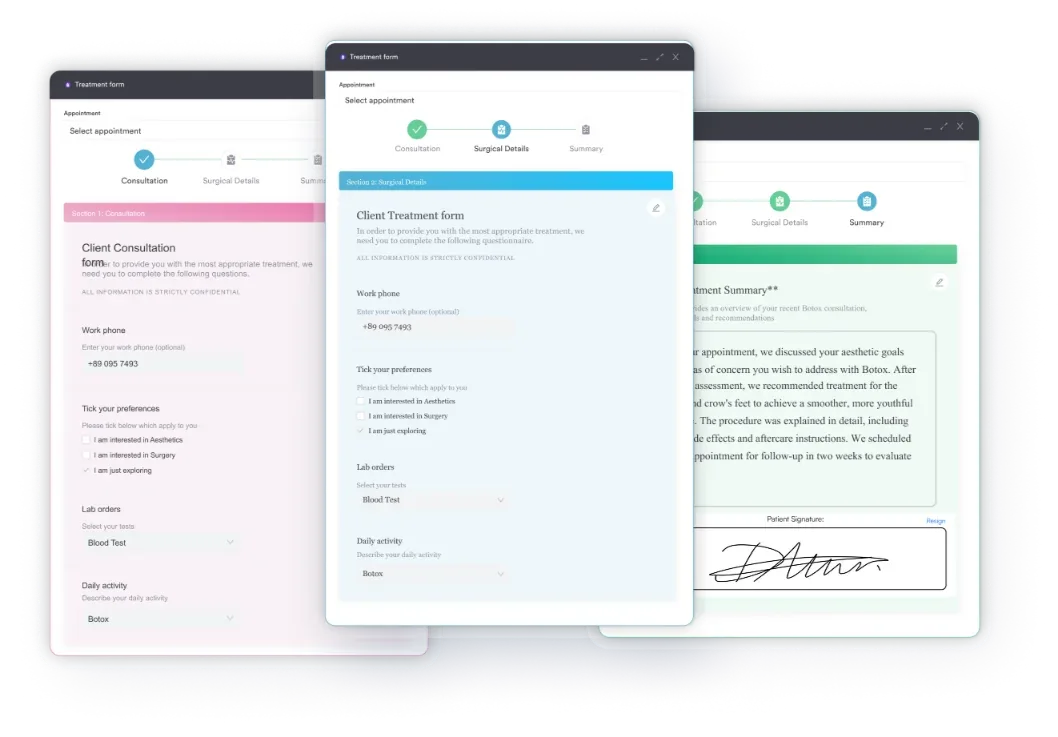

Pabau’s claims management tools help oncology billing teams document drug units, attach JW/JZ modifiers, and link CPT administration codes – so J0894 claims go out clean the first time.

J0894 covers the drug cost only. Therefore, the infusion service itself requires a separate CPT administration code. Billing J0894 without an administration code leaves a significant portion of the claim revenue unreported.
For outpatient IV chemotherapy infusion, the standard pairing is:
Palmetto GBA’s published billing guidance (referenced in AAPC coding forums) confirms this pairing: submit J0894 alongside CPT 96413 (initial hour) and CPT 96415 for each subsequent hour. Additionally, the ICD-10-CM D46 series codes for MDS subtypes should appear as the primary diagnosis on the claim. As with ICD-10 diagnosis code documentation in behavioral health billing, the diagnosis must support the medical necessity of the procedure billed.
Place of service matters. Specifically, outpatient hospital billing routes J0894 through the Outpatient Prospective Payment System (OPPS), where drug reimbursement is bundled differently than under the Part B Physician Fee Schedule. In contrast, for freestanding oncology clinics billing under the Physician Fee Schedule, the CPT 96413/96415 plus J0894 combination described above applies. Therefore, confirm your facility’s billing setting with your MAC before assuming which payment methodology governs your J0894 claims.
Additionally, using lab management software that tracks IV drug preparation records alongside clinical orders creates a natural audit trail linking the ordered dose to the billed units – a connection auditors look for when reviewing chemotherapy drug claims.
Document the infusion start and stop time in the clinical record for every J0894 session. CPT 96415 units depend on total infusion time: if the clock shows 2 hours 5 minutes, you bill 96413 x1 and 96415 x1. If the record only shows the date and not the time, you cannot support the 96415 unit, and payers will reduce the claim to 96413 only. Time documentation is the single most auditable element on chemotherapy infusion claims.
J0893 and J0894 are both decitabine injection codes, but CMS has been explicit: they are not interchangeable. Specifically, the CMS JW/JZ Modifier Policy HCPCS Codes document states that J0893 – Injection, decitabine (Sun Pharma) – is “not therapeutically equivalent to J0894, 1 mg.”
In practice, this means you cannot submit J0894 when Sun Pharma’s decitabine was dispensed and administered, and you cannot submit J0893 when Dacogen (the originator product) was used. The distinction is product-specific, not just manufacturer-specific. Therefore, billing the wrong code when one of these products was actually administered constitutes a billing error – and potentially a false claim if the discrepancy is not corrected.
The practical workflow fix is straightforward: verify the dispensed product’s NDC at the point of drug preparation, match it to the correct HCPCS code before claim generation, and document the NDC on the claim. Similarly. Additionally, the PGM Billing HCPCS lookup tool allows side-by-side code comparison and NDC verification for J0893 and J0894.
Practices that have a pharmacy or compounding service managing decitabine procurement should include the HCPCS code verification step in the drug preparation workflow – not just the billing workflow. In other words, by the time a coder is reviewing a claim, the dispensing record should already carry the correct product identifier. As with ICD-10 coding documentation requirements for complex conditions, accuracy starts at the clinical encounter, not at the billing workstation.
HCPCS Code J0894 billing has three real failure points: unit calculation errors from the per-1-mg billing structure, JW/JZ modifier omissions on single-dose vials, and the J0893 substitution error that CMS has specifically flagged. Importantly, each of these is preventable with structured documentation at the point of care.
As a result, Pabau’s claims management software helps oncology billing teams build those controls into the workflow – linking drug records, administration times, and diagnosis codes to each claim before submission. To see how it handles chemotherapy drug billing in practice, book a demo.

Coding an asbestosis diagnosis? ICD-10 code J61 covers asbestosis coding for confirmed cases without pleural plaque or tuberculosis.
Coding a periapical abscess diagnosis? ICD-10 code K04.7 covers periapical abscess coding within the K00-K14 oral cavity code range.
Coding cellulitis or abscess of the mouth? ICD-10 code K12.2 covers documenting and coding mouth cellulitis and abscess for the claim record.
HCPCS Code J0894 is the billing code for Injection, decitabine, 1 mg – a pyrimidine analog antimetabolite chemotherapy agent sold under the brand name Dacogen. It is used in outpatient oncology settings to treat myelodysplastic syndromes (MDS) and acute myeloid leukemia (AML).
The West Virginia BMS payment allowance for J0894, effective October 1–December 31, 2025, is $1.218 per 1 mg. Medicare pays ASP plus 6%; allowances update quarterly — always verify the current rate via the CMS Physician Fee Schedule before submitting.
J0894 is for Dacogen (originator decitabine); J0893 is for Sun Pharma’s decitabine. CMS states they are not therapeutically equivalent and cannot be substituted. Always bill the code matching the dispensed product’s NDC.
Use JW when the vial contains more drug than the administered dose and the remainder is discarded — bill the administered units with no modifier and the wasted units on a second line with JW. If no waste occurs, append JZ instead to confirm zero waste.
Bill CPT 96413 (IV chemotherapy, up to 1 hour) as the primary infusion code and CPT 96415 for each additional hour. J0894 covers the drug cost only — omitting the administration code leaves infusion service revenue unreported.



