CPT Code 62284: Injection procedure for myelography
CPT Code 62284: official descriptor and procedure overview The American Medical ...

Last Updated: Oct 19, 2026
J0571 is the HCPCS Level II code for buprenorphine, oral, 1 mg.
Let Pabau's smart automation suggest the right codes, reduce claim denials, and keep your practice compliant—effortlessly.
Automate repetitive tasks and focus on what matters most—your patients.
Reduce coding errors and ensure compliance with the latest regulations.
Clean claims, fewer denials, and faster reimbursements.
Powerful insights and reporting to help your practice thrive.
HIPAA compliant SOC 2 certified GDPR-compliant Trusted by 4,000+ clinics worldwide

HCPCS Code J0571 covers buprenorphine, oral, 1 mg, dispensed for medication-assisted treatment of opioid use disorder. One billed unit equals 1 mg.
Unit miscounts are the most common J0571 denial reason. A 16 mg dose dispensed at one visit bills as 16 units, not 1.
Medicare pays J0571 at ASP plus 6% in the physician office setting. Rates change quarterly, so verify the current figure at cms.gov.
Place of service decides the rate. POS 11 pays the non-facility amount, and POS 22 pays the lower hospital outpatient rate.
Pabau’s claims management software pre-fills claim submissions from existing patient-record data and tracks the status of each submission.
HCPCS Code J0571 is the Level II code for buprenorphine, oral, 1 mg. One unit equals one milligram of oral buprenorphine dispensed, so the unit count on the claim tracks the dose.
The Centers for Medicare and Medicaid Services (CMS) placed the code in the J-series drug codes. It covers physician-administered oral buprenorphine dispensed in an office or outpatient setting, as part of medication-assisted treatment (MAT) for opioid use disorder (OUD).
The code itself is simple. Denials come from the conversion between milligrams and units, and from formulation mismatches inside the J0570 to J0575 range.
The table below captures the core attributes of J0571 as CMS maintains them in the HCPCS Level II code file.
Miscoding between codes in the J0570-J0575 series is a persistent audit risk. Each code maps to a distinct formulation, route, or strength. Billing J0571 for an implant or a combination product is a coding error. The Probuphine implant reports under HCPCS code J0570 instead, billed as one unit per 74.2 mg rod.
The order of the decision is what keeps it simple. Formulation narrows the code family first, and only then does the buprenorphine dose narrow it to a single code.
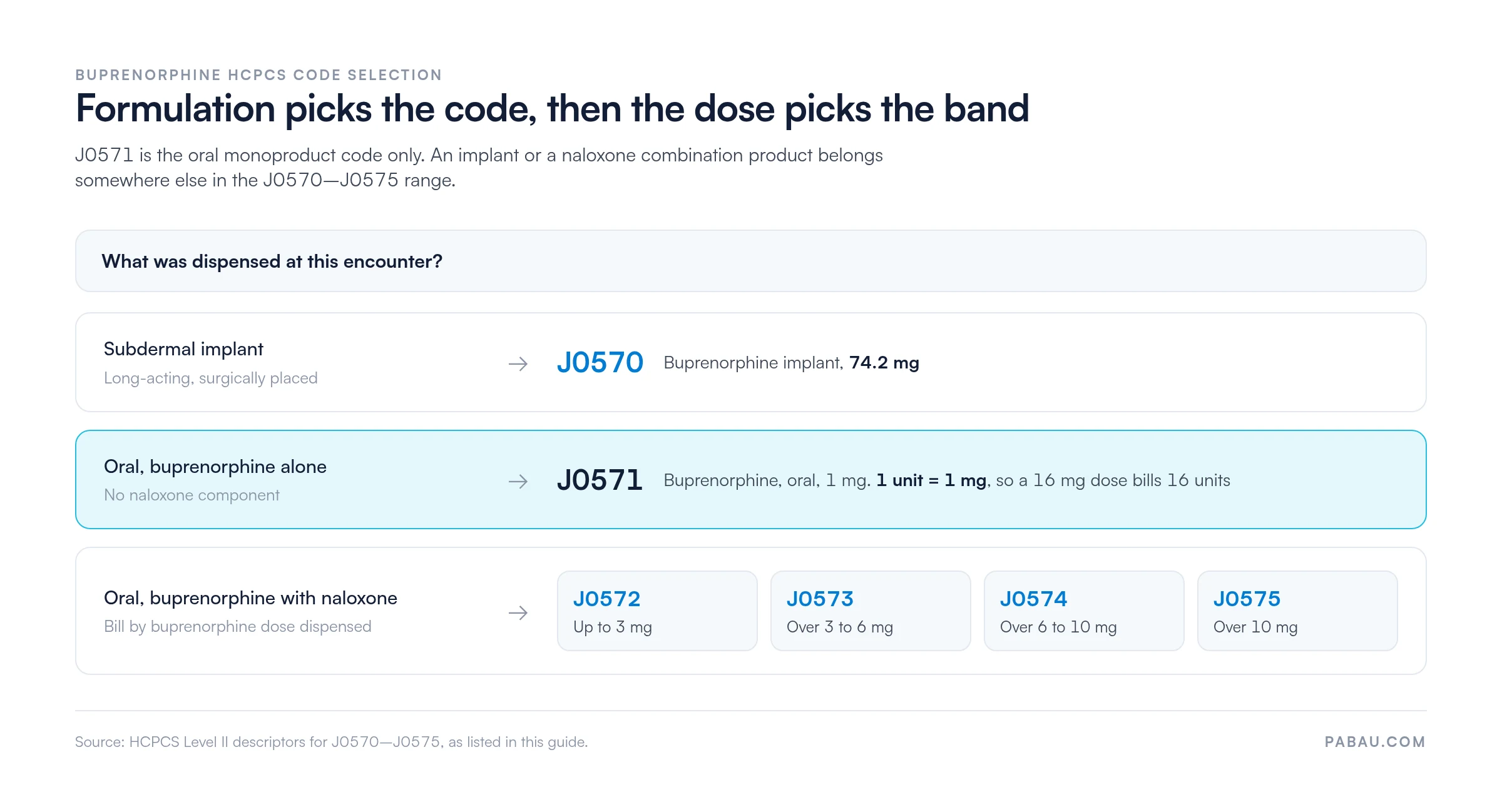
J0571 applies specifically to the buprenorphine monoproduct, with no naloxone component. If a patient receives a combination formulation such as Suboxone or Zubsolv, the correct code is J0572, J0573, J0574, or J0575. The buprenorphine dose dispensed decides which one. Billing J0571 for a combination product is a coding mismatch that triggers denial.
Verify formulation before selecting a J-code. Ask the prescriber whether this is buprenorphine alone, or buprenorphine combined with naloxone. The answer decides whether you are in the J0571 column or the J0572-J0575 range. Getting it wrong at code selection creates denials that take weeks to appeal.
Bill one unit for every milligram of oral buprenorphine dispensed. That single rule covers the whole calculation, and it is still where most J0571 errors start.
Bill for the milligrams dispensed at that encounter, not the prescribed daily dose. If a patient receives their full 16 mg dose at a single office visit, bill 16 units. Do not round down and do not bill 1 unit per visit. Payers audit unit counts against dispensing records and prescriber documentation.
Every J0571 claim needs a linked ICD-10-CM diagnosis code demonstrating medical necessity, and opioid use disorder is the primary indication. The table below lists the codes most frequently accepted by Medicare and commercial payers alongside J0571.
The ICD-10 code must reflect the clinical documentation. Billing F11.20 when the record documents active withdrawal creates audit risk, and so does billing F11.21 with no clinical evidence of remission.
The Substance Abuse and Mental Health Services Administration (SAMHSA) and the Office of Inspector General (OIG) both flag MAT billing as a high-scrutiny area. Diagnosis accuracy is a compliance requirement here, so the code on the claim should come from the note rather than from habit.
Medicare reimburses J0571 under Part B using the Average Sales Price (ASP) plus 6% methodology, and CMS updates that rate quarterly. According to the CMS Physician Fee Schedule, the payment amount for any given quarter should be verified against the current ASP drug pricing file.
The ASP plus 6% formula applies in the non-facility setting, typically the physician office at POS 11. Hospital outpatient settings at POS 22 follow the Outpatient Prospective Payment System (OPPS) rate, which is usually lower. The setting the drug was dispensed in therefore decides which fee schedule column applies.
Medicaid coverage for J0571 varies significantly by state. States set their own fee schedules and coverage criteria, and some require prior authorization even where Medicare does not. Verify coverage with the specific state agency before submitting, and record that verification in the pre-claim workflow so an audit can see it.
Medicare Part B does not currently require prior authorization for J0571 in most circumstances. Commercial payers and state Medicaid programs frequently do. Requirements vary by plan rather than by payer type. A practice with a mixed payer mix needs a verification step in its MAT intake workflow.
Typical prior authorization criteria for commercial payers include:
One compliance note matters here. As of December 2022, the DATA 2000 waiver (X-waiver) is no longer required. Any DEA-registered practitioner with Schedule III authority may prescribe buprenorphine for opioid use disorder.
Some commercial payers have not updated their prior authorization criteria to match, and may still request proof of X-waiver status. If a payer asks, document that you prescribe under DEA Schedule III authority per the Consolidated Appropriations Act 2023 (Public Law 117-328).
National Drug Code (NDC) reporting is required on Medicaid claims for J0571, and many Medicare Administrative Contractors (MACs) recommend it on Part B claims. The NDC identifies the specific buprenorphine product dispensed, which supports the Medicaid drug rebate program.
NDC codes follow an 11-digit format of labeler, product, and package. When billing with an NDC, report the quantity in the NDC unit alongside the HCPCS unit count. Those two numbers are rarely the same. A claim for 8 mg of buprenorphine carries 8 HCPCS units of J0571, and may reference a single 8 mg tablet as 1 NDC unit.
Products that crosswalk to J0571 include buprenorphine HCl sublingual tablets and Subutex, the brand now discontinued in the US market. Always use the NDC from the dispensed lot rather than a reference NDC. On Medicaid claims, an incorrect or outdated NDC is a leading cause of rejection. The CMS HCPCS overview sets out NDC-to-HCPCS reporting requirements by program.
A clean J0571 claim rests on documentation that exists before submission, not after a denial arrives. The OIG treats MAT billing as a high-audit area, which makes record completeness a compliance question as much as a billing one.
Required documentation elements for each J0571 encounter include:
Practices operating opioid treatment programs (OTPs) under SAMHSA certification carry additional documentation requirements beyond office-based MAT. OTP billing has its own code set and compliance structure, separate from J0571 physician office billing. Capture every field at the point of care, because reconstructing a dispensing record weeks later rarely satisfies an auditor.
Place of service (POS) directly affects what J0571 pays, and it is the part of drug billing that most references leave at one line. The difference between the office and facility amounts lands on every claim, so a habitual POS error compounds quietly.
A practice billing POS 22 for a service delivered in a standard physician office gets paid at the lower facility rate. It loses that difference on every claim. Billing POS 11 for a hospital outpatient setting misstates the service location, which creates a compliance exposure larger than the payment difference. Use the POS code that matches where the drug was dispensed.
J0571 denials cluster around a small number of recurring errors, so identifying the error type is the first step in resolving one. A structured denial management workflow that sorts J0571 rejections by reason code catches a pattern before it spreads across a patient panel.
Where the same rejection keeps arriving, sorting medical billing denial codes by category turns a correction loop into a prevention protocol. Tracking denial rates by payer also shows which commercial plans hold the most restrictive J0571 policies, so those plans get the prior authorization work first.
Audit your J0571 denial reasons once a quarter, sorted by denial code rather than by claim count. One systemic error, such as billing 1 unit for a multi-milligram dose, shows up as dozens of denials sharing a reason code. Fixed at the source, it takes minutes.
MAT billing teams usually work across two systems. The dose, the product, and the diagnosis are documented in the clinical record, and the claim then gets keyed into a separate portal. Every re-keyed field is a chance to transpose a unit count.
Practice management software like Pabau closes that distance. Its claims software for practices works from the same patient record the clinician documented in. Insurer and policy details are therefore already attached to the invoice. In the US, claims go out through the Claim.MD integration, with real-time eligibility checks available before the visit.
Pabau also validates a claim before it leaves. If a detail the payer needs is missing, the send button stays disabled until someone supplies it. Each claim then moves through set stages from submitted to paid, and remittances post back against the invoice that raised them.
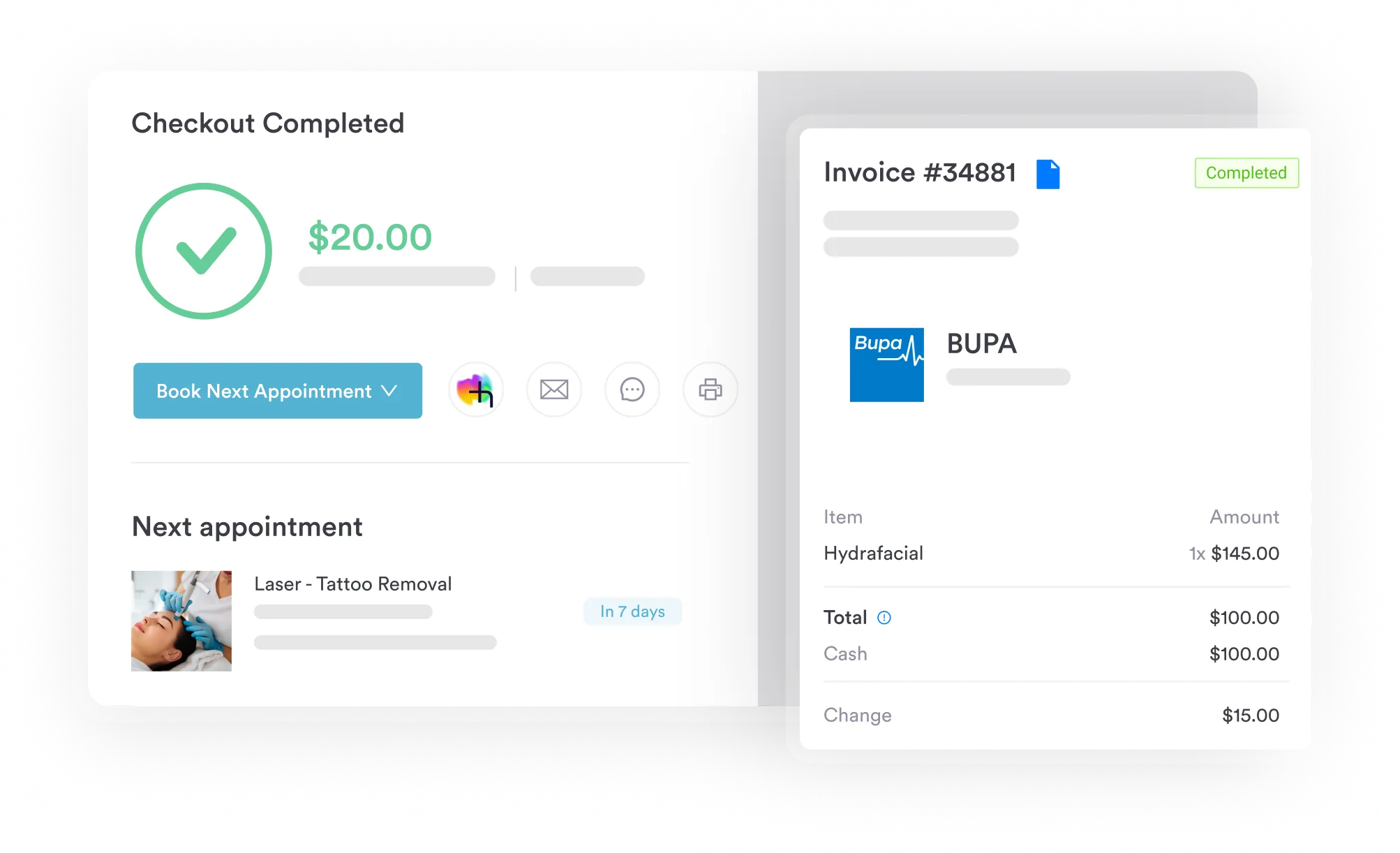
The unit count and the diagnosis code stay yours to determine. What the software removes is the re-entry between the note and the claim, plus the guesswork about where a submitted claim currently sits. According to the AAPC’s HCPCS Level II code resources, drug billing is among the most audited areas across payer types. Cutting manual hops out of the process protects revenue.

Pabau’s claims management software pre-fills each submission from the patient record your team already keeps. Track every claim through submitted, processing, and paid stages from one dashboard.

J0571 rewards a boring workflow. Record the milligrams dispensed and the exact product at the encounter. Both the unit count and the code choice then follow from the record rather than from memory.
The trade-off worth remembering is scale. One transposed unit count is a small write-off. The same habit across a MAT panel of 200 patients becomes a monthly revenue leak. Auditing one denial reason per quarter costs less than appealing the claims it produces.
Pabau keeps the clinical record and the claim in one system. Submissions are pre-filled from documented data, and each claim’s status stays visible to the billing team. Book a demo to see how Pabau handles insurance billing for a MAT panel.

Need to understand how claims flow through a clearinghouse? Medical claims clearinghouse guide walks through how electronic claims are validated, scrubbed, and routed to payers.
Seeing patterns in claim rejections across your practice? Clean claim submission checklist covers the data elements every claim must include to pass payer edits on the first pass.
Managing eligibility verification before dispensing buprenorphine? Insurance eligibility verification workflows outlines how to confirm coverage and prior auth requirements before the patient leaves the office.
HCPCS Code J0571 is the billing code for buprenorphine, oral, 1 mg, used in medication-assisted treatment (MAT) for opioid use disorder. Providers use it to bill Medicare Part B, Medicaid, and commercial payers when buprenorphine is dispensed in a physician office or outpatient clinic setting.
Bill 16 units. Each unit of J0571 equals 1 mg of oral buprenorphine, so the unit count must equal the number of milligrams dispensed at the encounter. Billing 1 unit for a 16 mg dose is the most common and costliest J0571 billing error.
J0571 covers buprenorphine monoproduct (no naloxone) at 1 mg per unit. J0572 covers buprenorphine/naloxone combination products at doses up to 3 mg buprenorphine. If your patient receives Suboxone, Zubsolv, or another combination formulation, J0571 is the wrong code. Use J0572, J0573, J0574, or J0575, depending on the buprenorphine dose.
NDC reporting is required on J0571 Medicaid claims to support the drug rebate program. For Medicare Part B, NDC reporting is not mandated but is recommended by many Medicare Administrative Contractors. Always include the 11-digit NDC of the specific dispensed product on Medicaid claims.