CPT Code 62284: Injection procedure for myelography
CPT Code 62284: official descriptor and procedure overview The American Medical ...

Last Updated: Oct 19, 2026
G0444 is the HCPCS Level II code for annual depression screening, 5 to 15 minutes. Medicare Part B covers it once every 12 months in a primary care setting, with no deductible or coinsurance for the patient.
The screening uses a standardized tool such as the PHQ-9, with Z13.31 as the primary diagnosis. It can be billed with a subsequent annual wellness visit (G0439), but never with the initial visit (G0438). Most commercial payers and Medicaid plans expect CPT 96127 instead.
Let Pabau's smart automation suggest the right codes, reduce claim denials, and keep your practice compliant—effortlessly.
Automate repetitive tasks and focus on what matters most—your patients.
Reduce coding errors and ensure compliance with the latest regulations.
Clean claims, fewer denials, and faster reimbursements.
Powerful insights and reporting to help your practice thrive.
HIPAA compliant SOC 2 certified GDPR-compliant Trusted by 4,000+ clinics worldwide

HCPCS Code G0444 covers a 5-to-15-minute annual depression screening for Medicare Part B patients, with no deductible or coinsurance.
Z13.31 (encounter for screening for depression) is the primary ICD-10 diagnosis code, and a treatment diagnosis in its place is a common denial cause.
G0444 is payable once every 12 months, after 11 full months have passed following the month of the last screening.
G0444 can share a date of service with a subsequent annual wellness visit (G0439), but never with the initial visit (G0438).
Pabau, the practice management platform we build, checks eligibility and validates claim details before a G0444 claim goes out.
HCPCS Code G0444 is a Medicare HCPCS Level II G-code for a standardized annual depression screening. The screening happens face to face in a primary care setting and lasts 5 to 15 minutes. The US Preventive Services Task Force (USPSTF) gave adult depression screening a Grade B recommendation. The Centers for Medicare and Medicaid Services then added it to the Medicare preventive benefit.
Under Section 4104 of the Affordable Care Act, covered preventive services that the USPSTF grades A or B carry no deductible or coinsurance. As a result, G0444 costs the patient nothing out of pocket.
The table below summarizes the key coverage parameters for HCPCS Code G0444.
G0444 covers a single face-to-face screening encounter using a validated, standardized depression tool. A qualified primary care practitioner must complete it and document it as a preventive screen, not as treatment.
Crossing either line leads to a denial. A treatment diagnosis on a screening claim typically returns CO-11, meaning the diagnosis is inconsistent with the procedure. A screen billed with a service that already includes it can return CO-97, meaning the benefit is included in payment for another service. Our guide to medical billing denial codes explains how to work each one.
Covered under G0444:
Not covered under G0444:
CMS requires a standardized, validated screening instrument for G0444, but it does not publish a list of approved tools. The PHQ-9 (Patient Health Questionnaire-9) is the most common choice in primary care. It produces a numeric score that’s simple to document and easy for an auditor to follow.
Some MACs question the PHQ-2 on its own. If your practice uses it as a first-pass screen, document the full PHQ-9 whenever the PHQ-2 is positive, then bill G0444.
An incorrect primary ICD-10 code is one of the most frequent reasons G0444 claims are denied. A treatment or active-diagnosis code tells the payer the encounter was diagnostic rather than a covered preventive screen. That mismatch typically returns a CO-11 denial (diagnosis inconsistent with procedure). Lead with Z13.31, and add a secondary code only if it’s clinically justified.
Do not use F32.0 through F33.9 as the primary diagnosis on a G0444 claim. Those codes indicate an active depressive episode under treatment. They turn the visit from a preventive screen into a diagnostic encounter, and the Medicare preventive benefit no longer applies.
Medicare pays G0444 when a physician or another qualified primary care practitioner furnishes it in a primary care setting. The practice must also have staff-assisted depression care supports in place. Those supports make sure a positive screen leads to accurate diagnosis, effective treatment, and follow-up.
Psychiatrists and other specialty-only providers may run into MAC-specific restrictions. Check with your local MAC before billing G0444 outside a primary care setting.
Place of service (POS) tells the MAC where the screening happened, and that setting must still count as primary care. MAC guidance lists these codes for G0444:
Medicare pays G0444 through the Medicare Physician Fee Schedule (PFS). The rate comes from relative value units (RVUs), adjusted by the geographic practice cost index (GPCI) for your payment locality. G0444 carries a non-facility total of 0.56 RVUs. At the 2025 conversion factor of $32.35, that works out to approximately $18 to $19 nationally.
The facility rate is lower because Medicare assumes the facility absorbs practice expense overhead. Check the current rate for your locality in the CMS Physician Fee Schedule lookup tool before billing. Rates change with each annual PFS final rule.
Incomplete documentation is a frequent cause of G0444 denials and a common trigger for post-payment audits. Each element below must appear in the medical record, not only on the claim, because MACs audit source documentation. Medical billing compliance reviews tend to catch the same two failures: no tool name, or no follow-up plan for a positive screen.
Build a G0444 documentation template into your EHR that auto-populates the tool name, score field, and time notation. Make the follow-up plan a required field, so a positive screen can’t be signed off without one.
G0444 can be billed on the same date as a subsequent Annual Wellness Visit (AWV), coded G0439. Medicare does not pay G0444 on the same date as the initial AWV (G0438) or the Initial Preventive Physical Examination (IPPE). Both of those visits already include a review of depression risk.
The Health Risk Assessment (HRA) inside the AWV may include depression questions too. G0444 is still a distinct preventive service, with its own tool, score, and time. Getting a clean claim on a same-day G0439 and G0444 visit comes down to four steps.
G0444 and CPT 96127 (brief emotional or behavioral assessment) both involve standardized screening instruments, so coders often mix them up. For the annual depression screen, Medicare expects G0444. CPT 96127 is the code most commercial payers and Medicaid plans use instead. A Medicare claim that reports 96127 for this screen is typically denied or rejected under payer policy.
G0444 doesn’t need a modifier when billed as a stand-alone preventive screening. Modifier mistakes usually happen on same-day visits that combine G0444 with an E/M service or an AWV. On those visits, the modifier belongs on the E/M line.
G0444 denials follow a predictable pattern, and practices that audit them keep finding the same six causes. Each fix is just as predictable, which makes denial management workflows for G0444 easy to standardize. Running insurance eligibility verification before the visit catches coverage problems before submission.
Five checks, run in order before every G0444 claim goes out, prevent most of these denials.
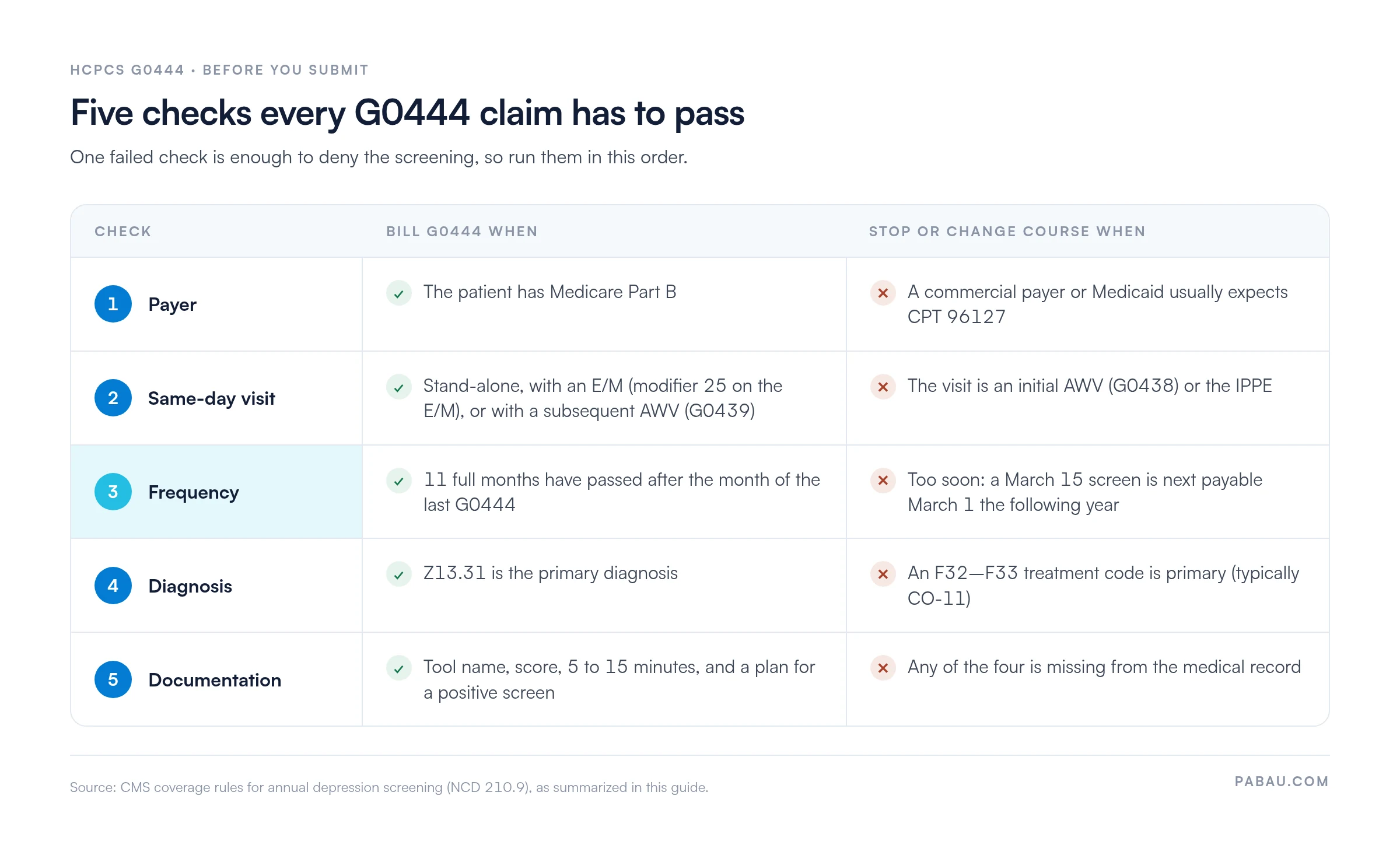
When a claim still comes back denied, the table below maps each cause to its usual code and fix.
G0444 is payable once every 12 months, and Medicare counts the interval in whole months. At least 11 full months must pass following the month of the last screening. If a patient received G0444 on March 15, the next payable date is March 1 of the following year. A claim dated January 10 of that year is premature and will deny.
Before each G0444 submission, check the patient’s claim history under their Medicare Beneficiary Identifier (MBI). Confirm that no G0444 was paid inside that window. Pabau’s error-catching claims software adds a second layer, with validation checks and real-time eligibility checks before each claim is sent.
Telehealth coverage for G0444 expanded during the COVID-19 Public Health Emergency, and later legislation extended some of those flexibilities. The current rule depends on your MAC and changes annually, so no single statement applies to every jurisdiction.
Before billing G0444 via telehealth, check the CMS telehealth services list and your MAC’s current LCD or coverage article. If G0444 is on this year’s list and your MAC permits it, bill POS 02 or POS 10. POS 02 covers telehealth outside the patient’s home, and POS 10 covers telehealth in it.
Follow your MAC’s telehealth modifier instructions, since some require Modifier 95. If G0444 isn’t on the list or your MAC doesn’t allow it, deliver the screening in person at an accepted POS. The PGM Billing HCPCS lookup tool is a quick way to confirm current status before each year’s billing cycle begins.
Set a calendar reminder each January to check G0444 telehealth status against your MAC’s updated policy and the CMS telehealth services list. Telehealth rules can change mid-year, and your practice won’t always get a separate notice.
Many primary care practices run G0444 across three or four tools. The PHQ-9 sits on paper or in the EHR, the claim goes out through a separate billing system, and eligibility gets checked by phone. Each handoff is another chance for a wrong code or a missed date.
Pabau keeps those steps on one patient record. The screening note, the invoice, and the patient’s insurer details live together. When you send the claim, Pabau pre-fills it from that record and runs validation checks in the background. In the US, claims go out through Claim.MD, with real-time eligibility checks and ERA remittance posting in the same dashboard.
Your team rekeys less and sees the status of every G0444 claim, from submitted to paid. That leaves more time for the follow-up a positive screen needs.

Pabau pre-fills claims from the patient record, checks eligibility in real time, and tracks each claim from submission to payment. Your team spends less time reworking preventive screening claims.

G0444 rarely fails on the clinical side. It fails on timing and pairing. Think of a screen billed a few weeks early, a G0444 added to an initial AWV, or an F-code where Z13.31 belongs.
So build the five checks into the visit itself, not the billing queue. Confirm the payer and the last screening date at scheduling, and record the tool and score before the patient leaves. The trade-off is a minute of front-desk work per patient against an $18 claim that’s hard to win back on appeal.
If you’d like to see how Pabau checks eligibility and pre-fills preventive screening claims from the patient record, book a demo.

Need to understand the denial codes hitting your G0444 claims? Denial codes in medical billing explains the most common CARC and RARC codes and how to action each one.
Billing G0444 alongside a wellness visit? HCPCS code G0439 covers the billing rules for the subsequent annual wellness visit.
Running other Medicare preventive screens? HCPCS code G0442 walks through billing the annual alcohol misuse screening.
Want to reduce claim rework across your entire billing cycle? Revenue cycle management fundamentals covers the end-to-end workflow from eligibility verification to payment posting.
HCPCS Code G0444 covers an annual face-to-face depression screening lasting 5 to 15 minutes, using a validated standardized instrument such as the PHQ-9. It is a Medicare Part B preventive benefit with no patient cost-sharing. It does not cover psychotherapy, diagnostic psychiatric evaluation, or treatment services.
Z13.31 (encounter for screening for depression) is the primary ICD-10 diagnosis code for G0444 claims. Reporting a treatment diagnosis such as F32.0 in its place is a common cause of denials. It reclassifies the encounter from a covered preventive service to a diagnostic visit.
G0444 is payable once every 12 months, after 11 full months have passed following the month of the last screening. A patient screened on March 15 is next eligible on March 1 of the following year. A claim dated January 10 of that year would be premature and will deny.
Yes, G0444 can be billed on the same day as a separately identifiable evaluation and management (E/M) service. Append Modifier 25 to the E/M code, not to G0444, to show the E/M was significant and separate from the screening. Without Modifier 25 on the E/M, the claim may bundle and the E/M payment will be denied.
G0444 is the HCPCS code Medicare expects for the annual depression screen. CPT 96127 is the brief emotional or behavioral assessment code most commercial payers and Medicaid plans use. A Medicare claim that reports 96127 for this screen is typically denied or rejected under payer policy, so use G0444 for Medicare patients.
G0444 needs no modifier when billed as a stand-alone preventive service. With a same-day E/M, append Modifier 25 to the E/M code, not to G0444. For telehealth, bill POS 02 or POS 10 and follow your MAC’s modifier instructions, since some require Modifier 95.