HCPCS Code G0163: Skilled nursing observation and assessment
What is HCPCS Code G0163? HCPCS Code G0163 is a deleted Level II code for skille...

Last Updated: Oct 15, 2026

CPT code 96127 covers one brief emotional or behavioral assessment using a validated instrument, including scoring and documentation of the result.
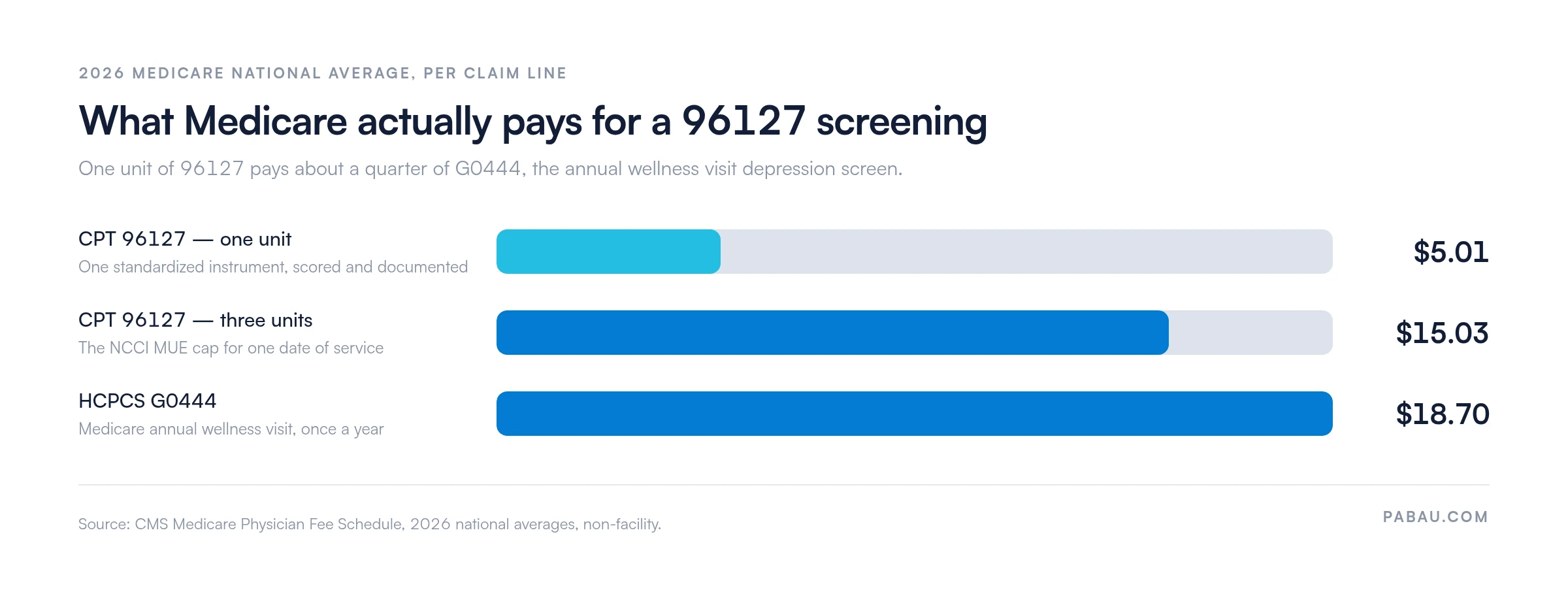
Medicare pays a 2026 national average of $5.01 per unit, and the NCCI medically unlikely edit caps billing at three units per date of service.
The 96127 Payer Crosswalk below sets out rate, unit cap, required modifier, and paired ICD-10 code for each payer type.
At a Medicare annual wellness visit, bill G0444 instead of 96127, because G0444 pays $18.70 and covers the depression screen.
Pair 96127 with Z13.31 for depression screening or Z13.39 for other mental health screening, and name the instrument in full.
CPT code 96127 is the billing code for a brief emotional or behavioral assessment using a standardized instrument, scored and documented. Three problems drive most 96127 denials: an abbreviated instrument name, too many units, and an ICD-10 code that fails medical necessity.
This reference covers the official descriptor, qualifying instruments, ICD-10 pairings, 2026 reimbursement rates, documentation, modifiers, and the denial triggers behind most 96127 rejections. The 96127 Payer Crosswalk further down pairs each payer type with its rate, unit cap, modifier, and diagnosis code.
CPT code 96127 describes a brief emotional or behavioral assessment using a standardized instrument, with scoring and documentation of the result.
The service has three parts: administering the instrument, scoring the results, and documenting the findings with a clinical interpretation. The American Medical Association publishes the code in the Medicine section of the CPT code set.
The instrument must be a validated, standardized tool rather than a clinician-designed questionnaire. Open-ended screening questions and informal checklists do not qualify. That validated-tool requirement is the most common source of denial on first audit.
Payers recognize a defined set of validated instruments for CPT code 96127, and the record must name the instrument in full.
The PHQ-9 CPT code is 96127, the same code that covers the GAD-7, PHQ-A, CRAFFT, EPDS, and Pediatric Symptom Checklist.
Age criteria come from the instrument, not from the code. The Pediatric Symptom Checklist is validated for ages 4 to 18, the PHQ-A for 12 and up, and CRAFFT for ages 12 to 21. A pediatric practice therefore switches instruments as a patient ages, while the code stays 96127.
Other validated instruments may qualify depending on payer policy. Verify with your carrier before billing a tool not listed here. A payer that recognizes a tool will name it in its coverage policy or its published screening list.
Any qualified healthcare professional who administers, scores, and documents the instrument can bill CPT code 96127, including physicians, nurse practitioners, and physician assistants.
Billing rights are broad, but the exact list depends on the payer contract and the provider type.
Medicare incident-to rules add complexity for non-physician staff. When billing incident-to, the supervising physician must be present in the office suite, though not necessarily in the same room. Verify your Medicare Administrative Contractor (MAC) policy first, because supervision requirements affect payment eligibility.
Bill one unit of CPT code 96127 for each standardized instrument administered, up to three units per date of service under Medicare’s medically unlikely edit.
The medically unlikely edit (MUE) is the units ceiling CMS applies to one date of service, and for 96127 that ceiling is three. Payer policy is often tighter than the edit. CMS publishes the current figures in its NCCI medically unlikely edit files.
Many commercial carriers pay two units, and some Medicaid programs and Medicare Administrative Contractors pay only one. CMS sets no annual frequency limit on 96127, so the constraint is units per date of service plus each payer’s own policy. Check the local coverage determination (LCD) before billing two units routinely.
Pair CPT code 96127 with Z13.31 for depression screening, Z13.39 for other mental health screening, or an F-code once a diagnosis exists.
Payers read the diagnosis code to decide whether the screening was medically necessary. The ICD-10 code for PHQ-9 screening is Z13.31 when the purpose is depression screening. Use Z13.39 when the PHQ-9 forms part of a broader mental health screen.
Precision matters here. Z13.9, encounter for screening, unspecified, is too vague to carry medical necessity on a behavioral screening claim. Z13.30 sits between the two, covering a mental health screen the record does not specify further.
Z-codes cover screening in a patient with no established diagnosis. F-codes apply when the instrument monitors a condition already diagnosed. Mixing the two is what generates a medical necessity denial.
Postpartum screening carries two codes of its own. Z13.32 is the screening code for a maternal depression screen, and F53.0 is the follow-up code once postpartum depression is diagnosed. Confirming the pairing against every ICD-10-CM screening code takes less time than appealing the denial. The Z13.31 code entry sets out the screening codes that sit alongside it.
Medicare’s 2026 national average for CPT code 96127 is $5.01 per unit, so a full three-unit date of service pays about $15.03.
That figure comes from the Medicare Physician Fee Schedule. CPT code 96127 carries 0.15 total relative value units: 0.00 work, 0.14 practice expense, and 0.01 malpractice. Multiplied by the 2026 conversion factor of $33.40, that gives $5.01. Verify your own locality in the CMS Physician Fee Schedule lookup.
Older guidance and several current billing blogs still quote $20 to $30 per unit for 96127. That range does not match the published fee schedule. At 0.15 relative value units, no locality adjustment reaches $20.
The comparison that matters more is G0444, the Medicare annual wellness visit depression screen. G0444 pays a 2026 national average of $18.70, so one wellness-visit screen is worth more than three units of 96127.
Rates alone don’t tell a biller what to submit. The unit cap, the modifier, and the diagnosis code all move together by payer type, and no single published table puts them side by side.
The 96127 Payer Crosswalk sets rate, daily unit cap, required modifier, and paired ICD-10 code against each payer context.
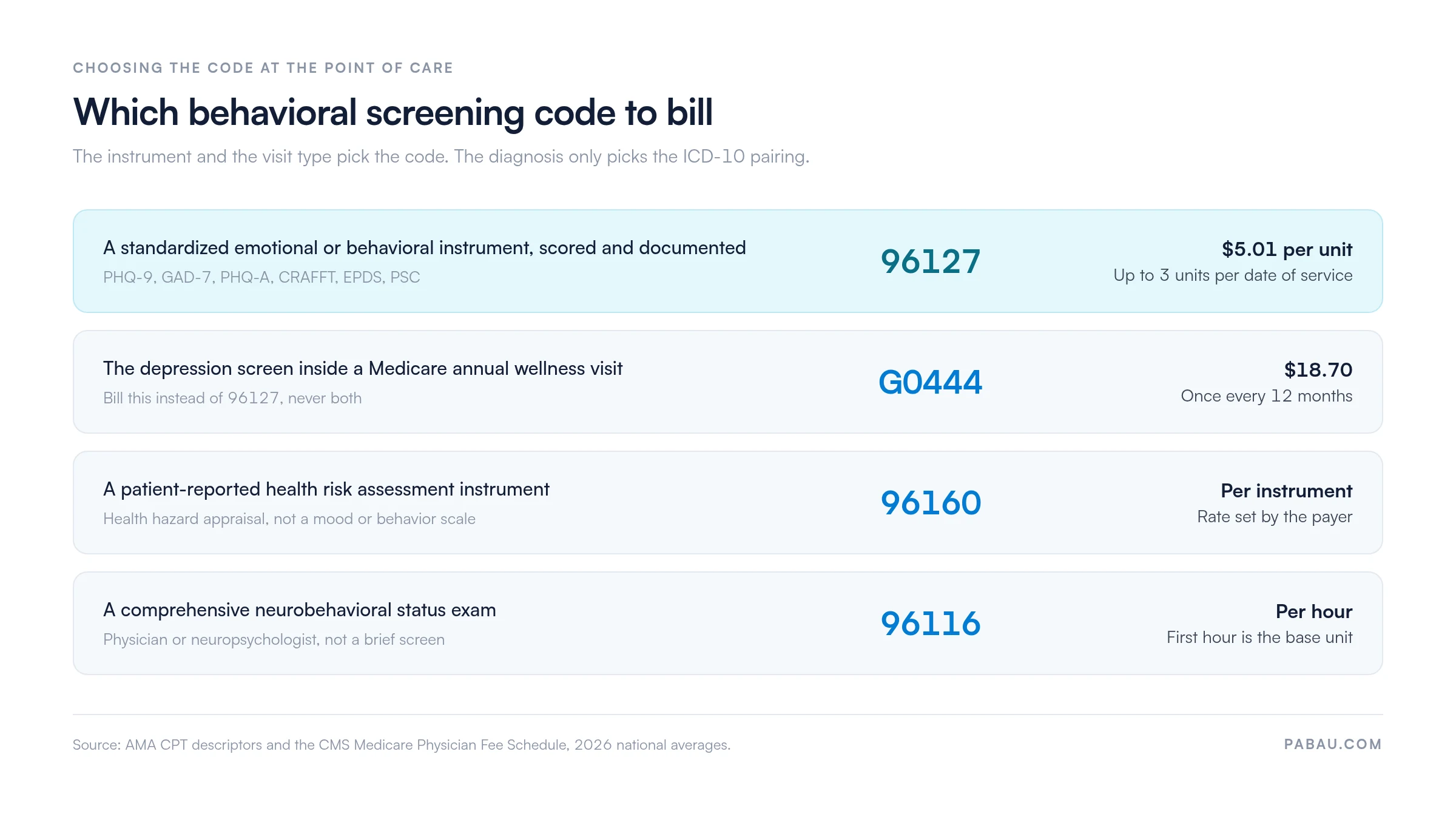
Use G0444 for the depression screen inside a Medicare annual wellness visit. Use 96127 for a standardized instrument at any other visit. Never bill both on the same date.
Medicare covers CPT code 96127 under Part B when an eligible provider administers it and a qualifying diagnosis supports it. Practices submit through their Medicare Administrative Contractor. Frequency limits and qualifying instruments sit in the applicable local coverage determination, so read your MAC’s LCD before assuming coverage.
G0444 is the one Medicare context where 96127 is the wrong choice. G0444 covers the annual depression screen at a wellness visit, pays $18.70, and is limited to once every 12 months. Medicare also requires a documented follow-up plan whenever that screen comes back positive.
When that follow-up plan becomes monthly behavioral health care management, 99484 covers the clinical staff time. The screen and the monthly care management are billed as separate services.
Medicaid coverage varies significantly by state. Some state programs reimburse CPT code 96127 at rates comparable to Medicare. Others exclude the code entirely or require prior authorization. Read your state Medicaid fee schedule directly, because blanket Medicaid coverage cannot be assumed.
Practices billing several state Medicaid plans need carrier-specific rules built into the billing workflow, or the same error repeats across state lines.
The 96127 documentation requirements are the instrument’s full name, the date administered, the score, a clinical interpretation, and the follow-up plan.
Incomplete documentation is the leading cause of 96127 denials. Each instrument administered gets its own record entry, and the chart must carry the full instrument name rather than an acronym.
A claim that pays on first submission needs every one of those fields present before it reaches the clearinghouse. Digital intake and documentation tools capture the instrument name and score straight into the billing record. That removes the transcription step behind most of these denials.
CPT code 96127 needs no modifier when billed alone, but a same-day E/M visit usually needs modifier 25 on the E/M code.
Modifiers only come into play when 96127 shares a date of service with an Evaluation and Management (E/M) code. The National Correct Coding Initiative (NCCI) may bundle the two, and a modifier is what signals that the services were distinct and separately identifiable.
On a new adolescent patient’s first preventive visit, modifier 25 belongs on 99384 and never on the 96127 line.
Modifier requirements vary by payer, so verify current NCCI edits and your carrier’s policy each year. Applying modifier 59 where it isn’t needed and omitting modifier 25 where it is produce the same denial.
Telehealth adds one more check. Where a payer covers 96127 by video, the claim carries modifier 95 with place of service 02, or 10 when the patient is at home. Confirm the code on the CMS telehealth services list before billing it that way.
CPT codes 96116 and 96127 get confused because both involve behavioral assessment. They differ in scope, time requirement, provider credentials, and reimbursement. Billing 96116 when only a brief screening happened is the coding error auditors flag fastest.
Feature differences are one question. The question at the desk is narrower: which of four codes goes on the claim. The instrument and the visit type answer it, not the diagnosis.
Review your NCCI edits table every year. An edit that did not apply last year can now bundle 96127 into the E/M payment. The screening unit then disappears from the remittance, with no denial code to explain it.
Most 96127 denials trace to six causes: an abbreviated instrument name, excess units, the wrong ICD-10 code, a missing modifier, non-coverage, or no interpretation.
In practices we onboard, the instrument name is the field that goes missing most often. A chart that reads “PHQ” instead of “Patient Health Questionnaire-9” fails the payer’s documentation test even though the screening happened.
Denial management starts with identifying which of those six patterns is generating rejections in your practice. Claims routed through a clearinghouse with built-in CPT and ICD-10 editing catch several of them before submission.
Primary care physicians and pediatricians are among the most frequent billers of CPT code 96127. Annual wellness visits, ADHD evaluations, and adolescent depression screenings all commonly include a validated instrument billed under this code.
Common use-case scenarios by practice type:
The split that matters on a pediatric claim is the instrument’s validated age band, not the patient’s age alone. A 10-year-old gets the PSC, a 14-year-old can get the PHQ-A or CRAFFT, and the code stays 96127.
When billing 96127 at an annual wellness visit, confirm that the payer’s wellness policy covers screening instruments as a separately billable service. Some carriers bundle the instrument into the wellness global service. For Medicare specifically, the wellness visit depression screen is G0444, not 96127.
Billing errors on CPT code 96127 follow predictable patterns: the wrong ICD-10 code, a missing instrument name, a unit count above the payer’s limit. Platforms that connect documentation to billing catch those at the point of care rather than during a separate coding step.
Practice management software like Pabau connects clinical documentation directly to claim generation. The instrument name, the score, and the ICD-10 pairing move from the chart into the claim without manual re-entry.
Pabau’s audit-ready claims management then submits electronically, and its built-in CPT and ICD-10 catalogs flag coding conflicts before the claim reaches the payer. For practices billing 96127 alongside an E/M code, automated NCCI edit checking surfaces the modifier requirement before submission instead of after a denial.
Practices that route claims through a clearinghouse with real-time payer edits catch unit-count errors and incompatible ICD-10 pairings before the carrier sees them. That shortens the loop between a coding mistake and a corrected claim.

Pabau integrates billing, documentation, and claim submission into one workflow. Your team codes accurately the first time, and claims move through the clearinghouse with fewer errors and faster reimbursement.

CPT code 96127 pays little per unit, and that is exactly why the denials hurt. Reworking a $5 claim line costs more in staff time than the line is worth. The only economical fix is getting it right the first time.
Set the instrument’s full name, the score, and the diagnosis code as required fields in the chart. Then check the payer’s unit cap once per contract year. On Medicare wellness visits, reach for G0444 instead.
Pabau’s integrated claims management ties instrument documentation to claim generation and validates CPT and ICD-10 pairings before submission. Book a demo to see how that works for behavioral health and primary care billing.

Need to understand how clearinghouse claim validation works? Medical claims clearinghouse explained covers how electronic claim routing reduces denials before they reach the payer.
Want to see how denial patterns are tracked after submission? Denial codes in medical billing breaks down the most common CARC codes and how to resolve them.
Want the full checklist a claim has to pass? What is a clean claim in medical billing? sets out the fields a payer accepts on first submission.
CPT code 96127 is a brief emotional or behavioral assessment using a standardized, validated instrument. The service covers administration of the screening tool, scoring of results, and clinical documentation including interpretation and any follow-up plan. One unit equals one instrument administered.
Most payers allow up to two units of CPT 96127 per date of service, with each unit representing one standardized instrument administered. The NCCI medically unlikely edit caps Medicare at three units for one date of service. Some carriers, including certain Medicare Administrative Contractors and Medicaid programs, restrict billing to one unit per encounter. Always verify your specific payer’s local coverage determination before billing multiple units.
Recognized instruments include the PHQ-9, GAD-7, PHQ-A, CRAFFT, Edinburgh Postnatal Depression Scale (EPDS), and Pediatric Symptom Checklist (PSC and PSC-17). The instrument must be validated and standardized. Open-ended clinician-designed questionnaires do not qualify, and the full instrument name must appear in the clinical record.
CPT code 96127 needs no modifier when it is the only service billed that day. When an E/M service falls on the same date, modifier 25 goes on the E/M code. NCCI edits may also require modifier 59 on the 96127 line to show a distinct procedural service. Verify current NCCI edits and your carrier’s policy annually, because requirements change.
Yes. Physicians of any specialty can bill CPT 96127, including primary care, pediatrics, OB/GYN, and psychiatry. Nurse practitioners and physician assistants can bill it independently or incident-to. The code is not restricted to behavioral health specialists, which makes it common at primary care and pediatric wellness visits.
Six causes account for most 96127 denials. The biggest is an abbreviated instrument name in the record. The others are units above the payer’s limit, an ICD-10 code that fails medical necessity, and a missing modifier on a same-day E/M claim. Non-coverage by that plan and a score with no clinical interpretation complete the list. Fixing the instrument name resolves most first-round rejections.
No. G0444 is the Medicare annual depression screening code, used only inside an annual wellness visit, and it pays a 2026 national average of $18.70. CPT code 96127 covers a standardized instrument at any other visit and pays about $5.01 per unit. The 96127 Payer Crosswalk above lists both.
The depression screening CPT code is 96127 when a standardized instrument such as the PHQ-9 is administered and scored at a standard visit. Inside a Medicare annual wellness visit, use HCPCS G0444 instead. Pair either code with ICD-10 Z13.31.
The CPT code for anxiety screening is 96127, the same code used for depression screening. A GAD-7 administered, scored, and documented bills as one unit of 96127. Pair it with Z13.39 for screening, or F41.1 once generalized anxiety disorder is diagnosed.
CPT code 96160 covers administration and scoring of a patient-focused health risk assessment instrument, such as a health hazard appraisal. CPT code 96127 is specific to standardized emotional and behavioral instruments like the PHQ-9. Both codes bill per instrument, and both need the instrument named in the record.
Yes. CPT code 96127 can be billed alone on a date of service with no E/M visit, and no modifier is needed. When an E/M service occurs the same day, modifier 25 usually goes on the E/M code. NCCI edits may also require modifier 59 on 96127.
Yes, when the E/M work is significant and separately identifiable from the screening. Append modifier 25 to 99214, and document the E/M service and the instrument as distinct entries. Some payers also apply an NCCI edit that requires modifier 59 on the 96127 line.
No. CPT code 96127 carries no age limit at the code level. The age criteria come from the instrument and from payer policy. The Pediatric Symptom Checklist is validated for ages 4 to 18, the PHQ-A for 12 and up, and CRAFFT for ages 12 to 21.