HCPCS code J7520: Sirolimus oral billing guide
HCPCS code J7520 covers oral sirolimus, one unit per milligram HCPCS code J7520 ...

Last Updated: Nov 12, 2026
HCPCS code E0242 is the Level II code for a bath tub rail, floor base. The rail stands on its own base beside the tub and gives the patient a handhold for stepping in or out, with no wall mounting.
Original Medicare does not cover E0242. CMS treats bath safety rails as convenience items outside the durable medical equipment benefit, so Part B has no fee schedule allowance. A Medicare line carries GY, never KX, and is filed only to get a denial another payer can act on. Medicaid, Medicare Advantage and commercial plans set their own rules.
Let Pabau's smart automation suggest the right codes, reduce claim denials, and keep your practice compliant—effortlessly.
Automate repetitive tasks and focus on what matters most—your patients.
Reduce coding errors and ensure compliance with the latest regulations.
Clean claims, fewer denials, and faster reimbursements.
Powerful insights and reporting to help your practice thrive.
HIPAA compliant SOC 2 certified GDPR-compliant Trusted by 4,000+ clinics worldwide

HCPCS code E0242 describes a bath tub rail that stands on a floor base, not a wall rail (E0241) or a tub-mounted transfer rail (E0246).
Original Medicare does not cover E0242, because CMS treats bath safety rails as convenience items outside the durable medical equipment benefit.
E0242 has no DMEPOS fee schedule allowance, no LCD and no Medicare coinsurance, so the patient or another plan pays the supplier’s charge.
A Medicare line for E0242 carries GY, plus GX after a voluntary ABN, and never KX.
Medicaid, Medicare Advantage and commercial plans set their own rules, so verify the benefit and any prior authorization before delivery.
HCPCS code E0242 is the Level II code that the Centers for Medicare & Medicaid Services (CMS) assigns to a bath tub rail, floor base. The rail stands on its own base beside the tub and gives the patient a handhold for stepping in or out. It needs no wall anchors and no clamp on the tub rim.
E0242 sits in the E-section of the HCPCS Level II code set, which covers durable medical equipment. Within it, E0242 belongs to the bath and toilet aids range, E0240 to E0249. The code is active, but Original Medicare does not pay for it. Neighboring codes are listed in our HCPCS reference for suppliers.
Because Part B does not price E0242, there is no national or local Medicare rate to look up. The supplier sets its own charge, and the patient or a covering plan pays it.
The defining feature of E0242 is the mounting method. The rail sits on a floor base rather than attaching to the wall or clamping to the tub rim. That lets a supplier set it up in rental housing without drilling, which is why it suits patients in apartments.
Included under E0242: freestanding rail assemblies whose weight rests on the bathroom floor beside the tub. Single or dual grips and adjustable heights still fall under the code, as long as the floor carries the base.
Not included: the items below take different codes, however similar they look.
When an order asks for a “bathtub safety rail” without naming the mounting type, the item delivered decides the code. Billing E0242 for a wall rail, or the reverse, leaves the order and the delivery record out of step.
These three rail codes describe devices that look alike but mount differently. The correct code depends on what holds the rail in place.
The most frequent miscoding happens when a supplier delivers a floor-base rail but bills E0241 because the order says “bathtub rail.” If the order is ambiguous, ask the ordering practitioner before delivery and note the answer in the file.
No, Original Medicare does not cover E0242. The CMS HCPCS file gives it coverage code M, non-covered by Medicare, and pricing indicator 00. Part B therefore has no fee schedule allowance for the rail.
The reason is the benefit category. Durable medical equipment has to be primarily medical in nature, under chapter 15, section 110.1 of the Medicare Benefit Policy Manual. NCD 280.1, the DME reference list, denies comparable bath items (bathtub seats, grab bars) as convenience items not primarily medical in nature.
So the rail is not covered because it is not DME, whatever the diagnosis or the strength of the order. That changes five things on the claim.
Palmetto GBA is sometimes named as a DME MAC, but it is the Pricing, Data Analysis and Coding (PDAC) contractor. It answers coding questions and does not process E0242 claims.
With no Medicare coverage criteria to meet, the paperwork does two jobs. It supports a claim to a plan that covers the rail, and it protects the supplier when the patient pays.
Keep these records in line with your medical billing compliance policy. The written order should name a “bath tub rail, floor base,” not just a “grab bar,” so the code and the item match.
No diagnosis makes Medicare pay for E0242. The codes below are examples a practitioner may document for a plan that covers bath safety items, or for the record behind a self-pay sale.
Two codes changed recently. G35 became a category in FY2026, so code multiple sclerosis to its type, such as G35.D. G20 on its own has not been billable since FY2024. Confirm current code status in the CDC ICD-10-CM tabular list before you submit.
On an Original Medicare claim, the E0242 line goes out as a non-covered item. You file it only when a secondary payer needs a Medicare denial on record before it pays.
Medicare does not require an ABN for an item outside the DME benefit, so GA and GZ do not fit E0242. Many suppliers still issue a voluntary ABN, because it puts the patient’s cost in writing. If past claims carry KX on E0242, review them with your compliance lead.
Check your E0242 claim template once instead of fixing claims one by one. If it still carries KX, a 20% patient estimate or a fee schedule lookup, every claim built from it repeats the error. Switch the Medicare line to GY, with GX after a voluntary ABN.
Other payers can still pay for E0242, and each payer type treats it differently. The diagram below shows where the charge goes for each one, so you can set the patient’s expectations before the order ships.
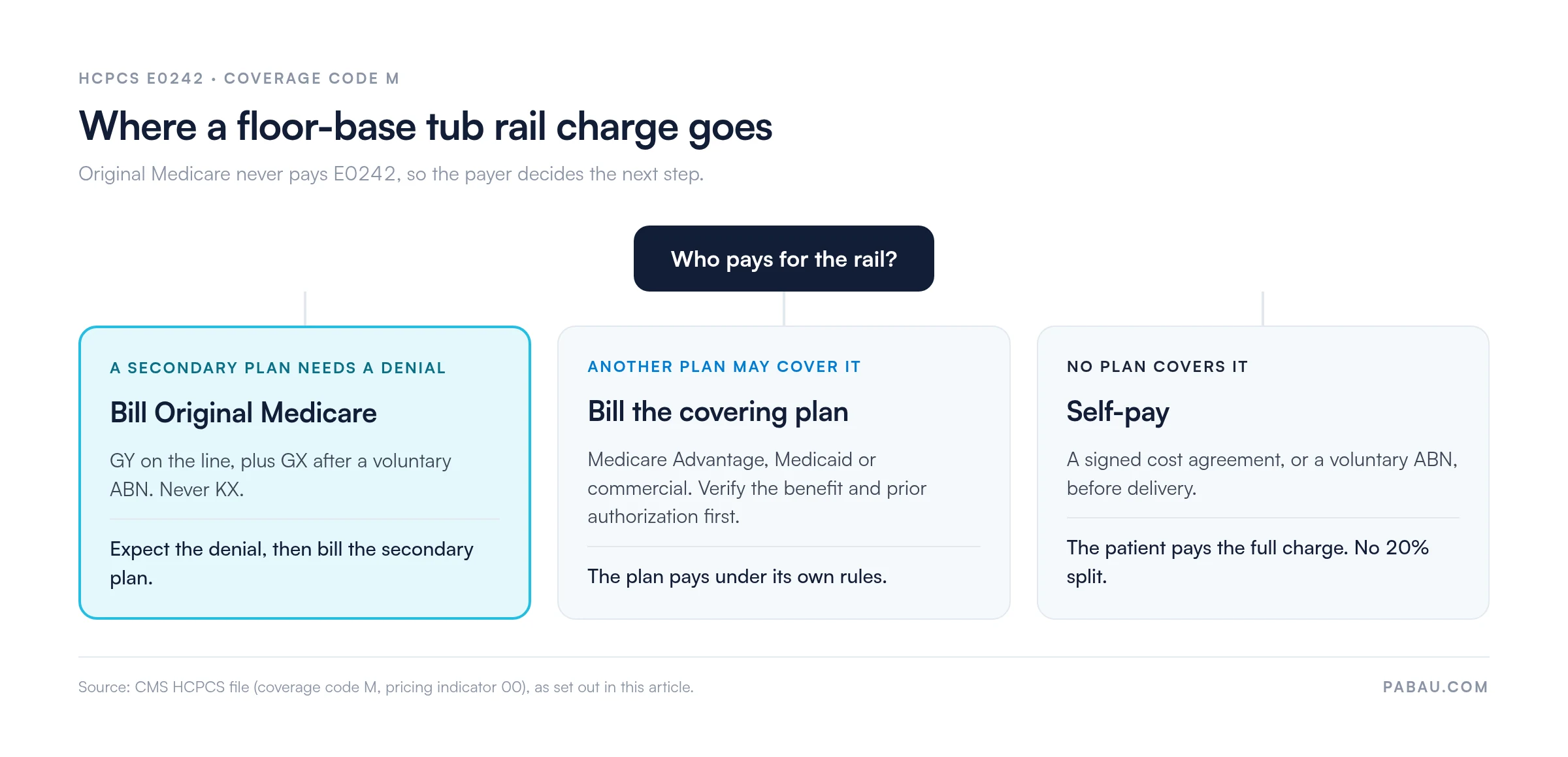
Record each benefit check with the date and reference number. Using revenue cycle management workflows keeps the secondary claim and the patient invoice moving once the Medicare denial arrives.
The denial management cycle for bath safety items follows predictable patterns. Most E0242 problems start from treating the rail as covered DME.
Appealing a benefit-category denial on medical necessity grounds will not succeed. If a line was denied for a coding error instead, correct it and resubmit, or request a redetermination within 120 days of the notice.
Billing E0242 starts with the payer check, because the payer decides whether a claim goes out at all. The seven steps below run from the delivered device to the final invoice.
A clean claim for E0242 matches the code to the device and the modifier to the payer.
A practice that supplies bath safety items juggles benefit checks, signed cost agreements and patient balances. When those sit in separate tools, a missing signature or an unpaid balance surfaces weeks later.
Pabau, the practice management platform we build, includes claims management software so the team can submit and track insurance claims from the patient record. Signed forms, clinical notes and invoices sit in the same record.
Checkout then closes the loop. The rail gets invoiced, the patient pays, and the balance stops sitting in an unassigned bucket.
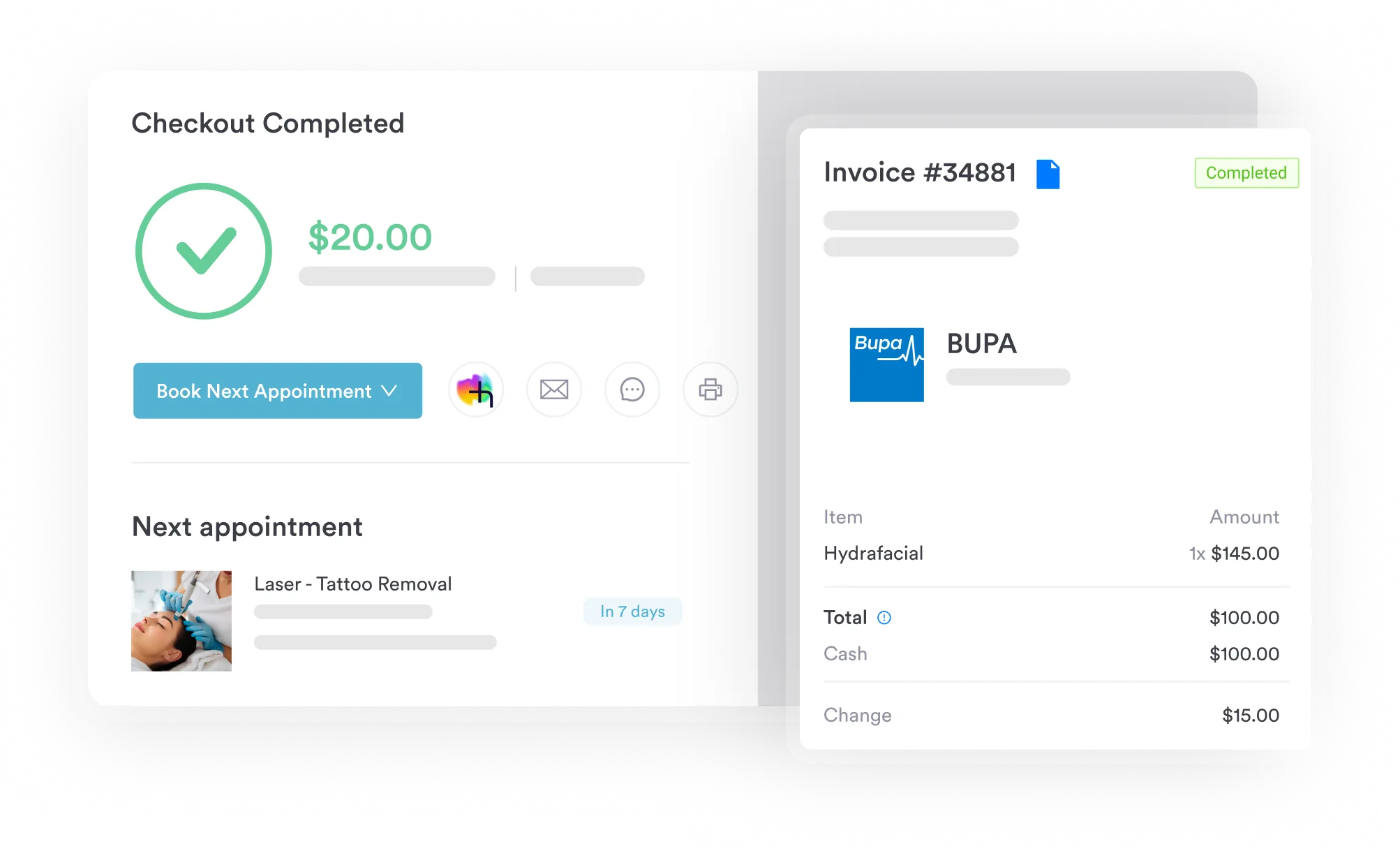

Pabau helps practices submit and track insurance claims, keep signed forms with the patient record and invoice patients for items their plan does not cover.

E0242 is a reporting code with no Medicare payment behind it. The rail falls outside the DME benefit, so the Medicare line carries GY and the denial is the expected result.
That makes the payer check the step that decides who pays. Run it before the rail ships, and put the price in writing so the patient knows the cost up front.
To see how Pabau helps practices submit and track insurance claims, book a demo.

Getting repeated denials on DME claims? Denial codes in medical billing explains the most common CARC and RARC codes and how to respond to each.
Supplying a wall-mounted rail instead? HCPCS code E0241 covers the bath tub wall rail and how it is billed.
Supplying a rail that clamps to the tub? HCPCS code E0246 explains the transfer tub rail attachment and its modifiers.
Want to understand the 837P transaction your clearinghouse sends? 837 file format and submission guide covers the EDI standard used for electronic DME claim submission.
E0242 covers a bath tub rail with a floor base, a freestanding rail that stands beside the tub without wall mounting. Wall rails use E0241, tub-mounted transfer rails use E0246 and toilet rails use E0243.
No. CMS gives E0242 coverage code M, non-covered by Medicare, and pricing indicator 00. Bath safety rails fall outside the durable medical equipment benefit. Medicaid, Medicare Advantage and commercial plans may cover the rail under their own rules.
Nothing. Part B does not price E0242, so there is no fee schedule allowance and no 20% coinsurance. The supplier sets its own charge, and the patient or a covering plan pays it.
GY is the main one. It tells Medicare the item is not a benefit, which produces the denial a secondary payer needs. Add GX after a voluntary ABN. KX never applies, because no Medicare policy sets criteria for E0242.
E0241 is a bath tub wall rail fixed to the bathroom wall. E0242 is a freestanding rail on a floor base. The item delivered decides the code, not the wording of the order.
Not from Original Medicare, because Medicare does not cover the rail at all. A Medicare Advantage, Medicaid or commercial plan that covers it may require prior authorization before delivery.
No LCD lists diagnoses for E0242, so no code makes Medicare pay. Examples a practitioner may document for other payers include R26.81 (unsteadiness on feet), M62.81 (muscle weakness, generalized) and Z91.81 (history of falling).