HCPCS code E0193: Powered air flotation bed billing guide
HCPCS code E0193 covers a complete powered bed HCPCS code E0193 pays for a power...

Last Updated: Oct 13, 2026
HCPCS code E0246 is the Level II code for a transfer tub rail attachment. The rail clamps onto the side of a bathtub and gives the patient a steady handhold for stepping in or out.
Original Medicare doesn't cover it, so Part B pays nothing for the rail. That makes the modifier the part to get right. Medicare lines carry GY, or GA when the patient signed an Advance Beneficiary Notice (ABN), and never KX. Medicare Advantage, Medicaid and commercial plans may still pay, so the benefit check decides who gets the bill.
Let Pabau's smart automation suggest the right codes, reduce claim denials, and keep your practice compliant—effortlessly.
Automate repetitive tasks and focus on what matters most—your patients.
Reduce coding errors and ensure compliance with the latest regulations.
Clean claims, fewer denials, and faster reimbursements.
Powerful insights and reporting to help your practice thrive.
HIPAA compliant SOC 2 certified GDPR-compliant Trusted by 4,000+ clinics worldwide

HCPCS code E0246 describes a transfer tub rail that attaches to the bathtub itself, not a wall rail, a floor-base rail or a tub bench.
Original Medicare does not cover E0246, so it has no fee schedule allowance, no DME MAC LCD and no KX modifier.
Medicare lines for E0246 carry GY, or GA when the patient signed an ABN, and the supplier may bill the patient.
Medicare Advantage, Medicaid and commercial plans may cover E0246 under their own criteria, so verify benefits and prior authorization first.
Code the rail by its mounting point, which is E0246 on the tub, E0241 on the wall and E0242 on a floor base.
HCPCS code E0246 is the Level II code that the Centers for Medicare & Medicaid Services (CMS) assigns to a transfer tub rail attachment. The rail fixes to the side of a standard bathtub and gives the patient a firm handhold while stepping in or out. It needs no wall installation, which sets it apart from a wall rail, a floor-base rail or a tub bench.
E0246 sits in the E-section of the HCPCS Level II code set, E0100 to E9999, which covers durable medical equipment. Within it, E0246 belongs to the bath and toilet aids range, E0240 to E0249. Its neighbors include wall and floor rails, toilet rails, raised toilet seats and tub benches. CMS publishes HCPCS Level II updates every quarter.
Because Part B does not price E0246, there is no national or local Medicare rate to look up. The supplier sets its own charge, and the patient or another plan pays it.
E0246 describes one device: a rail that attaches to the bathtub itself and serves as a transfer aid. Code the device by where it mounts, because each neighboring code describes a different mounting point or a different item.
Two mix-ups come up often in bath safety coding. E0156 is a seat attachment for a walker, so it never describes a grab bar. E0241 is a wall rail, so it never describes a rail mounted on the tub.
No, Original Medicare does not cover E0246. The HCPCS file gives it pricing indicator 00, which means Part B does not price it separately. There is no DMEPOS fee schedule allowance for it either.
None of the four DME MAC jurisdictions has an LCD for E0246. Noridian runs Jurisdictions A and D, and CGS runs B and C. With no LCD, there is no covered-diagnosis list and no KX requirement.
The HCPCS file gives E0246 coverage code C (carrier judgment) and no DME MAC LCD sets criteria for it. That puts E0246 in the same position as E0244 and E0172, which policy article A52461 lists as noncovered. E0241, which carries HCPCS coverage code M, sits there too.
One detail differs. Code C means carrier judgment, while code M means noncovered by Medicare. So describe E0246 as not covered by Original Medicare, rather than statutorily excluded.
In practice, Medicare denies the line and the supplier may bill the patient. Payment comes only from a Medicare Advantage, Medicaid or commercial plan that chooses to cover the rail.
With no Medicare coverage criteria to meet, E0246 documentation does two jobs. It supports a claim to a plan that covers the rail, and it protects the supplier when the patient pays.
Keep these records in line with your medical billing compliance policy. Medicare-enrolled DMEPOS suppliers also keep their accreditation current and retain records for seven years.
No LCD lists diagnoses for E0246, so no code below guarantees payment. These are examples a practitioner may document to show why a patient needs help with tub transfers.
G20 on its own has not been billable since FY2024. Code Parkinson’s disease to G20.A1, G20.B1 or the G20 subcode that matches the documentation.
The modifiers on an E0246 line depend on which payer you bill. On an Original Medicare claim, the line goes out as a noncovered item and never carries KX. The flow below shows where each payer route ends.
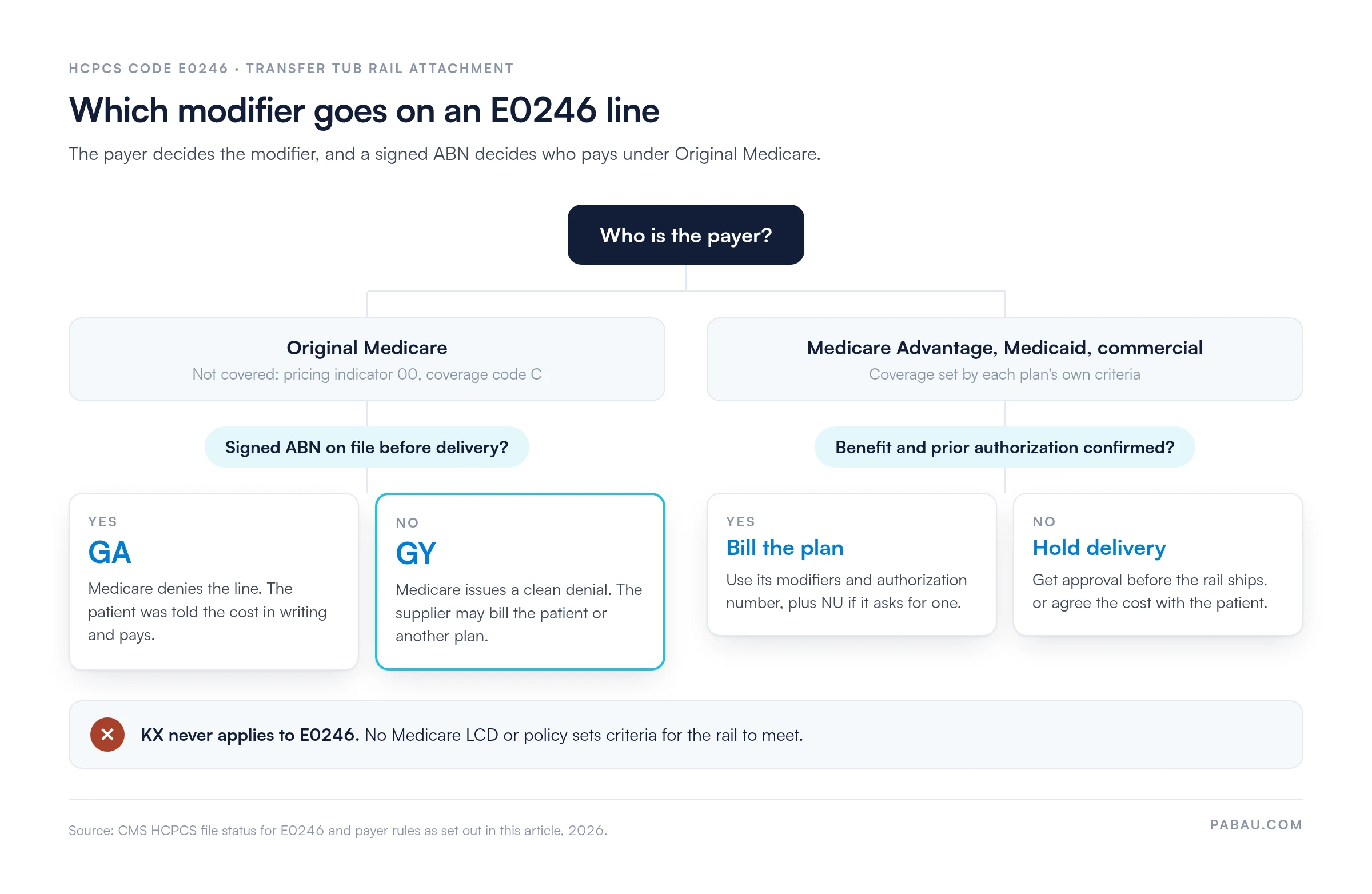
A line billed with KX attests to coverage criteria that do not exist for E0246. If past claims carry KX on E0246, review them with your compliance lead and bill future lines with GY or GA.
Search your last 90 days of claims for E0246 lines that carry KX. Each one attested to Medicare criteria that E0246 does not have. Switch future Medicare lines to GY, or GA when a signed ABN is on file.
The bath and toilet aids range is small, but its codes are easy to mismatch. Use this table to pick the right code before you bill.
E0246 and E0241 are easy to confuse because both are bathtub rails. An E0246 rail attaches to the tub itself, while an E0241 rail is fixed to the bathroom wall.
Original Medicare has no prior authorization for E0246, because it does not cover the item at all. A Medicare Advantage, Medicaid or commercial plan that covers the rail may require prior authorization before delivery.
Record each check with the date and reference number, and get approval before the rail ships.
Each payer type treats E0246 differently. Use this table to set the patient’s expectations before the order is placed.
Studying the patterns behind claim denials helps suppliers fix the process as well as the claim. These are the errors to check for on E0246.
Billing E0246 starts with the payer, not the code. These seven steps cover Original Medicare and the plans that may pay. For the basics behind each step, see what medical billing involves.
A clean claim for E0246 matches the code to the device and the modifier to the payer. Get those two right, and the Medicare denial arrives exactly as the patient was told it would.
Take a Medicare patient going home after a hip replacement. The surgeon orders a rail that clamps to the tub, so E0246 applies. Before delivery, the supplier explains that Medicare won’t pay and gives the price in writing.
The patient signs an ABN and the rail ships with a signed delivery receipt. The claim goes out with GA, Medicare denies the line, and the patient pays the agreed price. Nobody is surprised by the bill.
A practice that supplies bath safety items juggles payer checks, signed notices and patient balances. When those sit in separate tools, a missing ABN or an unpaid balance surfaces weeks later.
Pabau, the practice management platform we build, includes claims management for practices, so the team can submit and track insurance claims from the patient record. Signed forms, clinical notes and invoices sit in the same record, so the team can see what was agreed and what is still owed.

That keeps the order, the claim and the patient’s payment connected, so fewer balances slip through.

Pabau helps practices submit and track insurance claims, keep signed forms with the patient record and invoice patients for items their plan does not cover.

E0246 rarely goes wrong on the code itself. It goes wrong when the line carries KX, misses GY or GA, or reaches the patient as a surprise bill. Get the mounting point and the modifier right, and the Medicare denial becomes a routine step.
For patients with Medicare Advantage, Medicaid or commercial cover, the benefit check decides who pays. Run that check before the rail ships, so the patient knows the cost up front.
Keep superbills and billing records tidy so each answer is on file. To see how Pabau helps practices submit and track insurance claims, book a demo.

Need a framework for reducing DME claim rejections? Denial codes in medical billing breaks down common CARC and RARC codes so you can act on remittance data faster.
Want to understand the full claim lifecycle? Electronic remittance advice covers how to read ERA files and reconcile payments from DME MACs.
Checking eligibility before delivery? Insurance eligibility verification outlines how to confirm DME benefit coverage before the item ships.
Billing the tub seat as well? HCPCS code E0245 covers the tub stool or bench that often ships alongside a rail.
Supplying a transfer bench instead? HCPCS code E0247 explains how the tub or toilet transfer bench is coded and billed.
E0246 covers a transfer tub rail attachment, a rail that clamps onto the side of a bathtub. Wall rails (E0241), floor-base rails (E0242), tub benches (E0245) and wall grab bars use other codes.
No, Original Medicare does not cover E0246. It has pricing indicator 00 and no DMEPOS fee schedule allowance. The HCPCS file gives E0246 coverage code C (carrier judgment) and no DME MAC LCD sets criteria for it. Other plans may cover it under their own rules.
Nothing. Part B does not price E0246, so there is no national or local Medicare rate. The supplier sets its own charge, and the patient or another plan pays it.
Some do, as a supplemental benefit for bath safety items. Check the plan’s evidence of coverage, and get any prior authorization before the rail is delivered.
Yes. When the patient receives both items, a supplier can bill E0246 with E0245 or E0247. Original Medicare still won’t pay for E0246, so that line carries GY or GA.
No LCD lists diagnoses for E0246, so no code guarantees payment. Examples a practitioner may document include R26.81 (unsteadiness on feet), M62.81 (muscle weakness, generalized) and Z96.641 or Z96.642 after a hip replacement.
E0246 attaches to the bathtub itself. E0241 is a bath tub wall rail, billed per rail, that is fixed to the bathroom wall.