CPT code 93503: Swan-Ganz catheter billing and modifiers
CPT code 93503: Official descriptor and procedure overview In the AMA CPT code s...

Last Updated: Oct 23, 2026
C1788 is the HCPCS Level II code for port, indwelling (implantable).
It reports the implanted vascular access port itself, the reservoir placed under the skin for chemotherapy, long-term infusions, or repeated blood draws. Hospitals list it on the outpatient UB-04 claim, usually under revenue code 278, beside the port placement procedure code.
CMS assigns C1788 status indicator N under OPPS, so the port's cost is packaged into the procedure payment. The device line still matters, because it records what the case cost and matches the claim to the operative note.
Let Pabau's smart automation suggest the right codes, reduce claim denials, and keep your practice compliant—effortlessly.
Automate repetitive tasks and focus on what matters most—your patients.
Reduce coding errors and ensure compliance with the latest regulations.
Clean claims, fewer denials, and faster reimbursements.
Powerful insights and reporting to help your practice thrive.
HIPAA compliant SOC 2 certified GDPR-compliant Trusted by 4,000+ clinics worldwide

HCPCS Code C1788 reports an implanted vascular access port, such as a chemotherapy port, on hospital outpatient UB-04 claims.
CMS assigns C1788 status indicator N, so the port’s cost is packaged into the placement procedure and earns no separate payment.
Report it beside the port procedure code, such as CPT 36561 or 36571, usually under revenue code 278 for implanted devices.
Pair it with the condition that needs long-term venous access, most often a cancer treated with chemotherapy.
Pabau, the practice software we build, keeps device details, consent forms, and treatment notes on one patient record, so the claim matches the chart.
HCPCS Code C1788 is the Level II code for “Port, indwelling (implantable).” It reports the vascular access port itself, the small reservoir placed under the skin and connected to a central vein. Hospitals use it to show which device went in during an outpatient port placement.
The code was added to HCPCS on April 1, 2001, and sits in the assorted devices, implants, and systems range of the C-code series. Check the current descriptor on CMS’s HCPCS code set page each quarter, since C-codes can be revised. Hospital coders can look up neighboring C-codes in our HCPCS reference for coders.
An implantable port is a venous access device placed under the skin, usually in the upper chest. A catheter runs from the port into a large central vein, often through the jugular or subclavian vein.
Nurses reach the port by pushing a special needle through the skin into its septum. Patients avoid repeated peripheral sticks, and the line can stay in place for months or years.
Physicians usually place a port when a patient needs one of these:
Placement typically takes an hour or so under local anesthesia with sedation. It happens in a hospital outpatient department, interventional radiology suite, or surgical center.
C1788 belongs on the hospital outpatient claim, the UB-04 that the facility submits under Medicare OPPS. It is never reported on an inpatient claim, where the device cost rolls into the DRG payment.
The physician who places the port bills the procedure on a CMS-1500 with the CPT code alone. C-codes are not reported on physician claims, so the device line stays with the facility.
Patient status decides which claim the port goes on. A patient admitted as an inpatient for the same placement cannot have C1788 on an outpatient claim, so confirm registration status before coding. The diagram below maps each claim path.
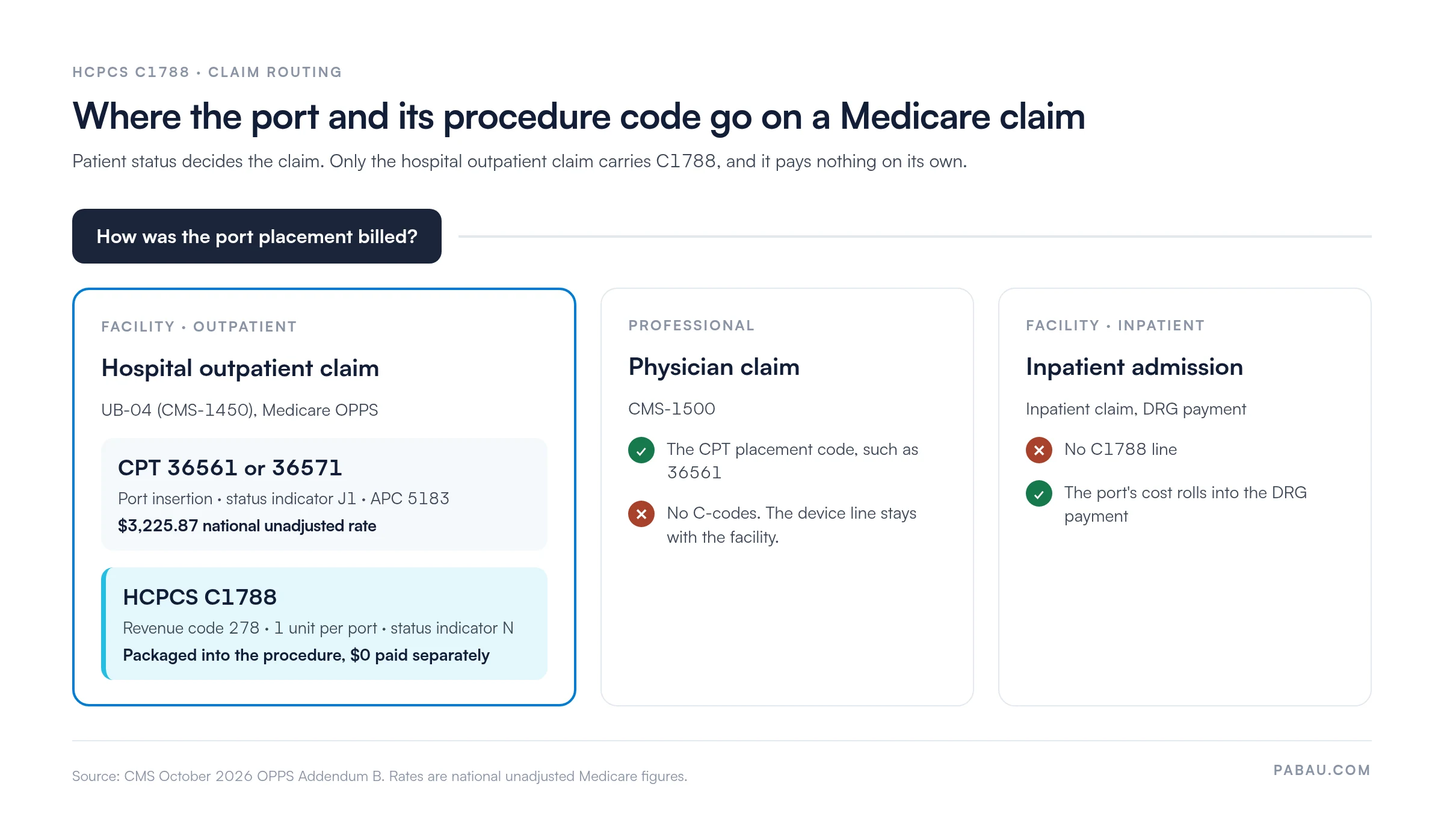
C1788 earns no separate payment under Medicare OPPS. The October 2026 OPPS Addendum B lists it with status indicator N, which means its cost is packaged into the related procedure.
The procedure codes carry the payment instead. Port insertion codes 36561 and 36571 sit in comprehensive APC 5183, with status indicator J1. That indicator packages the other covered services on the claim into one payment.
These figures are national unadjusted Medicare rates. Your payment shifts with the wage index, and commercial payers follow their own contracts.
Packaged does not mean optional. CMS uses the device charges on your claims to set future APC rates, so a missing C1788 line understates what port placement costs. Port insertion codes such as 36561 sit below CMS’s device-intensive threshold in the CY 2026 OPPS final rule. No Medicare edit sends the claim back when C1788 is missing, so the omission only surfaces in your own audit.
Billing C1788 correctly means getting a handful of elements right on the UB-04. Claims management software that checks codes before submission catches most errors before the claim leaves the facility.
The billing field reference below maps each element to its UB-04 locator.
Map C1788 to the port items in your chargemaster once, then audit it each quarter. When a port appears in the operative report but not on the claim, the cause is usually a chargemaster or supply-capture default.
Every C1788 line needs a record that shows a port was implanted, which one, and why. Strong medical billing compliance builds that record during the case rather than after a denial arrives.
Medicare does not usually require prior authorization for port placement, but payer policies vary. Confirm requirements per plan before the procedure date.
Most C1788 coding errors come from picking a nearby access-device code. The table below compares the codes most often confused with an implanted port.
When the operative report describes a catheter with no reservoir, the device line takes C1751 instead. An implanted access system for hemodialysis takes C1881.
Implanted pumps deliver drug on their own, so they never share a code with a passive port. Code a programmable pump to C1772 and a fixed-rate pump to C1891.
Verify neighboring descriptors in the current CMS HCPCS file or AAPC’s HCPCS code lookup. Never choose a code from memory or from last year’s claim.
Most C1788 problems are preventable. Good denial management workflows trace each rejection to a root cause before anyone resubmits.
When a denial arrives, read the electronic remittance advice (ERA) first. The Claim Adjustment Reason Code (CARC) and Remittance Advice Remark Code (RARC) together identify the exact reason.
Before you submit a port claim, check four things. Is the patient registered as an outpatient? Does the operative report name a port? Are the procedure code and C1788 both on the claim? Does the diagnosis explain the need for long-term access?
The diagnosis on a C1788 claim should explain why the patient needs long-term venous access. A clean claim pairs the port with the condition it serves, which is most often a cancer needing chemotherapy.
The table below lists common examples. Always code the specific condition in the record, and check your payer’s policy before submission.
Use the most specific code the documentation supports. Z45.2 does not apply when the port has a complication, so code the complication itself instead.
Port claims go wrong at the point of capture. The device sticker sits in a folder, the operative note gets typed hours later, and the coder never sees which port went in.
Pabau keeps consent forms, treatment notes, photos, and custom device fields on one patient record. Staff record the port name and lot number while the case is open.
Our claims and billing tools sit on that same record. When an auditor asks which port you used and why, the answer is already in the file.

Pabau brings consent forms, treatment notes, photos, and custom device fields onto one patient record. Your team documents the port once, so coders and auditors find what they need without chasing paper.

C1788 will not change your OPPS payment for a port placement, because CMS packages the device into the procedure. Its value is in the data and the evidence trail. No Medicare edit flags a missing C1788, so the habit has to live in your chargemaster.
Map the port to C1788 in your chargemaster, pair it with the right procedure and diagnosis, and keep the device sticker on the record. Book a demo to see how Pabau keeps device details, notes, and consent on one patient record.

Need to understand the broader claims ecosystem? Medical claims clearinghouse overview explains how outpatient claims move from the facility to the payer and where C-code claims are most likely to stall.
Want to reduce denial volume across your billing team? Denial management in healthcare covers root-cause analysis frameworks and appeal workflows that apply to HCPCS device code denials.
Unclear on ERA codes when a C1788 claim comes back denied? Electronic remittance advice guide decodes CARC and RARC codes so billing staff can identify the exact denial reason and act on it.
HCPCS Code C1788 covers an indwelling implantable port, the vascular access device placed under the skin for chemotherapy or long-term infusions. Hospitals report it on the outpatient UB-04 claim alongside the port placement procedure code.
No. The October 2026 OPPS Addendum B lists C1788 with status indicator N and no pass-through expiration. Its cost is packaged into the port placement procedure, so it earns no separate payment.
C1788 is usually billed with a port insertion code, such as 36561 for a centrally inserted port or 36571 for a peripherally inserted one. Replacement codes such as 36582 can also pair with it.
Enter C1788 in form locator 44 with revenue code 278 in FL 42 and one unit per port in FL 46. Report the procedure code on its own line and the supporting diagnosis in FL 67.
No. C-codes are reported only on hospital outpatient facility claims. The physician bills the port placement with the CPT code alone on the CMS-1500.
CMS uses device charges on outpatient claims to set future APC payment rates. A missing C1788 line understates what port placement costs, and no Medicare edit flags the omission.