HCPCS code A4714: Treated water for peritoneal dialysis billing guide
HCPCS code A4714: Official descriptor, code type, and payment status HCPCS code ...

Last Updated: Oct 15, 2026
C1891 is the HCPCS Level II code for infusion pump, non-programmable, permanent (implantable). It reports the implanted pump device only, on a hospital outpatient facility claim, and not the implantation procedure, catheter, or drug.
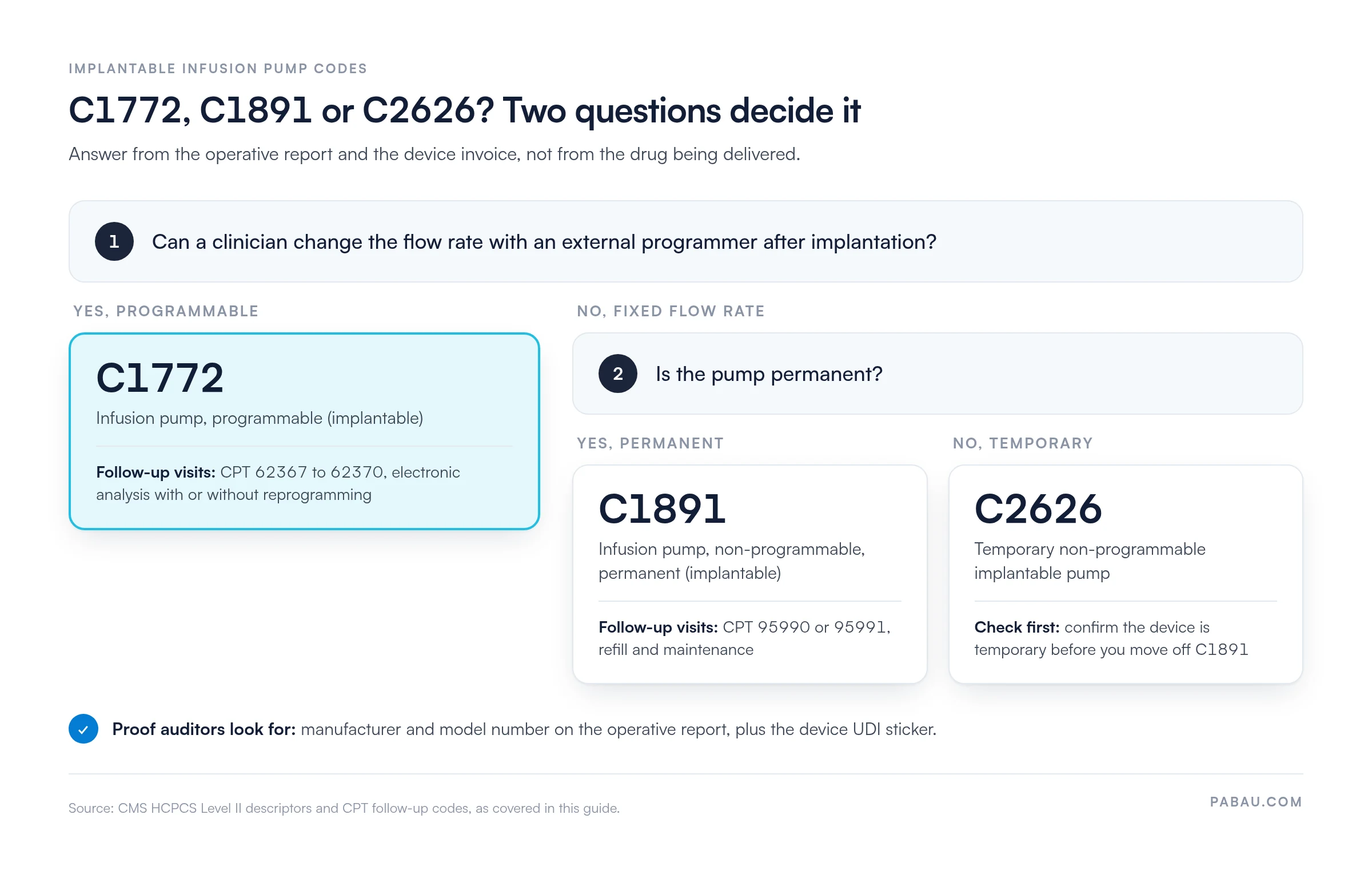
The code turns on two facts. The pump runs at a fixed flow rate that no external programmer can change, and it is meant to stay in the body. A programmable pump is C1772, and a temporary non-programmable pump is C2626.
Let Pabau's smart automation suggest the right codes, reduce claim denials, and keep your practice compliant—effortlessly.
Automate repetitive tasks and focus on what matters most—your patients.
Reduce coding errors and ensure compliance with the latest regulations.
Clean claims, fewer denials, and faster reimbursements.
Powerful insights and reporting to help your practice thrive.
HIPAA compliant SOC 2 certified GDPR-compliant Trusted by 4,000+ clinics worldwide

HCPCS Code C1891 reports a permanent, non-programmable implantable infusion pump. It covers the pump device only, not the implantation, catheter, or drug.
Programmability and permanence decide the code. A programmable pump is C1772, and a temporary non-programmable pump is C2626.
C1891 is a facility code for hospital outpatient claims on the UB-04. The physician bills the implantation CPT code on a separate professional claim.
C1891 began as an OPPS pass-through device category. The pump cost is now generally packaged, so check the current status indicator in Addendum B.
The operative report and device label should name the pump’s manufacturer and model, because that record proves the pump is non-programmable at audit.
HCPCS Code C1891 is defined in the Level II code set as “Infusion pump, non-programmable, permanent (implantable).” The Centers for Medicare and Medicaid Services (CMS) maintains it for hospital outpatient reporting under the Outpatient Prospective Payment System (OPPS).
A non-programmable implantable pump sits in a pocket under the skin, usually in the abdomen. Most models use a propellant chamber that pushes drug from the reservoir through a catheter at a constant, preset flow rate.
Common uses include intrathecal therapy for chronic pain or spasticity and hepatic arterial chemotherapy for liver tumors. Because the rate can’t be reprogrammed, the clinician changes the dose by refilling the reservoir with a different drug concentration.
C-codes are facility-only, so C1891 goes on the hospital’s claim and never on a physician’s CMS-1500. Confirm the current descriptor on the CMS HCPCS Level II page each year, since CMS can revise descriptors in its quarterly updates.
Two questions settle which implantable pump code applies. Can a clinician change the flow rate with an external programmer after implantation? Is the pump intended to stay in the body?
If the rate can be reprogrammed, report C1772, whatever the intended duration. If the rate is fixed and the pump is permanent, report C1891. A fixed-rate pump intended for temporary use is C2626.
Take both answers from the device record rather than from memory. The pump’s FDA labeling and model number show whether it is programmable and whether it is meant for permanent implantation.
The implantation code has to match the pump too. A non-programmable spinal pump is implanted under CPT 62361, while CPT 62362 describes a programmable pump. A C1891 line next to CPT 62362 tells the payer the two codes disagree.
One more code describes a similar device. E0782 covers a non-programmable implantable pump under the DMEPOS benefit, bundled with its catheter and connectors. A hospital outpatient department reports C1891 on its facility claim instead.
Keep a copy of the pump’s FDA labeling or instructions for use with the billing record. It shows the pump is non-programmable and permanent, which supports C1891 if a payer questions the code.
C1891 covers the pump device only. The implantation procedure, catheter, drug, and refill visits each need their own code. Report one unit of C1891 for each pump implanted.
Those codes land on three different claims, and only the facility claim carries C1891.
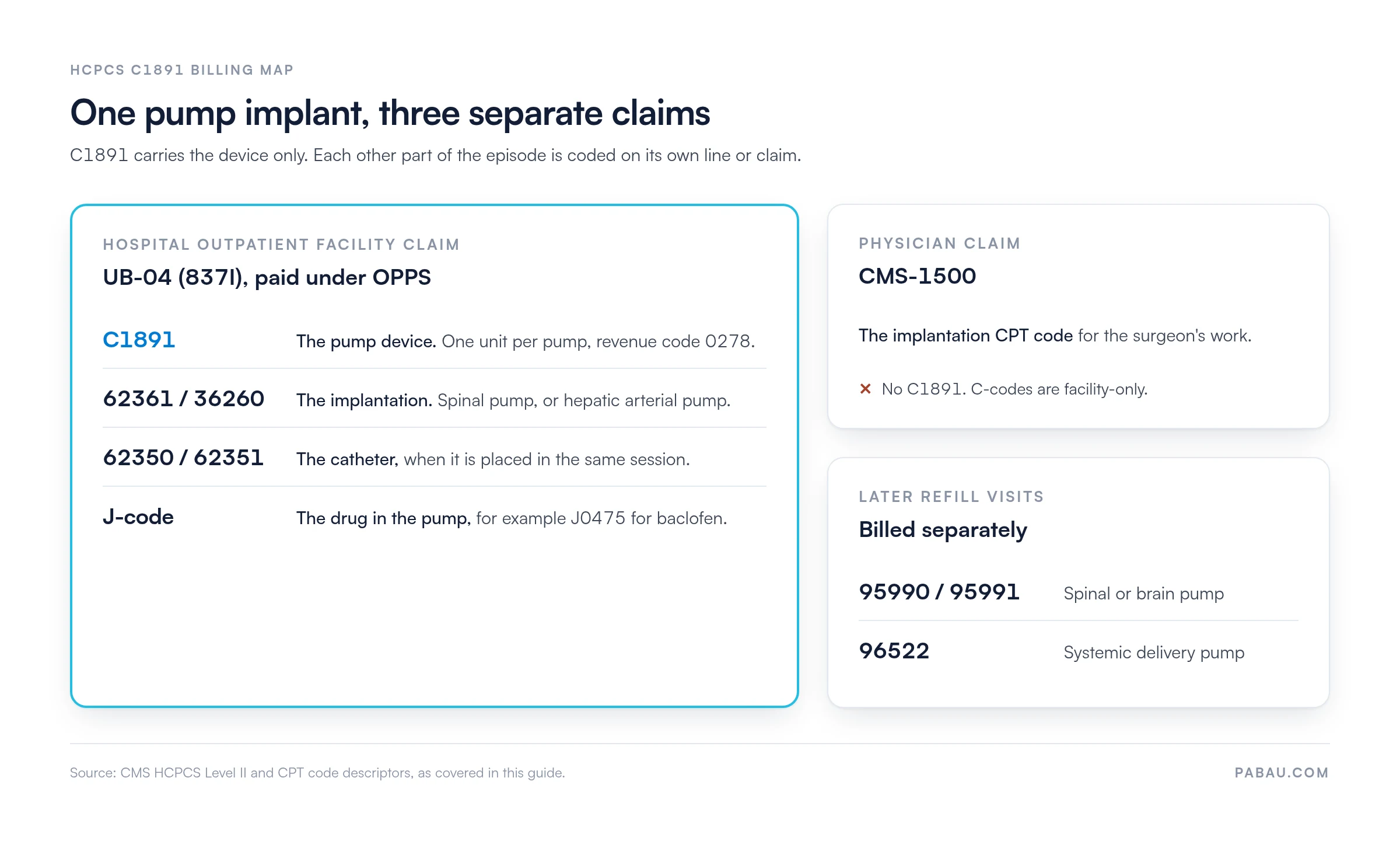
Bill the drug in the pump separately with its J-code, for example J0475 for baclofen. A drug cost folded into the C1891 device line is a common audit trigger.
C1891 is one of the device categories CMS created for OPPS transitional pass-through payment. Pass-through status lasts only a few years. For a category this long established, the pump cost is generally packaged into the procedure’s Ambulatory Payment Classification (APC) rate.
A packaged code still belongs on the claim. CMS uses device C-codes on claims to set future APC rates. Procedures that CMS designates as device-intensive also need a device code on the claim, or the claim can be returned.
Check the status indicator and APC for both C1891 and the paired CPT code in the CMS quarterly OPPS addenda for the date of service. Commercial and Medicare Advantage payers set their own rates and may pay the device separately under contract.
Report C1891 under revenue code 0278 (other implants) unless the payer names another revenue center. A pump replaced free or at a credit from the manufacturer needs value code FD on the Medicare claim. Add the matching condition code, such as 49 or 50.
Medicare covers implantable infusion pumps for the indications listed in National Coverage Determination (NCD) 280.14. Coverage isn’t automatic, so the record has to show the patient fits one of them.
Medicare Advantage and commercial plans may apply stricter criteria than traditional Medicare. Check each plan’s requirements before the implant is scheduled.
Traditional Medicare does not usually require prior authorization for C1891, but the claim can face post-payment review against the NCD. Most Medicare Advantage and commercial plans require authorization before implantation.
Every item below should be in the patient record before the claim goes out:
Strong medical billing compliance starts with these items captured at the point of care. Rebuilding them after an auditor asks often ends in a partial or full recoupment.
Most C1891 denials come from a coding mismatch or a missing record. When a claim does come back, this guide to medical billing denial codes explains what the payer’s reason code means.
Each of these checks takes minutes at charge capture. Working the same error as a denial takes an appeal cycle on a high-value device line.
Facilities billing HCPCS Code C1891 need the device record, procedure code, and authorization on file before the claim goes out. Pabau, the practice management platform we build, includes claims management software that keeps those pieces on one claim.
Pabau’s digital forms capture the operative note, pump model, device label, and trial results in a consistent format, tied to the patient record. If a payer audits the claim, the records are already in one place.
Pabau’s reporting also shows denial trends over time. A monthly review tells you whether pump-code mismatches are falling, and which workflow step to fix if they aren’t.

Pabau’s claims management tools support accurate charge capture, revenue code pairing, and audit-ready documentation for outpatient billing teams.

Most C1891 problems start before the claim exists. Move the pump-code decision into surgical scheduling, where the device record, FDA labeling, and authorization can be checked against the planned procedure.
Once the patient has gone home, a wrong pump code or a missing label is much harder to fix. A few minutes of front-end checking costs less than a single appeal on a device line.
Book a demo to see how Pabau keeps implant records, authorizations, and claims in one place for your billing team.

Need to understand how denials are tracked and reversed? Denial management in healthcare covers the end-to-end workflow for identifying, appealing, and preventing claim denials across billing teams.
Unsure whether your billing process meets payer audit standards? Medical billing compliance outlines the documentation and procedural standards that reduce audit exposure.
Looking for a broader overview of the billing process? What is medical billing explains the full claim lifecycle from charge capture to remittance posting.
Implanting a device with no specific C-code? HCPCS code C1889 explains when the not-otherwise-classified device code applies on an outpatient claim.
HCPCS Code C1891 covers a permanent, non-programmable implantable infusion pump. It reports the pump device only, not the implantation, catheter, drug, or refill visits. Hospitals report it on outpatient facility claims under the OPPS.
C1891 is a permanent implantable pump with a fixed flow rate. C1772 is a programmable pump whose rate a clinician can change externally after implantation. C2626 is a non-programmable pump intended for temporary use.
For a spinal pump, the usual pairing is CPT 62361, implantation or replacement of a non-programmable pump. A hepatic arterial pump pairs with CPT 36260. The catheter, drug, and refills are billed with their own codes.
Usually not. C1891 began as a temporary pass-through device category, and the pump cost is now generally packaged into the procedure’s APC. Check the current status indicator in Addendum B for the date of service.
Traditional Medicare does not usually require prior authorization, but claims can face review against NCD 280.14. Most Medicare Advantage and commercial plans require authorization before implantation, so check each plan before scheduling.
The leading causes are a wrong pump code, a procedure code that doesn’t match the pump, and missing authorization. Claims are also denied when C1891 appears on a professional or inpatient claim, or when the drug cost sits inside the device line.
No. C1891 is a facility code reported on the hospital’s outpatient UB-04 claim. The physician bills the implantation CPT code on the CMS-1500.