CPT Code 62284: Injection procedure for myelography
CPT Code 62284: official descriptor and procedure overview The American Medical ...

Last Updated: Oct 19, 2026
C1771 is the HCPCS Level II code for repair device, urinary, incontinence, with sling graft. It reports the sling graft implanted during a urinary incontinence repair in an ambulatory surgery center or hospital outpatient department. The surgeon's sling operation is billed separately with CPT 57288.
The code sits in the C-series, which CMS uses for devices billed under the Outpatient Prospective Payment System. It is not reported on inpatient claims, where the device cost is bundled into the DRG payment.
Let Pabau's smart automation suggest the right codes, reduce claim denials, and keep your practice compliant—effortlessly.
Automate repetitive tasks and focus on what matters most—your patients.
Reduce coding errors and ensure compliance with the latest regulations.
Clean claims, fewer denials, and faster reimbursements.
Powerful insights and reporting to help your practice thrive.
HIPAA compliant SOC 2 certified GDPR-compliant Trusted by 4,000+ clinics worldwide

C1771 reports the sling graft device itself, while the sling operation is reported separately with CPT 57288.
The code is active for 2026 and applies in ambulatory surgery centers and hospital outpatient departments, never on inpatient claims.
An operative note that does not name the device and a weak diagnosis pairing are the two most common reasons C1771 claims are denied.
C2631 covers the same repair device without a sling graft, so the graft language in the operative note decides between the two codes.
Pass-through status changes each calendar year, so confirm it against the current OPPS addendum before every device line goes out.
HCPCS code C1771 is the billing code for a urinary incontinence repair device that includes a sling graft. It applies when the graft is supplied and implanted in an ambulatory surgery center (ASC) or a hospital outpatient department (HOPD).
The code belongs to the C-series of HCPCS Level II, which CMS maintains for outpatient devices, drugs, and supplies. These are items a CPT code does not capture on its own.
C-series codes like C1771 were introduced to allow separate device pass-through payments in outpatient settings. Pass-through status carries an expiry date, and CMS updates the list every year. Check the current OPPS Addendum B to see whether C1771 is paid separately or packaged into the APC payment.
A sling procedure for stress urinary incontinence (SUI) places a narrow strip of material, the graft, beneath the urethra or bladder neck. It restores support lost to pelvic floor weakness. The graft acts as a hammock.
When abdominal pressure rises during coughing, sneezing, or exertion, the sling supports the urethra and prevents leakage. A practice billing this procedure needs both the surgical CPT code and the device HCPCS code on the same encounter.
The sling graft material may be synthetic mesh, autologous fascia (harvested from the patient’s own tissue), or processed allograft. Each material type remains within the C1771 descriptor provided it functions as the sling component of a urinary incontinence repair. The device is implanted during the same session as the sling operation itself.
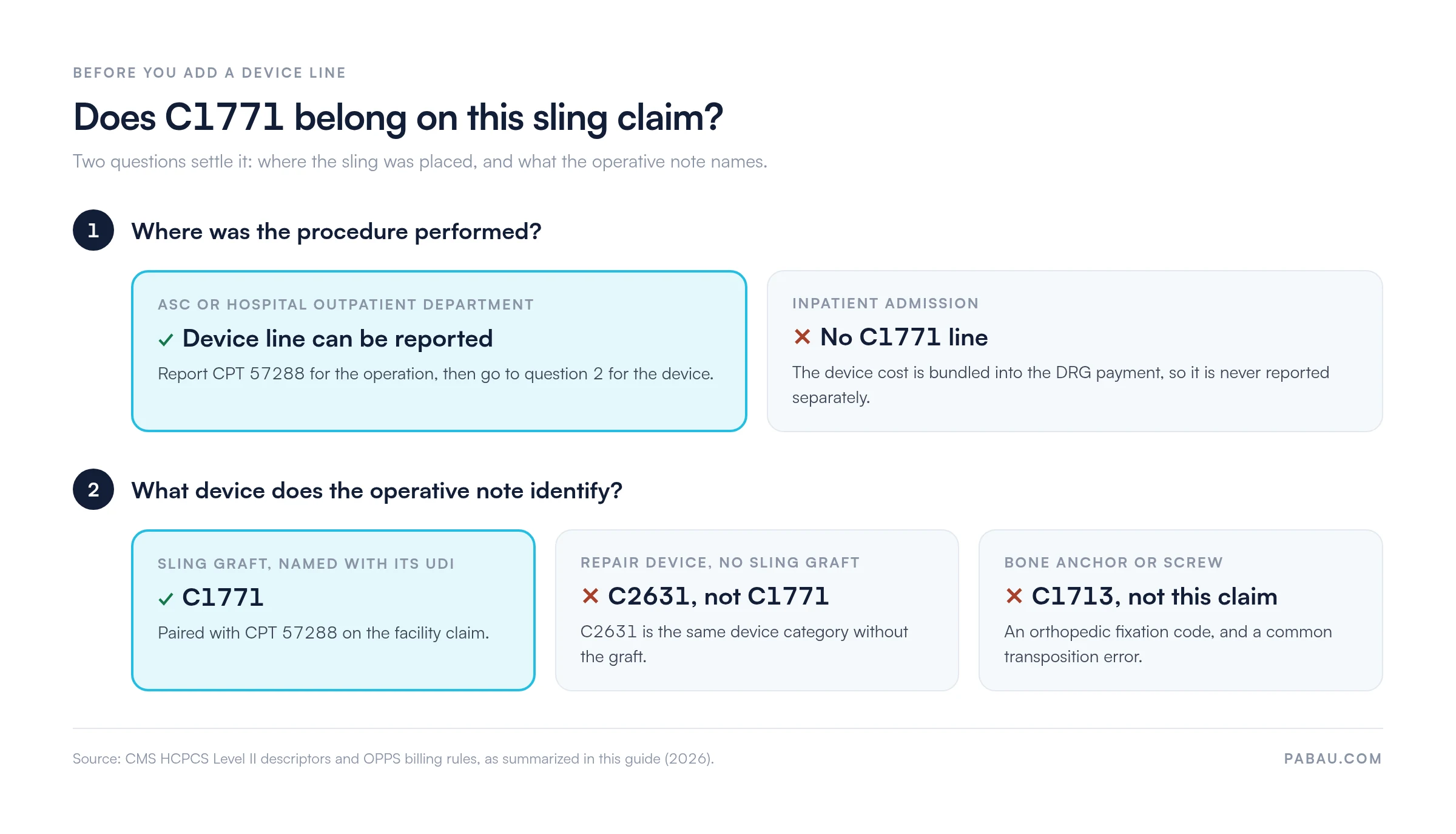
C1771 applies when a sling graft device is furnished in an ASC or HOPD during a urinary incontinence repair procedure. It does not apply in inpatient hospital settings, where the device cost is bundled into the DRG payment rather than reported separately.
Billing C1771 on an inpatient claim is one of the most common setting-related denial triggers. The two checks below decide whether the device line belongs on the claim at all.
Medical necessity for C1771 is established through the primary diagnosis code. The ICD-10 codes below are the most commonly accepted diagnoses. Criteria vary by region, so check the Local Coverage Determination (LCD) from your Medicare Administrative Contractor (MAC).
CPT code 57288 describes the sling operation itself: the surgeon’s incision, graft placement, urethra support creation, and closure. C1771 describes the physical device used during that operation. Both codes may appear on the same ASC claim. One reports the work and the other reports the implant, so neither can stand in for the other.
Reporting CPT 57288 without C1771 can forfeit separate device payment where the payer allows pass-through or device reimbursement. Conversely, reporting C1771 without 57288 will typically result in a denial for missing the primary procedure code.
C1713 is the HCPCS code for an anchor or screw used in bone-to-bone or soft-tissue-to-bone fixation. It belongs to orthopedic and musculoskeletal procedures, not urinary incontinence repair. Both codes sit in the same C-series range and look alike at a glance. That makes them easy to transpose during manual entry.
Submitting C1713 on a urology claim draws an immediate denial. The payer’s clinical edits will not match an orthopedic bone anchor to an incontinence diagnosis. Practices that bill both specialties should add a code-verification step before submission.
The closer neighbor is C2631, repair device, urinary, incontinence, without sling graft. It describes the same device category with no graft implanted. If the operative note documents a sling graft, C1771 is correct. If it documents a repair device alone, the claim needs C2631.
Medicare reimburses C1771 under the Hospital Outpatient Prospective Payment System (OPPS) for HOPD claims and under the ASC payment system for ASC facility claims. Current rates come from the annual OPPS Addendum B and the CMS fee schedule lookup tool.
CMS publishes the addendum each November for the following calendar year. C-series rates change annually and pass-through status expires, so the list below describes how payment works rather than a dollar amount. Confirm the current addendum before billing.
Effective revenue cycle management for C1771 requires tracking whether pass-through status is active at the time of service, not at the time of coding. A procedure performed in December may be paid as pass-through. If the new year’s OPPS rule drops the code from the list, January claims are packaged instead.
Track pass-through expiry dates for every C-series device code your practice bills. Set a calendar reminder each November to verify status against the CMS OPPS final rule before the new year begins. A single missed expiry means billing a device line that no longer pays separately. Correcting those claims afterward adds avoidable rework.
The National Correct Coding Initiative (NCCI) publishes bundling edits that determine which code pairs may be billed together. ASC coders reporting C1771 alongside CPT procedure codes need to know how those edits apply to a device line.
C1771 is a device and supply code, so it does not trigger the procedure-to-procedure edit pairs that two competing CPT codes would. Bundling can still affect it in two ways:
Modifiers on HCPCS device codes serve a different purpose than on CPT procedure codes. For C1771, the most relevant modifier scenarios are:
Verify current modifier applicability against the CMS NCCI Policy Manual for Medicare Services, updated quarterly, before assuming a prior-year modifier strategy is still valid.
Traditional Medicare (Parts A and B) does not currently require prior authorization for C1771 as a standalone device code. Medicare Advantage plans set their own policies, and checking them is part of medical billing compliance.
A Medicare Advantage plan may require prior authorization for the sling procedure (CPT 57288) or for the device (C1771) even when traditional Medicare does not. Check the specific plan’s authorization list before scheduling the procedure.
For commercial payers, prior authorization requirements vary by plan and state. When authorization is required, the documentation typically needed includes:
Insufficient documentation is the most common root cause of C1771 denials. Usually the operative note does not identify the sling graft that was used. A note may describe the procedure clinically but never name the device or record its unique device identifier (UDI).
That gives the payer grounds to deny separate payment. A clean claim submission for C1771 needs the following in the record before the claim goes out.
C1771 denials follow predictable patterns. A denial management workflow sorts rejections by root cause. That lets you fix the process instead of appealing each denial as a one-off.
The denial code on the remittance advice usually points to one of these rows, so reading denial codes quickly shortens the fix. An appeal should lead with three documents:
Resubmitting the same claim without new documentation will not overturn the denial.
Run a six-point check before every C1771 claim. The operative note names the device, and the UDI is recorded. The diagnosis is N39.3 or another specified code. Place of service is 24 (ASC) or 22 (HOPD). Pass-through status is confirmed for the current year, and prior authorization is on file where the payer requires it. With that check in place, denials become edge cases rather than routine rework.
The details a C1771 claim depends on often live in different places. The device name sits in a dictated note, the UDI on a packaging label, and the prior authorization in an email thread. Each one has to be found again when the claim is built.
In Pabau, the practice management platform we build, the treatment note, the signed consent and the invoice sit in one patient record. Its error-checking claims management pre-fills each submission with the patient, treatment and insurer details. Background checks catch missing fields, such as membership numbers and authorization codes, before the claim can be sent.
In the US, claims go out through Claim.MD, with real-time eligibility checks and ERA remittance posting. A status dashboard tracks every claim from submitted to paid, so your team sees a rejected device line as soon as it comes back.
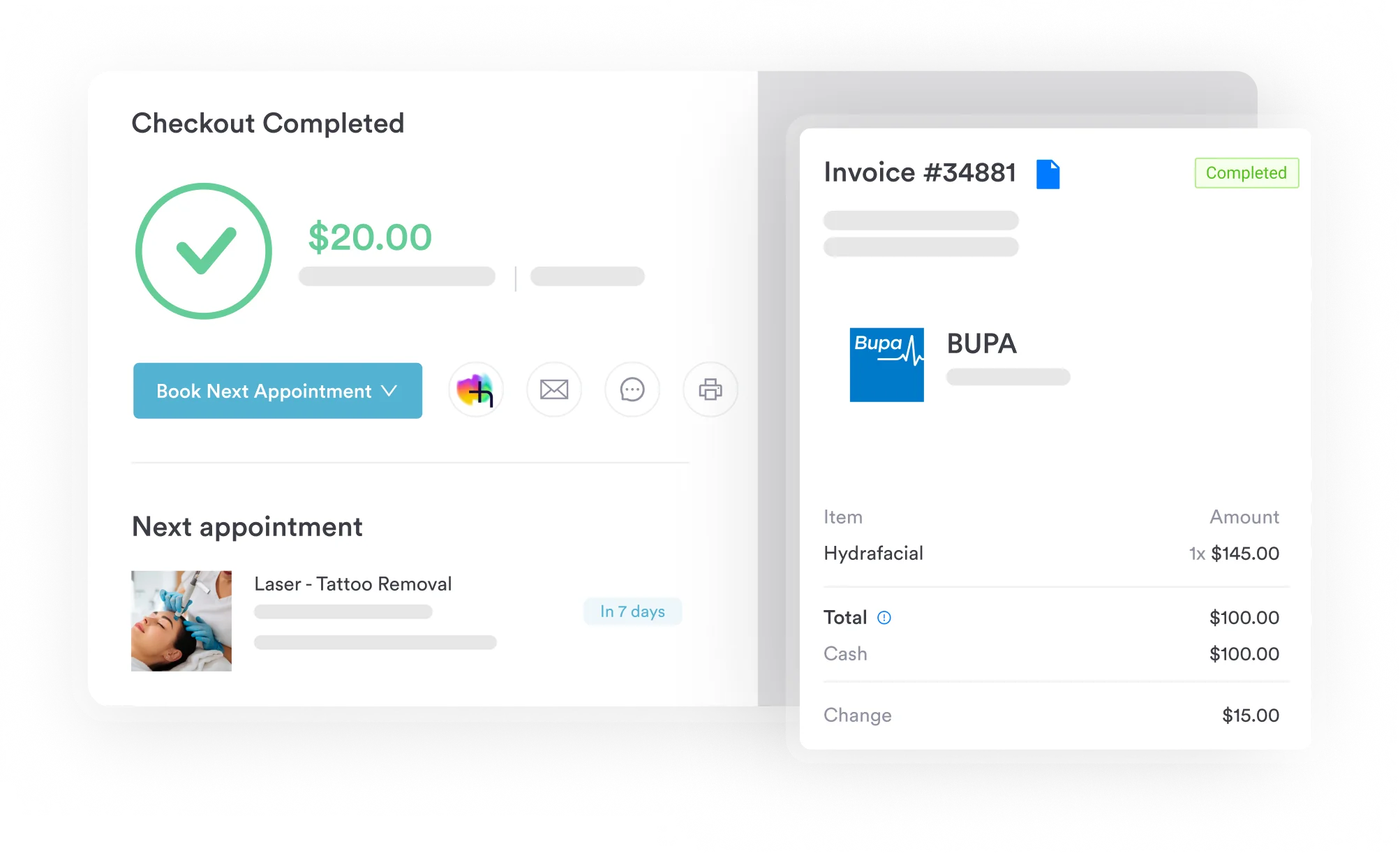

Pabau pre-fills each claim from the patient record and flags missing details before it goes out. Your billing team spends less time reworking denied device lines.

Treat C1771 as a documentation code as much as a billing code. Every denial pattern in this guide traces back to the operative note, the care setting or the year’s pass-through list.
The practical move is to make the pre-submission check routine before the next OPPS update lands. It costs a few minutes per claim. Skipping it costs an appeal cycle on a device line that should have paid the first time.
Book a demo to see how Pabau checks each device claim for missing details before it reaches the payer.

Coding the other urinary incontinence implant? HCPCS code C1815 explains how to bill an implantable urinary sphincter prosthesis, the other device reported for urinary incontinence repair.
Was the graft billed as mesh instead of a sling? HCPCS code C1781 covers implantable mesh, so you can see where its descriptor ends and C1771’s begins.
Choosing the diagnosis code for the claim? ICD-10 code R32 explains when unspecified urinary incontinence applies and when a more specific code is needed.
Does the payer want approval before the sling surgery? The prior authorization process walks through a step-by-step workflow for getting approval before the procedure date.
HCPCS code C1771 covers the sling graft device used in a urinary incontinence repair. It is reported separately from the surgical CPT code 57288 in ambulatory surgery centers and hospital outpatient departments. It does not cover the surgical service itself.
CPT 57288 captures the sling operation the surgeon performs. C1771 captures the sling graft device implanted during that operation. Both may appear on the same ASC facility claim as separate line items when the device is separately reimbursable.
No. C1771 applies in both ambulatory surgery centers (ASC) and hospital outpatient departments (HOPD). It does not apply to inpatient hospital claims, where device costs are bundled into the DRG payment and cannot be reported separately.
Traditional Medicare does not currently require prior authorization for C1771 as a standalone device code. Medicare Advantage plans and commercial payers may require it. Requirements vary by payer and plan year, so check the specific plan before scheduling the procedure.
The most common reason is an operative note that does not name the sling graft or record its UDI. Claims also fail when filed on an inpatient stay, where the device cost sits in the DRG. An unspecified code such as R32 instead of N39.3 is another trigger. So is billing a device whose pass-through status has expired.
C1713 is an anchor or screw used in orthopedic bone-to-bone or soft-tissue-to-bone fixation procedures, while C1771 is a sling graft device for urinary incontinence repair. The two codes describe entirely different devices for different specialties. Submitting C1713 on a urology claim will result in a denial because the code and diagnosis do not match.