HCPCS Code G0163: Skilled nursing observation and assessment
What is HCPCS Code G0163? HCPCS Code G0163 is a deleted Level II code for skille...

Last Updated: Oct 15, 2026
57288 is the CPT code for a sling operation for stress incontinence, using either fascia or synthetic material. The descriptor includes reconstruction of the urethrovesical junction, so bladder neck work in the same session is not coded separately.
Confusion with the adjacent codes 57287 and 57289 is the most common source of incorrect claims. Payers also expect documented failure of conservative therapy before they will process a 57288 claim.
Let Pabau's smart automation suggest the right codes, reduce claim denials, and keep your practice compliant—effortlessly.
Automate repetitive tasks and focus on what matters most—your patients.
Reduce coding errors and ensure compliance with the latest regulations.
Clean claims, fewer denials, and faster reimbursements.
Powerful insights and reporting to help your practice thrive.
HIPAA compliant SOC 2 certified GDPR-compliant Trusted by 4,000+ clinics worldwide

CPT 57288 covers a sling operation for stress urinary incontinence, with urethrovesical junction reconstruction included in the descriptor.
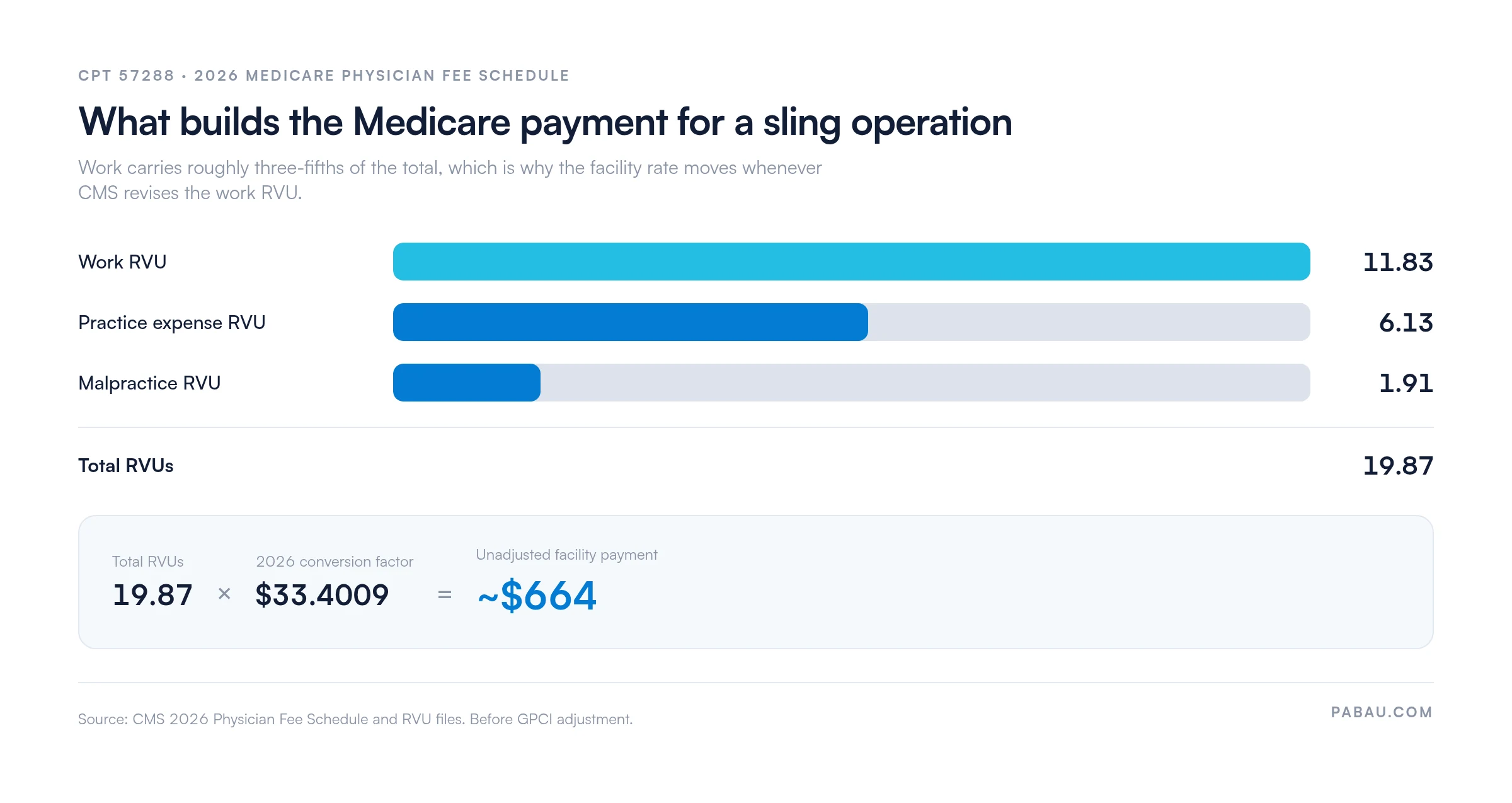
Medicare’s 2026 unadjusted facility payment is roughly $664, from 19.87 total RVUs at a $33.4009 conversion factor.
Primary ICD-10 support codes are N39.3, N39.41, and N39.498, so verify the pairing against your payer’s LCD.
The global surgical period is 90 days, and services inside that window need modifier 24 or 79 to bill separately.
Practice management software like Pabau connects CPT lookup, ICD-10 crosswalk, and claim scrubbing in one workflow.
CPT code 57288 describes a “sling operation for stress incontinence (eg, fascia or synthetic),” with urethrovesical junction reconstruction included in the descriptor.
According to the American Medical Association’s CPT code set, the code sits in the Surgery section (10004-69990). Within that section it falls under the Female Genital System subsection, in the range for Repair Procedures on the Vagina (57200-57335).
The parenthetical “(eg, fascia or synthetic)” signals that 57288 is a procedure-type code covering multiple sling materials. Both autologous fascia slings and synthetic mesh midurethral slings are captured under this single code.
The urethrovesical junction reconstruction component means bladder neck work performed in the same operative session is bundled and should not be coded separately. Understanding this inclusion prevents unbundling errors, a leading cause of claim denial and NCCI edit flags on urology and gynecology claims.
The sling operation covered by CPT code 57288 treats stress urinary incontinence, known as SUI. Coughing, sneezing, or exercise raises abdominal pressure, and the urethral sphincter cannot hold closure against it, so urine leaks.
The procedure places a strip of material, either fascia or synthetic mesh, beneath the urethra. That strip creates a hammock-like support reinforcing the urethrovesical junction.
Regardless of approach, the operative report must document the specific technique. Payers that cover SUI surgery typically require evidence that conservative management failed first. Pelvic floor physical therapy and pessary trials are the two most common conservative measures payers expect to see documented.
Patients who are unsuitable for a sling, or who decline one, may instead receive a urethral bulking injection billed under 51715. That claim pairs with the same N39.3 diagnosis, and payers typically expect the same conservative-failure documentation.
Medicare reimbursement for CPT code 57288 varies by setting and by geography. The CMS Physician Fee Schedule lookup tool is the authoritative source for current rates by locality. The national averages below are directional, so verify the exact figure for your MAC jurisdiction before quoting or budgeting.
Always qualify a rate citation with the calendar year it belongs to. CMS updates the fee schedule annually, and the 2025 conversion factor of $32.35 no longer applies. For current figures, open the CMS Physician Fee Schedule lookup and filter by your MAC locality and the 2026 pricing year.
The Medicare payment formula is Payment = (Work RVU + Practice Expense RVU + Malpractice RVU) x GPCI adjustments x Conversion Factor. CMS publishes the component values for every code in its annual RVU data file.
RVU values are approximate and subject to annual CMS revision, so check them before you model reimbursement. The three components carry very different weight, and the chart below shows how they build the payment.
ICD-10 diagnosis codes must document medical necessity for CPT code 57288. The primary codes for stress urinary incontinence are listed below.
These are commonly accepted pairings, but payer coverage determinations vary. Always verify the crosswalk against your payer’s Local Coverage Determination (LCD) first. Picking the wrong ICD-10-CM code is one of the fastest paths to a medical necessity denial.
N39.3 is the primary supporting diagnosis in the majority of 57288 claims. Using N39.41 (urge incontinence) alone as the primary code on a sling claim is a common denial trigger.
Urge incontinence is not the indication for a urethral sling. Document the stress component explicitly in the pre-operative evaluation, and carry that language through to the claim.
Run your ICD-10 pairing against your payer’s LCD before every 57288 submission. Some MACs have issued specific LCDs for SUI surgery that list acceptable ICD-10 codes precisely. A crosswalk that works for one payer can fail with another. Keep a payer-specific crosswalk reference card in your billing system so your coders aren’t rebuilding it from memory each time.
Modifier selection for CPT code 57288 depends on the clinical scenario and on payer requirements. The table below covers the most commonly applied modifiers. This is general coding guidance only.
Verify modifier requirements against your payer’s policy, and bring in a certified coder for complex scenarios, particularly where modifier 22 is in play.
A clean 57288 claim needs documentation that answers three questions a payer reviewer will ask. Was the diagnosis correct? Was the procedure medically necessary? Was the procedure performed as described?
Missing any one of those answers is enough to trigger a denial or a request for records. Structured note templates that enforce the required fields reduce the risk of omitting one under time pressure.
A clean claim starts long before the billing team touches the code. When coders receive an operative note that does not specify the sling material or approach, they must request an addendum, which delays the claim. Build a structured operative note template that maps to 57288’s descriptor elements. That single change does more for a urology or gynecology practice than any downstream edit check.
The global surgical period for CPT code 57288 is 90 days, consistent with CMS’s major surgery classification. Routine follow-up visits and postoperative care from the same surgeon within those 90 days are included in the surgical fee. Knowing what falls inside and outside the window prevents both revenue leakage and compliance exposure.
The day before surgery and the day of surgery are both included in the global period on the surgical side. Track the 90-day window in your practice management system from the date of service, so an included service never goes out as a separate claim.
Selecting the correct code from the cluster of sling and pelvic floor repair codes is where billing errors most frequently originate. The table below covers the codes most likely to be confused with CPT code 57288.
The 57288 versus 57287 distinction is the most operationally critical. A revision claim submitted with 57288 instead of 57287 will usually be processed.
It may still trigger a post-payment audit where the payer has a prior sling on record for that patient. Use the AAPC Codify CPT lookup to cross-reference descriptors and inclusion notes when choosing between adjacent codes.
Code selection driven by how a service was delivered is not unique to sling surgery. HCPCS code G0109 applies to diabetes self-management training only when two or more beneficiaries attend together, with one-to-one instruction coded separately.
Denials on 57288 cluster around a short list of causes. These are the patterns that reach the remittance advice in urology and gynecology practices, drawn from NCCI edit violations and LCD non-compliance.
Diagnosis code accuracy is one measurable output that revenue cycle managers can review monthly. A denial rate above 5-10% on 57288 claims usually signals a documentation or crosswalk problem rather than a payer policy issue.
Pull a 90-day denial report filtered to CPT 57288 specifically. Sort by denial reason code. If the most common CARC code is 50 (Non-covered service) or 57 (Medical necessity), the fix is documentation upstream. If it is 4 (Deductible) or 45 (Charge exceeds fee schedule), look at the payer contract instead. Separating those two categories directs your team’s effort to the right intervention.
Coding reference sites tell you which code applies, and they stop there. The claim still has to leave the practice cleanly. Practice management software like Pabau connects the clinical note, the code selection, and the submission step in one platform built for specialist practices.
Pabau’s claims management software runs eligibility checks and claim validation before anything is submitted. A 57288 claim carrying the wrong ICD-10 pairing gets flagged inside the practice, not after the payer has adjudicated it.
Pabau also connects to Claim.MD as a clearinghouse, which reaches thousands of US payers. It supports 837P electronic claim submission, real-time eligibility verification, and ERA/835 remittance processing, so the revenue cycle for 57288 runs through one pipeline.

Pabau connects CPT code lookup, ICD-10 crosswalk, claim scrubbing, and audit-ready documentation in one platform. See how urology and gynecology practices use Pabau to reduce 57288 denials and speed up the revenue cycle.

Most 57288 denials trace back to the operative note. When the record never captured the conservative treatment failure or named the surgical approach, downstream scrubbing cannot rescue the claim.
Build those documentation requirements into the pre-operative workflow, so every note answers the descriptor before the billing team sees it.
For urology and gynecology practices with a volume of surgical claims, keeping the clinical record and the billing workflow in sync protects the revenue. Book a demo to see how Pabau handles 57288 documentation and claims end to end.

Need a guide to managing claim denials systematically? Denial management in healthcare covers the end-to-end process for identifying, appealing, and preventing recurring claim denials.
Want to understand how clearinghouses process your 837P files? 837 EDI file guide explains the electronic claim format, required segments, and submission workflow for US payers.
Looking for a comprehensive overview of medical billing workflows? Revenue cycle management guide covers the full RCM process from patient registration through to payment posting.
CPT code 57288 covers a sling operation for stress urinary incontinence, including urethrovesical junction reconstruction. The sling may be fascia or synthetic mesh, and the code captures both retropubic and transobturator approaches. It sits under Repair Procedures on the Vagina, in the Female Genital System subsection of the CPT Surgery section.
The 2026 national average Medicare facility payment for CPT 57288 is roughly $664 before geographic adjustment. That comes from 19.87 total RVUs multiplied by the $33.4009 conversion factor. Use the CMS Physician Fee Schedule lookup at cms.gov and filter by your MAC locality for the precise rate.
The primary ICD-10-CM code for CPT 57288 is N39.3 (stress incontinence, female). N39.41 (urge incontinence) and N39.498 (other specified urinary incontinence) may apply for mixed presentations. Always verify the accepted crosswalk against your payer’s Local Coverage Determination before submitting, as payer-specific requirements vary.
The global surgical period for CPT 57288 is 90 days. Routine postoperative visits and care for surgical complications without a return to the OR are included in the global fee. Unrelated procedures or services need modifier 79 or 24 to be billed separately within that window.
CPT 57288 is used for the original placement of a urethral sling for stress incontinence. CPT 57287 covers removal or revision of a previously placed sling. Using 57288 for a revision is a coding error that can trigger a post-payment audit.
CPT 57425 (laparoscopic colpopexy) and CPT 57288 address different anatomical problems and may share an operative session. Check the NCCI edit tables before submitting both codes together, because bundling rules can apply. Modifier 59 may be appropriate where the procedures are genuinely distinct and the documentation supports separate reporting.