CCSD code H4430: Examination of rectum under anaesthetic
CCSD code H4430 pays for the examination alone CCSD code H4430 is the UK private...

Last Updated: Oct 20, 2026
A4366 is the HCPCS Level II code for ostomy vent, any type, each.
Let Pabau's smart automation suggest the right codes, reduce claim denials, and keep your practice compliant—effortlessly.
Automate repetitive tasks and focus on what matters most—your patients.
Reduce coding errors and ensure compliance with the latest regulations.
Clean claims, fewer denials, and faster reimbursements.
Powerful insights and reporting to help your practice thrive.
HIPAA compliant SOC 2 certified GDPR-compliant Trusted by 4,000+ clinics worldwide

HCPCS code A4366 describes an ostomy vent, any type, each. The CMS descriptor is “vent,” not “belt,” even though some supplier catalogs use both terms.
Medicare Part B covers A4366 as durable medical equipment under CMS policy article A52487, subject to the medical necessity criteria in LCD L33828.
Qualifying diagnoses include colostomy, ileostomy, and urostomy. A valid physician order and supporting medical records must be on file before you bill.
Billing A4366 for an ostomy belt is a common compliance error, because the belt has its own code, A4367.
Practice management software like Pabau helps billing teams track documentation and submit claims accurately, so fewer ostomy supply claims come back denied.
A4366 sits in the A4361-A4438 ostomy supply range maintained by the Centers for Medicare and Medicaid Services (CMS) under the HCPCS Level II code set. One unit equals one vent dispensed. Each vent is billed separately from the pouch, the skin barrier, and the belt.
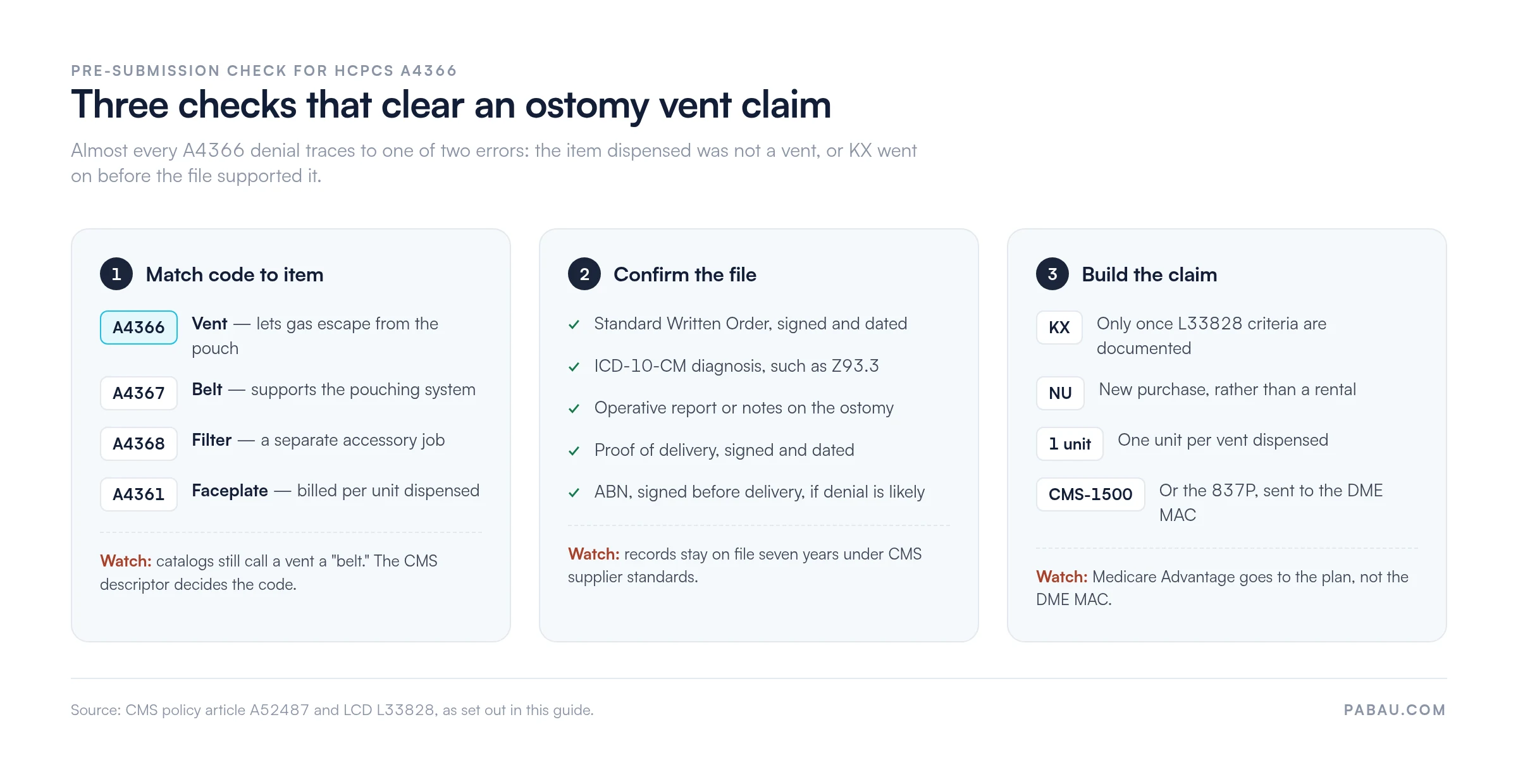
Some supplier catalogs and patient-facing materials describe A4366 as an “ostomy belt.” The current CMS descriptor is specifically “ostomy vent, any type, each.” Vents and belts serve different functions within a pouching system. If you need to bill for a belt, check the applicable code in the A4361-A4438 range. The AAPC HCPCS code set lists a distinct code for each accessory. Billing A4366 for a belt invites a denial or a medical review request.
A4366 is one of several accessory codes in the A4361-A4438 range. Picking the right code for each product in the pouching system prevents downcoding and denials. The table below lists the codes most commonly billed next to A4366.
Key distinction: A4366 and A4367 are separate codes. Vents let gas escape from the pouch. Belts provide external support for the pouching system. Billing one code for the other misrepresents the item dispensed, and DME auditors flag it often.
Medicare Part B covers HCPCS code A4366 as a DMEPOS item under CMS policy article A52487 (ostomy supplies). Coverage depends on meeting the medical necessity criteria in Local Coverage Determination L33828. The claim goes to the patient’s assigned DME Medicare Administrative Contractor (DME MAC), not to a regional Part B carrier.
Medicare considers an ostomy vent medically necessary when the beneficiary has had a procedure resulting in a permanent or temporary ostomy. Per LCD L33828, covered indications include:
Coverage for ostomy accessories, including A4366, requires that the beneficiary is actively using a pouching system. A vent billed with no active pouching system claim can trigger a medical review. Quantity limits for accessories are set in LCD L33828. Always confirm the current version of the LCD with your DME MAC before billing, because limits are revised.
Check your DME MAC’s LCD L33828 every year. Coverage criteria, quantity limits, and documentation requirements for ostomy accessories are updated periodically and vary by jurisdiction. Billing against a superseded LCD version is a common audit trigger.
Missing or incomplete documentation is the leading reason ostomy supply claims are denied on post-payment audit. CMS policy article A52487 and LCD L33828 together define what the supplier must hold in the beneficiary’s file at the time of billing. Every record has to be contemporaneous, specific, and traceable to the item billed. Collecting those records as digital forms keeps them attached to the patient file instead of scattered across systems.
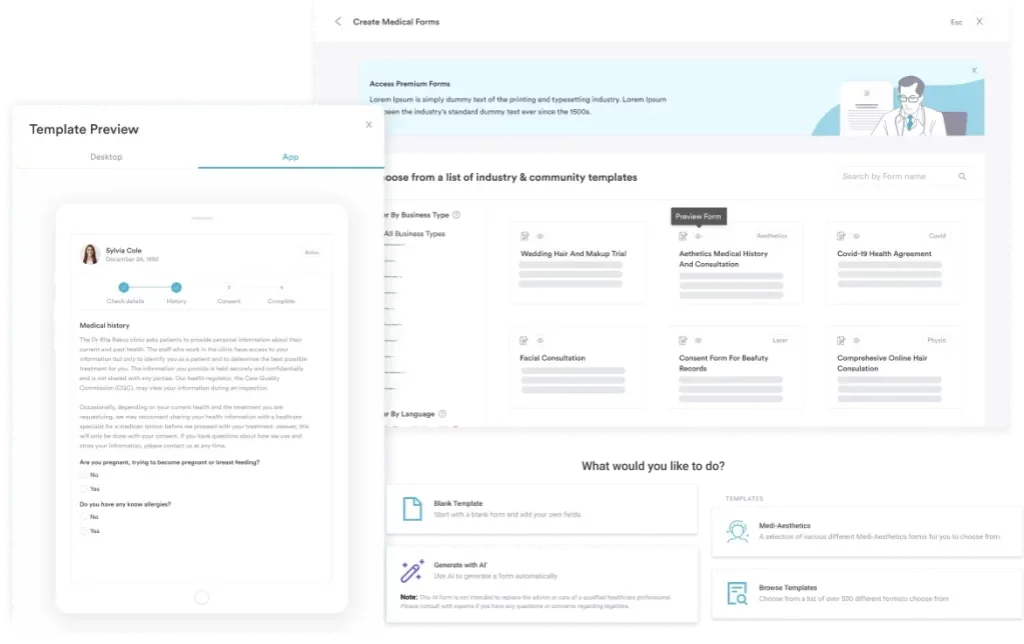
Required documentation for A4366 includes:
The diagnosis on the order carries the medical necessity argument, so choose it from the ICD-10-CM codes that name the ostomy status precisely. A status code such as Z93.3 tells the reviewer why a vent was dispensed at all.
Records supporting an A4366 claim have to be kept for at least seven years under CMS DME supplier standards. Keeping the order, the operative note, and the delivery ticket on one patient file cuts retrieval time when an auditor asks.
A4366 is submitted by a DMEPOS-enrolled supplier, not by the ordering physician’s office. The physician documents medical necessity and issues the prescription, and the supplier files the claim with the DME MAC. In practice the order is usually written at the first follow-up visit after discharge.
Three checks decide whether an A4366 claim clears. The panel below sets them out in submission order.
Medicare reimbursement for A4366 is set annually through the CMS DMEPOS fee schedule. The allowed amount varies by geographic payment locality, and by whether the item is furnished as a new purchase (NU) or a rental (RR). Rates change every calendar year, so verify the current allowed amount before you estimate patient liability.
Medicare pays 80% of the lesser of the actual charge or the fee schedule amount, once the annual Part B deductible is met. The beneficiary or their supplemental insurer covers the remaining 20% coinsurance. Suppliers that accept assignment agree to take the Medicare-allowed amount as payment in full.
Coverage guidance for A4366 is usually written around Medicare alone, and suppliers bill the code across several payer types in practice. Rules differ materially between Medicare, Medicaid, and commercial plans. Read the plan document before you assume Medicare’s criteria carry over.
Commercial payer tip: Some commercial plans set quantity limits stricter than Medicare’s LCD. Check each plan’s DME benefit schedule before you dispense several accessory codes in one delivery, or part of the claim comes back denied.
Pull the plan’s current ostomy supply policy before dispensing under a commercial contract. Aetna Clinical Policy Bulletin 0906 and similar payer documents list covered codes explicitly. A code listed in a prior policy version may sit in non-covered status in the current revision.
A single A4366 file usually comes together from four systems at once. The order arrives by fax and the operative note sits in the clinical system. The delivery ticket is scanned into a shared drive. The ABN sits in a folder somewhere else. The first signal that a piece is missing is usually a denial or an audit letter.
Practice management software like Pabau keeps all of it on one patient record. Orders and consent are captured as digital forms, and delivery confirmations attach to the same file. Then claims management software tracks what has been submitted and what is still open. Your team can see whether the KX modifier is justified before the claim leaves.
The outcome is fewer clawbacks, and less time spent reconstructing files after the fact. When an auditor asks for the order behind a vent you billed 14 months ago, you can pull it in seconds instead of a morning.

Pabau brings patient records, digital order and consent forms, and claim tracking into one system. Your billing team can see what a claim is missing before it goes out, so fewer ostomy supply claims come back denied.

A4366 is a low-value supply code that carries a disproportionate compliance burden. Two decisions do most of the damage. One is coding a belt as a vent. The other is applying the KX modifier before the file supports it. Both are cheap to check and expensive to fix later.
So the useful habit is a standing pre-submission check. Confirm the item dispensed matches the descriptor. Confirm the order and proof of delivery are on file. Then confirm the criteria in your DME MAC’s current LCD L33828. That takes a minute per claim and removes almost every reason A4366 gets denied.
Book a demo to see how Pabau keeps ostomy supply documentation and claim tracking in one place for your billing team.

Billing other DME accessory codes? HCPCS code E0159 walks through the documentation pattern behind a walker attachment claim.
Billing a service by the month instead of the unit? HCPCS code H0044 shows how per-month HCPCS billing and its support records differ.
Working across surgical and supply coding? CPT code 15274 covers graft billing where the supply and the procedure are billed together.
Billing the rest of the pouching system? HCPCS code A4361 covers the ostomy faceplate that is billed alongside A4366.
HCPCS code A4366 is used to bill for an ostomy vent, any type, each. It sits in the A4361-A4438 ostomy supply range. DMEPOS-enrolled suppliers bill it to Medicare Part B, Medicaid, or commercial plans for a vent used with a pouching system.
Yes. A4366 is covered under Medicare Part B as a DMEPOS item per CMS policy article A52487, subject to the medical necessity criteria in LCD L33828. Coverage applies to beneficiaries with a colostomy, ileostomy, or urostomy who actively use a pouching system.
You need a valid physician order specifying the ostomy vent and an ICD-10-CM diagnosis such as Z93.3. You also need medical records confirming the ostomy procedure, plus signed proof of delivery. An Advance Beneficiary Notice is required when you expect Medicare to deny the claim.
A4366 covers an ostomy vent, which lets gas escape from the pouch. A4367 covers an ostomy belt, which supports the pouching system externally. The two products do different jobs. Billing the wrong code for the item dispensed can trigger a denial or an audit.
LCD L33828 requires that the beneficiary has had a colostomy, ileostomy, or urostomy procedure and is actively using an ostomy pouching system. The KX modifier on the claim affirms that these criteria are documented in the beneficiary’s file at the time of billing.
LCD L33828 applies in the jurisdictions where it is active. Because LCDs are jurisdiction-specific, confirm the current active LCD with your assigned DME MAC before billing. LCD numbers and criteria can change between coverage review cycles.