CCSD code H4430: Examination of rectum under anaesthetic
CCSD code H4430 pays for the examination alone CCSD code H4430 is the UK private...

Last Updated: Oct 20, 2026
A4300 is the HCPCS Level II code for implantable access catheter, (e.g., venous, arterial, epidural subarachnoid, or peritoneal, etc.) external access.
Let Pabau's smart automation suggest the right codes, reduce claim denials, and keep your practice compliant—effortlessly.
Automate repetitive tasks and focus on what matters most—your patients.
Reduce coding errors and ensure compliance with the latest regulations.
Clean claims, fewer denials, and faster reimbursements.
Powerful insights and reporting to help your practice thrive.
HIPAA compliant SOC 2 certified GDPR-compliant Trusted by 4,000+ clinics worldwide

HCPCS code A4300 is a permanent Level II supply code for implantable access catheters used in venous, arterial, epidural, subarachnoid, and peritoneal access.
A4300 covers the catheter supply only. The implantation procedure needs a separate companion CPT code, such as 36560 or 36561.
Modifiers KX, GA, GZ, and GY are the ones that apply to A4300, and a missing KX is a leading cause of denials.
A4305 and A4306 are disposable elastomeric infusion systems separated only by flow rate, so neither one substitutes for A4300.
Practice management software like Pabau keeps the physician order, catheter details, and authorization number on the patient record before billing.
HCPCS code A4300 describes an implantable access catheter with external access capability. It is a permanent HCPCS Level II code maintained by the Centers for Medicare and Medicaid Services (CMS) under the Medical and Surgical Supplies category. The short description used by CMS is “Cath impl vasc access portal.” The full long description reads: Implantable access catheter, e.g., venous, arterial, epidural, subarachnoid, or peritoneal, etc., external access.
The code applies to the catheter supply itself, not the surgical act of implanting it. Every billing decision below therefore follows from that one distinction.
A4300 applies whenever an implantable catheter with an external access port is supplied to a patient. The code is broad by design, since the long description names five access types. Its “etc.” language also leaves room for other implantable access applications.
In general, practices billing A4300 include oncology infusion centers, home infusion providers, pain management practices, and nephrology practices. At an infusion practice, the catheter type in use determines both the ICD-10 code and, in many cases, the prior authorization path.
Keeping the catheter type and the diagnosis on one record lets a coder see both at once. That matters because the diagnosis decides whether the claim adjudicates under a Local Coverage Determination (LCD) or a National Coverage Determination (NCD).
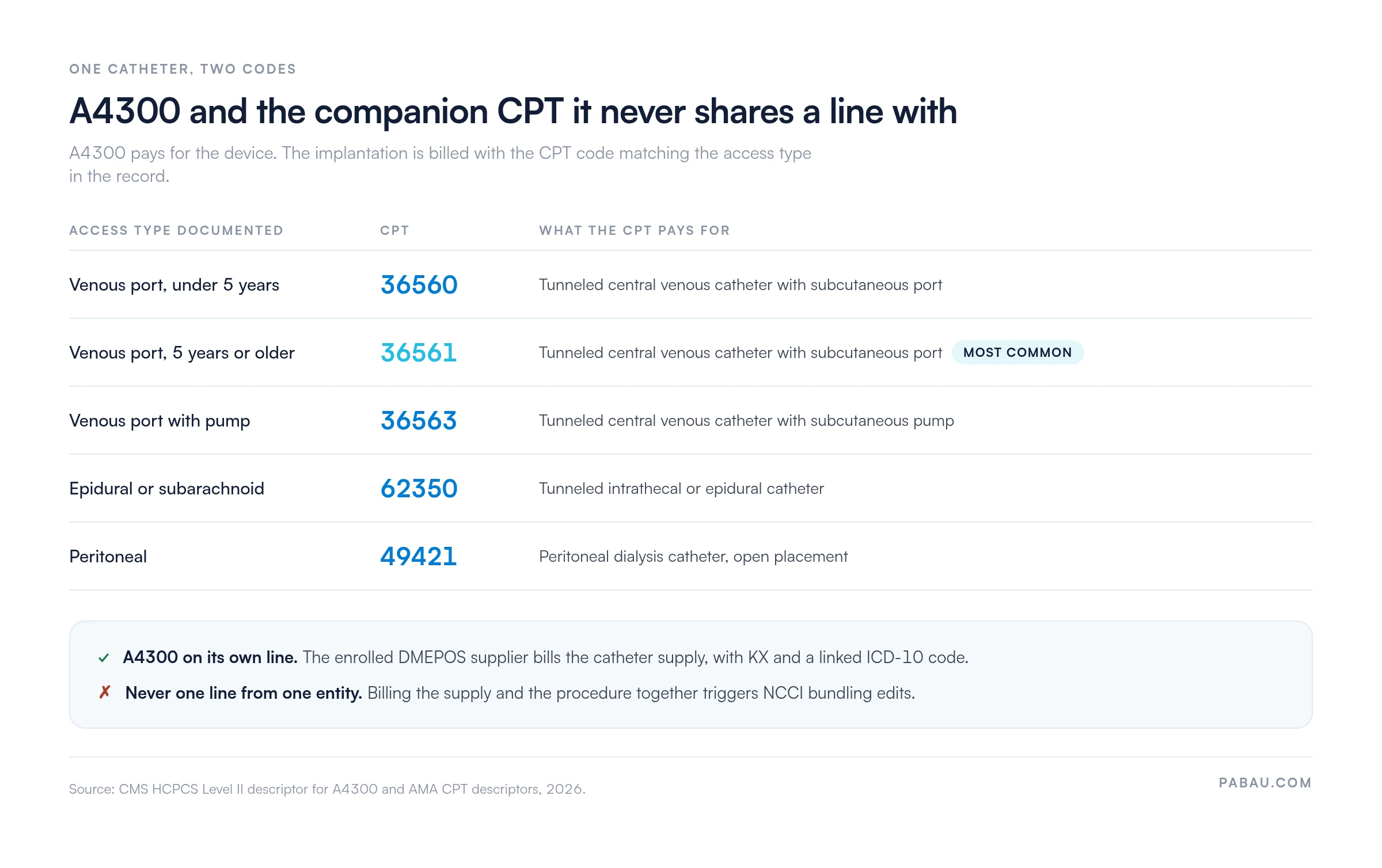
A4300 bills the supply, not the service. That one rule drives most of the downstream billing decisions. Because of that rule, the implantation procedure needs a separate CPT code from the performing physician or facility. A4300, by comparison, is billed by the supplier or practice that provides the device. The chart below maps each access type to the CPT code that covers its implantation.
Practices with DMEPOS supplier enrollment can bill A4300 directly. Those without a supplier number generally cannot submit A4300 to Medicare, so confirm your status with your Medicare Administrative Contractor (MAC) first. Suppliers usually bill other DMEPOS items alongside it, and the other HCPCS codes on that claim carry their own modifier rules.
Documentation requirements: Claims need a physician’s order and a certificate of medical necessity where the payer requires one. They also need documentation linking the specific catheter type to the patient’s diagnosis. In fact, inadequate documentation is the second most common reason A4300 claims are denied, after missing modifiers.
Capture the physician order, the clinical indication, and the catheter specification at the point of care. As a result, the biller has nothing to reconstruct at billing time, and the record already holds what a reviewer will ask for.
A4300 modifiers signal coverage and financial liability, not equipment status. That is why the purchase and rental modifiers used for reusable equipment do not belong on a single-use implantable supply. Attaching the wrong modifier, or omitting one entirely, is a common trigger for medical review or denial. Verify current applicability with your MAC’s LCD before submitting, as requirements vary by jurisdiction.
Every A4300 claim requires a linked ICD-10 diagnosis code that justifies the medical necessity of the implantable catheter. The appropriate code, though, depends on why the catheter was implanted, not simply on the catheter type.
Always verify specific ICD-10 linkage requirements against the applicable LCD from your MAC. The CMS HCPCS overview and the NLM HCPCS Level II API are authoritative references for code structure and coverage policy, respectively.
Before submitting A4300, verify whether your MAC has a specific LCD for implantable catheters or vascular access devices. Some MACs require KX modifier documentation to be retained for seven years. Review the LCD’s ICD-10 coverage list to confirm your diagnosis code is on the approved list before submission, not after a denial.
A4300 is reimbursed under the CMS DMEPOS fee schedule, which is updated annually. Geographic payment localities affect the specific reimbursement amount, so a practice in California will receive a different rate than one in rural Mississippi. Always pull current rates directly from the CMS DMEPOS fee schedule rather than relying on third-party aggregators, which may lag behind quarterly updates.
In contrast, commercial payer rates for A4300 are negotiated separately. Many commercial plans follow Medicare allowables; some exceed them, particularly for oncology-related vascular access. Always verify contracted rates before relying on Medicare fee schedule figures for commercial claim pricing.
A4300 sits within a cluster of catheter and drug-delivery supply codes, and picking the wrong one is a frequent audit finding. A4305 and A4306 are the two most often confused with it, because all three describe ways of getting a drug into a patient. The table below separates them.
A4300 vs A4305: A4300 describes an implantable access catheter. A4305 and A4306 both describe disposable elastomeric infusion systems, and the only thing that separates them is flow rate. A4305 covers a flow rate of 50 ml or greater per hour, and A4306 covers anything slower. Neither is a reusable device code, and neither is a catch-all for devices with no specific code.
So the choice is made by the device documented in the record, not by the therapy. Either way, an implantable catheter of any named type is A4300. A single-use elastomeric pump delivering the drug is A4305 or A4306, depending on the rate.
For that reason, practices with complex infusion programs keep a code-to-device reference at the billing desk. Staff then select the supply code from the device documented in the clinical record, not from memory.
A4300 covers the supply. The procedure that implants the catheter, meanwhile, is billed with a CPT code by the physician or facility. Coders who handle both the supply and the procedure need to know which CPT codes accompany A4300. That knowledge prevents the costliest error here, which is bundling or double-billing the device and the procedure.
CPT codes for catheter implantation are selected by the clinician based on the specific access type, patient age, and approach. The table below shows the most commonly used companion CPT codes. Adult venous port placement pairs with 36561 most often, and that code carries its own documentation rules. CPT selection is a clinical determination, so coders should not assign CPT codes independently of physician documentation.
One compliance point governs the rest. A4300 and its companion CPT code should never share a claim line from the same billing entity. The one exception is an entity that is both the DMEPOS supplier and the proceduralist. In most settings, the hospital or ASC bills the CPT, and a separate DMEPOS supplier bills A4300. Mixing them on a single claim triggers bundling edits under the National Correct Coding Initiative (NCCI).
Run an NCCI edit check on every claim that includes a catheter-related CPT code and an A4300 supply code. NCCI edits apply to many catheter codes. A claim that adjudicates cleanly one quarter may fail the next, once CMS updates the NCCI edit table. The AAPC’s code lookup and CMS’s NCCI edit files are the most reliable sources for current edit pairs.
Prior authorization requirements for A4300 are payer-specific and MAC-jurisdiction-specific. Medicare, for instance, does not universally require prior authorization for DMEPOS supply codes. However, individual MACs may impose it through an LCD for specific catheter types, and commercial payers almost always set their own rules.
Put prior authorization on a documented workflow. Obtain the auth, record the number, attach it to the claim, and then retain the supporting documentation for audit. Keeping authorization records with the clinical documentation is what an auditor asks for first.
For peritoneal dialysis catheters specifically, the AAPC’s HCPCS code lookup and the relevant MAC’s LCD for peritoneal dialysis are the starting points for coverage criteria. In addition, ESRD LCDs often specify frequency limitations for catheter supply billing that differ from other access types. The CGS Medicare coding verification guidance is particularly useful for Jurisdiction C providers billing peritoneal and vascular access supplies.
A4300 problems usually surface on the remittance advice. The coder submits, and the payer rejects the line for a missing KX modifier or an unlinked diagnosis. Someone then hunts for an order and a device serial number recorded in three different places.
Practice management software like Pabau moves that work forward, to the day of the encounter. Digital intake and medical forms capture the physician order, the catheter specification, and the clinical indication as the patient is seen. All of it files against the patient record. When a biller opens the A4300 line weeks later, the medical necessity narrative and the authorization number are already sitting there.
Code and modifier selection stays with your coder, where it belongs. Pabau’s claims management validates the fields an insurer requires, such as membership and authorization numbers. It then submits and tracks the claim through the supported clearinghouse. Confirm your DMEPOS payer is supported before you route A4300 claims that way.
For an infusion center billing A4300 several times a week, that removes the reconstruction work. Invoices and insurer responses stay linked to the patient record, so a denial gets answered from the chart instead of from memory.

Pabau keeps the physician order, catheter specification, and authorization number on one patient record. Your DMEPOS documentation is in place before the claim goes out.

A4300 rewards a practice that decides its billing rules once and then enforces them. In short, three checks carry almost all of the risk. Confirm the modifier, and confirm the diagnosis sits on your MAC’s LCD list. Then confirm the supply and the companion CPT are not billed by one entity on a single line.
Run those checks before submission and the appeal queue mostly disappears, which is worth more than any single reimbursement rate. Book a demo to see how Pabau keeps DMEPOS orders, authorizations, and invoices together on the patient record.

Placing an epidural or intrathecal catheter? CPT code 62350 covers the implantation billed alongside the A4300 supply line.
Working an A4300 denial? Denial codes in medical billing explains what each code the payer returns is asking you to fix.
Want a quick reference at the desk? Medical coding cheat sheet puts the code sets your billers use most on a single printable page.
Billing other durable medical equipment? E0155 explains the documentation and modifier rules for another common DMEPOS supply code.
HCPCS Code A4300 is a permanent HCPCS Level II supply code for implantable access catheters used for venous, arterial, epidural, subarachnoid, or peritoneal external access. It covers the catheter device supply, not the surgical implantation procedure, so the implantation needs a separate CPT code.
Bill A4300 separately from the companion implantation CPT code. Then attach KX to confirm the patient meets LCD coverage criteria. Add GA, GZ or GY where liability or a statutory exclusion applies. Also link an appropriate ICD-10 diagnosis code. Your practice also needs a DMEPOS supplier enrollment number to bill Medicare.
The modifiers that apply to A4300 are KX for LCD coverage criteria, plus GA, GZ and GY for liability and exclusions. Purchase and rental modifiers such as NU, RR and UE apply to reusable equipment, not to a single-use implantable supply. KX is the one most frequently omitted, and its absence is a leading cause of medical review referrals.
Commonly paired ICD-10 codes include C80.1 for chemotherapy catheters, N18.6 for peritoneal dialysis catheters, and G89.29 for epidural catheters. Z45.2 covers vascular access device management, and G35 covers intrathecal baclofen catheters. Always verify against your MAC’s current LCD coverage list.
A4300 is an implantable access catheter with external access capability. A4305, in contrast, is a disposable elastomeric infusion system with a flow rate of 50 ml or greater per hour. Use A4300 when the record documents an implantable venous, arterial, epidural, subarachnoid, or peritoneal catheter. Use A4305 only for a single-use infusion system at that flow rate.
Traditional Medicare Part B does not universally require prior authorization for A4300, but KX modifier documentation must confirm the patient meets LCD coverage criteria. Medicare Advantage plans and commercial payers, however, frequently do require prior authorization. Check with the specific plan before the supply is provided, as retro-authorization is rarely approved for DMEPOS supply codes.