CCSD code H4430: Examination of rectum under anaesthetic
CCSD code H4430 pays for the examination alone CCSD code H4430 is the UK private...

Last Updated: Oct 20, 2026
A4286 is the HCPCS Level II code for locking ring for breast pump, replacement.
Payment turns on the detail around the code. The modifier, the written order, and the beneficiary's DME MAC jurisdiction decide whether the claim is paid or reworked.
Let Pabau's smart automation suggest the right codes, reduce claim denials, and keep your practice compliant—effortlessly.
Automate repetitive tasks and focus on what matters most—your patients.
Reduce coding errors and ensure compliance with the latest regulations.
Clean claims, fewer denials, and faster reimbursements.
Powerful insights and reporting to help your practice thrive.
HIPAA compliant SOC 2 certified GDPR-compliant Trusted by 4,000+ clinics worldwide

HCPCS code A4286 describes a locking ring for breast pump, replacement, classified as a HCPCS Level II DME supply.
Medicare Part B may cover A4286 when medically necessary and properly documented, and coverage criteria vary by DME MAC jurisdiction.
Modifiers such as KX, NU, and RR must be applied correctly to avoid denials on replacement accessory codes.
A4286 covers the locking ring alone, so billing a broader accessory code for it invites a mismatch denial.
Keeping the prescribing order, the delivery proof, and the claim on one patient record is what makes an audit response quick.
A4286 is billable and names a single part. It is dispensed and billed separately from the pump itself, and from every other accessory in its series.
The code is HCPCS Level II alphanumeric, so it is maintained by the Centers for Medicare and Medicaid Services (CMS) rather than the AMA. It sits in the Durable Medical Equipment (DME) supply category, inside the A4281-A4286 breast pump accessory series.
Billers who dispense DME supplies need to separate A4286 from the adjacent codes in the same series. Each code in the range names a single part, so reaching for a neighboring accessory code triggers a mismatch denial.
A4282 is the adapter in that range, and it carries milk flow while the A4286 ring only fastens the bottle.
Medicare Part B may cover A4286 when the beneficiary has a qualifying medical need and an enrolled DME supplier submits the claim. Coverage is never automatic for a replacement accessory, and documentation requirements apply.
Four points decide whether Medicare pays. The allowable behind them comes from the CMS DMEPOS fee schedule, not the physician fee schedule:
The same evidence bar applies across the DME accessory ranges. The written order, the clinical rationale, and the delivery record carry the claim in every case.
The ACA’s preventive benefit mandate covers breast pumps for insured individuals, but the mandate applies to the pump itself. Coverage of replacement parts varies by payer and plan design. Verify it before dispensing a locking ring, and note the answer on the patient’s record.
Before submitting A4286 under Medicare, pull the applicable DME MAC LCD for your jurisdiction. Two contractors administer DME MAC work today. CGS covers Jurisdictions B and C, while Noridian covers Jurisdictions A and D. Their documentation requirements for replacement accessories can differ. Matching the right LCD to the beneficiary’s state prevents avoidable denials.
Reimbursement follows the Medicare DME fee schedule, which CMS updates annually. Rates vary by DME MAC jurisdiction and by whether the item is billed as a purchase or as part of a rental.
Cross-reference the published rate against the current CMS DMEPOS fee schedule file before you submit. Low-cost accessories move with the annual revision, so a 2025 figure may not match the 2026 allowable.
Medicaid coverage for locking ring replacements is not uniform. Most states cover breast pumps under their DME benefit, but replacement accessories are billed separately and often carry a prior authorization requirement.
Pull the state fee schedule and check for that requirement before issuing A4286. This matters most in maternity services, where one patient may need several accessories inside a single cycle.
Sound documentation means capturing the prescribing clinician’s order, the date the pump was first dispensed, and the reason for the replacement part. Those records support the claim and reduce audit risk.
Modifier selection is where many A4286 claims go wrong. Replacement accessory codes need a modifier stating the payment status of the item. That means a new purchase, a rental, or an expected denial.
Two questions settle the choice, and the chart below runs through both.
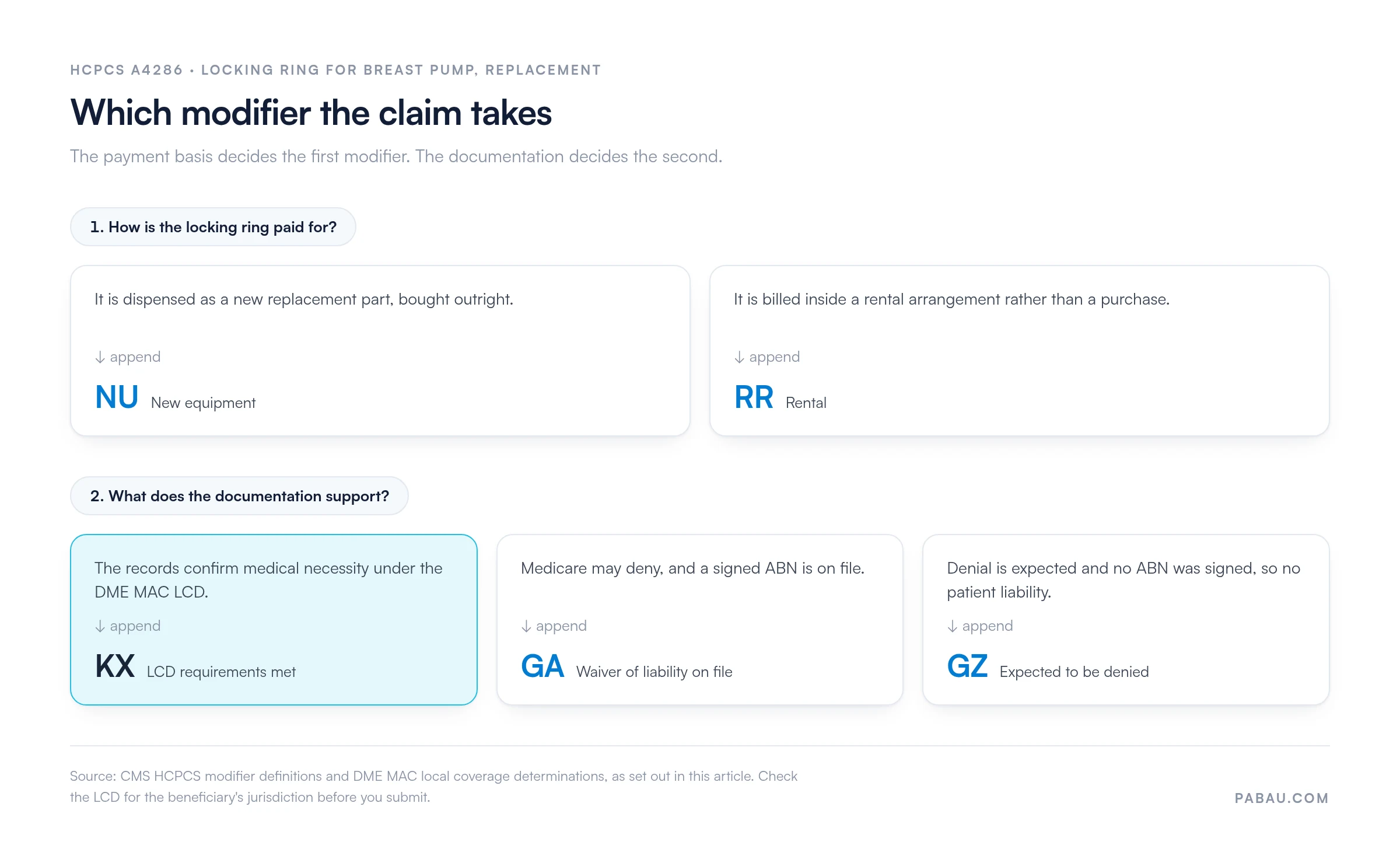
Confirming modifier requirements against the LCD before submission saves hours of rework later. When a claim comes back anyway, the remittance advice names the reason. Reading the medical billing denial codes tells you whether the modifier or the documentation failed.
Run a quarterly audit of your A428x claims using your denial tracking reports. Filter by denial reason code CO-4, which flags a modifier mismatch, and CO-97, which flags a service already included in another payment. Both are common on breast pump accessory codes, and both come down to modifier selection.
DME billing for breast pump accessories takes more pre-claim preparation than most outpatient codes. The steps below reflect standard CMS requirements for replacement part claims.
Keeping the written order, the delivery proof, and the submitted claim on one patient record is what makes an audit response quick. Chasing the same claim across three systems is where the hours go.
A4286 belongs to the A4281-A4286 series, which covers individual breast pump accessory replacements. The table below maps each code to the part it pays for.
Maternity and OB/GYN services can meet the whole A4281-A4286 range inside one patient episode. Saving a code and modifier pairing for each part cuts entry time. A medical coding cheat sheet keeps the descriptors to hand at the desk.
A4286 usually touches three places at once. The order sits in the chart, the delivery note sits in a folder, and the claim is keyed into a separate billing tool. Each hand-off is a chance to mislay a document.
Practice management software like Pabau holds that material on one patient file. The prescribing order, the treatment notes, and the delivery paperwork sit together, so a biller can assemble the supporting record from one screen.
For insurer billing, Pabau’s claims tools for billers send claims straight from that record and track what each one is doing. Pre-send validation checks the details the record already holds, so a missing membership or authorization number is caught early.
The DME claim itself still goes out on your CMS-1500 or 837P route. What changes is the time it takes to answer a DME MAC request. The order and the delivery proof are already attached to the patient.

Pabau stores the prescribing order, treatment notes, and delivery paperwork on the patient record, and sends insurer claims with pre-send checks. See how it fits your billing workflow.

A4286 rewards precision over speed. The code itself is easy to find. The money is won or lost on the modifier, the written order, and the LCD for your beneficiary’s jurisdiction.
If your practice dispenses these accessories regularly, build the check once and reuse it. A saved code and modifier pairing, plus a document requirement attached to the claim, turns a recurring denial risk into routine work.
The trade-off worth remembering is that a low-value accessory code still costs full price to rework. Book a demo to see how Pabau keeps the order, the delivery proof, and the patient record in one place.

Want a quick reference at the desk? Medical coding cheat sheet collects the code sets and modifiers billers reach for most often.
Billing another DME replacement part? E0111 follows the same component-level rules for a single accessory.
Collecting assignment of benefits up front? Benefit assignment form gives you a form the patient signs before the claim goes out.
Coding a behavioral health service too? H0044 shows how a service code is documented and submitted.
HCPCS code A4286 is a Level II alphanumeric code that describes a locking ring for breast pump, replacement. It is classified as a Durable Medical Equipment (DME) supply and is maintained by CMS. Billers use it to claim reimbursement for the locking ring component specifically, separate from other breast pump accessories in the A4281-A4286 series.
The A4281-A4286 series covers individual breast pump replacement accessories. The codes run in order: tubing, adapter, cap, breast shield and splash protector, polycarbonate bottle, and locking ring. Each code covers a distinct component, so billing the bottle code A4285 when only a locking ring was dispensed can trigger a mismatch denial.
Medicaid coverage for A4286 varies by state. Most states cover breast pump accessories as part of their DME benefit, but replacement parts often require a prescribing order and may need prior authorization. Check the specific state Medicaid fee schedule and coverage policy before billing.
Bill A4286 on CMS-1500 or EDI 837P with a written prescribing order and proof of delivery. Append KX for Medicare when LCD requirements are met, or NU for a new purchase. Retain documentation for up to seven years to support potential DME MAC audits. Check the current rate in the CMS DME fee schedule before submission.