CPT code 95808: Attended polysomnography billing guide
CPT code 95808 covers attended PSG with 1 to 3 extra channels CPT code 95808 is ...

Last Updated: Nov 11, 2026
97152 is the CPT code for behavior identification-supporting assessment by one technician, face-to-face with the patient, each 15 minutes. The technician works under the direction of a physician or other qualified health care professional, usually a BCBA.
In ABA therapy, a registered behavior technician (RBT) collects the observation and probe data the BCBA uses to adjust the treatment plan. Only face-to-face time counts toward 97152 units.
Let Pabau's smart automation suggest the right codes, reduce claim denials, and keep your practice compliant—effortlessly.
Automate repetitive tasks and focus on what matters most—your patients.
Reduce coding errors and ensure compliance with the latest regulations.
Clean claims, fewer denials, and faster reimbursements.
Powerful insights and reporting to help your practice thrive.
HIPAA compliant SOC 2 certified GDPR-compliant Trusted by 4,000+ clinics worldwide

CPT code 97152 covers a technician-administered ABA supporting assessment, billed in 15-minute units of face-to-face time with the patient.
A registered behavior technician (RBT) performs it under the direction of a BCBA or other qualified health care professional. The BCBA’s own assessment work bills as 97151.
Most payers require prior authorization tied to an autism spectrum disorder diagnosis, such as ICD-10-CM F84.0, and a current treatment plan.
Daily unit caps and same-day rules with 97153 vary by payer, so record separate start and stop times for every code you bill.
Pabau, the practice management software we build, tracks each authorization’s code, dates and sessions on the case and submits US claims through Claim.MD.
CPT code 97152 bills the time a behavior technician spends assessing a patient face-to-face, in 15-minute units, under a BCBA’s direction. The official descriptor from the American Medical Association (AMA) reads:
Behavior identification-supporting assessment, administered by one technician under the direction of a physician or other qualified health care professional, face-to-face with the patient, each 15 minutes.
The code belongs to the adaptive behavior services family, 97151 to 97158. The AMA introduced that family when it restructured the ABA codes, effective January 1, 2019.
That’s the short version. The sections below follow a 97152 session from the room to the remittance, starting with the technician’s work in the room.
CPT code 97152 covers structured observation and data collection that help the BCBA decide whether to change the treatment protocol. It gathers clinical information rather than delivering therapy. The supervising BCBA uses that data to adjust or confirm the behavior intervention plan (BIP).
Three activities fall under 97152 during a session:
Treatment delivery is a different code. Once the technician moves from assessing to running a treatment program, that time bills under 97153 (adaptive behavior treatment by technician).
A Registered Behavior Technician (RBT) or qualified paraprofessional performs 97152, under the direction of a BCBA. The BCBA doesn’t need to be in the room. They do need to document their oversight and be available for consultation.
Supervision ratios vary by payer and state. The Behavior Analyst Certification Board (BACB) sets the baseline at a minimum of 5% of an RBT’s monthly service hours. Commercial insurers and state Medicaid programs often set stricter ratios, and auditors check them, so confirm the payer’s rule before you bill.
The difference between 97152 and 97151 is who administers the assessment. A behavior technician performs 97152, while the BCBA or other qualified health care professional performs 97151 directly.
Billing 97151 for an assessment an RBT delivered is upcoding. It can trigger audits and repayment demands, so confirm who ran the assessment before you assign the code.
CPT code 97152 covers assessment, and CPT code 97153 covers treatment. What the technician did in each block of the session decides the code. Two questions settle it every time, as the grid below shows.
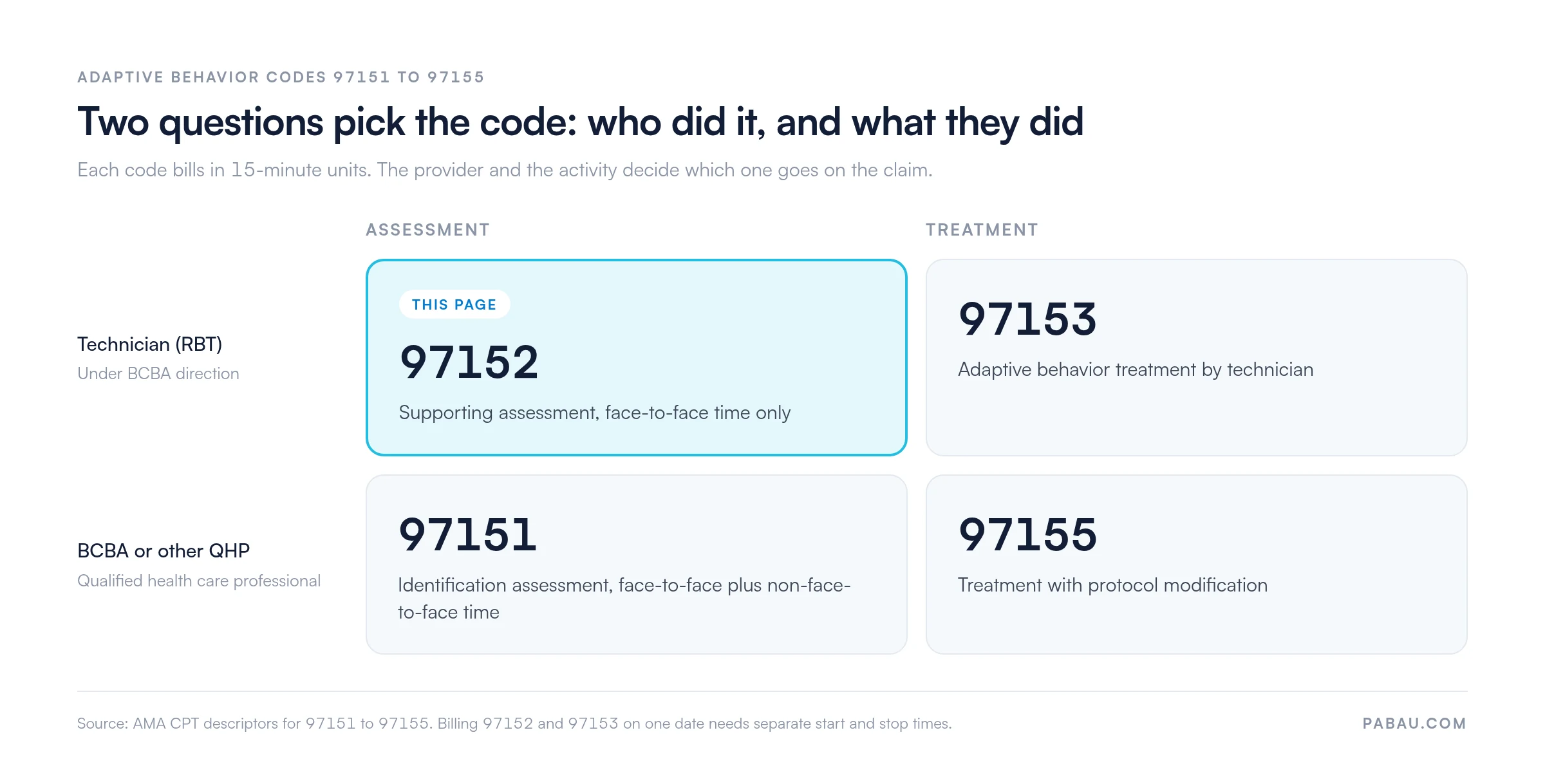
97153 describes direct skill instruction or behavior reduction procedures. When a technician runs discrete trial training or naturalistic teaching, that is 97153 time. When the same technician pauses to run a formal probe for the BCBA’s protocol review, that is 97152 time.
You can bill 97152 and 97153 on the same date of service if the activities happened separately. National Correct Coding Initiative (NCCI) edits apply to this pair, so each block needs its own start and stop times. Claims that carry both codes without that split are routinely denied or flagged for overpayment review.
CPT code 97152 bills in 15-minute increments of face-to-face technician time. The CMS 8-minute (CPT midpoint) rule applies, so 8 to 22 minutes bills as 1 unit. A 30-minute assessment therefore bills as 2 units, and a 45-minute session as 3.
Per-day unit caps vary by payer. Many commercial plans cap 97152 units per date of service, and several state Medicaid programs cap assessment codes separately from treatment codes. Going past the cap without a medical necessity override is a leading cause of denials. Check the payer’s coverage policy or the authorization letter for the approved ceiling.
What you’re paid for 97152 depends on the payer, the contract and the state, and it changes every year. For Medicare figures, use the current-year CMS Physician Fee Schedule lookup tool rather than numbers copied from third-party guides.
Medicaid must cover ABA therapy, including CPT code 97152, for children under 21 with autism. That obligation comes from the federal Early and Periodic Screening, Diagnostic and Treatment (EPSDT) mandate. No state can deny medically necessary ABA outright, but each state decides how coverage works.
These Medicaid variables change how 97152 gets billed:
Most commercial payers and many state Medicaid programs require prior authorization before they’ll process a 97152 claim. The approval usually sits under an ongoing ABA authorization rather than covering a single assessment session. A standard prior authorization process applies, with a few ABA-specific documents.
A typical 97152 authorization request includes:
Authorization timelines vary. Some payers re-authorize every 6 months, and others follow the annual treatment plan cycle. A missed renewal is one of the costliest ABA billing errors, because payers often deny every claim dated after the expiry.
Documentation decides whether a 97152 claim gets paid, denied or clawed back in an audit. Each session note must show that a qualified technician delivered a medically necessary assessment under BCBA direction. A clean claim starts with capturing these elements at the point of care, not chasing them afterward.
Required documentation elements for each 97152 session:
Post-payment auditors look hardest at start and stop times and BCBA supervision records. If either is missing or vague, the payer can recoup the claim even when the service was clinically sound. Building the billing compliance requirements into your note template prevents most of that exposure.
Each step below hands something to the next, and a slip early on shows up later as a denial.
Run through these six checks on every 97152 claim. Each one maps to a denial reason in the next section.
97152 denials follow a predictable pattern. Each one below has a workflow fix that stops it recurring, which beats appealing the same denial every month.
Sort your denials by code and reason over a rolling 90-day window. Structured denial management workflows show whether a 97152 denial is a one-off slip or a recurring documentation problem.
Run a 97152 denial audit quarterly. Pull every denied claim for the code, group them by claim adjustment reason code (CARC), and find the top cause. Authorization problems, documentation misses and unit-limit errors each need a different workflow fix. Lumped together, they send billing staff after the wrong appeals.
CPT code 97152 is one of eight adaptive behavior codes. Knowing the neighbors helps you code each session block by what happened in it.
AAPC’s adaptive behavior code range lists the family under the CPT Medicine section, which helps when you check for annual updates. For other codes your practice bills, our library of procedure codes covers each one in the same format.
Most 97152 billing errors start with paperwork spread across tools. Session times sit on paper, authorizations live in a spreadsheet, and claims go out from a separate billing system. By the time a claim is built, something is often missing.
Pabau brings those pieces onto one patient record. Its claims management software handles insurance billing, with US claims submitted to payers through Claim.MD. Session notes and the patient’s records stay tied to the same patient, so billers work from one place.
Here’s what that changes for 97152 billing:

Pabau tracks prior authorizations on the case and submits US claims through Claim.MD. Your team spends less time chasing 97152 paperwork before claims go out.

CPT code 97152 has a narrow definition, and most of its denials have nothing to do with clinical care. They come from lapsed authorizations, blended session times and missing BCBA sign-offs.
Fix those three before you touch your appeal process. Give every session block its own times, check the authorization balance before the session, and treat the BCBA sign-off as part of the note. Your denial rate will tell you within a quarter whether it worked.
Book a demo to see how Pabau keeps authorizations, session notes and US claims together for your ABA practice.

Need a broader view of the billing cycle? What is revenue cycle management explains how session documentation connects to claim submission and payment posting.
Seeing high denial rates across your code mix? Denial codes in medical billing breaks down common CARC and RARC codes and how to respond to each.
Want to know how electronic claims are built? 837 file format covers how electronic claims are structured and sent to payers.
Billing parent training alongside assessment? CPT code 97156 covers family adaptive behavior treatment guidance led by the BCBA.
Yes, in some cases. CPT guidance lets a BCBA or other QHP who personally performs the technician’s activities count that time toward 97152. Some payers restrict this, so check the policy before billing it.
It depends on the payer. Some Medicaid programs require a credential modifier, such as HM or HN, to show the technician’s education level. Others need none, so follow each payer’s billing guide.
Some payers allow it. Those that do usually want a telehealth place of service, such as 02 or 10, and sometimes modifier 95. Confirm the payer’s telehealth policy before the session.
0362T is the supporting assessment for patients with destructive behavior. It needs two or more technicians and a QHP on site. 97152 uses one technician, without that on-site requirement.
No. 97152 is a standalone, time-based code. You report it with its own units, whether or not other adaptive behavior codes appear on the same claim.