HCPCS Code S0115: Deleted bortezomib billing code
HCPCS Code S0115 is a deleted Level II S-code that described bortezomib, 3.5 mg,...

Last Updated: Oct 5, 2026
97156 is the CPT code for family adaptive behavior treatment guidance, delivered face-to-face to the patient's guardian(s) or caregiver(s) in 15-minute units. A physician or other qualified health care professional administers it, with or without the patient present.
In applied behavior analysis (ABA), a BCBA or BCaBA uses the session to train caregivers in the strategies from the patient's treatment plan. Most payers require prior authorization for it, and many require a credential modifier on the claim.
Let Pabau's smart automation suggest the right codes, reduce claim denials, and keep your practice compliant—effortlessly.
Automate repetitive tasks and focus on what matters most—your patients.
Reduce coding errors and ensure compliance with the latest regulations.
Clean claims, fewer denials, and faster reimbursements.
Powerful insights and reporting to help your practice thrive.
HIPAA compliant SOC 2 certified GDPR-compliant Trusted by 4,000+ clinics worldwide

CPT Code 97156 bills face-to-face guidance for a patient’s caregiver or family member within an ABA treatment plan, in 15-minute units.
A BCBA or BCaBA must deliver the session, and an RBT cannot bill it.
97156 is a standalone timed code rather than an add-on to 97153, so both can be billed on the same day with separate documentation.
Most payers require prior authorization, and billing past the authorized unit count triggers an automatic denial.
Pabau’s claims management software links ABA session notes to the claim, which helps practices track units and modifiers across payers.
CPT Code 97156 is the timed procedure code for family adaptive behavior treatment guidance, delivered face-to-face to a patient’s guardian(s) or caregiver(s). A physician or other qualified health care professional provides it, with or without the patient present.
It forms part of an applied behavior analysis (ABA) treatment plan. According to the American Medical Association’s CPT code set, it sits in the Adaptive Behavior Services family (97151-97158) and is billed in 15-minute units.
With 97156, the person being trained is the caregiver or family member. The session teaches the parent or guardian to use behavior intervention strategies at home, so the therapy carries on between clinical sessions.
ABA billing forums often describe CPT Code 97156 as an add-on to 97153. The AMA CPT code set classifies it as a standalone timed code instead. It can go on the same date of service as 97153, and each code stands on its own documentation.
CPT Code 97156 covers face-to-face family guidance sessions where a qualified behavior analyst trains a caregiver to implement ABA strategies. The session must be clinically directed by a BCBA or BCaBA and tied to the patient’s individualized treatment plan.
Covered services:
Not covered under 97156:
CPT Code 97156 requires a Board Certified Behavior Analyst (BCBA) or Board Certified Assistant Behavior Analyst (BCaBA) to deliver or directly supervise the service. Licensed psychologists may also qualify under some payer policies, particularly state Medicaid plans. Each payer decides which credentials it accepts, and assuming one rule covers every payer is a common cause of credential denials.
Track each provider’s credential status against every payer’s requirements, and recheck it on a schedule rather than once at setup.
The Behavior Analyst Certification Board (BACB) sets the credential standards for BCBAs and BCaBAs. Payer enrollment for these providers can take 90 to 120 days, so begin insurance credentialing well before you schedule billable family guidance sessions.
Run a quarterly credential audit against each payer’s current ABA policy. Some Medicaid managed care organizations update their qualified provider lists mid-year without direct notification. A BCBA whose credential was accepted in January can face denials by the third quarter if the payer changes its policy and nobody re-verified enrollment.
CPT Code 97153 covers direct adaptive behavior treatment that a technician delivers to the patient. CPT Code 97156 covers guidance that a qualified behavior analyst delivers to a caregiver or family member. The two codes have different recipients, purposes and billing rules. They still get confused because they often appear on the same claim.
Yes. Most payers allow same-day billing of CPT Code 97156 and CPT Code 97153. The caregiver guidance and the patient’s direct treatment must happen as separate services. The documentation has to keep the two services apart, with:
Some payers run bundling edits that deny 97156 automatically when it appears with 97153 and the notes don’t show the services were separate. Check each payer’s concurrent billing rules before relying on same-day claims, and record the separation in both session notes.
CPT Code 97156 is one of eight codes in the Adaptive Behavior Services family. Knowing where it sits in the treatment workflow stops you billing the wrong code for a service. The full set, listed in the AAPC Codify CPT lookup, covers assessment, direct treatment, group treatment, protocol modification and caregiver guidance.
Practices treating patients with autism spectrum disorder often bill several ABA codes in the same month. A typical mix is 97151 for assessment, 97153 for direct treatment and 97156 for family guidance. Clear boundaries between the codes prevent overbilling and bundling denials.
Modifier requirements for CPT Code 97156 vary by payer and state Medicaid plan. No single modifier set applies to every payer. Treating one payer’s rules as the default repeats the same error across all your claims. Always verify requirements in the payer’s current ABA billing policy or provider manual.
A missing or incorrect modifier is among the most common reasons CPT Code 97156 claims are denied. Build payer-specific modifier rules into your billing workflow before claims are submitted rather than relying on staff memory.
Medicare publishes no national fee schedule rate for CPT Code 97156. The code is contractor-priced, so each Medicare Administrative Contractor (MAC) sets its own payment, and the amount varies by region. The CMS Physician Fee Schedule lookup tool shows the code’s pricing status, and your MAC’s fee schedule gives the local rate.
Medicaid rates are set by each state plan. Commercial payer rates are negotiated through your contract and are generally higher than Medicaid. Record each payer’s contracted rate per unit before you submit claims, so you can spot short payments when the remittance arrives.
Calculating session-level reimbursement: A 60-minute caregiver guidance session equals four units of 97156, so the payment is four times your payer’s per-unit rate. Track payment-to-billed ratios by payer from your electronic remittance data. That catches underpayments faster than reading each explanation of benefits (EOB) by hand.
Most payers require prior authorization for ABA services, including Medicaid managed care organizations, commercial insurers and TRICARE. CPT Code 97156 falls under that requirement. Authorization usually covers a block of hours per treatment period across every ABA code in the patient’s plan.
Requirements differ by payer, so confirm them with each one before scheduling services. Insurance eligibility verification at the start of each authorization period flags lapsed or limited coverage before it turns into a denial.
A prior authorization request typically includes:
If your practice is building ABA billing workflows from scratch, start with these medical billing fundamentals.
The session note must contain all of the following to support a 97156 claim:
The prior authorization sets how many units of CPT Code 97156 you can bill per day, and no universal cap applies. Common caps range from four to eight units (60 to 120 minutes) per date of service, but the authorized plan always governs. Billing past the authorized count triggers an automatic denial, whatever the clinical justification.
To find a payer’s limit, check the authorization letter, read the payer’s ABA policy document or call provider relations. Build unit tracking into your billing system so no claim exceeds the authorized count.
Most 97156 denials follow a handful of patterns, and pre-submission checks prevent the majority of them. Denial management workflows work best upstream, before the claim goes out.
Each of those denials maps to one check you can run before the claim leaves your system, as the table below shows.
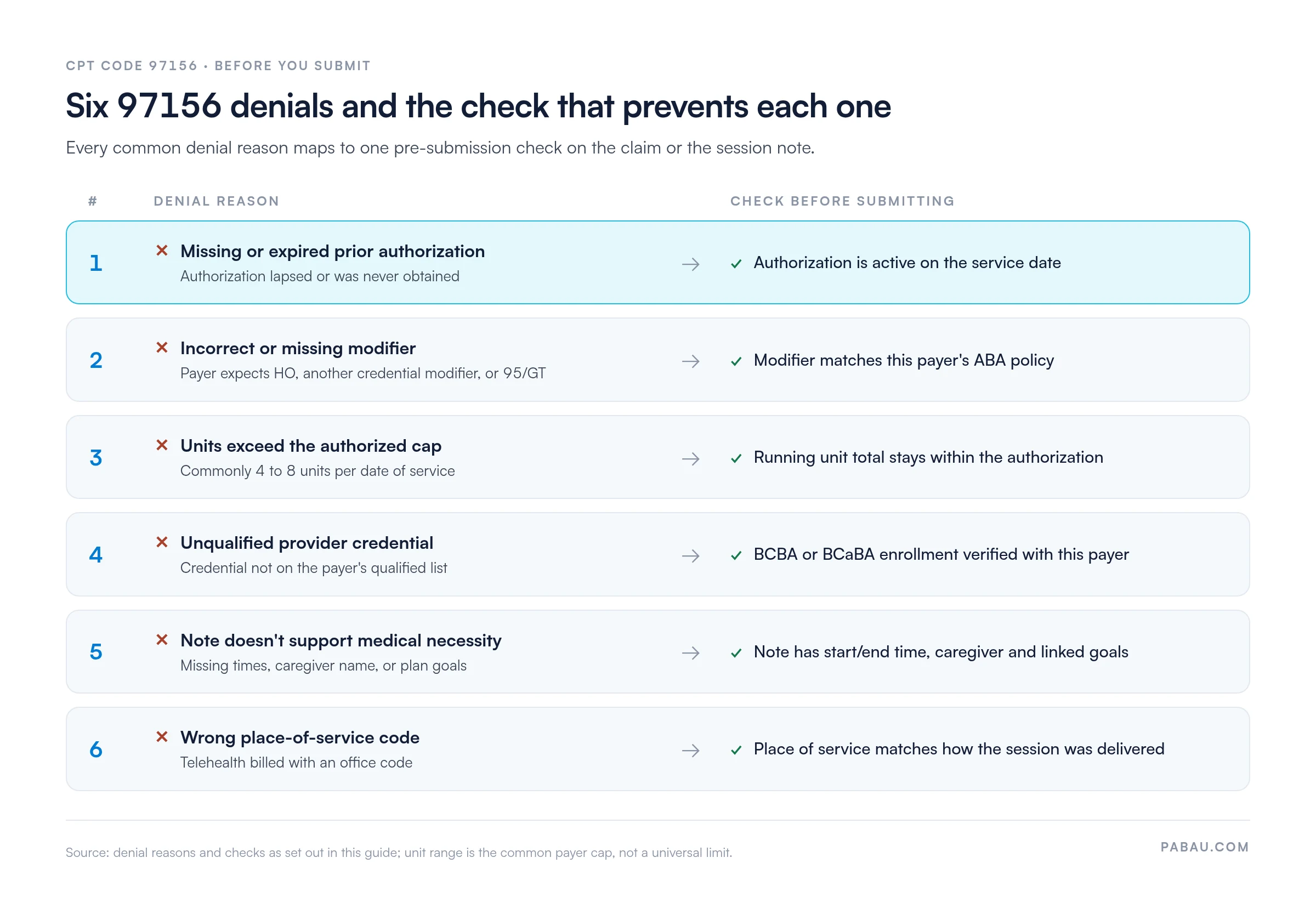
When a denial does come back, the reason code on the remittance tells you which check failed. This guide to medical billing denial codes explains the common ones and how to fix each.
Running claims through claims management software with built-in payer edits catches the most common errors before the claim reaches the clearinghouse.
Build a pre-billing checklist specific to 97156. Confirm the prior authorization is active and the units sit within the authorized cap. Check that the payer’s modifier is applied and the session note carries start and end times plus the caregiver’s name. Running this check before each batch submission catches most of the denial reasons above without waiting for an EOB.
Many ABA practices track 97156 authorizations, units and payer modifiers across spreadsheets, session notes and a clearinghouse portal. Each handoff between those tools is a chance for a unit count or a modifier to slip.
Pabau, the practice management platform we build, links each ABA session note to the claim it produces. The times, credential and caregiver details you bill match what the clinician documented, and claims go out electronically through our Claim.MD clearinghouse integration.
The result is fewer 97156 claims coming back for units or modifiers, and less of your billing team’s week spent reworking denials.

Pabau links session notes directly to claim generation and tracks unit counts and modifier requirements across payers. Your 97156 claims go out clean the first time.

CPT Code 97156 is simple to define. The denials come from the payer layer around it, where modifiers, unit caps and same-day rules change from plan to plan.
So treat each payer’s ABA policy as the source of truth, and build its rules into the claim before submission. Re-verify credentials and authorizations on a schedule, because a rule that held in January can fail by the third quarter.
To see how Pabau ties ABA session notes to clean 97156 claims, book a demo.

Need to submit ABA claims electronically? Submitting a clean claim covers the documentation elements every ABA claim needs to clear a payer’s front-end edits.
Want to understand how clearinghouse submission works? How Claim.MD clearinghouse works explains how electronic claim transmission and ERA processing reduce manual reconciliation for ABA practices.
Dealing with high denial rates across your ABA codes? Electronic remittance advice (ERA) explained shows how to use 835 remittance data to identify denial patterns by code and payer.
Billing the initial ABA assessment? CPT code 97151 covers the behavior identification assessment that comes before a treatment plan and its family guidance sessions.
Running group sessions with protocol changes? CPT code 97158 explains how to bill group adaptive behavior treatment led by a BCBA.
CPT Code 97156 bills face-to-face family adaptive behavior treatment guidance. In these sessions, a qualified behavior analyst trains a caregiver or family member to use ABA strategies at home. The session must be directed by a BCBA or BCaBA and tied to the patient’s individualized treatment plan.
CPT Code 97153 covers direct adaptive behavior treatment that a technician delivers to the patient. CPT Code 97156 covers guidance that a BCBA or BCaBA delivers to a caregiver or family member. The two codes carry different credential requirements, and both can appear on the same date when caregiver and patient are seen separately.
No universal daily cap applies to CPT Code 97156. Each payer sets the limit through the prior authorization, commonly four to eight units (60 to 120 minutes) per date of service. Billing past the authorized count triggers an automatic denial, so track running unit totals against the active authorization.
Most state Medicaid programs cover CPT Code 97156 for eligible patients, often under the EPSDT mandate for children with autism spectrum disorder. Coverage rules, unit limits, qualified provider credentials, and prior authorization requirements vary significantly by state Medicaid plan. Verify with your specific state Medicaid agency or managed care organization before billing.
Modifier requirements for CPT Code 97156 vary by payer. Common ones are HO (master’s degree level) for credential identification, and GT or 95 for telehealth delivery. No single modifier applies to every payer, so check each payer’s current ABA billing policy or provider manual.
A CPT Code 97156 session note must include the start and end time, the clinician’s name and credential, and the caregiver’s name and relationship. They also need the topics covered, a link to treatment plan goals and medical necessity language. Missing any of these is a leading cause of documentation denials.