CCSD Code F3400: Tonsillectomy guide for ENT practices
What is CCSD Code F3400? CCSD Code F3400 is the Clinical Coding and Schedule Dat...

Last Updated: Oct 22, 2026

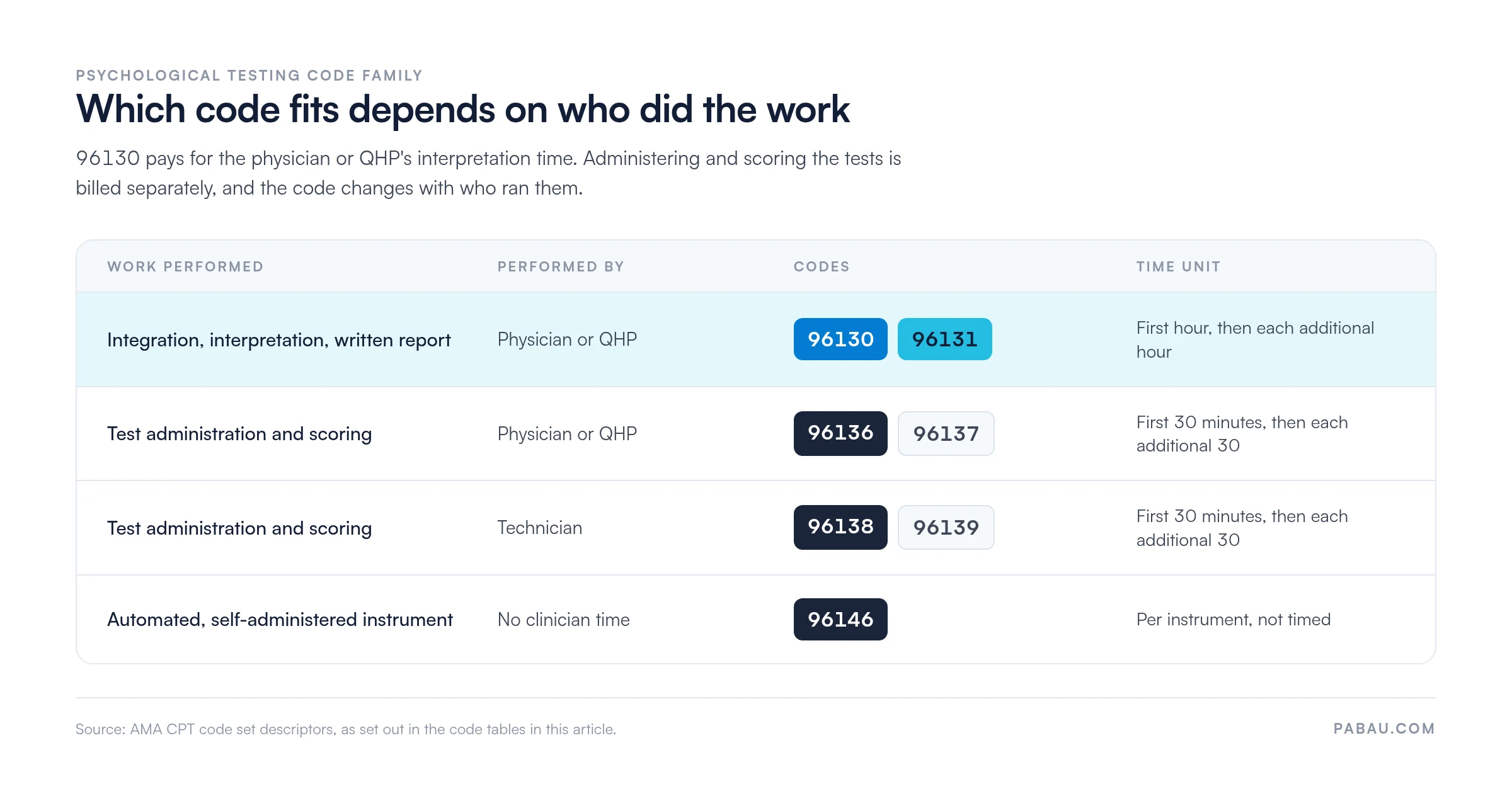
CPT code 96130 covers the first hour of psychological testing evaluation by a physician or qualified health professional, including test integration and a written report.
96130 is time-based: Bill 96131 as an add-on for each additional hour beyond the first. Never bill 96131 without 96130 as the primary code.
Technician-administered testing is billed under 96138 and 96139, not under 96130 or the QHP administration codes 96136 and 96137.
Missing documentation is the leading denial reason: The integrated written report, test names, time spent, and clinical observations must all be in the medical record.
Pabau’s claims management software can automate add-on code prompting and claim scrubbing for the 96130/96131 pair, reducing the most common billing errors.
CPT code 96130 describes psychological testing evaluation services performed by a physician or other qualified health professional. The code covers the first hour of professional time spent integrating patient data, reviewing clinical observations, interpreting test results, and producing a written report. It does not pay for administering the tests. It pays for the QHP’s evaluative and interpretive work once the testing is done.
The AMA CPT code set defines 96130 as a physician or QHP service. Administering and scoring the tests is a separate billable activity. When a technician performs that work, it is captured under 96138 and 96139. Those codes can be reported alongside 96130 where applicable, subject to current Correct Coding Initiative (CCI) edits.
CPT code 96130 is restricted to physicians or other qualified health professionals (QHPs) whose scope of practice includes psychological testing interpretation. Scope of practice rules vary by state licensure. Always confirm that the billing provider’s license permits independent psychological testing evaluation in your jurisdiction.
Technicians or testing administrators cannot bill 96130. Their work is captured separately under 96138 (first 30 minutes) and 96139 (each additional 30 minutes). The supervising QHP reviews and interprets those results, then bills 96130 for the evaluation service. Where the QHP administers and scores the tests personally, that time belongs to 96136 and 96137 instead.
Configure provider-level billing permissions so a technician is never assigned as the rendering provider on a 96130 claim. The grid below maps each part of a testing episode to the code that covers it, and to the person who has to perform it.
Payers require that 96130 be medically necessary. Claims submitted without a clear diagnostic indication attract scrutiny under Local Coverage Determinations (LCDs) issued by Medicare Administrative Contractors (MACs). These are the scenarios that most commonly support medical necessity for psychological testing evaluation:
Whichever indication applies, capture the supporting diagnosis in the medical record before you submit the 96130 claim. Payers cross-check the diagnosis code against the medical necessity criteria in the applicable LCD. A testing battery with no stated clinical question rarely survives that check.
Submitting a clean 96130 claim requires accurate time documentation and a completed integrated report before the claim leaves the practice. Here is the standard workflow for a time-based evaluation code.
CPT code 96130 uses a one-hour minimum rule. Bill 96130 once when the QHP’s time reaches the first full hour. Add 96131 for each additional complete hour. AMA guidance does not support billing 96131 for partial additional hours, so confirm your payer’s rounding policy before you bill fractional time.
Documentation failures drive the majority of 96130 denials and post-payment audits. Every element below must appear in the patient’s medical record before the claim is submitted.
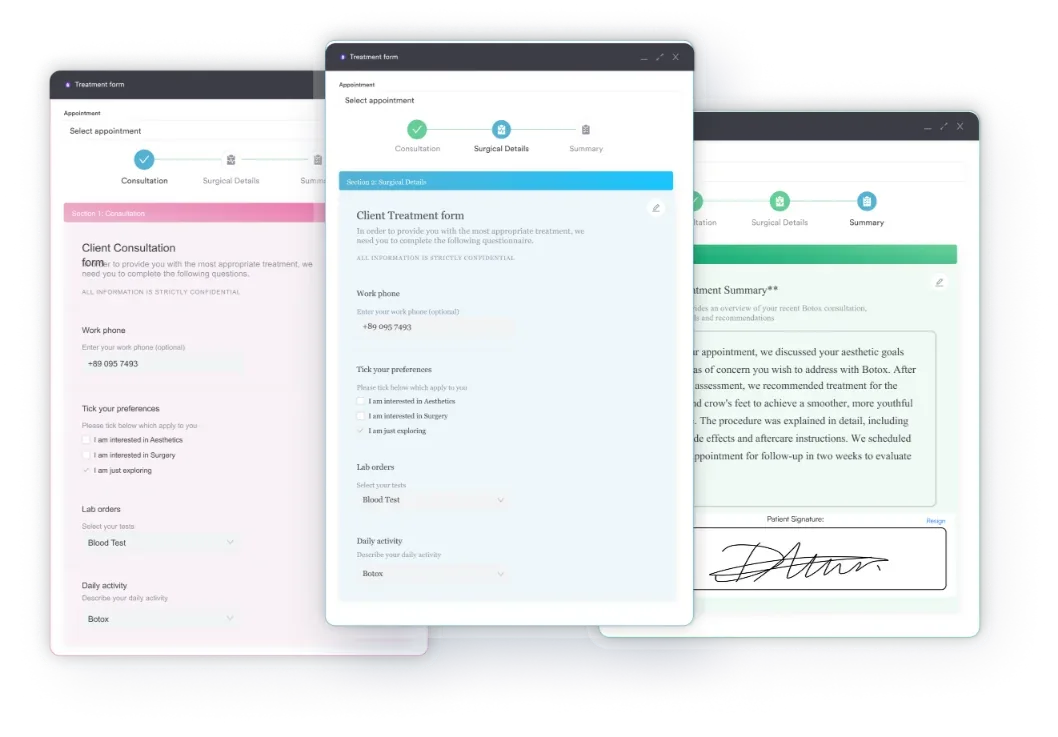
Structured digital forms for testing intake and report generation capture these elements consistently, so fewer records reach the payer with a field missing. Free-text notes in general EHRs often omit test names or time documentation, because nothing in the note prompts for them. That omission is what triggers an additional documentation request (ADR).
The most common unbundling error in psychological testing billing is submitting 96131 without 96130, or billing 96131 as a standalone service. CPT code 96131 is an add-on code and cannot be billed independently.
CPT code 96130 and CPT code 96132 are parallel evaluation codes covering different testing specialties. Billing the wrong code for the service type is a common coder error that results in medical necessity denials.
Billing 96130 when the service is a neuropsychological evaluation (and the reverse) creates a mismatch between the clinical documentation and the code billed. Payers can detect this during audit by reviewing the test names in the report against the code submitted.
CPT code 96130 sits within a broader psychological and neuropsychological testing code family. Knowing which codes can be co-billed prevents unbundling errors and protects legitimate reimbursement.
Medicare reimbursement for CPT code 96130 is set annually through the CMS Physician Fee Schedule. Rates vary by geographic location through the Geographic Practice Cost Index (GPCI). Always look up the current-year national average and your locality adjustment before quoting figures to staff or patients.
For 2026 rates and RVU values, use the FastRVU 2026 RVU lookup tool, which pulls directly from CMS Physician Fee Schedule data. Enter code 96130 to retrieve the Work RVU, Practice Expense RVU, Malpractice RVU, and the calculated Medicare payment for your locality.
Medicare Part B covers CPT code 96130 when the service meets medical necessity criteria defined in the applicable Local Coverage Determination (LCD). LCDs are issued by Medicare Administrative Contractors and vary by region. Check the CMS coding and coverage page to identify your MAC and locate the relevant LCD.
Knowing why 96130 claims deny is more useful than knowing the billing rules in isolation. Each denial below has a specific prevention action. Most of them resolve to a handful of medical billing denial codes that payers reuse across every specialty.
Denial prevention for 96130 starts with pre-submission claim scrubbing. A clearinghouse that checks CCI edits and payer rules before transmission catches the bundling and provider-type errors behind most avoidable denials. The same discipline runs from the first encounter through payment, which is what a clean claim really takes.
Prior authorization (PA) requirements for CPT code 96130 vary widely by payer and plan type. Medicare fee-for-service does not typically require PA for psychological testing, but Medicare Advantage plans set their own rules and frequently do. Commercial insurers and Medicaid managed care organizations are the highest-risk category for surprise PA denials.
A PA request for 96130 should carry four things:
Vague PA requests citing “psychological testing” without naming the clinical question are frequently denied or returned for more information. That delays both the care and the payment.
The 96130/96131 pair creates a billing risk that general systems handle poorly. The add-on depends on accurate time tracking, and most EHRs never prompt for 96131 when QHP time passes one hour. The result is under-billing, or extra units submitted with no documented time to support them.
Practice management software like Pabau closes that loop. Pabau builds toward cleaner claims management by checking every 96130 claim against CCI edits and payer rules before transmission. The 96130/96131 pairing is verified at the claim level, rather than discovered after a denial lands.
Structured clinical note templates capture the documentation elements, report attachment, and time fields that payers ask for on 96130. That lowers audit exposure from incomplete notes, and it hands the biller a chart that already supports the units on the claim.

Pabau helps psychology and mental health practices automate add-on code prompting, track QHP time accurately, and submit clean 96130 claims through integrated clearinghouse connections. See how it works for your practice.

Every 96130 denial traces back to a decision made before the claim was built. Who performed the work, whether the hour landed in the chart, and whether the report was signed are settled during the encounter. Billing only records what already happened.
The practices that bill this code cleanly treat the integrated report as the deliverable rather than as follow-up paperwork. Write and sign it before the claim is queued, and the units are already defensible when a payer asks for the record.
To see how Pabau handles the 96130 workflow from encounter to payment, book a demo with our team.

Need to verify credentialing before billing 96130? Insurance credentialing for healthcare providers covers the enrollment steps that determine which payers your QHPs can bill under.
Managing superbills for psychological testing services? Superbill creation and management explains how to structure superbills that include time-based evaluation codes like 96130 and their add-ons.
Tracking 96130 denial rates across your practice? Revenue cycle management for clinics outlines how to monitor claim performance and reduce denial rates across your billing workflow.
CPT code 96130 covers psychological testing evaluation by a physician or qualified health professional. It pays for the first hour of professional time spent integrating test results, reviewing clinical observations, and writing an interpretive report. It is billed for ADHD evaluation, personality testing, cognitive screening, and pre-surgical psychological evaluation.
CPT code 96130 is the primary code for the first hour of psychological testing evaluation. CPT code 96131 is an add-on code billed for each additional complete hour of QHP evaluation time. 96131 cannot be billed as a standalone code and must always be submitted together with 96130.
No. 96130 is restricted to a physician or other qualified health professional. Technician administration and scoring is billed under 96138 for the first 30 minutes, then 96139 for each additional 30 minutes. The supervising QHP bills 96130 for the interpretation and the written report.
CPT code 96130 covers psychological testing evaluation, which includes personality, mood, and behavioral assessment. CPT code 96132 covers neuropsychological testing evaluation, which focuses on brain-behavior relationships and neurocognitive functioning. A neuropsychologist typically bills 96132, while a clinical psychologist or psychiatrist bills 96130. They should not be billed on the same day by the same provider. Verify current CCI edits before co-billing.
Yes, Medicare Part B covers CPT code 96130 when medical necessity criteria in the applicable Local Coverage Determination (LCD) are met. Coverage is subject to the specific MAC jurisdiction governing your practice location. Medicare Advantage plans set their own coverage rules and may require prior authorization, so verify with the plan before scheduling.
Prior authorization requirements depend on the payer. Medicare fee-for-service generally does not require PA for 96130, but Medicare Advantage and most commercial insurers frequently do. Medicaid managed care organizations vary by state. Check with each payer individually before the testing date to avoid a post-service PA denial.
The most common denial reason for 96130 is a missing integrated written report in the medical record. QHP time that never reaches the clinical note is a close second. Others include 96131 submitted without the primary 96130 code, and the wrong rendering provider type on the claim. Prior authorization denials are also frequent with commercial and Medicare Advantage payers.
Co-billing 96130 with 96146 (automated self-administered test administration) on the same day is payer-specific. Some payers allow it when the automated testing is a separate, clearly documented service. Others apply CCI edits that prevent same-day billing. Verify current CCI edit status for this pair before submitting both codes on a single claim.
Required documentation includes the names of all tests administered and total QHP time recorded in the chart. You also need behavioral and clinical observations, plus an integrated written report with interpretation and recommendations. Document whether results were discussed with the patient or family, and have the supervising QHP sign the report. Missing any element creates audit exposure and invites an additional documentation request.