CPT code 52648: Laser ablation of the prostate billing guide
What CPT code 52648 covers, and what it bundles in CPT code 52648 is the code fo...

Last Updated: Oct 21, 2026

CPT Code 94726 covers plethysmography for determination of lung volumes (TLC, RV, FRC) and, when performed, airway resistance.
CMS gives 94726 the same 1.91 total RVUs in both settings, so the 2026 national payment is about $64 either way.
CPT 94729 for diffusion capacity is an add-on billable with 94726 on the same date, but spirometry pairs may need modifier -59.
Documentation needs a signed order, a medical necessity note, a full test report with interpretation, and the interpreter’s credentials.
Practice management software like Pabau connects to Claim.MD, so 837P claims, eligibility checks, and denial tracking sit in one workflow.
CPT Code 94726 is the billable code for plethysmography for determination of lung volumes and, when performed, airway resistance.
It covers the body-box test that measures total lung capacity, residual volume, and functional residual capacity. Spirometry cannot produce any of those three on its own.
This guide covers the official descriptor and what Medicare pays. It then works through the ICD-10 codes that support medical necessity, the documentation payers expect, and the errors that get plethysmography claims denied.
The American Medical Association (AMA) defines CPT Code 94726 as: “Plethysmography for determination of lung volumes and, when performed, airway resistance.” It sits in the Pulmonary Diagnostic Testing and Therapies section of the CPT code set (94010-94799).
Two parts of that descriptor matter for billing. Lung volume determination is the primary purpose of the test. Airway resistance is incidental, captured “when performed” during the same plethysmographic session. It never triggers a separate code, so both components sit under one charge.
A body plethysmography session places the patient inside an airtight booth, known as a body box. It then measures pressure and volume changes as the patient breathes against a closed shutter. The result is a set of static lung volume measurements that spirometry cannot produce on its own.
The four primary measurements captured under CPT Code 94726 are listed below. Understanding each one helps coders confirm that the test performed matches the code billed.
None of these measurements require a separate code. All four are bundled within a single CPT Code 94726 charge per session.
Medicare pays for CPT Code 94726 under the CMS Physician Fee Schedule (PFS). Most pulmonary function codes pay less in a facility than in an office, because the practice expense relative value units drop. 94726 is the exception. CMS assigns it the same 1.91 total RVUs in both settings, so the site of service does not change the payment.
Geographic adjustment still does, through the Geographic Practice Cost Index (GPCI). The table below shows the 2026 national unadjusted figures, before any GPCI adjustment. They come from the CMS relative value unit file and the CY2026 conversion factor of $33.4009.
That flat payment has one practical consequence. A wrong place-of-service code on a 94726 line will not shift the money either way. It still creates audit exposure, and it can misprice other codes on the same claim.
Important: these are national figures before geographic adjustment. Check your own Medicare Administrative Contractor (MAC) fee schedule before you use them for revenue projections, since CMS updates the schedule each January.
Plethysmography is one of several pulmonary function tests (PFTs) a pulmonology practice bills regularly. Knowing where 94726 sits in the code family prevents both undercoding and improper bundling.
CPT 94729 (diffusion capacity, or DLCO) is an add-on code. It cannot be billed without a primary pulmonary function code on the same claim. When a patient has plethysmography and a DLCO measurement on the same date, bill 94726 as the primary. Add 94729 as the add-on, with no modifier.
DLCO testing is frequently ordered alongside plethysmography in interstitial lung disease workups. Both volume restriction and impaired gas transfer are expected findings there, so billing both codes captures the full clinical work performed.
Spirometry measures airflow dynamics such as FEV1, FVC, and the FEV1/FVC ratio. Plethysmography measures static lung volumes. The two use different equipment and answer different clinical questions, so a patient can legitimately need both at one visit.
Whether you can bill 94726 and a spirometry code on the same date depends on the National Correct Coding Initiative (NCCI) edits. CMS updates its Procedure-to-Procedure (PTP) edit tables quarterly. Where an edit carries a modifier indicator of “1,” modifier -59 (Distinct Procedural Service) may permit separate billing.
Check the current CMS PTP edit tables before you submit both codes. Then document that each test was clinically necessary and performed as a distinct procedure.
Before billing 94726 alongside any spirometry code, run the pair through your clearinghouse’s NCCI edit checker. Most practice management systems and clearinghouses surface these edits during the pre-submission scrub, catching modifier requirements before a claim reaches the payer.
Medicare Administrative Contractors decide which diagnoses count as a medically necessary indication for body plethysmography. They do it through Local Coverage Determinations (LCDs).
The table below lists ICD-10-CM codes that LCDs commonly accept, but covered diagnoses vary by region. Check your own MAC’s current LCD before you rely on any of them.
Coding tip: use the most specific ICD-10-CM code available. Symptom codes (R06.xx) are appropriate when a diagnosis has not yet been established, but they carry higher denial risk than confirmed etiology codes.
Document the clinical rationale in the chart note whenever a symptom code is the lead diagnosis on a plethysmography claim. Our ICD-10-CM code library carries the full descriptors if you need to confirm one before it goes on the claim.
Thin documentation is the largest single driver of 94726 denials, across both Medicare and commercial payers. The checklist below reflects the elements CMS guidance and MAC LCDs commonly require. Have a certified coder (CPC) review the protocol before your practice finalizes it.
Medicare covers body plethysmography when it is medically necessary for the diagnosis or management of a pulmonary condition. Coverage is governed at the MAC level through LCDs. CMS Article A57225 addresses respiratory care billing broadly and lists pulmonary function testing as a covered service category.
Four coverage rules decide most plethysmography claims:
Plethysmography claims fail for a predictable set of reasons. Five account for most of what a pulmonology practice sees come back, and each one enters at a different stage of the encounter.
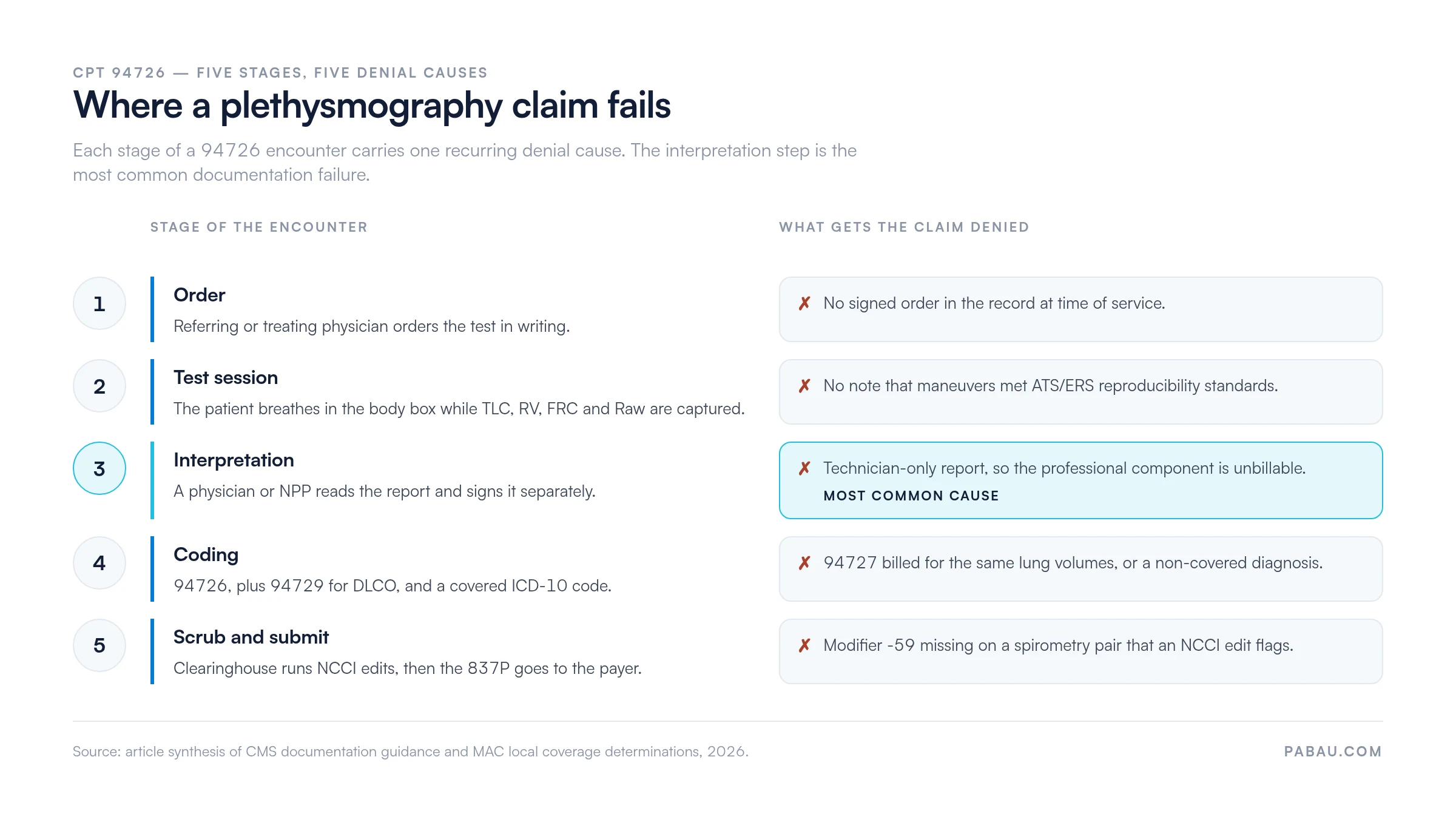
Audit your 94726 claims monthly. Pull a 30-claim sample and check each one for a signed order and a covered ICD-10 code from the MAC LCD. Then confirm a complete report with interpretation and the right POS. Patterns caught in-house never become a payer audit.
A pulmonary function test passes through five handoffs before it becomes money. The order, the test session, the interpretation, the encounter form, and the claim are each touched by a different person. Software that connects those steps electronically keeps the claim in step with what the practice did.
Practice management software like Pabau connects to Claim.MD for 837P electronic claim submission to thousands of US payers. Our claims management software also runs eligibility checks before the patient is seen, posts ERA (835) files against the right invoice, and flags underpayments. Built-in CPT and ICD-10 catalogs sit inside the billing screen, so coding staff pick a code without leaving the workflow.
For a pulmonology practice, that means a plethysmography encounter moves from signed report to submitted claim with nobody re-keying the codes. Fewer denials come back from transcription slips, and the money arrives sooner.
Practices with high pulmonary function volume get the most out of pre-submission scrubbing. The scrub surfaces NCCI conflicts between 94726 and a spirometry code before the claim leaves the building. Catching a modifier requirement there, rather than in a denial queue, is the most direct way to protect the payment.

Pabau integrates with Claim.MD to support electronic claim submission, eligibility checks, and ERA posting for pulmonology practices. See how a connected billing workflow reduces denials and cuts administrative time.

The coding side of 94726 is settled. The descriptor is fixed, the payment is flat across both settings, and the rules for pairing it with 94729 or a spirometry code are published. What decides whether the claim pays is the paperwork behind it.
So put the effort where the denials come from. A signed order, a covered diagnosis from your MAC’s LCD, and a separately signed interpretation clear most of the risk. They do it before a claim is ever built, and a monthly sample audit catches the rest.
The trade-off worth remembering is that none of this sits with one person. The order, the interpretation, and the coded claim each come from a different desk, so the handoffs are where the money leaks. Book a demo to see how Pabau keeps a plethysmography encounter connected from order to paid claim.

Need to understand denial patterns for PFT codes? Denial codes in medical billing breaks down the most common claim rejection reasons and how to resolve them before resubmission.
Wondering how clearinghouse connectivity works? What is a medical claims clearinghouse? covers how 837P transactions flow from practice to payer and where scrubbing catches errors.
Looking to verify patient coverage before the appointment? Claim.MD clearinghouse review explains real-time eligibility verification and ERA posting for US practices.
Not sure what belongs on the encounter form? What is a superbill? walks through the fields a payer expects before the claim is generated.
Want to stop authorization denials at the front desk? Insurance eligibility verification shows how to confirm coverage before every visit.
CPT Code 94726 is the billing code for plethysmography for determination of lung volumes and, when performed, airway resistance. It describes a body plethysmography procedure in which the patient sits inside an airtight chamber, known as a body box. Pressure and volume changes are measured there to calculate total lung capacity (TLC), residual volume (RV), and functional residual capacity (FRC). The code sits in the Pulmonary Diagnostic Testing and Therapies section of the AMA CPT code set (94010-94799).
CMS assigns CPT 94726 a work RVU of 0.25 and 1.91 total RVUs. The RVU total is the same for non-facility and facility settings, so this code carries no site-of-service differential. At the CY2026 conversion factor of $33.4009, that works out to roughly $64 nationally in either setting. Your own payment is adjusted by GPCI, so verify it with the CMS Physician Fee Schedule lookup tool or your MAC.
CPT 94726 is a stand-alone code for body plethysmography measuring lung volumes and airway resistance. CPT 94729 is an add-on code for diffusion capacity (DLCO) measurement, which tests how efficiently the lungs transfer gas into the bloodstream. The two can be billed together on the same date, with 94726 as the primary code and 94729 as the add-on. No modifier is required for this specific pairing.
It depends on current NCCI PTP edits, which CMS updates quarterly. Where an edit exists between 94726 and a spirometry code (94010 or 94060) with a modifier indicator of “1,” modifier -59 may allow separate billing. Both tests must have been performed for distinct clinical reasons. Check the current PTP edit tables on the CMS website, or your clearinghouse’s edit checker, before submitting both codes.
At minimum: a signed physician order, and a chart note documenting medical necessity through symptoms or a diagnosis. You also need a complete plethysmography report with all measured values and percent-predicted calculations. A physician or NPP interpretation note must be signed separately from the technician report, and patient cooperation with ATS/ERS standards must be documented. Missing the physician interpretation is the most common documentation failure that triggers denials.
Yes, Medicare covers CPT 94726 when the test is medically necessary for the diagnosis or management of a pulmonary condition. Coverage criteria, covered ICD-10 diagnosis codes, and frequency limits are defined at the MAC level through Local Coverage Determinations (LCDs). Most LCDs cover indications including COPD, emphysema, asthma, and interstitial lung disease. Routine screening with no documented indication is generally not covered.
Commonly accepted ICD-10-CM codes include J44.1 (COPD with acute exacerbation), J44.0 (COPD with acute lower respiratory infection), and J43.9 (emphysema, unspecified). Others include J45.20 (mild intermittent asthma, uncomplicated), J84.10 (pulmonary fibrosis, unspecified), and R06.00 (dyspnea, unspecified). Always verify against your MAC’s current LCD, as covered diagnoses vary by region and payer. Use the most specific ICD-10-CM code available to minimize denial risk.
Body plethysmography is a pulmonary function test performed inside an airtight booth (body box). It measures static lung volumes (TLC, RV, FRC) and, where equipment allows, airway resistance (Raw). It is coded with CPT 94726 whenever a physician orders a lung volume determination by the plethysmographic method. Gas dilution and nitrogen washout are coded with CPT 94727 instead. It is most commonly ordered for COPD, emphysema, and restrictive lung disease.