CPT code 52648: Laser ablation of the prostate billing guide
What CPT code 52648 covers, and what it bundles in CPT code 52648 is the code fo...

Last Updated: Oct 21, 2026

CPT code 93923 describes non-invasive physiologic studies of upper or lower extremity arteries, multiple levels or with provocative functional maneuvers, complete bilateral study.
93923 is the usual code for ankle-brachial index (ABI) testing to evaluate peripheral arterial disease. Medicare covers it when Billing and Coding Article A56758 supports medical necessity.
The level count separates 93922 from 93923, and both codes describe bilateral studies. Billing 93923 for a one or two level study triggers audits and denials.
Documentation must show both limbs studied, three or more pressure levels per limb, and stored waveform tracings.
Practice management software like Pabau validates codes, checks modifiers, and submits claims for practices billing 93923.
CPT code 93923 describes non-invasive physiologic studies of upper or lower extremity arteries, multiple levels or with provocative functional maneuvers, complete bilateral study. That is the official descriptor in the AMA CPT code set, and every word in it matters for billing.
“Multiple levels” means the study captures segmental pressure measurements at three or more anatomic sites along the limb, such as the thigh, calf, and ankle. “Complete bilateral” means both extremities are studied in the same session. Both conditions must be met, or the correct code is 93922.
The procedure sits in the non-invasive vascular studies CPT family (93922-93931), maintained by the AMA CPT Editorial Panel. It does not involve contrast, catheterization, or incision. A registered vascular technologist performs the study, and a physician or qualified non-physician practitioner interprets it.
A complete 93923 study typically involves segmental limb pressures at multiple anatomic levels, Doppler waveform analysis, and pulse volume recording (PVR). The descriptor calls for both limbs. When only one limb is studied, report 93923 with modifier 52 for reduced services.
The ankle-brachial index is the ratio of the systolic blood pressure at the ankle to the systolic pressure at the brachial artery. An ABI below 0.90 is the diagnostic threshold for peripheral arterial disease (PAD). Clinicians order ABI testing when a patient presents with claudication, rest pain, non-healing wounds, or unexplained lower extremity symptoms.
ABI testing maps directly to CPT code 93923 when performed bilaterally with segmental pressure measurements. A single resting ABI without additional segmental levels or waveforms is more likely 93922. The distinction matters because payers audit 93923 claims closely against the documented procedure components.
Medicare covers CPT code 93923 when a medically necessary ICD-10-CM diagnosis code supports the claim. Billing and Coding Article A56758 (Non-Invasive Vascular Studies) lists the covered diagnosis codes.
A56758 is a companion to the numbered LCDs, such as L33627, L34045 and L35761, rather than an LCD in its own right. Covered indications vary by MAC jurisdiction and change with annual updates, so check your MAC’s coverage database before billing.
Private payers generally follow similar medical necessity criteria, but their policies may differ from Medicare. Confirm each payer’s covered diagnosis list before submitting a claim. The ICD-10 code on the claim must reflect the documented diagnosis, not just a plausible indication.
This list is not exhaustive. Check the current version of Billing and Coding Article A56758 in your MAC’s online coverage database for the full covered-code list. Codes are added and removed in each annual update.
Medicare reimbursement for CPT code 93923 follows the Medicare Physician Fee Schedule (MPFS), updated annually by the Centers for Medicare and Medicaid Services (CMS).
Rates vary by geographic locality, by place of service, and by which component you bill. Use the CMS Physician Fee Schedule lookup tool to find the exact rate for your locality and service year.
For 2025, national non-facility rates for the global service (technical plus professional) typically ranged from approximately $115 to $140, depending on locality. Facility rates are lower because the facility receives a separate payment for overhead costs. Verify current rates in the MPFS before submitting claims, because rates change each calendar year.
The FastRVU 2026 RVU lookup tool lists work, practice expense, and malpractice RVU values for 93923 by locality. Those values let you project revenue before adding ABI testing to a service mix.
Verify your MAC’s locality adjustment before budgeting revenue from 93923. A practice in rural Mississippi and one in Manhattan work under different geographic practice cost indices. That difference can shift the payment by $20 or more per procedure. Pull your GPCI values from the CMS MPFS lookup tool each year.
Insufficient documentation is the leading reason 93923 claims are denied on post-payment audit. The medical record must independently support every element of the CPT descriptor before the claim is submitted.
The report must be a separate, standalone document, not embedded as a brief note in a progress note. MAC reviewers will look for the waveform images as physical evidence. Claims without retrievable waveform storage consistently fail audit, regardless of what the narrative report says.
Understanding modifier usage prevents the most expensive billing mistakes on CPT code 93923. The four modifiers that appear most frequently on 93923 claims are modifier 26, modifier TC, modifier LT/RT, and modifier 59.
NCCI (National Correct Coding Initiative) edits restrict which codes can be billed together on the same date of service without a modifier override. Before billing 93923 alongside other vascular codes, check the current NCCI edit tables published by CMS. Do not assume two codes can always be billed together, even when they describe different anatomic structures. Edit pairs change annually.
Under Medicare, 93923 in a physician office setting requires general supervision. The physician does not need to be in the room, but must be available. In a hospital outpatient setting the required supervision level may differ, so confirm with your MAC before billing.
A superbill that pre-populates the correct modifiers and place-of-service code for each encounter reduces the risk of a wrong combination. Practices submitting the 837P electronic claim file get automated field validation before claims reach the clearinghouse.
The three most commonly confused codes in the non-invasive arterial study family are 93922, 93923, and 93925. Selecting the wrong one is the most frequent audit target in vascular billing. Two facts in the report settle the choice. The first is the modality, and the second is the number of pressure levels.
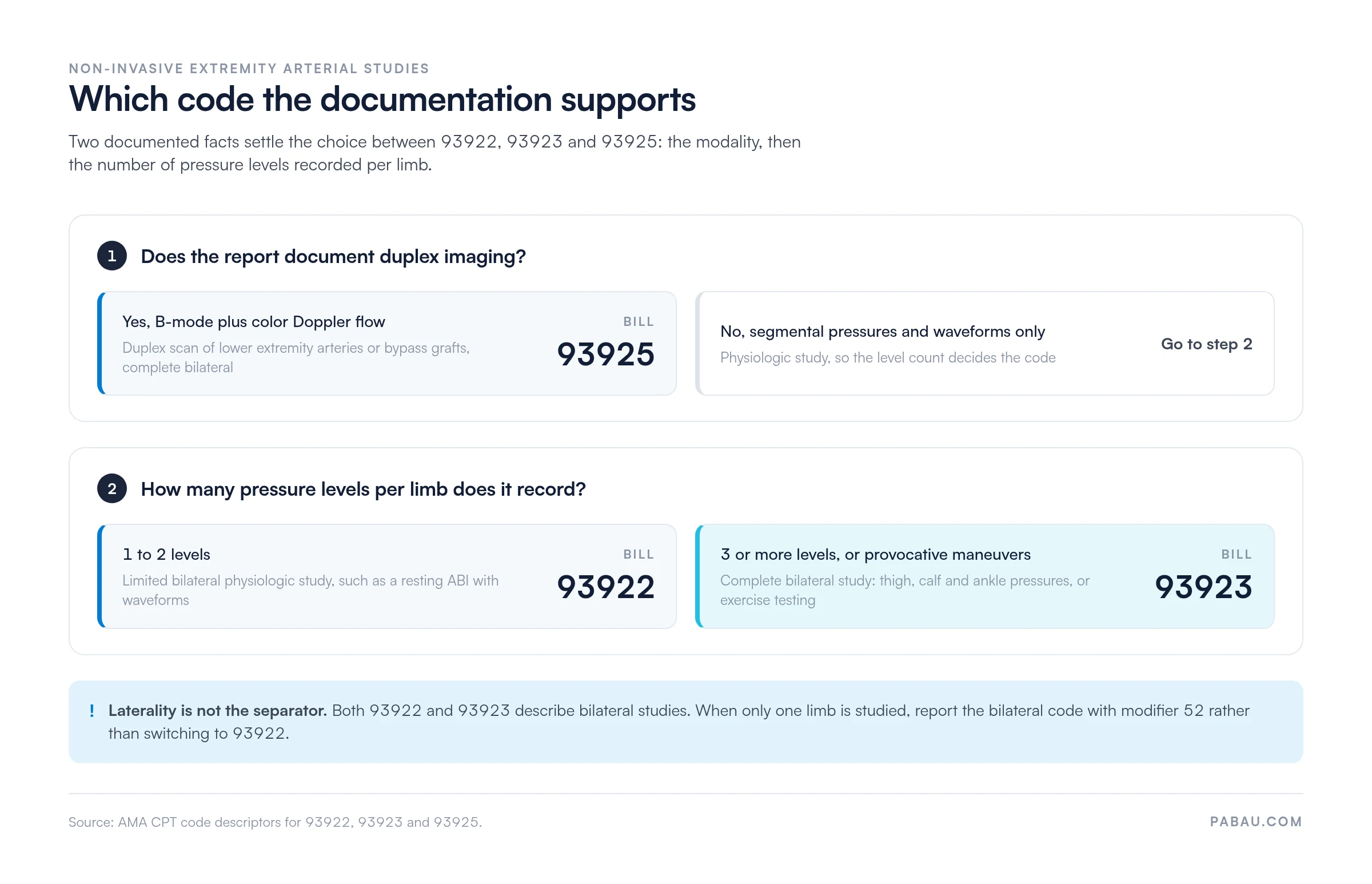
The separator between 93922 and 93923 is the level count, not laterality. Both descriptors call for a bilateral study. A bilateral study at one or two levels is 93922, whatever the order said. Billing 93923 for that study is upcoding, and it carries audit and overpayment risk.
A unilateral study does not drop to the limited code either. Append modifier 52 for reduced services to the bilateral code instead.
Modality separates CPT code 93923 from 93925. 93923 is physiologic, using pressure measurements and waveforms, while 93925 is duplex imaging. A lower extremity study that adds ankle/brachial indices after a standardized treadmill walk is billed as CPT code 93924. At the top of the range, CPT code 93931 covers a unilateral or limited duplex scan of the upper extremity arteries.
Most CPT code 93923 denials cluster around five patterns. Recognizing them before submission is far cheaper than working a denied claim through appeals.
Every rejection carries a reason code, and reading it correctly is what routes the claim. Our reference on denial codes maps each one to its fix. That fix is usually a documentation request, a code correction, or an appeal with clinical records.
Run a monthly internal audit of your 93923 claims. Pull a sample of 10 claims and confirm each record shows a bilateral notation, three or more pressure levels, and retrievable waveform tracings. Catching a missing tracing yourself costs far less than a MAC audit recovery demand.
Vascular and cardiology practices billing CPT code 93923 run into the same three problems. The documentation checklist is long. The code family runs from 93922 to 93931, so selection has to be precise. Modifier errors are easy to make when staff pick codes by hand for every encounter.
A well-configured practice management system addresses three specific failure points in the 93923 billing workflow.
Pabau is practice management software with medical claims management built in. It validates claims across the 93922 to 93931 code family and submits the 837P file through the Claim.MD clearinghouse to over 4,000 US payers.
Centralized billing dashboards surface denial patterns by code, provider, and payer. A recurring 93923 documentation problem then shows up in a report rather than in a quarterly write-off.


Pabau’s claims management software validates CPT codes, modifiers, and ICD-10 combinations before submission. That cuts denials for practices billing 93923 and the rest of the non-invasive vascular study family.

The documentation decides the code, not the order and not the protocol. If the report shows both limbs at three or more pressure levels, with stored waveform tracings, 93923 is defensible on audit.
If it does not, bill 93922 and take the smaller payment. An overpayment demand across two years of claims costs far more than the difference between the two codes.
The practical move is to make the check automatic. Build the bilateral notation and the level count into the report template, then let the billing system refuse the claim when either is absent. Book a demo to see how Pabau validates 93923 claims before they reach the clearinghouse.

Need to understand your clearinghouse options? Medical claims clearinghouse guide explains how clearinghouses route 837P files to payers and what to look for when evaluating one.
Want to reduce front-end billing errors? Insurance eligibility verification covers how real-time eligibility checks prevent claim rejections before the appointment occurs.
Looking for a full billing software comparison? Best medical billing software in the US evaluates the top platforms for US vascular and cardiology practices.
CPT code 93923 is a non-invasive physiologic study of the upper or lower extremity arteries. It covers multiple anatomic levels, or a study with provocative functional maneuvers, and both extremities. It is the standard code for a comprehensive bilateral ankle-brachial index test with segmental pressures and Doppler waveform analysis.
Yes. Medicare covers CPT code 93923 when it is medically necessary and supported by a covered ICD-10-CM diagnosis code. The covered codes are listed in Billing and Coding Article A56758 (Non-Invasive Vascular Studies). Coverage is subject to MAC jurisdiction. Verify the current covered-diagnosis list in your MAC’s online coverage database before billing.
CPT code 93922 covers a limited bilateral study at one or two pressure levels. CPT code 93923 requires three or more levels per limb, or a study with provocative functional maneuvers. Both descriptors call for a bilateral study, so laterality does not separate them. When only one limb is studied, append modifier 52 to the bilateral code rather than switching codes.
Commonly accepted ICD-10-CM codes include I70.201 to I70.209 for atherosclerosis of extremity arteries, and I73.9 for peripheral vascular disease. E11.51 covers type 2 diabetes with peripheral angiopathy, and I87.2 covers venous insufficiency when arterial co-evaluation is ordered. The full covered-diagnosis list sits in Billing and Coding Article A56758. Always check it against the current version for your MAC jurisdiction.
Billing 93923 and 93925 together on the same date for the same extremity is subject to NCCI edit review. They may be payable together when the circumstances justify both a physiologic study and a duplex imaging study. That requires modifier 59 plus documentation supporting medical necessity for each service. Verify current NCCI edit pairs in the CMS NCCI tables before submitting.
The record needs a written or electronic order with a documented clinical indication. It needs an explicit statement that both extremities were studied, and segmental pressures at three or more levels per limb. It also needs retrievable Doppler or PVR tracings, a dated signed physician interpretation, and the technologist’s credentials. A report that describes waveforms without storing the tracing images will not survive an audit.
Modifier 26 is appended when a physician interprets the study at a facility that owns the equipment. The facility then bills the technical component with modifier TC. Modifier 59 is used only when 93923 must be distinguished from another service on the same date, because of an NCCI edit. LT and RT modifiers are generally not applicable, because 93923 is bilateral by definition.