CPT Code 93931: Duplex scan of upper extremity arteries
CPT Code 93931: official descriptor and code definition CPT Code 93931 is define...

Last Updated: Oct 8, 2026

CPT Code 93922 covers a limited bilateral noninvasive physiologic study of upper or lower extremity arteries, using Doppler or plethysmography at one or two levels.
The level count separates it from CPT 93923, which needs three or more levels. Upcoding to 93923 without those levels is a top audit trigger.
Documentation must include a physician order, clinical indication, Doppler waveform interpretation, ABI values with the calculation method, and segmental pressure measurements.
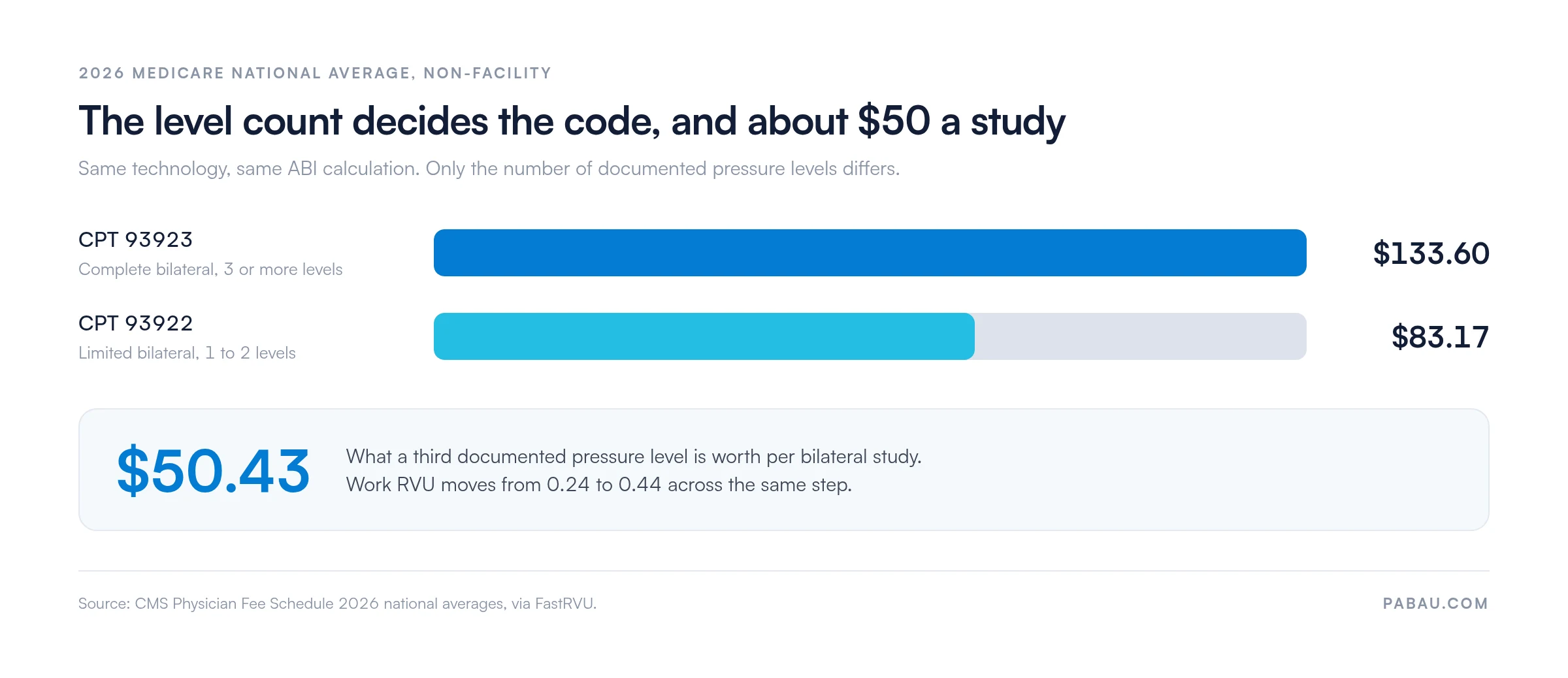
Medicare pays about $83.17 for 93922 in 2026 and about $133.60 for 93923, so one extra documented level is worth roughly $50 a study.
Practice management software like Pabau links clinical notes directly to billing codes, so a 93922 claim leaves with its documentation attached.
CPT Code 93922 covers a limited bilateral noninvasive physiologic study of upper or lower extremity arteries. It applies when the study documents one or two pressure levels. Measure three or more levels and 93923 becomes the correct code.
The American Medical Association’s CPT code set carries the official descriptor. It reads: Limited bilateral noninvasive physiologic studies of upper or lower extremity arteries, using Doppler ultrasound and/or digital plethysmography; includes 1-2 levels. The code set names evaluation of peripheral vascular disease as the example indication.
In plain terms, the study captures Doppler waveform analysis, segmental blood pressure at one or two anatomical levels, and an ankle-brachial index (ABI) calculation. Vascular surgeons, cardiologists, podiatrists, and interventional radiologists are the primary billers.
Medicare coverage criteria for non-invasive peripheral arterial vascular studies sit in LCD L35761. Meeting medical necessity takes documented clinical evidence, not a suspicion noted in the chart. Before billing CPT 93922, confirm the record supports one of the covered indications below.
Coverage is contractor-specific, so the version your Medicare Administrative Contractor (MAC) publishes is the one that governs your claims. Commercial payers often mirror L35761 and then add their own prior-authorization or frequency rules. Check the patient’s plan before the study rather than after the denial.
The CMS Physician Fee Schedule lookup tool is the authoritative source for 2026 payment rates. Rates vary by geographic practice cost index (GPCI) locality, so the figures below are national averages. Verify the rate for your MAC jurisdiction before you submit.
For a locality check, the FastRVU 2026 RVU lookup tool applies your MAC’s GPCI to the same RVUs. In a hospital outpatient setting the physician bills only the professional component, so the payment is a fraction of the office rate. Pull that professional-component figure for your own locality instead of working from a national average.
Pabau connects to the Claim.MD clearinghouse, which submits 93922 claims electronically to thousands of US payers. The integration covers real-time eligibility checks, 837P claim submission, and 835 remittance receipt.
That closes the reimbursement loop from claim creation to payment posting. Claim status and remittance data land in the same system that holds your study notes, so an underpaid 93922 is easy to spot.
Every claim for CPT 93922 needs an ICD-10-CM diagnosis code that establishes medical necessity under LCD L35761. The diagnosis must match the documented clinical reason for the study. Never code a suspected condition as confirmed.
Code specificity matters. Using I73.9 when the record supports I70.219 can trigger a medical necessity review, so code to the highest level of specificity the documentation carries. The ICD-10-CM code index is the place to confirm whether a more specific diagnosis code exists.
The level count is the whole distinction, and it carries a price. Billing 93923 when only two pressure levels are documented is upcoding. Billing 93922 after measuring three or more levels underpays the practice by about $50 a study.
A practical tip: document the number of pressure cuff levels explicitly in the study report. “Two-level segmental pressure study at the ankle and below-knee cuff positions” removes the ambiguity that invites a post-payment audit. No coder should have to infer the level count from an incomplete report.
CPT 93922 belongs to the non-invasive extremity arterial study family. Choosing the right code means knowing where 93922 ends and its siblings begin.
A common confusion: 93922 uses Doppler waveform or plethysmography with segmental pressures. The 93925 and 93926 family uses duplex imaging, which combines real-time B-mode with spectral analysis.
These are distinct technologies, so billing 93922 for a duplex scan is a coding error. The AAPC CPT code lookup helps when you are separating these two families.
Noninvasive cardiac imaging sits elsewhere in the code set. A contrast-enhanced CT of the heart is reported under CPT code 75572, which evaluates cardiac structure and morphology.
Modifier selection for CPT 93922 depends on where the service happens and who bills each component. The global service indicator for 93922 is “Global”, meaning the physician performs and interprets the study, so both components are bundled by default.
Place-of-service note: In a hospital outpatient setting, the physician typically bills 93922-26 and the hospital bills 93922-TC. In an office where the physician owns the equipment, no modifier is needed. Appending modifier 26 there reduces reimbursement for no reason and may prompt a payer inquiry. Check your MAC’s billing guidance if your practice works across both settings.
LCD L35761 sets the coverage criteria for non-invasive peripheral arterial vascular studies, but the billing detail sits in its companion articles. WPS publishes A54399 as a response to comments on that LCD, while article A57593 carries the billing and coding rules. Coverage is contractor-specific, so a Novitas policy may not apply under First Coast. Pull your own MAC’s LCD and coding article once a year.
Documentation failures are the main cause of CPT 93922 recoupment in post-payment audits. A claim can pay on submission and still be taken back later. When a MAC opens a probe audit on vascular studies, an incomplete report means repaying the money.
Every 93922 claim should be backed by a study report carrying all of the elements below. A clean claim starts with a complete clinical record, well before the submission reaches the clearinghouse.
Missing ABI values are the most-cited deficiency in 93922 audits. A waveform description without the numeric ABI ratio leaves the record incomplete under CMS guidance. If your technologist captures the values but the interpreting report omits them, the claim is vulnerable.
Set up a practice-specific documentation template for CPT 93922 that pre-populates the required fields. Those are the number of levels, ABI values for right and left, the Doppler waveform description, and the clinical indication. When interpreting physicians complete the same structured template every time, audit risk drops and coding stays consistent across your whole vascular study volume.
The equipment used determines which code family applies. CPT 93922 covers physiologic testing technology, not duplex imaging.
Duplex ultrasound adds B-mode imaging to spectral Doppler, which puts it in the 93925 and 93926 family. If your lab performs duplex scans and bills 93922, that is a systematic coding error, and a focused review will surface it.
Vascular study billing leaves little room for a missing field. One absent ABI value can turn a payable claim into a denial. When the study report lives in one system and the claim is built in another, the level count and the ABI values get retyped. Retyping is where they go missing.
Pabau’s claims software for specialists links structured clinical notes to billing codes. The ABI values, segmental pressure levels, and Doppler waveform descriptions captured during the study flow into the claim record.
Before submission, the system flags any required documentation field left empty, which catches the missing-ABI problem before the payer sees it.

Claims then route through the Claim.MD integration, which validates the CPT and ICD-10 pairing against payer edits before transmission. Anything that fails those edits comes back with a specific CARC reason code. A 93922 denial arrives with its reason attached instead of as a mystery to chase.

Pabau links clinical documentation to billing codes automatically, flags missing fields before submission, and routes claims through Claim.MD to thousands of US payers. See how it works for vascular and cardiology practices.

One number decides this code. Document the pressure levels explicitly, match them to 93922 or 93923, and put the ABI ratio in every report. Do those three things consistently and the denial pattern on vascular studies largely disappears.
Accuracy runs in both directions here. Downcoding to feel safe costs about $50 a study, and upcoding invites a probe audit that costs far more. The level count written in the report is what protects you either way.
Pabau’s claims management software connects study notes to the claim and routes submissions through Claim.MD to thousands of US payers. Book a demo to see how it handles vascular study billing from note to payment.

Want to understand how clearinghouse submissions work for vascular codes? Medical billing fundamentals covers the full claim lifecycle from patient encounter to payment posting.
Tracking down why a 93922 claim was underpaid? Electronic remittance advice explains how to read 835 files and separate contractual adjustments from non-covered ones.
Need to tighten up your denial workflow before the next MAC audit? Denial codes in medical billing breaks down the most common CARC codes and how to respond to each one.
Submitting your vascular studies electronically? The 837 file explains what the 837P transaction carries and how a payer reads it.
Expecting a probe audit on your vascular volume? Medical billing compliance sets out the documentation standards auditors apply and how to hold them.
CPT Code 93922 is a billing code for a limited bilateral noninvasive physiologic study of upper or lower extremity arteries. The study uses Doppler ultrasound and/or digital plethysmography at one or two pressure levels. It includes ankle-brachial index (ABI) measurement and Doppler waveform analysis, and it is commonly used to evaluate peripheral arterial disease (PAD).
The 2026 Medicare national average for CPT 93922 in a non-facility setting is about $83.17. That comes from a total non-facility RVU of roughly 2.49 and the 2026 conversion factor of $33.4009. Rates shift by MAC jurisdiction because of GPCI adjusters, so check the CMS Physician Fee Schedule lookup tool or FastRVU for your own locality.
CPT 93922 covers a limited bilateral study at one or two pressure levels. CPT 93923 covers a complete bilateral study at three or more levels. The level count documented in the study report decides which code applies. Billing 93923 when only two levels were measured is upcoding, and it is worth about $50 a study.
Commonly paired ICD-10-CM codes include I73.9 (peripheral vascular disease, unspecified) and I70.209 or I70.219 (atherosclerosis of native arteries with claudication). Others include I70.249 (atherosclerosis with rest pain), E11.51 (diabetic peripheral angiopathy), and R60.0 (localized edema). The code you select must reflect the documented clinical indication and support medical necessity under LCD L35761.
Yes, the CPT 93922 descriptor specifically describes a bilateral study. If only a unilateral study is performed, append modifier 52 (reduced services) or consult your MAC’s guidance on unilateral reporting. Some MACs allow laterality modifiers (LT/RT) for unilateral scenarios, so check the applicable coding article for your jurisdiction.
Required documentation includes a signed physician order, the documented clinical indication, the type of equipment used, and the number and location of pressure levels measured. You also need the Doppler waveform interpretation, bilateral ABI values with the calculation method, and the interpreting physician signature with a date. Missing ABI values are the most-cited deficiency in 93922 post-payment audits.
CPT 93925 covers a duplex scan of lower extremity arteries bilaterally, combining real-time B-mode imaging with spectral Doppler analysis. It is a distinct service from CPT 93922, which uses physiologic testing without imaging. Use 93925 when a duplex scan is performed, not 93922.